Signs Your Car Needs Brake Repair: What to Watch For
Brake problems announce themselves through sounds, sensations, and warning lights that most drivers initially ignore. Understanding these warning signs could be the difference between a routine service and an emergency stop on the motorway. At Kettering Motorist Centre, we've identified which signs demand immediate attention and which can wait until your next scheduled appointment.
Your brakes are your car's most critical safety system. When they fail, the consequences are potential accidents, not minor inconveniences. This guide covers the most common warning signs, what each means, and when to book a professional inspection.
Pro TipMost brake issues develop gradually. The earlier you catch them, the cheaper the repair and the safer your vehicle. Ignoring early warning signs often leads to damage costing three to five times more to fix.
Why Early Detection Matters
Catching brake problems early saves money and keeps your family safe. Many drivers delay repairs because they assume minor noises or soft pedal feel are cosmetic issues. They're not. A spongy brake pedal today becomes complete brake failure tomorrow if left unchecked.
The UK's MOT test includes a comprehensive brake check, but this happens only once yearly. Between tests, you're responsible for spotting problems yourself. Regular self-inspection, listening for unusual noises, feeling pedal response, and watching for warning lights, gives you weeks or months of advance notice before real failure occurs.
At Kettering Motorist Centre, we recommend a free brake inspection at least twice yearly, particularly if you drive frequently or in stop-start traffic. Early detection lets you plan repairs around your schedule rather than facing an emergency callout.
High-Pitched Squealing and Screeching Noises
Brake squealing is the most commonly reported brake noise and one of the most misunderstood. A high-pitched squeal when braking doesn't always mean your pads are dangerously thin, though that's certainly one possibility.
Modern brake pads include a wear indicator: a small metal tab that touches the brake rotor when friction material reaches critical thickness. When this tab makes contact, it produces a deliberate squealing sound. This is by design, your car's way of saying "book a brake pad replacement soon." This type of squeal is not an emergency, but it signals you to schedule an appointment within the next week or two.
Not all squealing comes from wear indicators. Brake dust, moisture, and temperature changes can all cause squealing. Cold morning braking often produces noise that disappears once the system warms up. If your car squeals consistently regardless of conditions, the wear indicator is almost certainly the culprit.
Watch OutIf squealing is accompanied by a soft or spongy pedal, or if the noise comes with visible brake fluid leaks, this is not just wear-indicator noise. Book an appointment immediately. These combinations suggest a more serious problem with your hydraulic system or caliper function.
Car Brake Noises Explained: Grinding and Metal-on-Metal Sounds
Grinding is fundamentally different from squealing. Where squealing is high-pitched and sharp, grinding is a coarse, rough sound like metal scraping against metal. This noise means your brake pads have worn completely through the friction material, and the metal backing plate is now rubbing directly against your brake rotor.
When grinding occurs, you've passed the wear-indicator stage and entered the danger zone. Your stopping power is already compromised. The metal-on-metal contact generates extreme heat, damaging both the rotor and the caliper. Continuing to drive with grinding brakes risks brake failure and creates a safety hazard for you and other road users.
Grinding can also indicate a seized caliper or severely damaged rotor. A seized caliper means the brake piston is stuck and not retracting properly after braking, causing uneven pad wear and potentially locking a wheel entirely. A damaged rotor with deep scoring or warping will also produce grinding sounds as the pad catches on the damaged surface.
The cost of ignoring grinding brakes escalates rapidly. Replacing worn pads costs significantly less than replacing both pads and rotors. Addressing grinding sounds within days rather than weeks is always more economical.
When Grinding Means Immediate Action
If grinding is severe, if you feel significant loss of braking power, or if the grinding is accompanied by a brake warning light, treat it as an emergency. Find a safe place to stop and call for roadside assistance. At Kettering Motorist Centre, we diagnose grinding noises quickly and advise whether your brakes are safe to drive on. Transparent diagnostics mean you'll know exactly what needs replacing before work begins.
Brake Pad Wear Symptoms and Visible Wear Signs
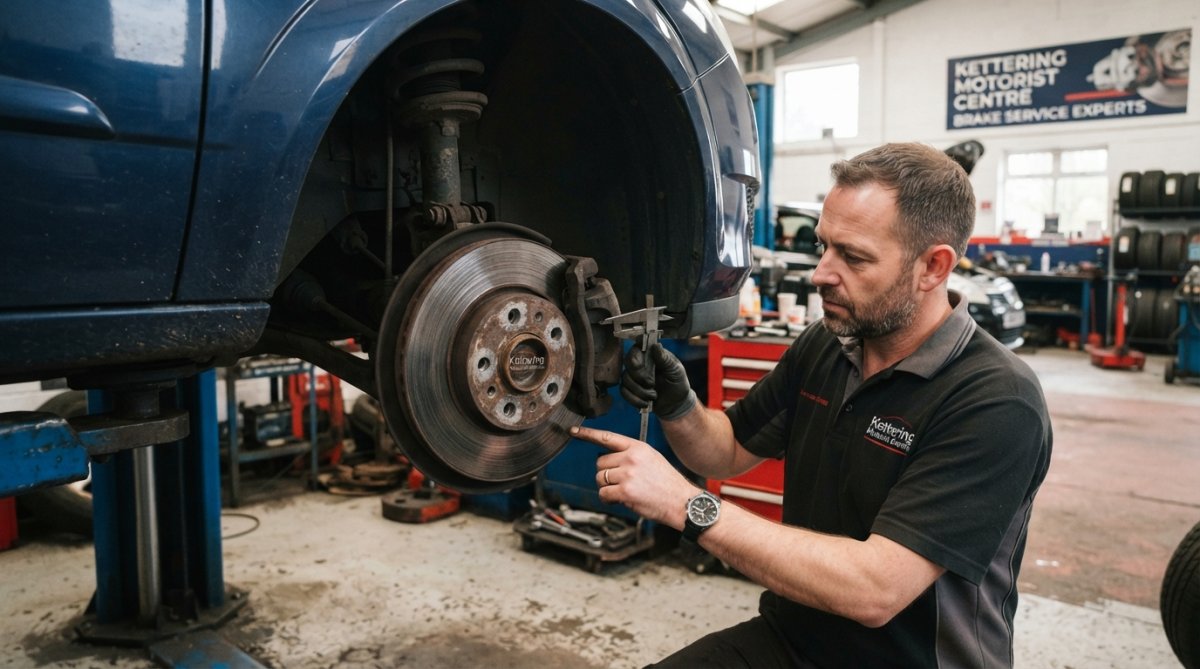
You can physically inspect your brake pads to assess their condition. Modern cars have brake pads visible through the wheel spokes without removing the wheel.
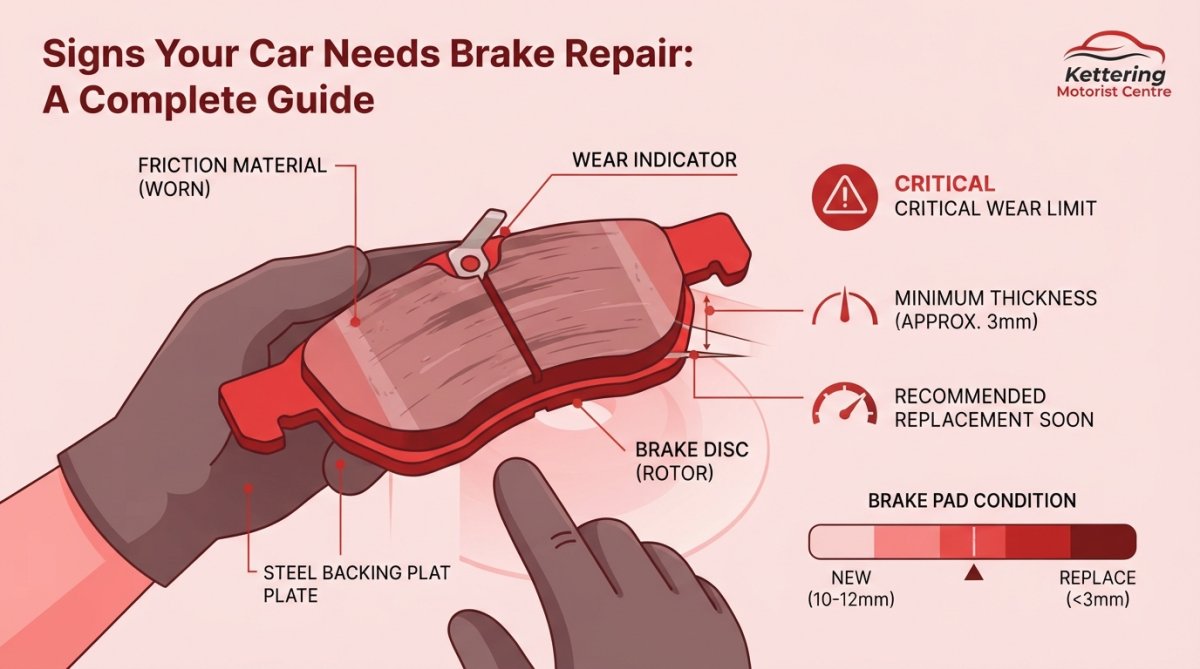
Professional illustration showing signs your car needs brake repair
Healthy brake pads are typically 10-12mm thick when new. Once they reach 3mm, they're approaching the wear-indicator stage. At 1-2mm, they're critically thin. If you can see the metal backing plate through the friction material, your pads have worn completely.
Visual inspection gives you a snapshot of current pad condition, but it doesn't tell the full story. Pads wear unevenly depending on your driving style, brake system alignment, and caliper function. Uneven wear indicates a sticky caliper or alignment issue requiring professional attention beyond just replacing pads.
Key TakeawayBrake pad wear is not linear. Hard braking and frequent stop-start driving accelerate pad wear dramatically. A driver in heavy urban traffic might need new pads every 18 months, while a motorway driver might get 4 years of life from the same pads.
How to Inspect Pad Thickness Yourself
Park on level ground, engage the handbrake, and loosen the wheel bolts. Raise the vehicle safely using a jack and secure it on axle stands. Remove the wheel.
Look through the wheel spokes at the brake assembly. You'll see the brake caliper, the brake rotor, and the brake pads. Measure the visible friction material. If it's thicker than a credit card (roughly 0.76mm), you have adequate pad life remaining. If it's thinner or level with the metal backing plate, book a brake service immediately.
While inspecting, check for other warning signs: brake fluid leaks around the caliper, rust or scoring on the rotor surface, or visible damage to the caliper itself. These observations help your mechanic understand what's happening in your braking system.
Spongy Brake Pedal Causes and Loss of Pedal Feel
A spongy brake pedal feels soft, mushy, or like it's sinking toward the floor when you press it. Unlike a firm, responsive pedal, a spongy pedal requires excessive force and feels like it's compressing rather than engaging a mechanical system.
Spongy pedal feel almost always indicates air in your brake lines. Brake fluid is incompressible and transfers pressure from the pedal directly to the calipers. Air is compressible. When air pockets form in the brake lines, the pedal compresses the air instead of transmitting pressure to the brakes, causing loss of stopping power and that characteristic mushy sensation.
Air enters brake lines through a leak that pulls in air when pressure drops, improper bleeding after brake work, or corrosion inside the master cylinder. A spongy pedal can also indicate brake fluid contamination. Brake fluid absorbs moisture from the air over time, which is why manufacturers recommend flushing and replacing brake fluid every two years. Contaminated fluid with excessive water content boils under heavy braking, creating vapour bubbles in the lines that compress like air pockets.
Brake Fluid Issues and Air in the Lines
Brake fluid is hygroscopic, meaning it actively absorbs moisture from the surrounding air. After two years, most brake fluid has absorbed enough moisture to reduce its boiling point and compromise performance.
When brake fluid boils, it turns to vapour. Vapour is compressible like air. Heavy braking generates tremendous heat in brake components. If your brake fluid has been in the system for three or more years, it may boil during intense braking, creating vapour bubbles that make your pedal feel spongy or fail entirely.
Professional brake fluid testing uses an electrolytic tester to measure moisture content. If moisture levels exceed 3%, fluid replacement is recommended. At Kettering Motorist Centre, we test brake fluid as part of routine brake inspections and advise replacement when necessary. Fresh brake fluid restores firm pedal feel and ensures reliable performance under all conditions.
Air in the lines requires bleeding, a process that removes air pockets and refills the system with fresh fluid. This is straightforward work for a professional mechanic but difficult to perform correctly at home without proper equipment.
Vehicle Pulling to One Side and Vibration During Braking
When you brake, your car should decelerate in a straight line. If it pulls sharply to one side, your braking system is not distributing braking force evenly across all four wheels.
Pulling usually indicates a seized or sticky caliper on one side. A seized caliper doesn't release fully after braking, causing that brake pad to remain in contact with the rotor even when you're not pressing the pedal. This constant friction generates heat and slows that wheel more than the others, causing your car to pull toward the seized side.
Pulling can also result from uneven brake pad wear. If one side has significantly thinner pads than the other, that side brakes less effectively, and the car pulls toward the side with more braking force.
Vibration in the brake pedal or steering wheel during braking indicates a warped brake rotor. When rotors warp from excessive heat, uneven wear, or impact damage, they no longer sit parallel to the brake pad. As the pad tries to contact an uneven surface, it chatters, creating vibration that transmits back through the hydraulic system.
Uneven Wear and Caliper Problems
Uneven brake pad wear is almost always caused by caliper problems. A sticky caliper doesn't fully retract, keeping one pad in constant contact with the rotor. Over time, that pad wears much faster than the opposite pad. Replacing just the pads without addressing the caliper problem means the new pads will wear unevenly again within months.
A proper brake service includes caliper inspection and cleaning. Calipers can be cleaned and reused if the piston moves freely and the seals are intact. If the piston is corroded or won't retract, the caliper must be replaced.
Warped rotors are often caused by aggressive braking while the brake system is hot, followed immediately by driving through water or cooling the brakes rapidly. This thermal shock can warp the rotor. Once warped, rotors cannot be restored to perfect flatness and must be replaced.
Issue
Symptom
Likely Cause
Action Required
Seized Caliper
Vehicle pulls to one side during braking
Caliper piston stuck or corroded
Professional inspection and caliper replacement
Warped Rotor
Vibration in pedal or steering wheel
Thermal shock or sustained overheating
Rotor replacement and brake system inspection
Uneven Pad Wear
Reduced braking on one side
Sticky caliper or alignment issue
Caliper cleaning/replacement and pad replacement
Contaminated Fluid
Spongy pedal feel
Moisture absorption over time
Brake fluid flush and replacement
Increased Stopping Distance and Dashboard Warning Lights
If your car takes noticeably longer to stop than it used to, your brakes have lost effectiveness. This is a safety emergency. Increased stopping distance can result from severely worn pads, contaminated brake fluid, a failing master cylinder, or a combination of these problems. Book an immediate inspection.
Dashboard warning lights are your car's direct communication with you. Two lights are specifically related to brakes: the ABS light and the brake warning light. The ABS (anti-lock braking system) light indicates a problem with the ABS module or wheel speed sensors. The brake warning light indicates low brake fluid, a brake system failure, or a problem with the brake proportioning valve.
Any brake-related warning light demands immediate attention. Do not ignore these lights in hopes they'll resolve themselves.
ABS Light and Brake Warning Indicators
The ABS light typically appears as a yellow or amber light with the letters "ABS" or an image of a car with skid marks. This light indicates the ABS system has detected a fault and disabled itself to prevent unpredictable behaviour. Your regular brakes still function, but you've lost anti-lock technology. In an emergency stop, your wheels may lock and skid.
ABS faults often stem from a faulty wheel speed sensor, a component that monitors wheel rotation and tells the ABS module when a wheel is about to lock. These sensors are prone to corrosion and can fail without warning. Replacement is straightforward and relatively affordable.
The brake warning light is red or amber and shows a circle with an exclamation mark or the word "BRAKE". This light indicates low brake fluid. A brake fluid leak is a serious problem. Stop driving immediately and call for roadside assistance or arrange a tow to your nearest garage.
At Kettering Motorist Centre, we diagnose dashboard warning lights quickly and explain what they mean in plain language.
MOT Brake Check Requirements in the UK
Your vehicle's MOT test includes a comprehensive brake check. The examiner tests both the service brake (the main braking system you use daily) and the parking brake (handbrake). The test measures braking efficiency, checks for leaks, inspects brake components for damage, and verifies that warning lights function correctly.
The MOT brake test is rigorous. Your car must meet strict efficiency standards; typically, the service brake must produce deceleration of at least 5.2 metres per second squared. The parking brake must hold the vehicle on a slope and must not require excessive force to engage.
Many cars fail their MOT on brake issues. Common failures include worn brake pads below the legal minimum (usually around 1.5mm), brake fluid leaks, inoperative warning lights, or excessive play in the brake pedal. If your car fails on brakes, you must complete repairs before the vehicle can be used on public roads.
What Examiners Test and Common Failures
MOT examiners follow a standardised procedure. They visually inspect brake pads through the wheel spokes to assess thickness. They check for leaks around calipers, wheel cylinders, and brake hoses. They verify that the brake warning light illuminates when the ignition is on and extinguishes when the engine starts. They test the handbrake's holding power on a ramp.
Common brake failures include worn pads below minimum thickness (1.5mm), visible brake fluid leaks from hoses or calipers, brake warning light not illuminating or remaining on after engine start, excessive play or sponginess in the brake pedal, brake hoses with cracks or splits, seized or damaged calipers, and parking brake unable to hold the vehicle on a slope.
Many of these failures are preventable with regular maintenance. Having your brakes inspected twice yearly catches problems before they become MOT failures. At Kettering Motorist Centre, we offer professional brake inspections and can advise whether your vehicle will pass its MOT brake test. We also specialise in electric and hybrid vehicles, visit kmcelectric.co.uk for EV-specific brake services.
Brake problems develop gradually, but they escalate quickly once they begin. The warning signs, squealing, grinding, spongy pedal feel, pulling, vibration, and dashboard lights, are your car's way of asking for help. Ignoring these signs is false economy. The cost of early brake repair is always less than the cost of emergency repairs or, worse, an accident.
If you've noticed any of these signs, don't delay. Kettering Motorist Centre offers hassle-free online booking for brake inspections and repairs. Our expert team diagnoses problems accurately and explains exactly what needs fixing and why. We serve Kettering, Northamptonshire, and surrounding areas, and we specialise in all vehicle types, including electric and hybrid vehicles. Book your brake inspection today and drive with confidence knowing your brakes are safe and reliable.
Frequently Asked Questions
What are the most common signs your car needs brake repair?
The most common signs your car needs brake repair include high-pitched squealing or screeching noises, grinding metal-on-metal sounds, a spongy or soft brake pedal, increased stopping distance, visible brake pad wear, vibration or pulsing in the pedal, the vehicle pulling to one side when braking, and dashboard warning lights such as the ABS light. Any of these signs warrant a professional inspection at Kettering Motorist Centre to prevent safety issues.
How often should I get my car's brakes checked in the UK?
Most UK manufacturers recommend a brake system inspection at least annually or during your MOT. However, brake pad wear symptoms may appear sooner depending on your driving habits and road conditions. If you notice any signs of brake wear or hear unusual noises, book a check immediately rather than waiting for your scheduled service. KMC offers convenient online booking for brake inspections without requiring upfront payment.
What does a grinding noise when braking mean?
A grinding noise when braking typically indicates that brake pads have worn down completely, causing metal-on-metal contact between the pad backing and the brake rotor. This is a serious issue that requires immediate professional attention, as continued driving can damage the rotors and calipers, leading to more costly repairs. Stop driving and contact a mechanic as soon as possible. KMC specialists can diagnose grinding sounds and perform necessary repairs to restore safe braking.
Why does my brake pedal feel spongy, and what causes this?
A spongy brake pedal typically indicates air in the brake lines or degraded brake fluid. Brake fluid naturally absorbs moisture over time, which reduces its effectiveness and can cause a soft pedal feel. Other causes include a failing master cylinder or brake line leaks. This affects your stopping distance and safety, so it requires professional diagnosis. Kettering Motorist Centre can test your brake fluid condition and bleed the system if needed to restore proper pedal feel.
Your booking Failed
Please try again or please call 01536 410142
Thank you for placing a booking with Kettering Motorist Centre Limited for vehicle
PLEASE TAKE YOUR BOOKING REFERENCE NUMBER WITH YOU TO THE MOT CENTRE
Your items
MOT Test
×
Terms and Conditions
These terms and conditions form the basis on which you can visit and use this website. Please read them carefully as they contain important information.
General terms and conditions
This website is owned and operated by Kettering Motorist Centre Ltd (company registration number: 4485858) operating at Trafalgar Road, Kettering, Northamptonshire, NN16 8DB (the "MOT Centre", the "Company", "we" or "us"). If you have any queries about these terms and conditions or if you have any comments or complaints on or about this website, you can contact us at [email protected] or 01536 410142.
The website is to promote and offer for sale the products and services of Kettering Motorist Centre Limited.
1. The contract between us
This website does not take payment for products or services online. The website enables you to view products and services online and to make a booking for later delivery and payment. The vehicle and provision of other products and services promoted by this website and the payment by you of the price of those products and services will take place at the MOT Centre. The booking does not constitute a contract.
The booking process on the site provides details of the booked MOT order. Please take the time to read and check your booking. It is your responsibility to make sure the order is correct and for the correct vehicle.
2. Ownership of rights
All rights, including copyright, in this website are owned by or licensed to the Company. Any use of this website or its contents, including copying or storing it or them in whole or part, other than for your own personal, non commercial use, is prohibited without our permission. You may not modify, distribute or repost anything on this website for any purpose.
3. Accuracy of content
We have taken care in the preparation of the content of this website, in particular to ensure that prices quoted are correct at the time of publishing and that all goods have been fairly described. However, bookings will only be accepted if there are no material errors in the description of the goods or their prices as advertised on this website. Any weights, dimensions and capacities given about the goods are approximate only.
4. Damage to your computer
We try to ensure that this website is free from viruses or defects. However, we cannot guarantee that your use of this website or any websites accessible through it will not cause damage to your computer. It is your responsibility to ensure that the right equipment is available to use the website. Except in the case of negligence on our part, we will not be liable to any person for any loss or damage which may arise to computer equipment as a result of using this website.
5. Availability
All bookings are subject to acceptance and availability. If the MOT date you have requested are is not available, the Centre will contact you by e-mail or phone. You will have the option either to wait until another slot is available or to cancel your booking.
6. Booking errors
You are able to correct errors on your booking up to the point on which you click on “Place Booking” during the booking process.
7. Price
The prices payable for goods that you order are as set out in our website. All prices are inclusive of VAT at the current rates and are correct at the time of entering information, errors and omissions excepted.
Whenever it is not possible to accept your booking to buy goods of the specification and description at the price indicated, the MOT Centre will advise you by email or phone or when you visit the centre.
8. Payment terms
You will be required to pay for the goods or services to the Centre at time of a completed MOT.
9. Delivery charges
N/A
10. Cancellation
The MOT Centre reserves the right to cancel the booking if:
10.1 There is insufficient stock to deliver the goods you have booked.
10.2 One or more of the goods you booked was listed at an incorrect price.
If your booking is cancelled the Centre will notify you by e-mail or phone.
You have the right to cancel your booking at any time up to the point of the MOT. If you do cancel your booking you should inform the centre by phone.
11. Liability
Notwithstanding the foregoing, nothing in these terms and conditions is intended to limit any rights you might have as a consumer under applicable local law or other statutory rights that may not be excluded nor in any way to exclude or limit our liability to you for any death or personal injury resulting from our negligence.
12. Notices
Unless otherwise expressly stated in these terms and conditions, all notices from you to us must be in writing and sent to our contact address given above and all notices from us to you will be displayed on our website from time to time.
13. Changes to legal notices
We reserve the right to change these terms and conditions from time to time and you should look through them as often as possible.
14. Law, jurisdiction and language
This website, any content contained therein and any contract brought into being as a result of usage of this website are governed by and construed in accordance with English law. Parties to any such contract agree to submit to the exclusive jurisdiction of the courts of England and Wales.
15. Invalidity
If any part of these terms and conditions is unenforceable (including any provision in which we exclude our liability to you) the enforceability of any other part of these conditions will not be affected.
16. Privacy
You acknowledge and agree to be bound by the terms of our privacy policy
17. Third party rights
Nothing in this Agreement is intended to, nor shall it confer any rights on a third party.