Knowing how to prepare for mot test day is one of those things most drivers leave too late. Kettering Motorist Centre sees this pattern repeatedly: cars arrive with faults that a 20-minute walk-around the night before would have caught. An MOT test is a legal requirement for vehicles over three years old in the UK, and failing one costs time, money, and the inconvenience of a retest. Below, we'll show you exactly how to check your vehicle section by section, what the most common failures look like before they happen, and what to do if things don't go to plan.
The DVSA official MOT testing guide outlines every item a tester examines, and the list is longer than most drivers expect. A structured pre-check catches the majority of failure points before a tester ever lifts a torch.
How to Prepare for Your MOT: Start With These Quick Checks
The fastest way to prepare for an MOT is to work through your vehicle systematically, starting with the items most likely to cause an outright failure. Lights, tyres, brakes, and windscreen condition account for a significant proportion of all MOT failures in the UK. Catching these before your appointment costs nothing and could save you the retest fee.
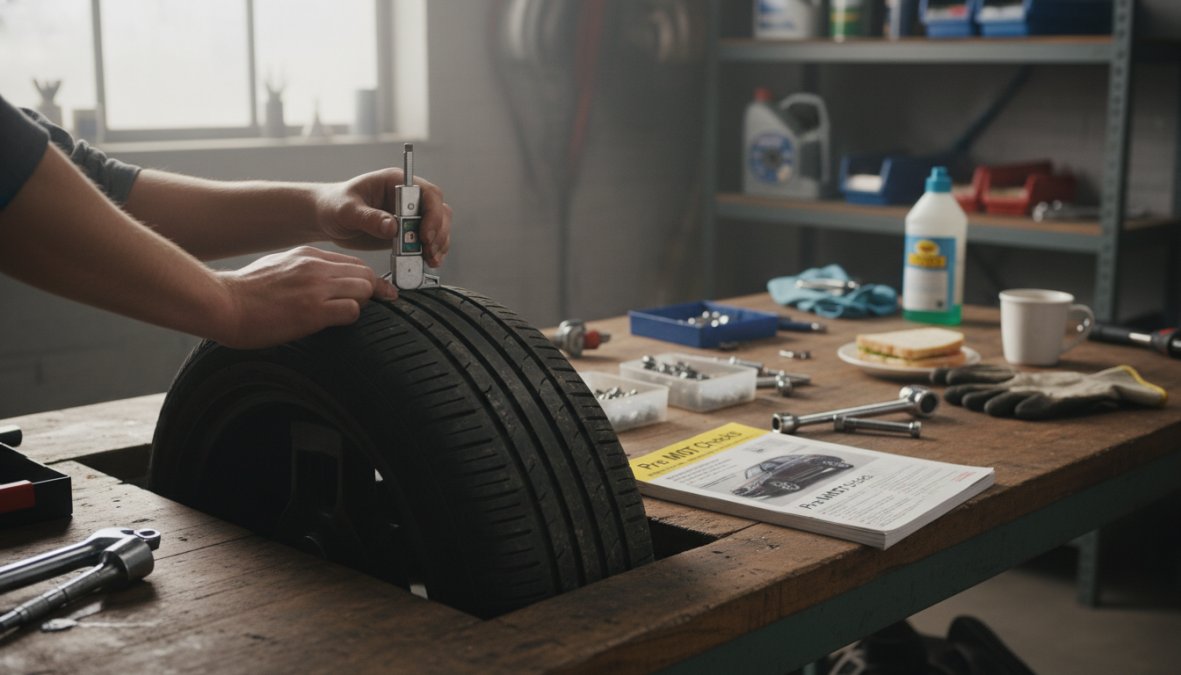
Step-by-step visual guide for tread and depth and person concepts for how to prepare for mot
Start your preparation the day before the test in good light. Look for anything obviously wrong: a blown bulb, a cracked lens, an underinflated tyre, or a wiper blade that smears. Fluid levels and brake feel take another ten minutes at most.
Lights and Signals: Headlights, Brake Lights, and Indicators
Every light on your vehicle is tested during an MOT, headlights, fog lights, brake lights, reversing lights, indicators, and hazards. A single failed bulb is an immediate failure.
Turn on your headlights and walk around the front to confirm both are working.
Ask someone to stand behind the car while you press the brake pedal, or reverse close to a wall and watch the reflection.
Activate each indicator individually; a bulb failure often causes the remaining indicators to flash faster than normal.
Test fog lights and reversing lights using the appropriate controls.
Bulbs fail without warning. Replacing one before the test takes minutes and costs very little.
Tyre Tread Depth, Condition, and Pressure
The legal minimum tread depth in the UK is 1.6mm across the central three-quarters of the tyre's width, below this is an automatic fail. Use the 20p test: insert a coin into the main tread groove; if the outer band is visible, the tyre is likely illegal. Check multiple points around the tyre, as uneven wear can mean one section is legal while another is not.
Inspect sidewalls for cuts, bulges, or embedded objects, and check tyre pressure against the manufacturer's specification (usually on a sticker inside the driver's door).
Watch OutTyres with visible cord or structural damage are an immediate MOT failure and dangerous to drive on. If you spot a bulge or deep sidewall cut, do not drive the vehicle until the tyre has been replaced.
Windscreen, Wipers, and Visibility
A crack or chip larger than 10mm in the driver's critical zone (a 290mm-wide band in front of the driver) is an automatic fail; damage larger than 40mm anywhere else on the windscreen also fails. Check in direct sunlight, which reveals chips invisible in overcast conditions.
Run your wiper blades and confirm they clear the screen without smearing or skipping. Top up windscreen washer fluid, running dry during a test signals poor maintenance and the tester will check the system.
Brakes, ABS System, and Parking Brake
The tester checks brake pads, discs, and lines for wear, corrosion, and leaks. Before your test, note any sponginess, pulling to one side, grinding, or vibration, these warrant investigation beforehand. An illuminated ABS warning light is a major failure. Test your parking brake on a slope; it should hold the vehicle securely without being pulled to its maximum extent.
Fluid Levels, Exhaust System, and Emissions
Check engine oil, coolant, brake fluid, and power steering fluid against their min/max markers and top up anything low. The exhaust is inspected for leaks, excessive noise, and secure mounting. On emissions, diesel vehicles driven mainly on short journeys may have a partially blocked DPF, a practical fix is a 20-minute motorway run before the test to help clear it.
Seat Belts, Number Plates, and Dashboard Warning Lights
Each seat belt must retract smoothly, latch correctly, and show no fraying. Inertia reel belts that don't retract are a common failure. Number plates must be clean, legible, correctly formatted, and securely fixed.
Dashboard warning lights are one of the most overlooked pre-MOT checks. Any warning light that stays on when the engine is running, engine management, ABS, airbag, steering, is a potential major failure.
Pro TipBook a diagnostic scan before your MOT if any warning light is showing. A scan tool reads the fault code in minutes and tells you exactly what the vehicle's system has flagged, saving you the cost of a failed test.
Your MOT Checklist: A Room-by-Room Walk Around Your Vehicle
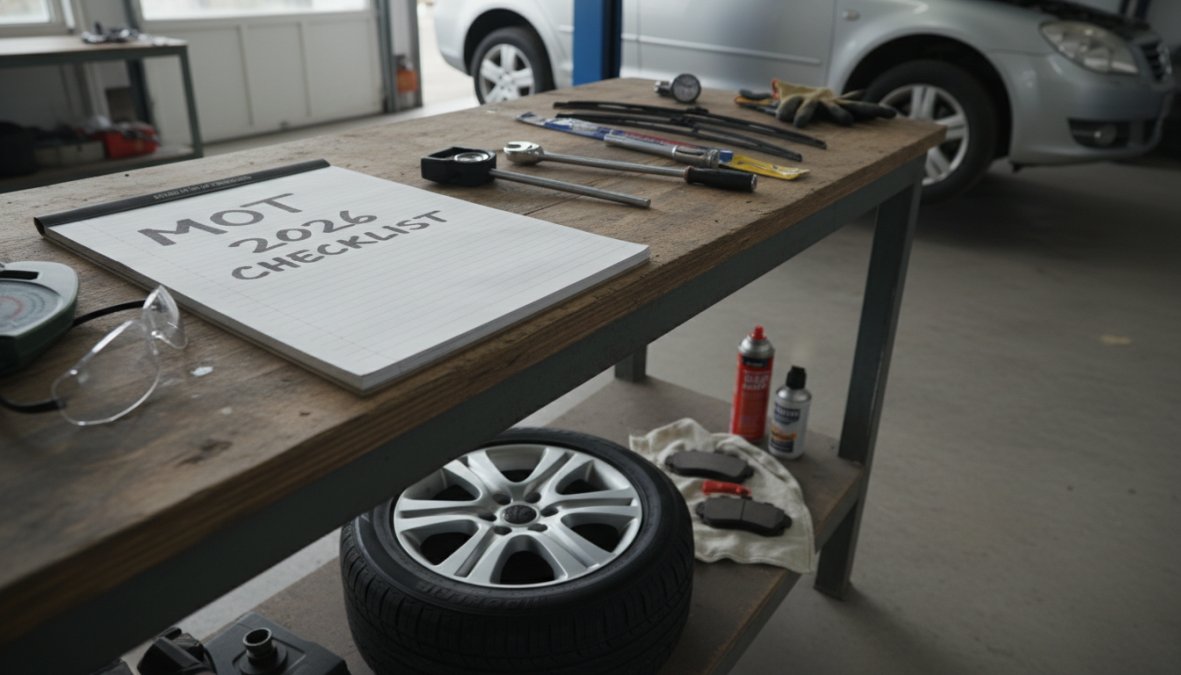
A structured walk-around takes less than 20 minutes and covers the majority of MOT check points. Use this checklist the day before your appointment:
Exterior - Front
Both headlights working (dipped and main beam)
Front indicators working on both sides
Front fog light working
Windscreen free from chips or cracks in the driver's zone
Number plate clean, secure, and legible
Bonnet closes and latches securely
Exterior - Sides and Roof
All four tyres at correct pressure
Tread depth above 1.6mm on all four tyres
No bulges, cuts, or visible cord on any tyre sidewall
All door mirrors present and secure
Exterior - Rear
Both brake lights working
Both rear indicators working
Rear fog light working
Reversing light working
Rear number plate clean, secure, and lit at night
Exhaust secure and not blowing
Interior
All seat belts retract and latch correctly
Parking brake holds on a slope
Horn works
No dashboard warning lights illuminated
Windscreen wipers clear the screen without smearing
Washer fluid topped up
Under the Bonnet
Engine oil between min and max
Coolant between min and max
Brake fluid between min and max
Power steering fluid (if applicable) between min and max
Common MOT Failures and How to Avoid Them
According to DVSA MOT failure data, lighting and signalling faults, tyre defects, and driver visibility issues consistently top the failure categories year after year. Most are maintenance failures, bulbs not replaced, wiper blades not changed, tyres not monitored, rather than mechanical breakdowns. A vehicle that receives regular attention rarely fails on these items.
Failure Category
Common Cause
DIY Fix?
Lighting and signalling
Blown bulb, cracked lens
Yes - bulb replacement
Tyres
Low tread, sidewall damage
Yes - tyre replacement
Windscreen and wipers
Chip in driver zone, worn blades
Partial - chips need repair
Brakes
Worn pads, scored discs
Partial - pads yes, discs need assessment
Emissions
Blocked DPF, running rich
Partial - DPF run may help
Dashboard warning lights
Unresolved fault codes
No - requires diagnostics
The failure category that catches drivers most off guard is dashboard warning lights. Many assume a light that has been on for months without obvious symptoms is harmless. Testers are required to record any illuminated warning light as a major failure, regardless of the underlying cause.
What Does MOT Advisory Mean - and Why It Matters
An MOT advisory flags a component that is not yet at the point of failure but is showing wear. The vehicle still passes, but the advisory identifies what to monitor before the next test. Common advisory items include brake pads approaching minimum thickness, tyres approaching minimum tread, shock absorbers showing slight weeping, and minor suspension joint play.
Advisories are a maintenance roadmap, not optional reading. A tester recording "front brake pads wearing thin" is telling you those pads will likely fail next year's test if ignored. Address advisory items in the months following your MOT, not the week before the next one, this spreads the cost and keeps your vehicle away from its limits.
Key TakeawayAn MOT advisory is not a bureaucratic footnote. It is a tester telling you exactly what will fail next year. Act on it within three to six months and your next MOT preparation becomes significantly easier.
How Long Does an MOT Take and What Happens on the Day
An MOT test typically takes between 45 minutes and one hour for a standard passenger vehicle. You are not permitted in the testing bay during the test, though most garages have a waiting area with a view. At the end, you receive one of three outcomes:
Pass: You receive a pass certificate (VT20) and your MOT expiry date is updated with the DVLA automatically.
Fail: You receive a failure notice (VT30) listing reasons by severity. The vehicle cannot legally be driven on public roads except to a pre-booked repair appointment.
Pass with advisories: Your vehicle passes but the tester has noted items to monitor.
Your previous MOT certificate is no longer required, the DVSA holds all records electronically.
How to Prepare for MOT if You Drive an Electric or Hybrid Vehicle
Fully electric vehicles are exempt from the emissions test, but the rest of the MOT checklist, lights, tyres, brakes, windscreen, seat belts, structural integrity, applies identically. Key EV and hybrid-specific points:
Regenerative braking: Brake discs see less use and can corrode, which can cause a failure.
High-voltage system warning lights: Any related warning light will be recorded and requires specialist diagnostics.
Brake fluid: Still degrades over time and should be checked even if hydraulic brakes are used infrequently.
Tyres: EVs are heavier due to battery weight, accelerating tyre wear, tread depth checks are particularly important.
Kettering Motorist Centre has specialist expertise in electric and hybrid vehicle maintenance, which matters when interpreting EV-specific warning lights and brake system condition. According to DVSA guidance on MOT testing for electric vehicles, the MOT testing manual has been updated to reflect EV-specific procedures.
What to Do If Your Car Fails Its MOT: Post-Failure Repair Strategy
Failing an MOT is frustrating but fixable. The failure notice lists every defect by severity. Major defects must be repaired before the vehicle returns to the road; dangerous defects mean the vehicle should not be driven at all until repaired.
Professional illustration showing how to prepare for mot
Dangerous: Do not drive the vehicle. Arrange recovery or repair at the test centre.
Major: Can be driven only to a pre-booked repair appointment.
Minor/Advisory: Did not cause the failure but should be addressed.
If repairs are carried out at the same garage, a partial retest covering only the failed items is often available at reduced cost. Taking the vehicle elsewhere typically requires a full retest.
DIY Fixes vs. Professional Repairs: What's Worth Doing Yourself
Reasonable DIY repairs after a failure:
Replacing a blown bulb
Topping up washer fluid
Replacing wiper blades
Replacing a number plate
Repairs that need a professional:
Brake pad and disc replacement (requires correct torque settings and brake bleeding)
Suspension joint or shock absorber replacement
Exhaust system repairs
Any ABS system or electronic component work
Emissions-related repairs on diesel vehicles with DPF issues
A brake pad replacement done incorrectly is not just an MOT failure, it is a safety hazard. For anything beyond simple consumables, professional repair is the correct choice. For drivers in Kettering and across Northamptonshire, Kettering Motorist Centre offers expert diagnostic and repair services with a transparent booking process and no upfront payment required online.
Conclusion: Book Your MOT With Confidence in Kettering
Most MOT failures are preventable with 20 minutes of preparation. For drivers near Kettering looking for a reliable MOT near me, Kettering Motorist Centre provides professional MOT testing backed by specialist knowledge of both conventional and electric vehicles. The family-run business offers hassle-free online booking with no payment required upfront, making it straightforward to schedule your test and arrive with confidence.
Book your MOT with Kettering Motorist Centre and arrive knowing your vehicle has the best possible chance of passing first time.
Frequently Asked Questions
How long does an MOT take? An MOT test typically takes between 45 minutes and one hour for a standard passenger car. Vehicles with initial failures or larger vehicles may take longer. Allow at least 90 minutes when planning your day.
What are the most common MOT failures? The most common MOT failures involve lighting and signalling faults (blown bulbs, cracked lenses), tyre defects (low tread depth, sidewall damage), and driver visibility issues (windscreen chips, worn wiper blades). Dashboard warning lights are also a frequent cause that many drivers overlook.
What does an MOT advisory mean? An MOT advisory is a note from the tester about a component showing wear but not yet at the point of failure. The vehicle still passes, but the advisory identifies items to monitor or repair before the next annual test. Ignoring advisories is the most common reason drivers face unexpected failures the following year.
Can I drive my car if it fails its MOT? A vehicle with a major defect can be driven only to a pre-booked repair appointment. A vehicle with a dangerous defect should not be driven at all until repaired. According to RAC guidance on driving after MOT failure, the rules carry significant penalties if ignored.
Do electric vehicles need an MOT? Yes. Electric vehicles require an MOT once they are three years old, the same as petrol or diesel vehicles. The emissions test does not apply, but all other checks, lights, tyres, brakes, seat belts, and structural condition, are carried out in the same way. EV-specific items such as high-voltage warning lights and brake disc condition are also assessed.
Frequently Asked Questions
What are the most common reasons for MOT failure?
The most common MOT failures involve lighting and signalling faults, worn tyre tread below the legal 1.6mm minimum, defective windscreen wipers, and brake system issues including worn brake pads. Dashboard warning lights left illuminated — particularly the ABS system warning — also cause failures. Running a thorough pre-MOT checklist at home can help you identify and fix many of these issues before your annual test, saving you the cost of a retest.
How long does an MOT test usually take?
A standard MOT test typically takes between 45 minutes and one hour for most vehicles. However, if the tester identifies issues that require closer inspection, it can take slightly longer. Electric and hybrid vehicles may take a little more time due to additional checks on high-voltage systems. Arriving with a clean, well-maintained car and all required documents — including your vehicle registration details — helps the process run smoothly.
What does an MOT advisory mean, and should I be worried?
An MOT advisory is a note from the tester flagging something that is not yet a failure but could become one. Common advisories include slightly worn brake pads, minor suspension joint wear, or early tyre deterioration. Your car still passes with advisories, but you should monitor these items closely and address them before your next MOT. Ignoring advisories often means they become full failures the following year, increasing your repair costs significantly.
Can I do my own pre-MOT checks at home before the test?
Yes — many pre-MOT checks require no tools and take under 30 minutes. You can check headlights, brake lights, and indicators by walking around the car with the engine running. Inspect tyre tread depth using a 20p coin as a rough guide, top up fluid levels, test your parking brake, and ensure seat belts click and retract properly. These simple steps help you prepare for your MOT and reduce the risk of a preventable failure.
What happens if my car fails its MOT?
If your car fails its MOT, you will receive a list of the reasons — categorised as minor, major, or dangerous. Major and dangerous failures mean the car cannot legally be driven until repaired. You are entitled to a partial retest if repairs are completed at the same garage on the same day or the following day. It is worth getting a repair quote from your MOT centre before authorising work, as costs and turnaround times can vary considerably.
Do electric and hybrid vehicles need an MOT?
Yes — electric and hybrid vehicles require an MOT once they are three years old, just like petrol or diesel cars. The test covers the same core roadworthiness checks, but testers also inspect EV-specific components such as the condition of high-voltage cables, warning labels, and the regenerative braking system. Emissions testing differs for EVs since there are no exhaust emissions to measure. It is advisable to use a garage with specialist experience in electric and hybrid vehicle maintenance.
Your booking Failed
Please try again or please call 01536 410142
Thank you for placing a booking with Kettering Motorist Centre Limited for vehicle
PLEASE TAKE YOUR BOOKING REFERENCE NUMBER WITH YOU TO THE MOT CENTRE
Your items
MOT Test
×
Terms and Conditions
These terms and conditions form the basis on which you can visit and use this website. Please read them carefully as they contain important information.
General terms and conditions
This website is owned and operated by Kettering Motorist Centre Ltd (company registration number: 4485858) operating at Trafalgar Road, Kettering, Northamptonshire, NN16 8DB (the "MOT Centre", the "Company", "we" or "us"). If you have any queries about these terms and conditions or if you have any comments or complaints on or about this website, you can contact us at [email protected] or 01536 410142.
The website is to promote and offer for sale the products and services of Kettering Motorist Centre Limited.
1. The contract between us
This website does not take payment for products or services online. The website enables you to view products and services online and to make a booking for later delivery and payment. The vehicle and provision of other products and services promoted by this website and the payment by you of the price of those products and services will take place at the MOT Centre. The booking does not constitute a contract.
The booking process on the site provides details of the booked MOT order. Please take the time to read and check your booking. It is your responsibility to make sure the order is correct and for the correct vehicle.
2. Ownership of rights
All rights, including copyright, in this website are owned by or licensed to the Company. Any use of this website or its contents, including copying or storing it or them in whole or part, other than for your own personal, non commercial use, is prohibited without our permission. You may not modify, distribute or repost anything on this website for any purpose.
3. Accuracy of content
We have taken care in the preparation of the content of this website, in particular to ensure that prices quoted are correct at the time of publishing and that all goods have been fairly described. However, bookings will only be accepted if there are no material errors in the description of the goods or their prices as advertised on this website. Any weights, dimensions and capacities given about the goods are approximate only.
4. Damage to your computer
We try to ensure that this website is free from viruses or defects. However, we cannot guarantee that your use of this website or any websites accessible through it will not cause damage to your computer. It is your responsibility to ensure that the right equipment is available to use the website. Except in the case of negligence on our part, we will not be liable to any person for any loss or damage which may arise to computer equipment as a result of using this website.
5. Availability
All bookings are subject to acceptance and availability. If the MOT date you have requested are is not available, the Centre will contact you by e-mail or phone. You will have the option either to wait until another slot is available or to cancel your booking.
6. Booking errors
You are able to correct errors on your booking up to the point on which you click on “Place Booking” during the booking process.
7. Price
The prices payable for goods that you order are as set out in our website. All prices are inclusive of VAT at the current rates and are correct at the time of entering information, errors and omissions excepted.
Whenever it is not possible to accept your booking to buy goods of the specification and description at the price indicated, the MOT Centre will advise you by email or phone or when you visit the centre.
8. Payment terms
You will be required to pay for the goods or services to the Centre at time of a completed MOT.
9. Delivery charges
N/A
10. Cancellation
The MOT Centre reserves the right to cancel the booking if:
10.1 There is insufficient stock to deliver the goods you have booked.
10.2 One or more of the goods you booked was listed at an incorrect price.
If your booking is cancelled the Centre will notify you by e-mail or phone.
You have the right to cancel your booking at any time up to the point of the MOT. If you do cancel your booking you should inform the centre by phone.
11. Liability
Notwithstanding the foregoing, nothing in these terms and conditions is intended to limit any rights you might have as a consumer under applicable local law or other statutory rights that may not be excluded nor in any way to exclude or limit our liability to you for any death or personal injury resulting from our negligence.
12. Notices
Unless otherwise expressly stated in these terms and conditions, all notices from you to us must be in writing and sent to our contact address given above and all notices from us to you will be displayed on our website from time to time.
13. Changes to legal notices
We reserve the right to change these terms and conditions from time to time and you should look through them as often as possible.
14. Law, jurisdiction and language
This website, any content contained therein and any contract brought into being as a result of usage of this website are governed by and construed in accordance with English law. Parties to any such contract agree to submit to the exclusive jurisdiction of the courts of England and Wales.
15. Invalidity
If any part of these terms and conditions is unenforceable (including any provision in which we exclude our liability to you) the enforceability of any other part of these conditions will not be affected.
16. Privacy
You acknowledge and agree to be bound by the terms of our privacy policy
17. Third party rights
Nothing in this Agreement is intended to, nor shall it confer any rights on a third party.