Steering pull is one of the most common complaints drivers bring to garages across Northamptonshire, yet it is also one of the most misdiagnosed. If you have ever asked yourself why does my car pull to one side, the answer is rarely a single fault. At Kettering Motorist Centre, we see this problem daily, and the root cause ranges from something as simple as tyre pressure to something as serious as a failing brake calliper. Below, we cover every major cause, what the symptoms look like, how to check for them yourself, and when you must hand the job to a qualified technician.
A car that drifts gently on a cambered road is not the same problem as one that lurches sharply under braking. Treating them the same way wastes money and can leave a genuine safety hazard unresolved.
Why Does My Car Pull to One Side? The Most Common Causes
Steering pull is a symptom, not a diagnosis. The three most frequent causes are tyre pressure imbalance, wheel alignment problems, and brake system faults. Each produces a slightly different character of pull, which helps narrow down the fault before any tools are picked up.
Tyre Pressure Imbalance
Start here before anything else. A tyre that is under-inflated on one side creates more rolling resistance on that corner, pulling the car in that direction. According to the UK Government's tyre safety guidance, correctly inflated tyres are critical to safe steering response and braking performance.
Check all four tyres cold, before the car has been driven. The correct pressures are in your owner's manual or on the sticker inside the driver's door jamb. A difference of even 5 PSI between the front-left and front-right can produce a noticeable pull at motorway speeds.
Pro TipCheck tyre pressures when the tyres are cold. Driving just three miles raises internal pressure enough to give a false reading, making a soft tyre appear normal on the gauge.
Close-up of a mechanic's gloved hands using a tyre pressure gauge on a front wheel of a raised car in a well-lit workshop, with a floor jack and tools visible nearby
Wheel Alignment Problems
Wheel alignment is the angle at which your tyres contact the road. Misalignment is caused by hitting a kerb, driving through a pothole, or gradual wear of suspension components. Roads in Northamptonshire, particularly on rural routes, are hard on alignment settings.
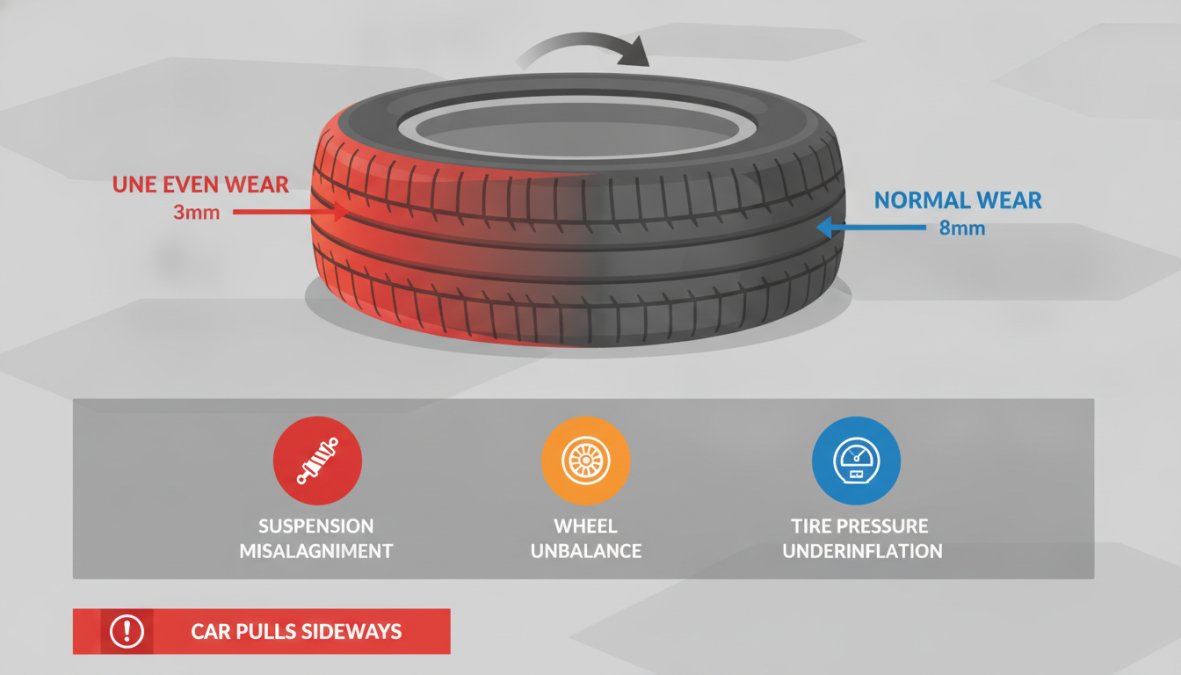
Three parameters matter: toe, camber, and caster. Toe misalignment causes a constant, steady pull. Camber issues produce pull combined with uneven tyre wear on one edge. Caster imbalance pulls the car toward the side with less positive caster. None of these can be corrected by eye, proper alignment requires a four-wheel alignment machine with laser or camera targets.
Brake System Faults
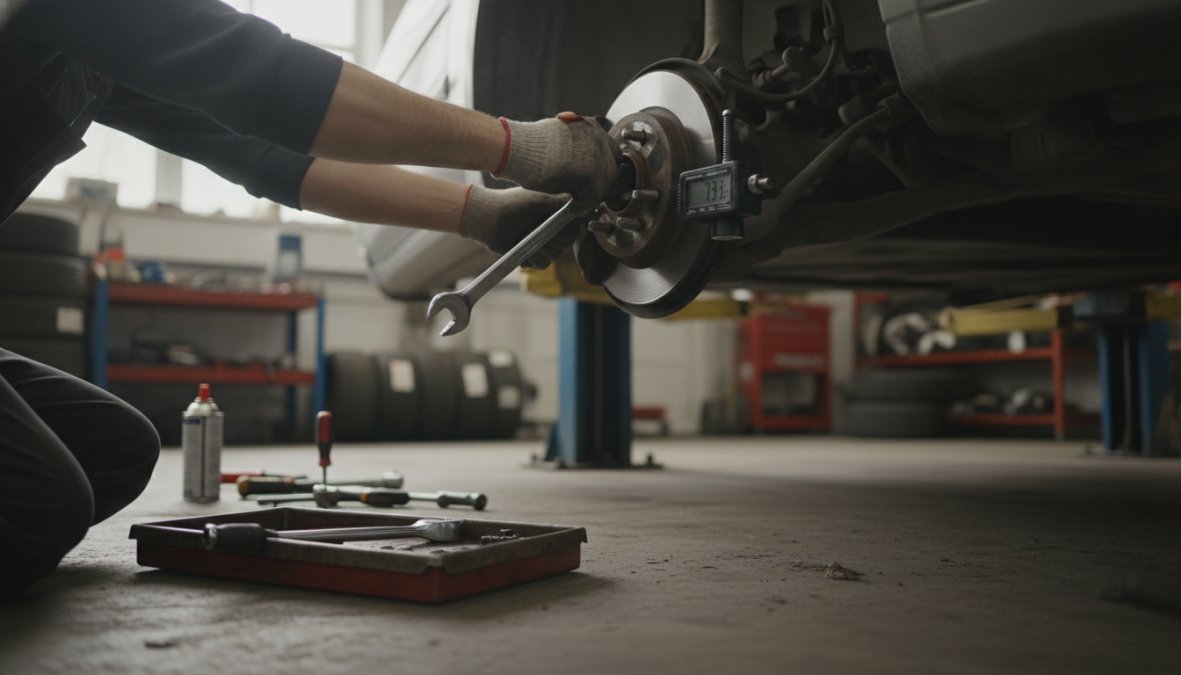
A pull that only appears under braking points directly at the brake system. A sticking calliper applies drag to one wheel even when the pedal is not pressed; a collapsed flexible brake hose restricts fluid return, keeping the pads partially applied.
This is not a fault to ignore. A sticking calliper generates heat, degrades brake fluid, and can cause a tyre fire in extreme cases. If your car pulls specifically when you brake, get it inspected the same day.
Bad Tie Rod Symptoms You Should Never Ignore
Bad tie rod symptoms deserve their own section because a failing tie rod is a structural failure, not a maintenance item. The tie rod connects your steering rack to the wheel hub. When it wears, the wheel can move independently of your steering input.
The warning signs are specific:
Vibration through the steering wheel, particularly at speeds above 50 mph
A loose or vague steering feel, as if there is play before the wheels respond
Uneven tyre wear concentrated on the inner or outer edge
A clunking or knocking noise from the front suspension over bumps
The car pulls to one side even after a fresh wheel alignment
That last point is the one most drivers miss. If a garage aligns your wheels and the pull returns within days, worn tie rod ends are the likely explanation. The alignment cannot hold if the component it is set against is moving.
According to the RAC's guide to steering and suspension safety, worn steering components are among the most common reasons vehicles fail their MOT. A tie rod end replacement is straightforward when caught early. Left until the rod separates, the result is a complete loss of steering.
Watch OutDo not drive a car with confirmed tie rod wear at motorway speeds. The joint can separate without further warning. If a mechanic has identified tie rod play, treat it as an urgent repair, not a "book it in next week" job.
Uneven Tyre Wear Causes and What They Tell You
Tyre wear patterns are a diagnostic tool. Each pattern points to a specific mechanical fault, directing attention to the right component immediately.
The main patterns and what they indicate:
Centre wear: Over-inflation. The tyre bows outward, wearing the centre tread faster than the edges.
Edge wear on both sides: Under-inflation. The tyre flexes excessively, wearing both shoulders.
Single-edge wear (inner or outer): Camber misalignment.
Feathering or sawtooth pattern: Toe misalignment. The tyre is being dragged sideways as it rolls.
Cupping or scalloping: Worn shock absorbers or struts, causing the tyre to bounce against the road surface.
One-sided wear on a single tyre: Often a bent wheel, worn wheel bearing, or damaged suspension component.
Uneven tyre wear causes are rarely about the tyres themselves. The tyre is simply recording what the suspension and alignment are doing to it.
Close-up of a car tyre showing heavily worn tread on the inner edge, photographed on a concrete garage workshop floor under fluorescent lighting
How to Inspect Your Tyres for Wear Patterns
You do not need specialist tools for a basic tyre inspection. Here is how to do it properly:
Park on a flat, level surface and turn the steering wheel to full lock to expose the inner tread face.
Run your hand across the tread from the inner edge to the outer edge. Uneven ridges or a smooth-to-rough transition indicate a wear pattern.
Use a 20p coin inserted into the tread groove. If the outer band of the coin is visible, the tread is below 3mm and approaching the legal 1.6mm minimum.
Check all four tyres, not just the fronts. Rear tyre wear reveals suspension and load issues the fronts may not show.
Look for cracking, bulging, or embedded objects on the sidewalls. A bulge indicates internal structural damage and means the tyre must be replaced immediately.
Do this check once a month and before any long journey.
Is It Safe to Drive When Your Car Pulls to One Side?
The honest answer: it depends entirely on the cause and severity. A mild drift caused by tyre pressure difference is a nuisance, not a crisis. A sharp pull caused by a seized brake calliper or a cracked tie rod is a genuine emergency.
Use this framework to assess your situation:
Symptom
Likely Cause
Safe to Drive?
Gentle drift, consistent direction
Tyre pressure or alignment
Yes, address within 1-2 days
Pull only under braking
Brake calliper or hose
No, inspect same day
Vibration + pull at speed
Wheel balance or tie rod
Limited, inspect urgently
Sharp pull with noise
Tie rod, bearing, or brake fault
No, do not drive
Pull after recent kerb strike
Alignment or bent wheel
Yes, book alignment check
The legal position is clear. As noted in the Highway Code's vehicle condition requirements, drivers are responsible for ensuring their vehicle is in a roadworthy condition before driving on public roads. A car with a known steering fault that causes an accident creates significant legal liability for the driver.
Wheel Alignment Cost: What to Expect in Kettering
Wheel alignment cost in Kettering varies depending on whether you need a two-wheel (front axle only) or four-wheel alignment check. A front-wheel alignment is the appropriate starting point for most drivers. A four-wheel alignment is necessary after suspension work, following a significant impact, or when rear tyre wear patterns suggest the rear axle is also out of specification.
The cost of leaving alignment unchecked is higher than the cost of the service itself. Misaligned wheels scrub tyre tread at an accelerated rate, a tyre that should last 25,000 miles may wear out in 15,000 miles if alignment is even slightly off.
Booking a wheel alignment check in Kettering should be routine after any of the following events:
Hitting a pothole or kerb at speed
Replacing a tyre, strut, or suspension component
Noticing a steering pull or uneven tyre wear
After every 12,000 miles as preventative maintenance
DIY Checks vs. Professional Diagnosis: What You Can and Cannot Do Safely
Most drivers can diagnose the approximate category of their problem without any tools. The question is where safe DIY work ends and where professional intervention becomes necessary.
Simple Checks You Can Do at Home
These checks require no specialist equipment and carry no safety risk:
Tyre pressure: Use a quality gauge and compare all four corners against the manufacturer's specification.
Visual tyre inspection: Check for uneven wear, bulges, cracking, and embedded objects.
Steering wheel centring: On a flat, straight road, note whether the wheel sits straight when the car tracks true.
Pull direction test: On a safe, empty road, briefly release the wheel and observe which direction the car drifts.
Brake pull test: Apply the brakes gently from 30 mph and note whether the car pulls to one side. If it does, the brake system is the primary suspect.
When You Must See a Qualified Technician
There is a clear line between observation and intervention. Cross it without the right equipment and you risk making the fault worse or introducing a new one.
Always see a qualified technician for:
Wheel alignment (requires a calibrated alignment machine)
Tie rod inspection and replacement (requires the car raised on a ramp and a torque wrench for reassembly)
Brake calliper inspection and replacement (hydraulic system work carries safety implications)
Wheel bearing diagnosis (requires a trained ear and specific load tests)
Suspension geometry checks after any significant impact
As referenced in the Institute of the Motor Industry's guidance on vehicle safety repairs, steering and brake components are classified as safety-critical systems that require trained technicians for repair and replacement. An incorrectly torqued tie rod end or a brake bleed done without proper technique can fail without warning at speed.
Key TakeawayDIY tyre pressure checks and visual inspections are genuinely useful and should be done monthly. Anything involving raised suspension, steering joints, or brake hydraulics requires a qualified technician with the right tools and training.
How Kettering Motorist Centre Diagnoses and Fixes Pulling Issues
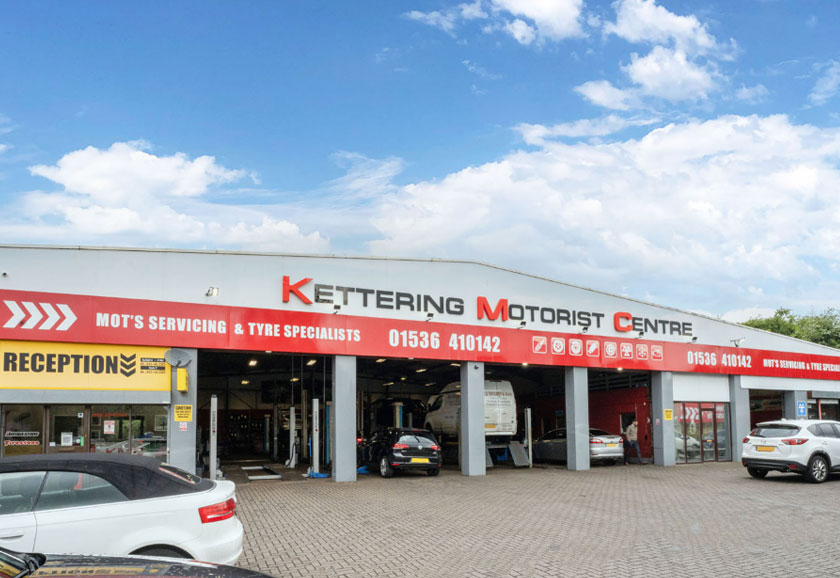
Kettering Motorist Centre takes a systematic approach to steering pull diagnosis, working through the most common causes in order of likelihood before recommending any repair work.
The diagnostic process covers:
Tyre pressure and condition check: All four tyres are checked cold against manufacturer specification. Tread depth and wear patterns are recorded.
Visual brake inspection: Calliper condition, pad wear, and flexible hose condition are checked for signs of seizure or collapse.
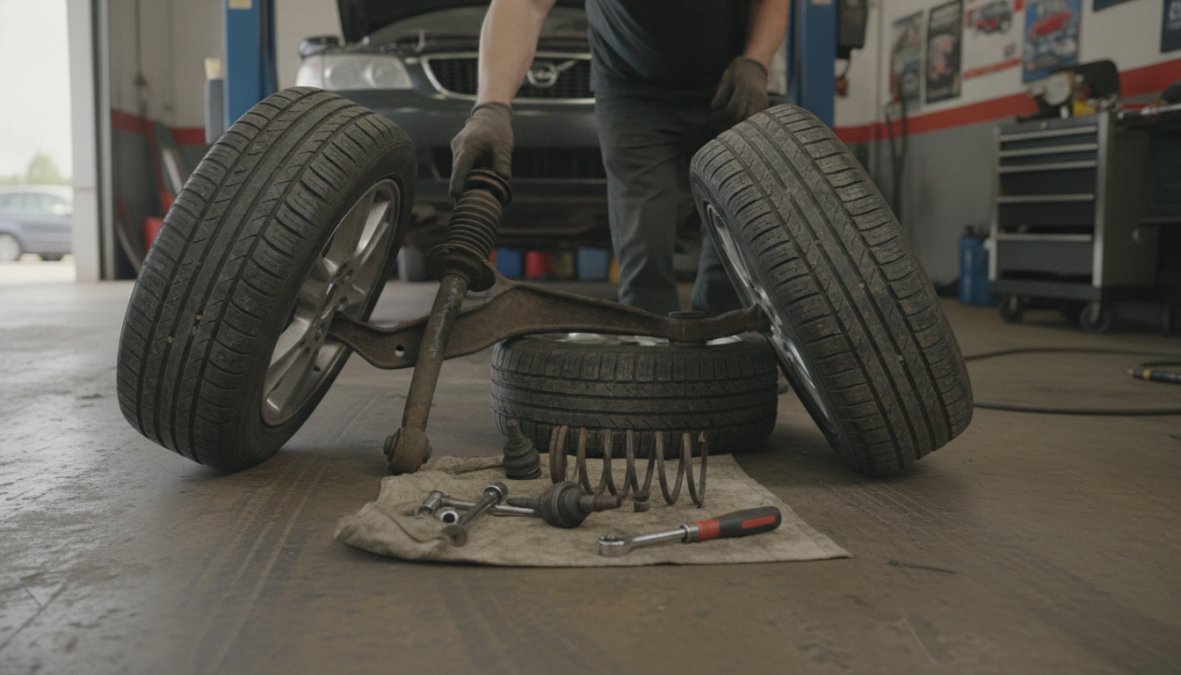
Steering and suspension inspection: Tie rod ends, ball joints, and wheel bearings are checked for play under load on a ramp.
Four-wheel alignment assessment: All four wheels are measured against manufacturer tolerances, identifying toe, camber, and caster deviations on each corner.
Road test: A qualified technician road-tests the vehicle before and after any work to confirm the fault is resolved.
The family-run approach at Kettering Motorist Centre means you get a clear explanation of what was found, what was done, and why, without unnecessary upselling. Booking is straightforward through the online system with no upfront payment required. For drivers across Kettering and the wider Northamptonshire area, the process from booking to road test is designed to be as transparent as possible.
Frequently Asked Questions
Is it safe to drive if my car pulls to one side?
It depends on the cause, but pulling to one side is generally a warning sign you should not ignore. If the pull is sudden or severe, it could indicate a tyre blowout, a seized brake calliper, or a broken suspension component, all of which make the vehicle unsafe to drive. Even a gradual pull caused by wheel misalignment or uneven tyre wear will worsen over time and increase stopping distances. Have it inspected by a qualified technician as soon as possible.
Can low tyre pressure cause a car to pull to one side?
Yes. If one tyre has significantly lower pressure than the others, the vehicle will naturally pull toward that side. This is one of the first things to check when your car pulls to one side, as it is the simplest fix. Check all four tyres with a reliable pressure gauge and inflate them to the manufacturer's recommended PSI, found in your vehicle handbook or on the sticker inside the driver's door. If the tyre repeatedly loses pressure, have it checked for a puncture or valve fault.
What are the symptoms of bad tie rods that cause pulling?
Bad tie rod symptoms include your car pulling to one side, a loose or wandering steering feel, clunking or knocking noises when turning or going over bumps, and uneven tyre wear, particularly on the inner or outer edges. In severe cases, the steering wheel may vibrate at speed. Tie rods are critical steering components that connect your steering rack to the wheel hub, so worn or damaged tie rods are a safety concern that requires prompt professional attention.
Does a wheel alignment fix a car that pulls to one side?
Wheel alignment is one of the most common fixes for a car that pulls to one side, and in many cases it resolves the issue completely. Misalignment means your wheels are not pointing in the correct direction, causing the vehicle to drift. However, if the pull is caused by something else, such as a tyre fault, worn tie rods, or a brake issue, alignment alone will not fix it. A proper diagnosis is important before booking an alignment to ensure you are treating the right problem.
How much does wheel alignment cost in Kettering?
Wheel alignment costs in Kettering can vary depending on whether you need a two-wheel (front axle) or four-wheel alignment and which garage you use. Two-wheel alignment is generally the more affordable option and is suitable for most standard vehicles. Four-wheel alignment is recommended for all-wheel-drive vehicles or if all four wheels are adjustable. Prices also vary based on the equipment used. Contacting a local garage like Kettering Motorist Centre directly for a quote is the best way to get an accurate, up-to-date price.
Steering pull that goes unchecked costs more than the repair itself, in tyre wear, fuel efficiency, and the risk of a more serious failure. Kettering Motorist Centre offers expert diagnostic and repair services covering wheel alignment, brake system faults, and suspension inspection, with a hassle-free online booking system that requires no upfront payment. Book your MOT or steering inspection with Kettering Motorist Centre and get a clear, honest diagnosis from a trusted local team.
Your booking Failed
Please try again or please call 01536 410142
Thank you for placing a booking with Kettering Motorist Centre Limited for vehicle
PLEASE TAKE YOUR BOOKING REFERENCE NUMBER WITH YOU TO THE MOT CENTRE
Your items
MOT Test
×
Terms and Conditions
These terms and conditions form the basis on which you can visit and use this website. Please read them carefully as they contain important information.
General terms and conditions
This website is owned and operated by Kettering Motorist Centre Ltd (company registration number: 4485858) operating at Trafalgar Road, Kettering, Northamptonshire, NN16 8DB (the "MOT Centre", the "Company", "we" or "us"). If you have any queries about these terms and conditions or if you have any comments or complaints on or about this website, you can contact us at [email protected] or 01536 410142.
The website is to promote and offer for sale the products and services of Kettering Motorist Centre Limited.
1. The contract between us
This website does not take payment for products or services online. The website enables you to view products and services online and to make a booking for later delivery and payment. The vehicle and provision of other products and services promoted by this website and the payment by you of the price of those products and services will take place at the MOT Centre. The booking does not constitute a contract.
The booking process on the site provides details of the booked MOT order. Please take the time to read and check your booking. It is your responsibility to make sure the order is correct and for the correct vehicle.
2. Ownership of rights
All rights, including copyright, in this website are owned by or licensed to the Company. Any use of this website or its contents, including copying or storing it or them in whole or part, other than for your own personal, non commercial use, is prohibited without our permission. You may not modify, distribute or repost anything on this website for any purpose.
3. Accuracy of content
We have taken care in the preparation of the content of this website, in particular to ensure that prices quoted are correct at the time of publishing and that all goods have been fairly described. However, bookings will only be accepted if there are no material errors in the description of the goods or their prices as advertised on this website. Any weights, dimensions and capacities given about the goods are approximate only.
4. Damage to your computer
We try to ensure that this website is free from viruses or defects. However, we cannot guarantee that your use of this website or any websites accessible through it will not cause damage to your computer. It is your responsibility to ensure that the right equipment is available to use the website. Except in the case of negligence on our part, we will not be liable to any person for any loss or damage which may arise to computer equipment as a result of using this website.
5. Availability
All bookings are subject to acceptance and availability. If the MOT date you have requested are is not available, the Centre will contact you by e-mail or phone. You will have the option either to wait until another slot is available or to cancel your booking.
6. Booking errors
You are able to correct errors on your booking up to the point on which you click on “Place Booking” during the booking process.
7. Price
The prices payable for goods that you order are as set out in our website. All prices are inclusive of VAT at the current rates and are correct at the time of entering information, errors and omissions excepted.
Whenever it is not possible to accept your booking to buy goods of the specification and description at the price indicated, the MOT Centre will advise you by email or phone or when you visit the centre.
8. Payment terms
You will be required to pay for the goods or services to the Centre at time of a completed MOT.
9. Delivery charges
N/A
10. Cancellation
The MOT Centre reserves the right to cancel the booking if:
10.1 There is insufficient stock to deliver the goods you have booked.
10.2 One or more of the goods you booked was listed at an incorrect price.
If your booking is cancelled the Centre will notify you by e-mail or phone.
You have the right to cancel your booking at any time up to the point of the MOT. If you do cancel your booking you should inform the centre by phone.
11. Liability
Notwithstanding the foregoing, nothing in these terms and conditions is intended to limit any rights you might have as a consumer under applicable local law or other statutory rights that may not be excluded nor in any way to exclude or limit our liability to you for any death or personal injury resulting from our negligence.
12. Notices
Unless otherwise expressly stated in these terms and conditions, all notices from you to us must be in writing and sent to our contact address given above and all notices from us to you will be displayed on our website from time to time.
13. Changes to legal notices
We reserve the right to change these terms and conditions from time to time and you should look through them as often as possible.
14. Law, jurisdiction and language
This website, any content contained therein and any contract brought into being as a result of usage of this website are governed by and construed in accordance with English law. Parties to any such contract agree to submit to the exclusive jurisdiction of the courts of England and Wales.
15. Invalidity
If any part of these terms and conditions is unenforceable (including any provision in which we exclude our liability to you) the enforceability of any other part of these conditions will not be affected.
16. Privacy
You acknowledge and agree to be bound by the terms of our privacy policy
17. Third party rights
Nothing in this Agreement is intended to, nor shall it confer any rights on a third party.