VW Transporter Servicing and Maintenance: What Every Owner Needs to Know
Proper VW Transporter servicing and maintenance is one of the most cost-effective decisions a van owner can make, yet it's consistently underestimated until something expensive breaks. This guide from Kettering Motorist Centre covers everything from service intervals and oil specifications to cambelt replacement and clutch warning signs, giving Transporter owners in Kettering and across Northamptonshire a clear, no-nonsense reference for 2026.
Here's what most guides get wrong: they treat all Transporters the same. A T5 2.0 TDI with a chain-driven engine has completely different maintenance priorities from a T6.1 with a DSG transmission. Getting this wrong costs real money.
Below, we'll cover the full service schedule, model-specific engine code differences, brake and clutch replacement costs, and why the DIY-versus-professional debate has more nuance than most owners realise. The one insight that changes everything? Knowing your exact engine code before you book any service.
VW Transporter Service Schedule: Intervals, Mileage, and Timing
The VW Transporter service schedule is built around two variables: mileage and time, whichever comes first. For most T5, T6, and T6.1 models, the standard recommendation is a service every 12 months or every 10,000 miles under normal driving conditions. Some later T6.1 variants with Longlife service settings can extend this to around 20,000 miles, but this depends on the engine management system confirming driving conditions support it.
The thing nobody tells you about Longlife service intervals is that they're designed for motorway-heavy driving patterns. If your Transporter spends most of its time on short urban runs or carrying heavy loads, the oil degrades faster than the interval assumes. Many owners who stick rigidly to Longlife intervals find elevated engine wear on inspection.
A minor service covers engine oil and filter replacement, visual inspection, fluid top-ups, and a safety check. A major service goes further, adding air filter replacement, pollen filter replacement, fuel filter replacement (on diesel models), spark plugs (on petrol variants), and a more thorough inspection of brakes, tyres, and suspension components.
The practical difference in cost between minor and major is meaningful. Minor services typically run less than a major, and skipping the alternating pattern to save money on a major service is one of the most common mistakes Transporter owners make. Deferred maintenance on fuel filters, for example, causes injector contamination that costs significantly more to repair.
Service Type
Key Items Covered
Typical Interval
Minor Service
Oil, filter, fluids, visual check
Every 12 months / 10,000 miles
Major Service
Minor + air filter, pollen filter, fuel filter, full inspection
Every 24 months / 20,000 miles
Cambelt Service
Belt, water pump, tensioners
Every 5 years / 60,000-80,000 miles
DSG Service
DSG oil and filter change
Every 40,000 miles
Model-Specific Engine Code Variations: T5, T6, and T6.1
This is the part most service guides skip entirely, and it matters enormously for maintenance planning.
The T5 (2003-2015) came with several engine codes including the AXD, AXE, BNZ, and CAAB variants of the 2.5 TDI, plus later 2.0 TDI units with codes like CAAC and CFCA. The 2.5 TDI engines used a cambelt; many 2.0 TDI units switched to a timing chain, which is maintenance-free but not failure-proof.
The T6 (2015-2019) and T6.1 (2019-present) standardised on 2.0 TDI engines with codes including CXHA, CXFA, and DFSA. These are chain-driven, which changes the maintenance picture significantly. However, the DSG 7-speed dual-clutch transmission introduced on many T6 and T6.1 models adds its own specific service requirement.
Watch OutNever assume your Transporter has a timing chain without checking the engine code. Some T5 2.0 TDI variants still used a cambelt. Confusing the two and skipping a cambelt replacement can result in catastrophic engine failure.
Engine Oil, Filter, and Essential Fluid Checks
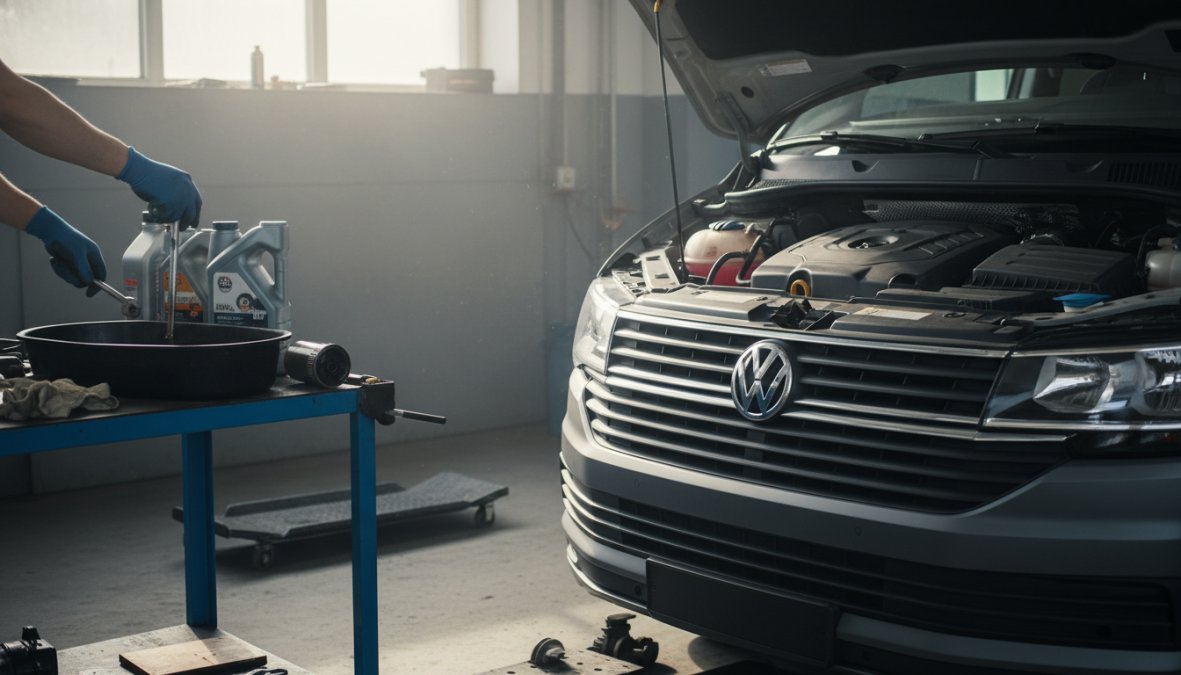
Engine oil selection is where Transporter owners make expensive mistakes most often. The VW Transporter requires oil meeting the VW 507.00 specification for diesel models on Longlife service intervals, and VW 504.00 for fixed service intervals. The widely available Longlife III 5W-30 fully synthetic oil meets these specifications, but using the wrong grade or specification can void warranty coverage and cause long-term engine damage.
The oil change process for a T6 2.0 TDI typically requires around 5.7 litres including the filter. Always replace the oil filter at every oil change without exception. Running a new oil charge through an old, clogged filter defeats the purpose of the service entirely.
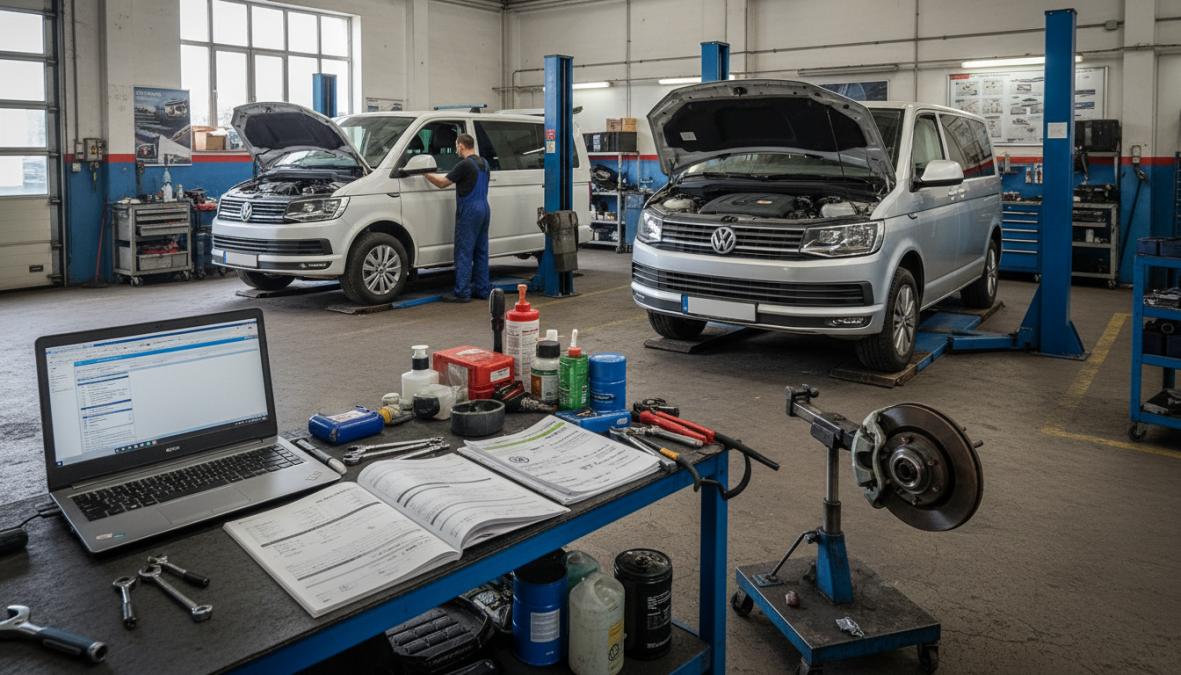
Software tools interface for VW Transporter for VW Transporter servicing and maintenance
Beyond engine oil, a thorough fluid check should cover:
Brake fluid (replace every two years regardless of mileage, as it absorbs moisture over time)
Coolant concentration (should withstand at least -25°C for UK winters)
Power steering fluid (on non-electric steering models)
Screenwash (use a proper concentrated formula, not diluted washing-up liquid, which corrodes seals)
AdBlue (on SCR-equipped diesel variants, typically T6 and T6.1 Euro 6 engines)
Pro TipCheck your AdBlue level every 5,000 miles on Euro 6 models. Running out does not just trigger a warning light; on some T6.1 variants, the engine will not restart once the tank is fully depleted until it's refilled.
Choosing the Right Oil: Longlife III and Beyond
Longlife III 5W-30 is the correct specification for the vast majority of T5, T6, and T6.1 diesel models on extended service intervals. For petrol Transporters, VW 504.00 specification oil applies. The key point: never substitute a cheaper oil that doesn't carry the correct VW approval number, even if the viscosity grade matches. The additive package is what matters for DPF-equipped engines.
Cambelt, Water Pump, and DSG Transmission Servicing
The cambelt replacement is the highest-stakes maintenance item on cambelt-equipped Transporters, specifically T5 models with 2.5 TDI engines and some earlier 2.0 TDI variants. Cambelt failure is not a roadside inconvenience; it typically causes catastrophic engine damage, with repair costs that can exceed the value of an older van.
The standard recommendation for cambelt-equipped T5 engines is replacement every 5 years or 60,000 to 80,000 miles, whichever comes first. Always replace the water pump at the same time. The labour cost to access the cambelt covers the water pump simultaneously, so replacing them together costs far less than returning for a water pump failure a year later.
For T6 and T6.1 owners with chain-driven engines, the cambelt concern disappears, but DSG transmission servicing takes its place. The 7-speed DSG (DQ200) fitted to many T6 variants requires an oil and filter change every 40,000 miles. Neglecting this leads to jerky gear changes, clutch pack wear, and ultimately expensive mechatronic unit failures. DSG servicing is not a dealer-only job, but it does require specific tooling and the correct DSG fluid specification.
VW Transporter Brake Disc and Pad Replacement: What to Expect
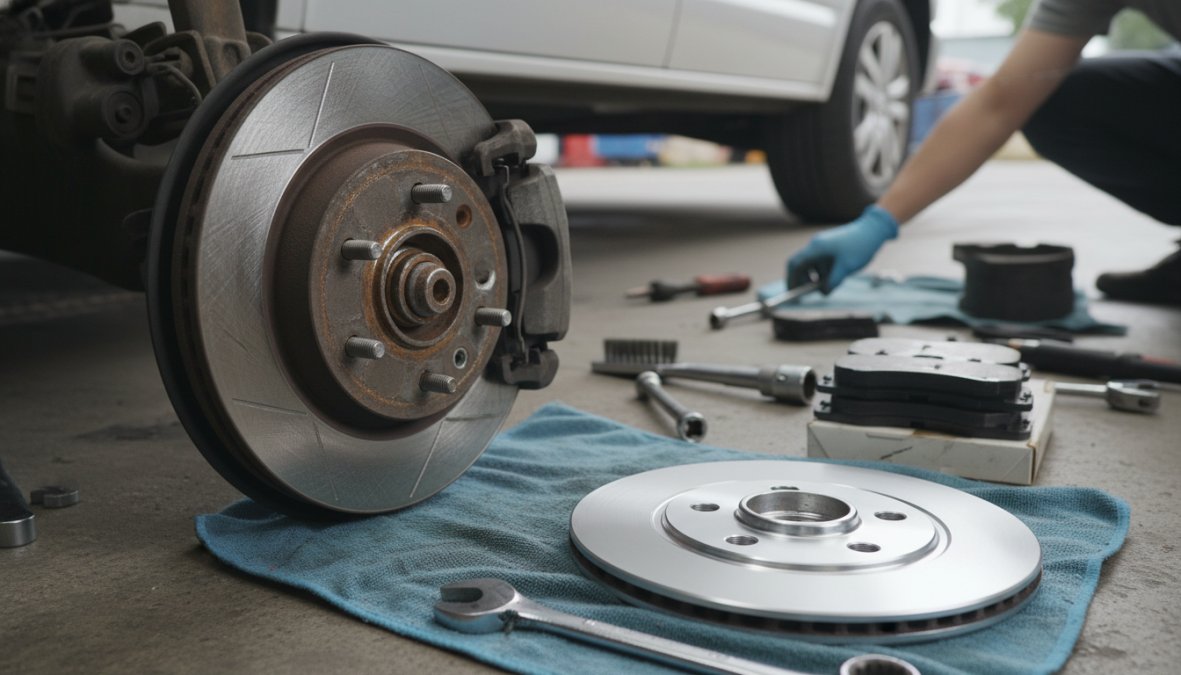
VW Transporter brake disc and pad replacement is one of the most frequent repair jobs on working vans, and the stakes are higher than on a passenger car. A fully loaded T6 at its 3,200 kg gross vehicle weight generates significantly more braking force than the same platform in Caravelle trim, and brake wear accelerates in direct proportion to payload and stop-start urban use. Getting the specification wrong, wrong disc diameter, wrong pad compound, wrong minimum thickness, is not just a waste of money; on a commercial vehicle it is a safety issue.
T5 vs T6 vs T6.1: Brake Specifications Are Not Interchangeable
This is the detail most generic guides omit entirely. Brake disc dimensions vary across Transporter generations and axle configurations, and fitting the wrong size is a surprisingly common error when owners source parts independently.
Front brake discs:
T5 (2003-2009, standard payload): 288 mm diameter, 25 mm new thickness, 23 mm minimum wear thickness
T5 (2009-2015, higher payload and some 4MOTION variants): 314 mm diameter, 30 mm new thickness, 28 mm minimum
T6 and T6.1 (2015-present, standard): 314 mm diameter, 30 mm new thickness, 28 mm minimum
T6 and T6.1 (heavier payload and 4MOTION variants): 330 mm diameter, confirm against your VIN before ordering
Rear brake discs:
Most T5 and T6 models: 272 mm diameter, 12 mm new thickness, 10 mm minimum
T6.1 with larger rear axle: 310 mm, again, verify against your specific vehicle
Watch OutAlways confirm disc diameter against your vehicle's VIN or the sticker inside the driver's door jamb before ordering parts. Transporter variants built for different payload ratings were sold alongside each other in the same model year, and the external appearance of the hub gives no reliable indication of which disc size is fitted.
Minimum thickness figures are not suggestions. A disc worn below its minimum has reduced thermal mass, which means it reaches dangerous temperatures faster under repeated heavy braking. On a van used for deliveries or towing, this is a real-world risk, not a theoretical one.
Signs That Brake Disc and Pad Replacement Is Due
Squealing under light braking (pad wear indicator making contact with the disc)
Grinding or metal-on-metal noise (pad material fully worn; disc damage likely already occurring)
Pulsing or vibration through the brake pedal under moderate pressure (disc warped or unevenly worn, often caused by uneven torquing of wheel bolts)
Increased stopping distances, particularly noticeable when loaded
Visible scoring or grooves on the disc face deeper than approximately 1.5 mm
Brake warning light illumination (electronic wear sensor triggered on T6 and T6.1 models)
Pulling to one side under braking (seized caliper slider or uneven pad wear)
The front brakes on a T6 Transporter in urban delivery use typically need attention every 30,000 to 50,000 miles, though this varies enormously with load and driving style. Rear brakes generally last considerably longer because the front axle carries the majority of braking force.
Caliper Sliders and Caliper Seizure: The Hidden Cost
One failure mode that rarely appears in generic brake guides is caliper slider seizure, which is disproportionately common on Transporters used in urban environments. The slider pins that allow the caliper to float and apply even pressure to both pad faces corrode and seize, causing one pad to wear significantly faster than the other. The result is uneven disc wear, premature pad replacement, and eventually caliper replacement, a substantially more expensive job.
At every brake service, the caliper sliders should be cleaned, inspected for corrosion or damage, and lubricated with a high-temperature copper-free brake grease. This takes approximately 20 minutes and can prevent a caliper replacement that costs several times more.
Watch OutFitting cheap, non-genuine brake pads on a commercial vehicle is a false economy. Budget pads often produce excessive brake dust that contaminates wheel bearings and caliper sliders, accelerating the seizure problem described above. Use pads that meet or exceed the original equipment specification, look for ECE R90 certification as a minimum standard for replacement pads in the UK.
Professional illustration showing Close for VW Transporter servicing and maintenance
Brake Fluid: The Two-Year Rule and Why It Matters
Brake fluid is hygroscopic, it absorbs moisture from the atmosphere through the reservoir cap and brake hose walls over time. As moisture content rises, the fluid's boiling point drops. Fresh DOT 4 brake fluid has a dry boiling point above 230°C; fluid with 3-4% water content can boil at under 160°C. On a loaded Transporter descending a hill or making repeated emergency stops, fluid that boils creates vapour bubbles in the hydraulic circuit, causing the pedal to go soft or fail entirely.
VW specifies brake fluid replacement every two years on Transporter models, regardless of mileage or appearance. Brake fluid does not look contaminated when it is, colour change is not a reliable indicator of moisture content. A refractometer or brake fluid test strips give a more accurate reading and cost very little.
The correct specification for T5, T6, and T6.1 Transporters is DOT 4, and VW recommends their own Super DOT 4 fluid, which has a higher wet boiling point than standard DOT 4. Do not use DOT 5 (silicone-based) fluid in any Transporter, it is incompatible with the seals in VW's hydraulic systems.
Key TakeawayBrake maintenance on a Transporter is not the place to cut costs or defer work. The combination of commercial payloads, frequent urban stops, and the caliper slider seizure risk means brake system neglect compounds faster than on a passenger car. A thorough brake inspection at every service, with disc thickness measured against model-specific minimums, is the single most important safety check on the vehicle.
VW Transporter Clutch Replacement Cost UK: Prices and Warning Signs
The VW Transporter clutch replacement cost UK is a topic that generates a lot of anxiety, and understandably so. Clutch replacement on a Transporter is a substantial job because the gearbox must be removed to access the clutch assembly.
For a manual T5 or T6 Transporter, clutch replacement typically involves the friction plate, pressure plate, release bearing, and often the dual-mass flywheel (DMF). The DMF is a known wear item on TDI-engined Transporters and should be inspected whenever the clutch is accessed. Replacing the clutch without replacing a worn flywheel is a common mistake that leads to a repeat job within a short mileage.
The slave cylinder is another component worth inspecting at the same time. On hydraulic clutch systems, a failing slave cylinder causes incomplete clutch disengagement and difficult gear selection.
Warning signs that clutch replacement is approaching:
Slipping under load, especially on hills or when pulling away in higher gears
Difficulty selecting gears, particularly first and reverse
Juddering on take-off
High clutch bite point, often accompanied by a spongy feel
Rattling at idle that disappears when the clutch pedal is pressed (DMF symptom)
Clutch replacement costs in the UK vary based on parts quality and location. At an independent specialist in Kettering, the total cost including parts and labour is generally more competitive than main dealer pricing. Using genuine or OEM-equivalent parts matters here; budget clutch kits on a heavy-use commercial vehicle often fail prematurely.
For guidance on realistic repair estimates, the RAC's vehicle repair cost guide provides useful benchmarks for clutch and drivetrain work across common van models.
VW Transporter Servicing and Maintenance: DIY vs Professional Care
The DIY-versus-professional debate for VW Transporter servicing and maintenance is more nuanced than most online forums suggest, and the stakes are higher than they appear. The two questions that generate the most confusion, and the most expensive mistakes, are not about which tasks are technically difficult. They are about what DIY work actually does to your warranty, and how to document your service history so that a future buyer, insurer, or dealer cannot challenge it.
What You Can Reasonably Do Yourself
Some tasks are genuinely straightforward for a mechanically competent owner and carry no meaningful risk if done correctly:
Screenwash top-up and concentration check
Tyre pressure checks and inflation (check cold, before driving)
Exterior bulb replacement on T5 models without CANBUS lighting systems, T6 and T6.1 models use CANBUS-controlled lighting where incorrect bulb types trigger fault codes
Air filter replacement (accessible without specialist tools on most T5 and T6 variants)
Pollen filter replacement (typically located behind the glovebox; a 20-minute job with basic tools)
AdBlue top-up on Euro 6 models
Battery terminal cleaning and visual inspection
Tasks Where Professional Servicing Is Strongly Recommended
Oil and filter change: Requires the correct torque setting on the sump plug (typically 30 Nm on T6 2.0 TDI engines, overtightening strips the thread on the aluminium sump), the correct oil specification (VW 507.00 for Longlife intervals), and a diagnostic reset of the service interval indicator. Without the reset, the instrument cluster continues counting down from the old interval, which can cause you to miss the next service.
Brake system work: Safety-critical; incorrect pad bedding procedure or caliper slider reassembly causes uneven wear and potential brake fade.
DSG oil and filter change: Requires a specific fill procedure using the correct fluid level at operating temperature, and specialist tooling to access the filter on the DQ200 unit.
Cambelt replacement: Zero margin for error; incorrect timing by even one tooth causes engine damage on interference engines.
DPF-related work: Forced regeneration and DPF pressure sensor diagnostics require VCDS or equivalent VW-compatible diagnostic software.
Service interval reset: Requires OBD-II diagnostic access; the Transporter's instrument cluster does not offer a manual reset procedure on T6 and T6.1 models.
Warranty Implications of DIY Servicing: What UK Law Actually Says
This is the question most Transporter owners get wrong, and the consequences of misunderstanding it can be significant.
A widespread belief is that servicing your Transporter outside a VW franchised dealer automatically voids the manufacturer's warranty. This is not correct under UK law. The Motor Vehicle Block Exemption Regulation (MVBER), which governs the relationship between manufacturers and independent repairers in the UK, prohibits manufacturers from making warranty coverage conditional on servicing being carried out exclusively at their own dealer network, provided the service is performed to the correct specification using appropriate-quality parts.
In practical terms, this means:
An independent garage can service your in-warranty Transporter without voiding the warranty, as long as they use the correct oil specification (VW 507.00 or 504.00 as applicable), the correct parts quality, and document the work properly.
DIY servicing by the owner is more complex. VW's warranty terms typically require that service work is carried out by a 'competent person' using appropriate equipment. An owner performing their own oil change is not automatically excluded, but the documentation burden falls entirely on them, and a warranty claim related to engine damage will be scrutinised closely if the service history is incomplete or the wrong oil specification was used.
What genuinely does risk warranty coverage: Using an oil specification that does not meet VW 507.00 or 504.00 (even if the viscosity grade matches), failing to reset the service interval indicator, and being unable to produce documentation of the service if a warranty claim is later made.
Watch OutIf your Transporter is within its manufacturer warranty period and you are performing any service work yourself, keep every receipt, for oil, filter, and any other parts used. Photograph the oil container showing the VW approval number. Record the date, mileage, and work performed in writing. Without this documentation, a warranty claim related to engine or transmission issues may be declined on the grounds that the service history cannot be verified.
Digital Service Records: How to Maintain a Verifiable Maintenance History
This is a practical area that almost no Transporter maintenance guide addresses, despite being a genuine pain point for owners, particularly those who buy used vans with incomplete paper service histories, or fleet operators managing multiple vehicles.
VW's own Digital Service History (DSH) system, accessible through the MyVW owner portal and recorded by franchised dealers at each service, creates a manufacturer-held electronic record of every dealer service visit. If your Transporter has been serviced exclusively at VW dealers, this record exists and can be accessed by any VW dealer to verify history. When buying a used Transporter, asking the seller to log into MyVW and show the DSH record is a more reliable check than inspecting a paper service book, which can be forged.
For owners using independent garages or performing some work themselves, the DSH will not be updated, but this does not mean you cannot maintain an equivalent verifiable record. The practical approach:
Use a dedicated vehicle logbook app (several are available for iOS and Android) that timestamps entries, records mileage, and allows you to attach photographs of receipts and parts packaging. The timestamp and GPS metadata on photographs provides a basic audit trail.
Photograph the oil container's approval label at every oil change, showing the VW 507.00 or 504.00 approval number alongside the vehicle's odometer reading in the same frame.
Ask your independent garage for a printed or emailed service invoice that specifies the oil grade and approval number used, the filter part number, and the mileage at service. A professional garage should provide this as standard; if they cannot, that is itself a warning sign.
Keep the physical service book stamped where possible. Many independent garages will stamp a service book; ask before booking if this matters to you.
For fleet operators: Cloud-based fleet management platforms allow centralised service record management across multiple vehicles, with automated service interval alerts based on mileage or time thresholds. This is significantly more reliable than paper-based systems when managing more than three or four vans.
A complete, well-documented independent service history is accepted by VW dealers for warranty purposes, by insurers for agreed-value policies, and by buyers who know what to look for. The documentation is what matters, not where the stamp came from.
Key TakeawayThe DIY-versus-professional question is really a documentation question. The work itself is secondary to being able to prove, months or years later, that the correct oil specification was used, the correct interval was observed, and the service was performed by someone competent to do it. Build the paper trail from the first service and maintain it consistently, it protects your warranty, your resale value, and your ability to make a warranty claim if something goes wrong.
Conclusion: Keep Your Transporter Running at Its Best
Staying on top of VW Transporter servicing and maintenance requires knowing your specific model, engine code, and driving pattern. Generic service advice misses the details that determine whether your van stays reliable for 200,000 miles or becomes a recurring repair bill.
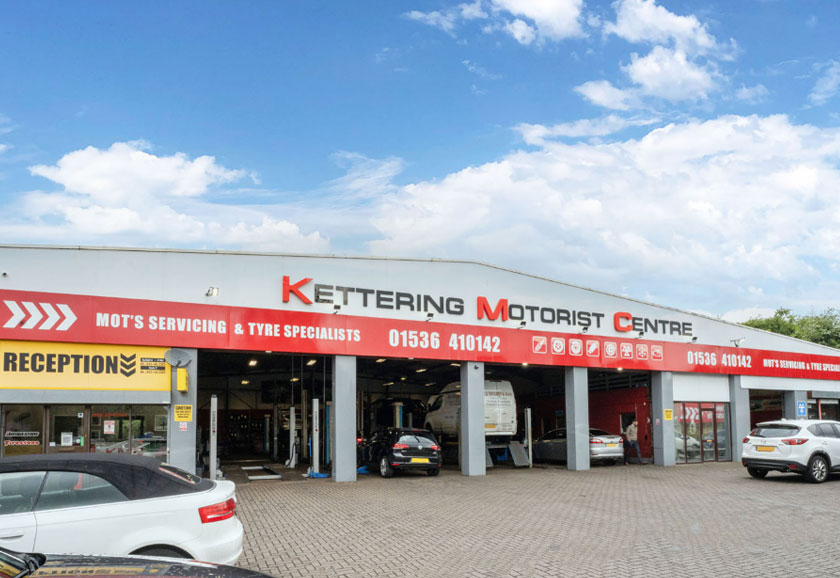
Kettering Motorist Centre provides professional servicing, brake and clutch work, and diagnostic services for Transporter owners across Kettering and the wider Northamptonshire area. The team offers expert diagnostic and repair services with transparent pricing and a hassle-free online booking system that requires no upfront payment.
Book your service or MOT with Kettering Motorist Centre and keep your Transporter in the condition it deserves.
Frequently Asked Questions
How often should a VW Transporter be serviced?
A VW Transporter should generally be serviced every 12 months or every 10,000 miles, whichever comes first — though this can vary depending on your engine code and driving style. T6 and T6.1 models with a Longlife service plan may extend intervals to around 20,000 miles, but more frequent servicing is advisable for high-mileage or heavy commercial use. Always check your vehicle's specific service schedule and reset the service indicator after each visit.
What is included in a VW Transporter major service?
A major VW Transporter service typically includes an engine oil and filter change, air filter and pollen filter replacement, fuel filter replacement, brake fluid change, spark plug replacement (petrol engines), a thorough visual under-van inspection, and a full brake system check. DSG oil and filter changes and air conditioning servicing may also be included or recommended. Major services are usually carried out every two years or at set mileage intervals depending on the model.
How much does it cost to replace a VW Transporter clutch in the UK?
VW Transporter clutch replacement costs in the UK typically range from around £600 to £1,200 or more, depending on the model year, engine type, and whether the dual-mass flywheel and slave cylinder also need replacing. T5 and T6 diesel variants often require flywheel replacement alongside the clutch, which increases the overall cost. Getting a detailed quote from a trusted independent specialist in your area — such as Kettering Motorist Centre — can help you avoid inflated dealer prices.
When should I replace the brake discs and pads on my VW Transporter?
Brake disc and pad replacement on a VW Transporter is generally recommended when pads wear below 3mm or discs show scoring, lipping, or fall below the minimum thickness. For vans used in commercial or heavy-load driving, wear can occur more quickly than on a standard car. Common warning signs include a grinding noise, longer stopping distances, or a vibration through the brake pedal. A visual inspection at every service will help catch wear before it becomes a safety issue or leads to more costly repairs.
Are VW Transporters expensive to maintain?
VW Transporter servicing and maintenance costs can be higher than average cars, particularly for diesel T5 and T6 models that require cambelt and water pump replacement, DSG servicing, or clutch work. However, sticking to a regular service schedule using genuine parts and Longlife III-specification oil helps prevent costly breakdowns. Choosing a reputable independent garage over a main dealer can offer significant savings without compromising on quality, especially for routine maintenance and brake or clutch work.
Your booking Failed
Please try again or please call 01536 410142
Thank you for placing a booking with Kettering Motorist Centre Limited for vehicle
PLEASE TAKE YOUR BOOKING REFERENCE NUMBER WITH YOU TO THE MOT CENTRE
Your items
MOT Test
×
Terms and Conditions
These terms and conditions form the basis on which you can visit and use this website. Please read them carefully as they contain important information.
General terms and conditions
This website is owned and operated by Kettering Motorist Centre Ltd (company registration number: 4485858) operating at Trafalgar Road, Kettering, Northamptonshire, NN16 8DB (the "MOT Centre", the "Company", "we" or "us"). If you have any queries about these terms and conditions or if you have any comments or complaints on or about this website, you can contact us at [email protected] or 01536 410142.
The website is to promote and offer for sale the products and services of Kettering Motorist Centre Limited.
1. The contract between us
This website does not take payment for products or services online. The website enables you to view products and services online and to make a booking for later delivery and payment. The vehicle and provision of other products and services promoted by this website and the payment by you of the price of those products and services will take place at the MOT Centre. The booking does not constitute a contract.
The booking process on the site provides details of the booked MOT order. Please take the time to read and check your booking. It is your responsibility to make sure the order is correct and for the correct vehicle.
2. Ownership of rights
All rights, including copyright, in this website are owned by or licensed to the Company. Any use of this website or its contents, including copying or storing it or them in whole or part, other than for your own personal, non commercial use, is prohibited without our permission. You may not modify, distribute or repost anything on this website for any purpose.
3. Accuracy of content
We have taken care in the preparation of the content of this website, in particular to ensure that prices quoted are correct at the time of publishing and that all goods have been fairly described. However, bookings will only be accepted if there are no material errors in the description of the goods or their prices as advertised on this website. Any weights, dimensions and capacities given about the goods are approximate only.
4. Damage to your computer
We try to ensure that this website is free from viruses or defects. However, we cannot guarantee that your use of this website or any websites accessible through it will not cause damage to your computer. It is your responsibility to ensure that the right equipment is available to use the website. Except in the case of negligence on our part, we will not be liable to any person for any loss or damage which may arise to computer equipment as a result of using this website.
5. Availability
All bookings are subject to acceptance and availability. If the MOT date you have requested are is not available, the Centre will contact you by e-mail or phone. You will have the option either to wait until another slot is available or to cancel your booking.
6. Booking errors
You are able to correct errors on your booking up to the point on which you click on “Place Booking” during the booking process.
7. Price
The prices payable for goods that you order are as set out in our website. All prices are inclusive of VAT at the current rates and are correct at the time of entering information, errors and omissions excepted.
Whenever it is not possible to accept your booking to buy goods of the specification and description at the price indicated, the MOT Centre will advise you by email or phone or when you visit the centre.
8. Payment terms
You will be required to pay for the goods or services to the Centre at time of a completed MOT.
9. Delivery charges
N/A
10. Cancellation
The MOT Centre reserves the right to cancel the booking if:
10.1 There is insufficient stock to deliver the goods you have booked.
10.2 One or more of the goods you booked was listed at an incorrect price.
If your booking is cancelled the Centre will notify you by e-mail or phone.
You have the right to cancel your booking at any time up to the point of the MOT. If you do cancel your booking you should inform the centre by phone.
11. Liability
Notwithstanding the foregoing, nothing in these terms and conditions is intended to limit any rights you might have as a consumer under applicable local law or other statutory rights that may not be excluded nor in any way to exclude or limit our liability to you for any death or personal injury resulting from our negligence.
12. Notices
Unless otherwise expressly stated in these terms and conditions, all notices from you to us must be in writing and sent to our contact address given above and all notices from us to you will be displayed on our website from time to time.
13. Changes to legal notices
We reserve the right to change these terms and conditions from time to time and you should look through them as often as possible.
14. Law, jurisdiction and language
This website, any content contained therein and any contract brought into being as a result of usage of this website are governed by and construed in accordance with English law. Parties to any such contract agree to submit to the exclusive jurisdiction of the courts of England and Wales.
15. Invalidity
If any part of these terms and conditions is unenforceable (including any provision in which we exclude our liability to you) the enforceability of any other part of these conditions will not be affected.
16. Privacy
You acknowledge and agree to be bound by the terms of our privacy policy
17. Third party rights
Nothing in this Agreement is intended to, nor shall it confer any rights on a third party.