Why Battery Health Matters for Your Electric Vehicle
The battery is the heart of your electric vehicle. Unlike a petrol engine that might run for 200,000 miles with routine maintenance, your EV's battery degrades with every charge cycle (peer-reviewed research). Understanding how to inspect EV battery health means catching problems early, avoiding unexpected breakdowns, and protecting your investment's value.
At Kettering Motorist Centre, we've seen owners who ignored battery warning signs until facing major replacement costs. Battery health directly affects your vehicle's range, charging speed, and resale value. A battery operating at 70% capacity might give you 150 miles instead of 200 miles per charge, fundamentally changing how you use your car.
The good news: inspecting EV battery health doesn't require dealership visits or expensive equipment. You can perform basic checks yourself, read your vehicle's diagnostic reports, and know exactly when to book professional assessment. This guide walks you through every method, from visual checks to interpreting battery management system data.
Pro TipMost EV owners wait for warning lights before checking battery health. By then, degradation is already significant. Monthly checks take five minutes and catch issues when still preventable.
Understanding EV Battery Degradation Signs
Battery degradation is normal and unavoidable. Lithium-ion batteries lose capacity with every charge-discharge cycle. Most EV batteries retain 80-90% capacity after five years, though some degrade faster (peer-reviewed research). Knowing the warning signs means spotting accelerated degradation before it becomes dangerous.
Reduced range is the first sign. If your vehicle originally delivered 250 miles on a full charge and now delivers 200 miles under identical conditions, you've lost 20% capacity. Track your actual range over weeks, if you're consistently getting 15-20% less than before, that's a degradation signal.
Slower charging speed is another indicator. A battery losing capacity often charges more slowly as the battery management system protects the cells. If your 30-minute rapid charge used to reach 80% and now reaches only 65%, the battery is struggling.
Uneven cell performance shows up as inconsistent power delivery. Your vehicle might feel sluggish on some days and responsive on others, despite similar conditions. This happens when individual cells degrade at different rates.
Temperature sensitivity increases with age. A degraded battery struggles more in cold weather. If your winter range drops 30-40% compared to summer, but used to only drop 15-20%, the battery is aging, particularly common in the UK where winter temperatures regularly dip below 5°C.
Watch OutIf your vehicle suddenly loses 30% or more range within a few weeks, don't wait. Book a professional diagnostic immediately at Kettering Motorist Centre.
Visual and Physical Inspection Checks
Start with what you can see and feel. Visual inspections won't tell you battery capacity, but they reveal physical damage affecting safety and performance. Most EV batteries sit beneath the vehicle floor, protected by metal housing. Damage allows moisture and debris inside, accelerating degradation.
Check the charging port first. Look for corrosion around the connector, cracks in the plastic housing, or loose connections. Corrosion increases charging resistance, generating heat that damages cells. If the port feels loose or the connector doesn't click firmly, you've found a problem. Clean any visible corrosion with a dry cloth. If corrosion returns quickly, moisture is getting inside, that needs professional attention.
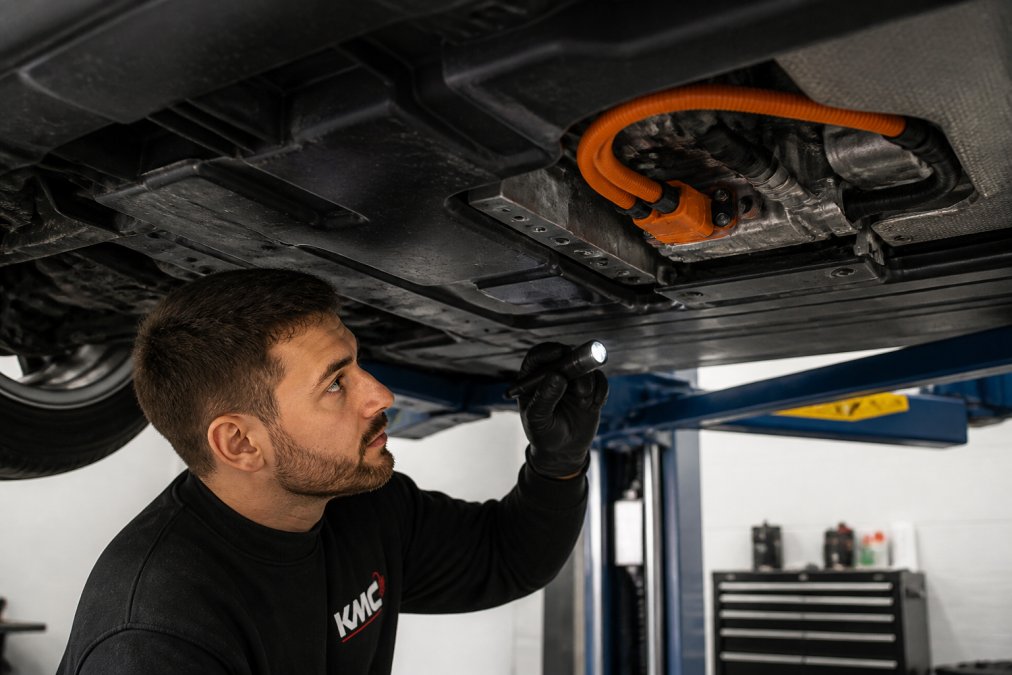
Inspect the battery housing underneath your vehicle. You'll need to safely raise the car or use a pit. Look for dents, cracks, or punctures in the metal casing. Even small damage lets water seep inside. Check for rust or discolouration indicating water exposure. Run your hand along the seams where the battery case closes; if you feel gaps or loose panels, the seal is compromised.
Look at the cooling system vents. Most EV batteries have active or passive cooling systems with visible vents or pipes running beneath the vehicle. Check that these aren't blocked by mud, leaves, or road debris. Blocked cooling reduces the battery's ability to manage heat, forcing the management system to throttle power.
Examine cable connections where the battery meets the motor and charging system. These high-voltage connections should be secure, clean, and free of corrosion. Loose connections cause voltage drops that damage cells.
Check tyre condition and pressure. Uneven tyre wear increases rolling resistance, forcing the battery to work harder. Properly inflated tyres reduce battery strain.
Finally, look inside your vehicle for warning lights on the dashboard. Most EVs have a dedicated battery health indicator. A solid green light means normal operation. An orange or amber light indicates degradation or a fault needing investigation. A red light is urgent, stop driving and get professional diagnostic from Kettering Motorist Centre.
Key TakeawayPhysical damage to the battery housing, charging port, or cooling system accelerates degradation far more than normal use. Catching and repairing these issues early adds years to your battery's lifespan.
Reading Your Electric Vehicle Battery Health Report
Your vehicle stores detailed battery data accessible through the dashboard menu or companion smartphone app. Learning to read this report gives you precise information about your battery's actual state.
Most EV battery health reports show state of charge (SOC), state of health (SOH), and cell voltage balance. State of charge is simply how full your battery is right now. State of health is critical, this percentage shows how much capacity your battery retains compared to when new. A battery at 95% SOH is nearly perfect. At 80% SOH, you're losing noticeable range. Below 70% SOH, you should consider professional assessment.
Cell voltage balance tells you whether all cells in the battery pack perform equally. Healthy batteries have all cells within 0.05V of each other (peer-reviewed research). If some cells are 0.1-0.2V higher or lower, uneven degradation is happening. This imbalance forces the battery management system to work harder.
Temperature data shows how hot your battery runs during charging and driving. Most EV batteries perform best between 20-40°C. If your battery regularly runs above 50°C during normal driving, thermal management is poor. Consistent temperature extremes indicate a cooling system problem.
Charge cycle count shows how many complete charge-discharge cycles your battery has completed. After 1,000 cycles, most batteries are at 85-90% SOH. After 2,000 cycles, they're typically at 75-80% SOH.
Check these figures monthly and record them. Graph the SOH over time. If it's dropping 1-2% per year, that's normal. If it's dropping 5-10% per year, something is wrong.
Pro TipMost EV manufacturers provide free battery health reports through their official app or website. Use official manufacturer data rather than third-party apps that estimate SOH, which are often inaccurate.
Practical Methods to Extend EV Battery Life
Battery degradation is inevitable, but you can slow it dramatically. Most damage happens during charging and at extreme temperatures. Control these two factors and your battery will last significantly longer.
Avoid charging to 100% regularly. Lithium-ion batteries degrade faster at high charge levels. Charging to 80% and stopping there extends battery life by years compared to always charging to 100%. Reserve 100% charges for long journeys when you actually need the range. For daily commuting, charge to 80%.
Similarly, avoid letting your battery drop below 10% charge. Deep discharges stress the cells. If you're not using your vehicle for several weeks, charge it to 50% before storage, the sweet spot where the battery experiences minimal stress.
Manage temperature aggressively. In winter, precondition your battery before driving. Most EVs have a climate preconditioning feature that warms the battery while plugged in. In summer, park in shade when possible. A battery running at 60°C degrades twice as fast as one running at 30°C.
Avoid rapid charging when the battery is cold. Rapid chargers pump enormous current into the battery. Cold batteries can't handle this safely. Wait 10-15 minutes after driving in winter before using a rapid charger.
Use moderate acceleration and avoid heavy regenerative braking in cold weather. Both put stress on a cold battery. Gentle driving in winter reduces degradation.
Don't leave your vehicle plugged in at 100% for days. If you charge to 100% for a journey and then don't drive for a week, the battery sits under stress. Unplug it once it reaches 100%, or set your charger to stop at 80%.
Rotate between different charger types. Using only rapid chargers accelerates degradation. Mix rapid chargers with slower home chargers to help cells age more evenly.
Professional EV Diagnostic Services
Sometimes visual checks and dashboard reports aren't enough. If you've noticed significant range loss, uneven charging, or warning lights, professional diagnostics are essential. A proper EV battery diagnostic reveals problems that self-checks miss.
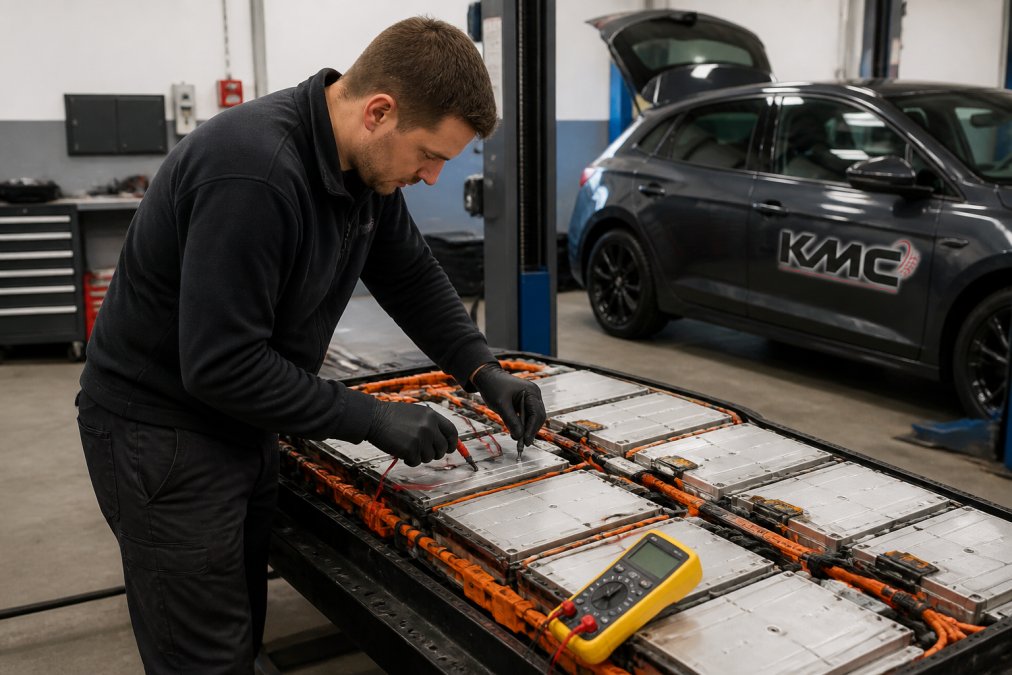
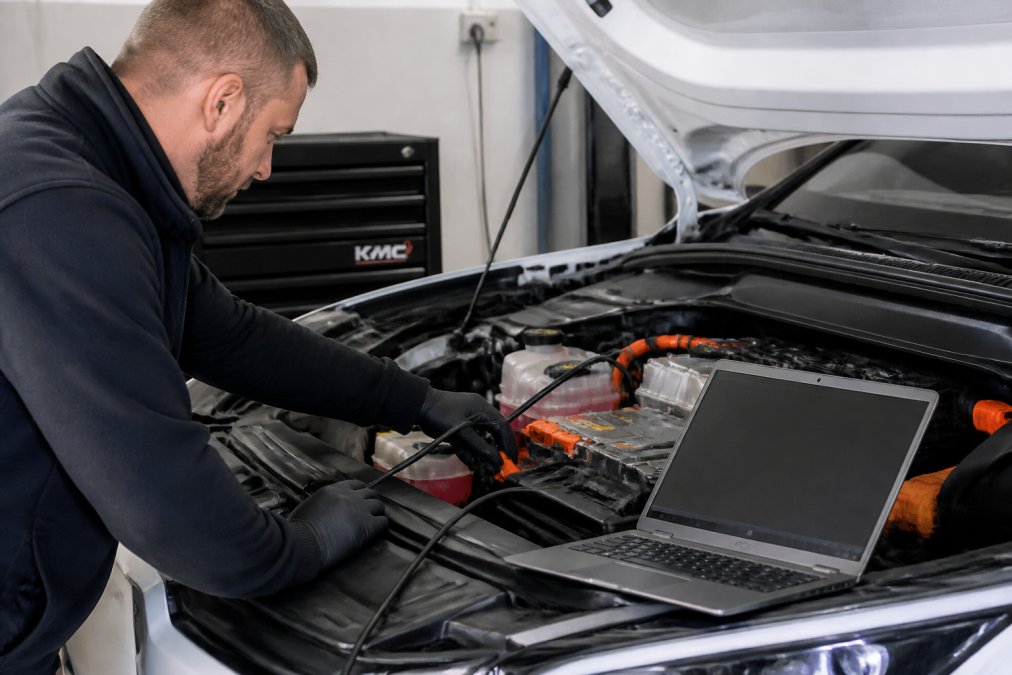
At Kettering Motorist Centre, our EV diagnostic service connects directly to your vehicle's battery management system. This reads every cell's voltage, temperature, and charge history. We can identify which specific cells are failing, whether the cooling system is working, and whether the battery management system itself is faulty.
If you're considering buying a used EV, professional battery diagnostics are invaluable. A pre-purchase diagnostic could save thousands by revealing hidden battery problems before you commit.
Key TakeawayProfessional diagnostics cost significantly less than battery replacement and give you certainty about your battery's condition. If you're facing major range loss or warning lights, a diagnostic is worth doing before making replacement decisions.
When to Book a Professional Battery Assessment
Certain situations demand expert evaluation. If you've noticed any of these signs, contact Kettering Motorist Centre to arrange a diagnostic.
Range loss exceeding 20% in a single year warrants investigation. This is faster degradation than normal and usually indicates a specific problem. A diagnostic will identify whether it's the battery itself, the charging system, or the battery management system.
Charging taking noticeably longer than before, especially at rapid chargers, suggests a developing fault. The battery might be protecting itself because a cell is failing, or the charging system might be degrading.
Warning lights related to the battery should never be ignored. A professional can triage these immediately.
If your vehicle is approaching the manufacturer's battery warranty limit (typically 8 years or 100,000 miles), get a diagnostic to understand your battery's actual condition. This helps you plan for potential replacement and claim warranty coverage if faults exist.
Uneven performance, sluggish acceleration, inconsistent range, or temperature sensitivity that's getting worse often indicates internal battery problems. These don't always show up on dashboard reports but will show up in a professional diagnostic.
If you're planning to sell your EV, a battery health report adds enormous value. Buyers want proof of battery condition. A professional diagnostic gives you that proof.
You should also book assessment if you've experienced physical damage to your vehicle. A collision, deep water crossing, or impact to the battery area might have damaged cells internally without visible external damage.
Kettering Motorist Centre offers hassle-free online booking for EV diagnostics. You can check availability and book your appointment without upfront payment. Our team will walk you through the process and explain exactly what the diagnostic involves.
Battery health is one of the most important factors in EV ownership, yet many drivers never check it until problems become expensive. Regular inspections, understanding your battery's diagnostic data, and knowing when to seek professional help puts you in control. Whether you're managing a healthy battery or investigating suspected problems, Kettering Motorist Centre has the expertise and diagnostic equipment to give you clear answers. Book your EV battery assessment today and drive with confidence knowing your battery's true condition.
Frequently Asked Questions
How can I check the state of health (SoH) of my EV battery?
You can check your EV battery's state of health through your vehicle's onboard display system, which often shows percentage degradation. Many modern electric vehicles provide battery health data via their companion smartphone app. For a detailed assessment, professional EV diagnostic services use specialist equipment to measure actual capacity loss and predict remaining lifespan. Kettering Motorist Centre offers comprehensive battery diagnostics for owners seeking accurate health reports.
What are the main signs of a degrading electric vehicle battery?
Common EV battery degradation signs include reduced driving range (noticeably shorter distance per full charge), slower charging speeds, the battery management system warning light appearing on your dashboard, and reduced performance during acceleration. Cold weather may temporarily reduce range, but persistent degradation shows across all conditions. If you notice your vehicle won't reach its original advertised range, this is a key indicator to have your battery professionally assessed.
Does a standard MOT test include an electric vehicle battery health check?
A standard MOT does not include a detailed battery health check. The MOT tests vehicle safety systems, emissions (not applicable to pure EVs), and roadworthiness, but battery capacity and state of health require specialist diagnostic equipment. For comprehensive battery assessment beyond MOT requirements, you'll need a dedicated EV diagnostic service. Kettering Motorist Centre can arrange specialist battery diagnostics alongside your MOT.
How often should I have my EV battery professionally inspected?
Most manufacturers recommend a professional EV battery health check every 2-3 years, or sooner if you notice degradation signs. If you're planning to sell your vehicle, a recent battery health report is essential for resale value and buyer confidence. Annual checks are worthwhile if your vehicle is older or shows early warning signs. Contact your local service provider to discuss an inspection schedule suited to your driving habits and vehicle age.
Thank you for placing a booking with Kettering Motorist Centre Limited for vehicle
PLEASE TAKE YOUR BOOKING REFERENCE NUMBER WITH YOU TO THE MOT CENTRE
Your items
MOT Test
×
Terms and Conditions
These terms and conditions form the basis on which you can visit and use this website. Please read them carefully as they contain important information.
General terms and conditions
This website is owned and operated by Kettering Motorist Centre Ltd (company registration number: 4485858) operating at Trafalgar Road, Kettering, Northamptonshire, NN16 8DB (the "MOT Centre", the "Company", "we" or "us"). If you have any queries about these terms and conditions or if you have any comments or complaints on or about this website, you can contact us at [email protected] or 01536 410142.
The website is to promote and offer for sale the products and services of Kettering Motorist Centre Limited.
1. The contract between us
This website does not take payment for products or services online. The website enables you to view products and services online and to make a booking for later delivery and payment. The vehicle and provision of other products and services promoted by this website and the payment by you of the price of those products and services will take place at the MOT Centre. The booking does not constitute a contract.
The booking process on the site provides details of the booked MOT order. Please take the time to read and check your booking. It is your responsibility to make sure the order is correct and for the correct vehicle.
2. Ownership of rights
All rights, including copyright, in this website are owned by or licensed to the Company. Any use of this website or its contents, including copying or storing it or them in whole or part, other than for your own personal, non commercial use, is prohibited without our permission. You may not modify, distribute or repost anything on this website for any purpose.
3. Accuracy of content
We have taken care in the preparation of the content of this website, in particular to ensure that prices quoted are correct at the time of publishing and that all goods have been fairly described. However, bookings will only be accepted if there are no material errors in the description of the goods or their prices as advertised on this website. Any weights, dimensions and capacities given about the goods are approximate only.
4. Damage to your computer
We try to ensure that this website is free from viruses or defects. However, we cannot guarantee that your use of this website or any websites accessible through it will not cause damage to your computer. It is your responsibility to ensure that the right equipment is available to use the website. Except in the case of negligence on our part, we will not be liable to any person for any loss or damage which may arise to computer equipment as a result of using this website.
5. Availability
All bookings are subject to acceptance and availability. If the MOT date you have requested are is not available, the Centre will contact you by e-mail or phone. You will have the option either to wait until another slot is available or to cancel your booking.
6. Booking errors
You are able to correct errors on your booking up to the point on which you click on “Place Booking” during the booking process.
7. Price
The prices payable for goods that you order are as set out in our website. All prices are inclusive of VAT at the current rates and are correct at the time of entering information, errors and omissions excepted.
Whenever it is not possible to accept your booking to buy goods of the specification and description at the price indicated, the MOT Centre will advise you by email or phone or when you visit the centre.
8. Payment terms
You will be required to pay for the goods or services to the Centre at time of a completed MOT.
9. Delivery charges
N/A
10. Cancellation
The MOT Centre reserves the right to cancel the booking if:
10.1 There is insufficient stock to deliver the goods you have booked.
10.2 One or more of the goods you booked was listed at an incorrect price.
If your booking is cancelled the Centre will notify you by e-mail or phone.
You have the right to cancel your booking at any time up to the point of the MOT. If you do cancel your booking you should inform the centre by phone.
11. Liability
Notwithstanding the foregoing, nothing in these terms and conditions is intended to limit any rights you might have as a consumer under applicable local law or other statutory rights that may not be excluded nor in any way to exclude or limit our liability to you for any death or personal injury resulting from our negligence.
12. Notices
Unless otherwise expressly stated in these terms and conditions, all notices from you to us must be in writing and sent to our contact address given above and all notices from us to you will be displayed on our website from time to time.
13. Changes to legal notices
We reserve the right to change these terms and conditions from time to time and you should look through them as often as possible.
14. Law, jurisdiction and language
This website, any content contained therein and any contract brought into being as a result of usage of this website are governed by and construed in accordance with English law. Parties to any such contract agree to submit to the exclusive jurisdiction of the courts of England and Wales.
15. Invalidity
If any part of these terms and conditions is unenforceable (including any provision in which we exclude our liability to you) the enforceability of any other part of these conditions will not be affected.
16. Privacy
You acknowledge and agree to be bound by the terms of our privacy policy
17. Third party rights
Nothing in this Agreement is intended to, nor shall it confer any rights on a third party.