Understanding what does a car diagnostic report show is one of the most practical things a driver can know before walking into a garage. At Kettering Motorist Centre, we see drivers arrive confused about what a diagnostic actually found, which often leads to unnecessary repairs or missed faults. A diagnostic report is a structured output from your vehicle's onboard computer, listing fault codes, sensor readings, and system health data across multiple vehicle systems. Below, we'll show you exactly how to read that data, what each section means, and when a professional scan beats a home OBD-II reader.
Most people assume a diagnostic test simply tells a mechanic "what's wrong." The reality is more layered. A car diagnostic report is a structured output generated by reading your vehicle's Engine Control Unit (ECU) and related electronic control modules, translating real-time sensor data and stored fault codes into actionable repair information. Knowing how to interpret that output separates a driver who gets the right fix from one who pays for guesswork.
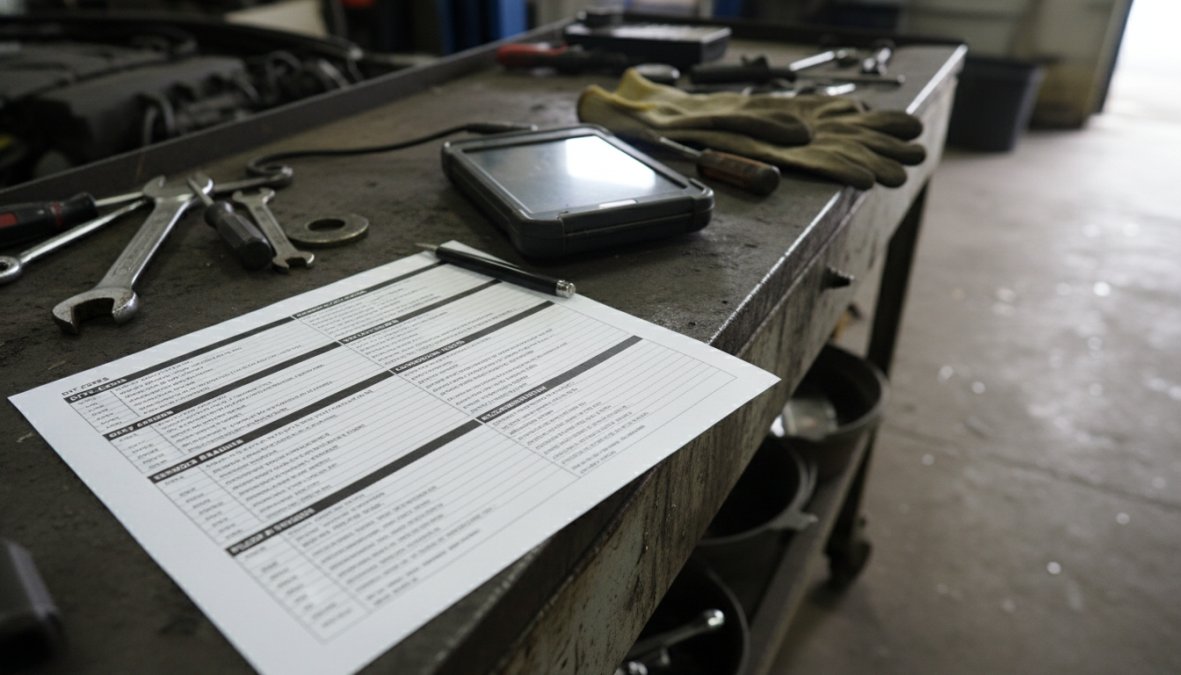
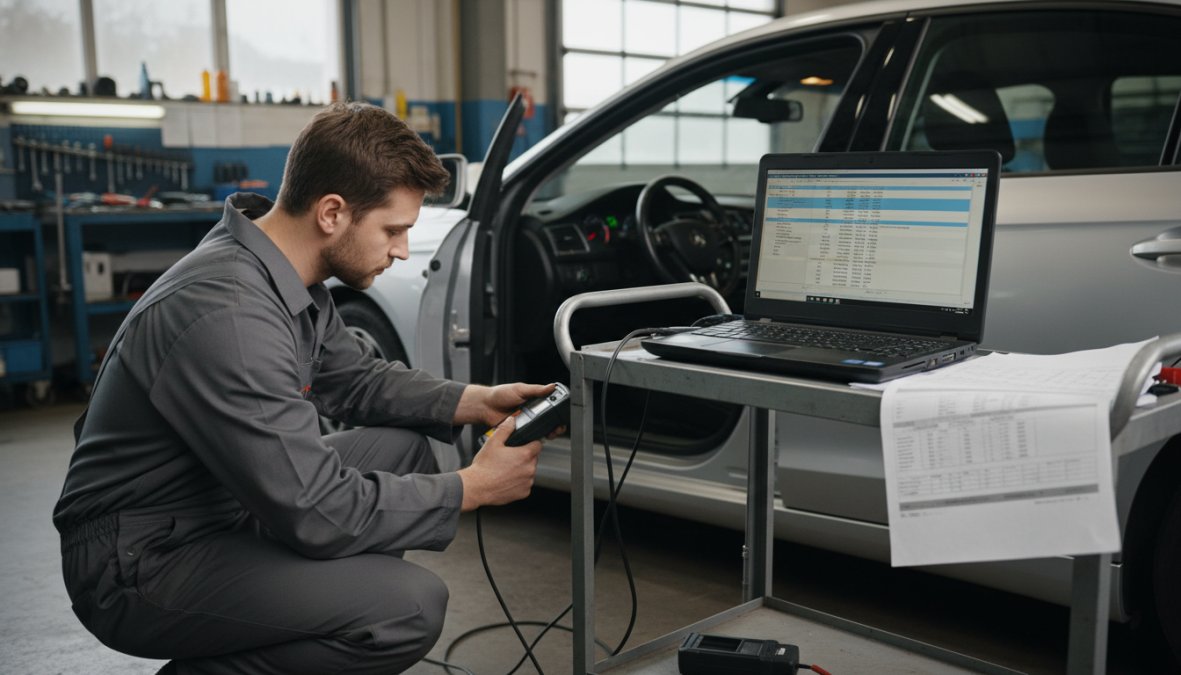
Professional illustration showing OBD for what does a car diagnostic report show
What Does a Car Diagnostic Report Show?
A car diagnostic report shows stored and pending Diagnostic Trouble Codes (DTCs), live sensor readings, freeze-frame data captured at the moment a fault occurred, and system-level health summaries across engine, transmission, emissions, safety, and charging systems. The report does not tell a mechanic what to replace outright; it identifies which system triggered a fault and under what conditions.
Diagnostic Trouble Codes (DTCs) Explained
Diagnostic Trouble Codes are alphanumeric identifiers generated by the ECU when a sensor or system reading falls outside its acceptable range. Each code follows a standardised format: a letter indicating the system (P for powertrain, B for body, C for chassis, U for network), followed by four digits that narrow down the specific fault.
For example, a P0300 code indicates random or multiple misfires in the engine. A P0420 points to catalyst system efficiency below the threshold, typically implicating the catalytic converter or oxygen sensors upstream of it.
DTCs are split into three categories:
Stored codes: Active faults the ECU has confirmed and logged
Pending codes: Faults detected once but not yet confirmed across multiple drive cycles
Permanent codes: Faults that cannot be cleared by a scan tool alone and require the underlying issue to be resolved first
Watch OutA cleared DTC does not mean a fixed fault. Many drivers clear codes with a cheap reader and assume the problem is gone. If the underlying issue persists, the code returns, sometimes after a failed MOT emissions check.
Real-Time Sensor Data and Live Readings
Beyond stored codes, a diagnostic report captures live data streams from sensors across the vehicle. This includes readings from oxygen sensors monitoring exhaust gas composition, mass airflow sensors tracking air entering the engine, coolant temperature sensors, throttle position, and fuel injector timing.
Freeze-frame data is particularly useful. When the ECU logs a fault, it simultaneously captures a snapshot of every sensor reading at that precise moment. A mechanic can see the engine speed, load, fuel trim, and coolant temperature at the instant the fault triggered, which narrows diagnosis considerably compared to a visual inspection alone.
What Components Are Checked During a Diagnostic Test?
A professional diagnostic test covers every system with an electronic control module, which on a modern vehicle means most of the car. The scan tool communicates with each module in sequence, requesting stored faults and live data.
Engine, Transmission, and Ignition System
The engine management system receives the most attention in any diagnostic report. The ECU monitors fuel delivery through the fuel injectors, combustion quality via knock sensors, ignition timing across the ignition system, and exhaust composition through oxygen sensors both before and after the catalytic converter.
The transmission control module logs its own fault codes separately. Transmission problems such as slipping gears, delayed engagement, or torque converter faults generate specific DTCs that appear in the transmission section of the report, not the engine section. This is a common source of confusion when drivers read only the powertrain summary.
Ignition system faults, including coil pack failures and spark plug degradation, typically show up as misfire codes (P0300-P0308 range), with the specific cylinder identified in the last digit.
ABS, SRS, and Safety-Critical Systems
The ABS (Anti-lock Braking System) and SRS (Supplemental Restraint System, i.e., airbags) modules are scanned separately from the powertrain. Dashboard warning lights for these systems are often the first sign a driver notices, but the light alone gives no information about which sensor or circuit has failed.
A diagnostic scan of the ABS module reveals whether a wheel speed sensor has failed, whether there is a hydraulic pressure fault, or whether the control module itself has an internal error. SRS codes identify which airbag circuit, seatbelt pretensioner, or crash sensor has triggered a fault.
Key TakeawayABS and SRS faults directly affect your vehicle's safety in an emergency. These codes should never be ignored or cleared without addressing the root cause, and they will trigger an MOT failure if active.
Exhaust System, Catalytic Converter, and Emissions
The exhaust system generates some of the most consequential fault codes from an MOT perspective. Oxygen sensor readings on both the upstream (pre-cat) and downstream (post-cat) sides of the catalytic converter allow the ECU to calculate catalyst efficiency. A degraded catalytic converter shows up as a P0420 or P0430 code.
Fuel efficiency is directly linked to these readings. A failing oxygen sensor causes the ECU to miscalculate the air-fuel ratio, increasing fuel consumption and raising exhaust emissions. According to the DVSA MOT testing guide for emissions, emissions readings outside the permitted range result in an immediate MOT failure, making exhaust system diagnostics particularly relevant for Kettering motorists approaching their annual test.
How to Interpret What a Car Diagnostic Report Shows
Most guides stop at listing fault codes. This section goes further: it walks you through what a real diagnostic report entry looks like, what each field means, and how to reason from a code to a likely cause without guessing.
What a Diagnostic Report Entry Actually Contains
A professional diagnostic report is not a single line that says "P0300, misfire detected." Each fault code entry in a properly formatted report contains several distinct fields:
Code identifier: The alphanumeric DTC (e.g., P0171)
Code status: Stored, pending, or permanent
Code description: A plain-language label (e.g., "System Too Lean, Bank 1")
Freeze-frame snapshot: Engine RPM, vehicle speed, coolant temperature, engine load percentage, short-term and long-term fuel trim values, and throttle position, all captured at the exact moment the fault triggered
Readiness monitors: A pass/fail status for each emissions-related system (oxygen sensor, catalyst, evaporative system, EGR), which determines whether the vehicle is ready for an emissions test
Module source: Which control module logged the code (ECM, TCM, ABS module, BCM, etc.)
When you receive a written report from a garage, every one of these fields should be present for each code. If a report hands you only a code number and a description, you are missing the diagnostic context that makes the data useful.
Reading a Real Code Entry: P0171 as an Example
Take a common fault: P0171, System Too Lean, Bank 1. Here is how to reason through it using the full report entry rather than just the code label.
Step 1, Check the freeze-frame fuel trim values. The freeze-frame will show short-term fuel trim (STFT) and long-term fuel trim (LTFT) as percentages. Fuel trim is the ECU's correction factor: a positive value means the ECU is adding fuel to compensate for a lean condition. An LTFT above +10% on Bank 1 confirms the ECU has been consistently compensating, meaning the lean condition is not a one-off event.
Step 2, Check the freeze-frame engine load and RPM. A lean condition that appears only at idle (low RPM, low load) points toward a vacuum leak, unmetered air entering after the mass airflow sensor. A lean condition that appears under load (high RPM, high load percentage) is more consistent with a fuel delivery restriction, a weak fuel pump, clogged injector, or failing fuel pressure regulator.
Step 3, Cross-reference with oxygen sensor live data. If the upstream oxygen sensor is switching rapidly between rich and lean (normal oscillating pattern) but the downstream sensor is also fluctuating, the catalytic converter may be involved. If the upstream sensor is stuck lean (flat low voltage), the sensor itself may be faulty rather than the fuelling system.
Step 4, Check code status. A stored P0171 with a high LTFT and a matching pending P0174 (System Too Lean, Bank 2) on a V6 engine suggests a common-path fault, a large vacuum leak at the intake manifold gasket or a failing mass airflow sensor affecting both banks simultaneously, rather than a single injector or sensor.
This four-step reasoning process is what separates a mechanic using a professional scan tool from a driver who read the code on a £20 Bluetooth reader and ordered a mass airflow sensor based on the code description alone.
Understanding Readiness Monitors in the Report
The readiness monitor section of a diagnostic report is frequently overlooked by drivers but is directly relevant to MOT emissions testing. Readiness monitors are self-tests the ECU runs during normal driving to verify that emissions-related systems are functioning correctly.
There are typically eight to eleven monitors depending on the vehicle, including:
Oxygen sensor monitor, checks sensor response time and switching frequency
Evaporative system monitor, tests the fuel vapour recovery system for leaks
EGR system monitor, verifies exhaust gas recirculation operation
Secondary air system monitor, checks cold-start emissions equipment where fitted
Each monitor shows one of three statuses: Complete/Ready, Incomplete/Not Ready, or Not Applicable (for systems not fitted to that vehicle).
Watch OutIf a diagnostic report shows multiple monitors as "Incomplete," the vehicle will fail an emissions readiness check even if no fault codes are present. This commonly happens after a battery disconnection or after codes have been cleared. The vehicle needs to complete a full drive cycle, including sustained motorway speed, stop-start urban driving, and a cold start, before monitors reset to "Complete."
The Code-to-Cause Reasoning Gap
The most important thing a diagnostic report shows is not the answer, it is the starting point for a structured investigation. A DTC identifies a circuit or system that has reported an out-of-range reading. It does not identify which component within that circuit caused the reading.
A practical way to think about this: a P0420 (Catalyst System Efficiency Below Threshold, Bank 1) is generated when the downstream oxygen sensor's output pattern begins to mirror the upstream sensor's pattern too closely, indicating the catalyst is no longer storing and releasing oxygen efficiently. That reading is consistent with a degraded catalytic converter, but it is equally consistent with a leaking exhaust manifold gasket introducing air upstream of the sensor, an engine misfire that has overheated and damaged the catalyst, or a faulty downstream oxygen sensor reporting incorrect data.
The code tells you the system failed its self-test. The freeze-frame data, live sensor readings, and physical inspection tell you why.
Key TakeawayWhen reviewing your diagnostic report, always ask for the freeze-frame data alongside the code list. A report that shows only code numbers and descriptions is giving you roughly half the available diagnostic information.
OBD2 scanner diagnostic codes are accessible to any driver with a reader that plugs into the OBD-II port, located beneath the dashboard on virtually every car sold in the UK since 2001. Basic Bluetooth OBD-II readers cost between £15 and £50 and pair with smartphone apps to display stored DTCs.
The limitation is significant: entry-level OBD2 scanner diagnostic codes tools read powertrain codes only. They do not access ABS, SRS, transmission, or body control modules. A dashboard warning light for the airbag system will show nothing on a basic reader because the SRS module communicates on a separate protocol.
Mid-range professional scan tools, the kind used at a specialist garage, communicate with all available modules, display live data streams, perform actuator tests (commanding a component to activate to verify it responds), and read manufacturer-specific codes that go beyond the generic OBD-II standard.
Pro TipIf you use a home OBD2 reader and it shows no codes despite an active warning light, the fault is almost certainly in a non-powertrain module. A professional scan tool is the only way to read it accurately.
DIY vs Professional Car Diagnostics: Which Should You Choose?
The honest answer depends on what you need from the scan. DIY vs professional car diagnostics is not a binary choice between saving money and getting quality; it is a question of what information you actually need.
A home OBD2 reader is genuinely useful for:
Identifying why the engine management light is on before booking a garage
Clearing a known fault after a confirmed repair
Monitoring live sensor data on a long journey
A professional diagnostic is necessary when:
Multiple warning lights are active simultaneously
The fault involves ABS, SRS, or transmission systems
An intermittent fault needs freeze-frame data to diagnose
The vehicle is approaching an MOT and emissions readiness needs confirming
A repair has been completed and the system needs to confirm the fix
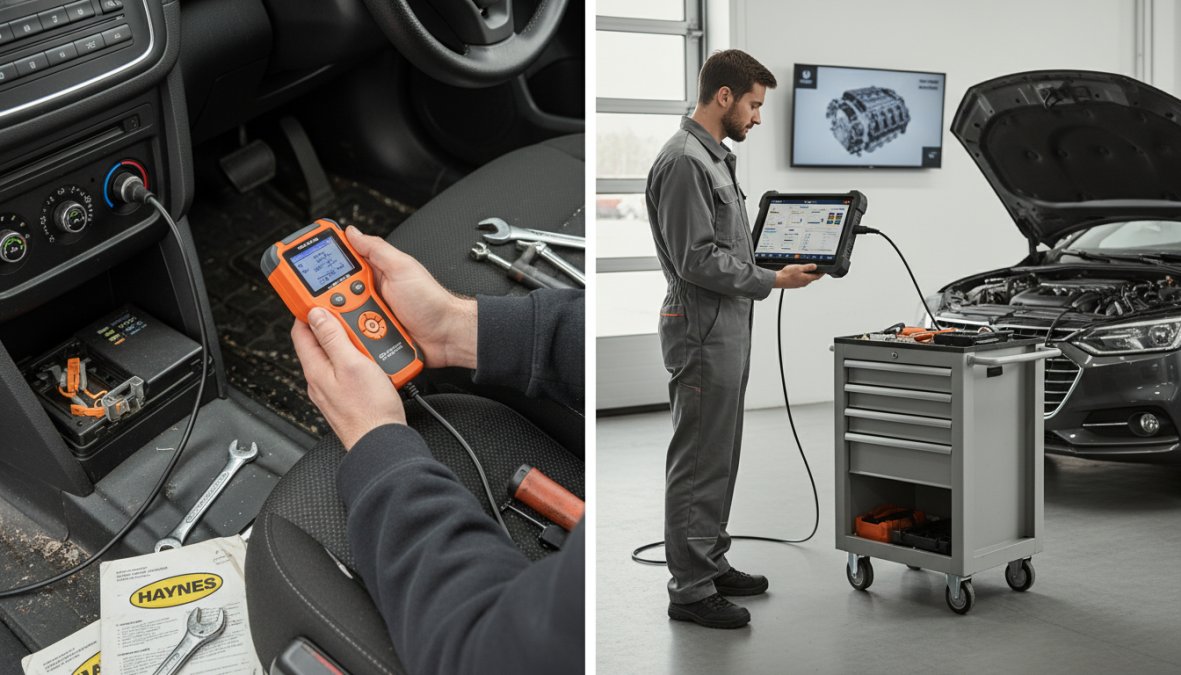
Side-by-side comparison of Side for what does a car diagnostic report show
Feature
Home OBD2 Reader
Professional Scan Tool
Cost
£15-£50
Included in diagnostic fee
Systems accessed
Powertrain only
All modules
Live data streams
Limited
Full
Actuator testing
No
Yes
Manufacturer codes
No
Yes
Freeze-frame data
Basic
Comprehensive
Suitable for MOT prep
Partial
Yes
The real difference between DIY and professional car diagnostics comes down to module access and data depth. A home reader gives you a starting point. A professional scan gives you a complete picture.
Diagnostic Limitations: What a Report Cannot Tell You
Every guide on car diagnostics tells you what a scan can find. Almost none of them explain the structural limitation that causes the most driver frustration and the most unnecessary parts replacements: a diagnostic code is a symptom reported by a sensor, not a confirmed diagnosis of a failed component.
Understanding this distinction will save you money.
Codes Describe Electrical Symptoms, Not Mechanical Failures
The ECU does not directly observe components. It observes voltage signals, resistance values, and frequency patterns from sensors. When a sensor's output falls outside the expected range, the ECU logs a fault code. The code describes what the ECU measured, not what physically caused the abnormal measurement.
This creates a category of misdiagnosis that is common enough to have a name in the trade: parts-cannon diagnosis, replacing the component named in the code description without verifying that the component is actually the source of the fault.
Consider three scenarios that all produce a P0102 (Mass Air Flow Sensor Circuit Low Input):
The MAF sensor itself has failed, the sensor element is contaminated or broken, producing a low voltage signal. Replacing the sensor fixes the fault.
The wiring harness has a damaged wire, a chafed or corroded wire between the MAF sensor and the ECU produces a low voltage signal identical to a failed sensor. Replacing the sensor changes nothing; the code returns within one drive cycle.
The ECU input circuit has failed, the ECU's own internal circuitry for reading the MAF signal has developed a fault. The sensor is fine, the wiring is fine, but the ECU is misreading the signal. Replacing the sensor and the wiring harness both fail to resolve the fault.
All three scenarios produce the same P0102 code. The code tells you the circuit has a problem. It does not tell you where in the circuit the problem is.
Watch OutBefore authorising a parts replacement based on a diagnostic code, ask the garage what test they performed to confirm the component is faulty, not just that the code points to it. A reputable workshop will perform a circuit voltage test, a resistance check, or a component substitution test before condemning a part.
Intermittent Faults and the Limits of Freeze-Frame Data
Freeze-frame data captures sensor readings at the moment a fault triggers. For a fault that occurs consistently, this is highly useful. For an intermittent fault, one that appears under specific conditions and then disappears, freeze-frame data captures one instance of a potentially complex pattern.
A common example is an intermittent misfire on a cold start that clears once the engine reaches operating temperature. The freeze-frame will show the conditions at the moment of the first misfire event, but it cannot show the mechanic whether the fault is caused by a coil pack that breaks down when cold, a fuel injector that sticks briefly at low temperature, or a valve clearance that is tight when cold and expands to within tolerance once warm.
In these cases, the diagnostic report is the beginning of the investigation, not the conclusion. A mechanic will often need to replicate the fault conditions, cold-starting the vehicle, performing a cylinder contribution test under load, or monitoring live data across a full warm-up cycle, before the root cause becomes clear.
What Electronic Diagnostics Cannot See
Beyond the sensor-versus-component limitation, there are categories of vehicle condition that fall entirely outside the scope of any diagnostic scan, regardless of how sophisticated the scan tool is:
Brake pad and disc wear: Most vehicles have no sensor monitoring pad thickness. A brake pad wear sensor, where fitted, is a simple contact wire that triggers a warning only when pads reach a critically low threshold, it does not report gradual wear progression. Disc thickness variation, scoring, and heat cracking are invisible to any scan tool.
Oil condition and contamination: The ECU monitors oil pressure and, on some vehicles, oil level. It does not monitor viscosity breakdown, fuel dilution, coolant contamination, or the presence of metal particles, all of which are signs of internal engine wear that require a physical oil sample or inspection.
Timing chain mechanical wear: A stretched timing chain produces variable valve timing errors and eventually misfire codes, but the mechanical wear itself precedes the codes by a significant margin. By the time fault codes appear, the chain may already be close to failure.
Exhaust system physical condition: A diagnostic scan checks catalyst efficiency and oxygen sensor readings. It does not detect a cracked exhaust manifold, a blowing gasket joint, or a corroded section of the exhaust mid-pipe, all of which affect emissions and can eventually trigger codes, but are not visible to the scan until the damage is advanced.
Suspension and steering wear: Worn ball joints, degraded bushes, and failing wheel bearings produce no fault codes until a wheel speed sensor is affected (in the case of a severely worn bearing). A diagnostic scan will not flag suspension wear that a physical inspection would identify immediately.
Key TakeawayA diagnostic report and a physical vehicle inspection are not the same thing and are not interchangeable. A complete vehicle health check combines both: the scan identifies electrical and system faults the eye cannot see, while the physical inspection identifies mechanical wear the sensors cannot measure. Neither alone gives you the full picture.
When a 'Clean' Diagnostic Report Is Misleading
A diagnostic report with no stored fault codes is not a certificate of vehicle health. It means no electronic system has logged a fault that meets the ECU's threshold for generating a DTC. A vehicle can have worn brake discs, degraded engine mounts, a leaking power steering rack, and a timing chain with measurable slack, and return a completely clean diagnostic scan.
This is particularly relevant for used vehicle purchases. A pre-purchase diagnostic scan is a valuable tool, but a clean scan result should prompt a physical inspection, not replace one. The scan rules out hidden electronic faults and cleared warning lights; it does not rule out mechanical wear.
According to the Society of Motor Manufacturers and Traders guidance on vehicle maintenance, electronic diagnostics and physical inspection are complementary processes. The most accurate picture of a vehicle's condition comes from combining a full multi-system diagnostic scan with a thorough visual and mechanical inspection by a qualified technician.
How Much Does a Car Diagnostic Test Cost in Kettering?
How much does a car diagnostic test cost is one of the most common questions we receive. In Kettering and across Northamptonshire, diagnostic test pricing varies depending on the depth of the scan and whether it includes a physical inspection alongside the electronic read.
A basic OBD-II scan at a fast-fit centre typically costs between £30 and £60. A comprehensive multi-system diagnostic, covering all available modules with live data analysis and a written report, generally ranges from £50 to £100 at an independent specialist. Some garages include a diagnostic scan as part of a full service or MOT advisory check.
The important distinction: a cheap scan that reads only powertrain codes is poor value if your warning light relates to the ABS or SRS system. Paying for a comprehensive scan from the outset avoids the cost of a second appointment when the first scan misses the fault.
For drivers in Kettering searching for a diagnostic service near me, booking with a specialist who uses professional-grade scan tools with full module access is worth the marginal cost difference over a basic reader service. The written report you receive should list every fault code found, the system it belongs to, freeze-frame data where available, and clear repair recommendations.
Many drivers in Kettering and across Northamptonshire discover warning lights and fault codes they cannot interpret, which leads to delayed repairs and higher costs down the line. Kettering Motorist Centre provides professional diagnostic and repair services using full-system scan tools, covering everything from engine management to ABS and SRS modules, with transparent results and clear repair recommendations. Our hassle-free online booking system requires no upfront payment, making it straightforward to arrange a diagnostic check at a time that suits you. Book your diagnostic or MOT with Kettering Motorist Centre and get a complete picture of your vehicle's health before a small fault becomes an expensive repair.
Frequently Asked Questions
Can a car diagnostic test detect all problems?
No — a car diagnostic report shows fault codes stored by the Engine Control Unit (ECU) and data from sensors, but it cannot detect every problem. Mechanical wear, physical damage, or intermittent faults that haven't yet triggered a Diagnostic Trouble Code may not appear. A diagnostic test is a powerful starting point, but a qualified mechanic should also carry out a visual inspection to catch issues the report may miss.
How much does a car diagnostic test usually cost?
In the UK, a professional car diagnostic test typically costs between £40 and £100, depending on the garage and depth of the scan. Basic OBD-II code reading may be cheaper or even free at some outlets, but a full multi-system diagnostic using a professional scan tool — covering ABS, SRS, transmission, and emissions — provides far more detail and is worth the additional cost for accurate repair recommendations.
What are the common trouble codes found in a diagnostic report?
Common OBD2 scanner diagnostic codes include P0300 (random engine misfires), P0420 (catalytic converter efficiency below threshold), P0171 (fuel system too lean), and P0113 (intake air temperature sensor fault). Codes beginning with P relate to the powertrain, B to the body, C to the chassis, and U to network communication. Your mechanic can cross-reference these fault codes with real-time data to pinpoint the root cause.
Is it worth getting a professional diagnostic instead of using a DIY OBD2 scanner?
For most drivers, yes. A DIY OBD2 scanner reads basic engine fault codes but typically misses ABS, SRS, transmission, and charging system data. A professional diagnostic tool accesses all vehicle systems, provides live sensor readings, and generates detailed repair recommendations. If your check engine light is on or you notice performance issues, a professional scan at a trusted garage like Kettering Motorist Centre gives you a far more complete picture of your vehicle's health.
How long does a car diagnostic test take?
A standard car diagnostic test usually takes between 30 minutes and one hour. A basic OBD-II scan for engine fault codes can take as little as 15 minutes, while a comprehensive multi-system diagnostic covering the ECU, transmission, ABS, SRS, and emissions systems takes longer. If the mechanic needs to investigate specific fault codes further or carry out additional troubleshooting, the process may extend to a couple of hours.
Your booking Failed
Please try again or please call 01536 410142
Thank you for placing a booking with Kettering Motorist Centre Limited for vehicle
PLEASE TAKE YOUR BOOKING REFERENCE NUMBER WITH YOU TO THE MOT CENTRE
Your items
MOT Test
×
Terms and Conditions
These terms and conditions form the basis on which you can visit and use this website. Please read them carefully as they contain important information.
General terms and conditions
This website is owned and operated by Kettering Motorist Centre Ltd (company registration number: 4485858) operating at Trafalgar Road, Kettering, Northamptonshire, NN16 8DB (the "MOT Centre", the "Company", "we" or "us"). If you have any queries about these terms and conditions or if you have any comments or complaints on or about this website, you can contact us at [email protected] or 01536 410142.
The website is to promote and offer for sale the products and services of Kettering Motorist Centre Limited.
1. The contract between us
This website does not take payment for products or services online. The website enables you to view products and services online and to make a booking for later delivery and payment. The vehicle and provision of other products and services promoted by this website and the payment by you of the price of those products and services will take place at the MOT Centre. The booking does not constitute a contract.
The booking process on the site provides details of the booked MOT order. Please take the time to read and check your booking. It is your responsibility to make sure the order is correct and for the correct vehicle.
2. Ownership of rights
All rights, including copyright, in this website are owned by or licensed to the Company. Any use of this website or its contents, including copying or storing it or them in whole or part, other than for your own personal, non commercial use, is prohibited without our permission. You may not modify, distribute or repost anything on this website for any purpose.
3. Accuracy of content
We have taken care in the preparation of the content of this website, in particular to ensure that prices quoted are correct at the time of publishing and that all goods have been fairly described. However, bookings will only be accepted if there are no material errors in the description of the goods or their prices as advertised on this website. Any weights, dimensions and capacities given about the goods are approximate only.
4. Damage to your computer
We try to ensure that this website is free from viruses or defects. However, we cannot guarantee that your use of this website or any websites accessible through it will not cause damage to your computer. It is your responsibility to ensure that the right equipment is available to use the website. Except in the case of negligence on our part, we will not be liable to any person for any loss or damage which may arise to computer equipment as a result of using this website.
5. Availability
All bookings are subject to acceptance and availability. If the MOT date you have requested are is not available, the Centre will contact you by e-mail or phone. You will have the option either to wait until another slot is available or to cancel your booking.
6. Booking errors
You are able to correct errors on your booking up to the point on which you click on “Place Booking” during the booking process.
7. Price
The prices payable for goods that you order are as set out in our website. All prices are inclusive of VAT at the current rates and are correct at the time of entering information, errors and omissions excepted.
Whenever it is not possible to accept your booking to buy goods of the specification and description at the price indicated, the MOT Centre will advise you by email or phone or when you visit the centre.
8. Payment terms
You will be required to pay for the goods or services to the Centre at time of a completed MOT.
9. Delivery charges
N/A
10. Cancellation
The MOT Centre reserves the right to cancel the booking if:
10.1 There is insufficient stock to deliver the goods you have booked.
10.2 One or more of the goods you booked was listed at an incorrect price.
If your booking is cancelled the Centre will notify you by e-mail or phone.
You have the right to cancel your booking at any time up to the point of the MOT. If you do cancel your booking you should inform the centre by phone.
11. Liability
Notwithstanding the foregoing, nothing in these terms and conditions is intended to limit any rights you might have as a consumer under applicable local law or other statutory rights that may not be excluded nor in any way to exclude or limit our liability to you for any death or personal injury resulting from our negligence.
12. Notices
Unless otherwise expressly stated in these terms and conditions, all notices from you to us must be in writing and sent to our contact address given above and all notices from us to you will be displayed on our website from time to time.
13. Changes to legal notices
We reserve the right to change these terms and conditions from time to time and you should look through them as often as possible.
14. Law, jurisdiction and language
This website, any content contained therein and any contract brought into being as a result of usage of this website are governed by and construed in accordance with English law. Parties to any such contract agree to submit to the exclusive jurisdiction of the courts of England and Wales.
15. Invalidity
If any part of these terms and conditions is unenforceable (including any provision in which we exclude our liability to you) the enforceability of any other part of these conditions will not be affected.
16. Privacy
You acknowledge and agree to be bound by the terms of our privacy policy
17. Third party rights
Nothing in this Agreement is intended to, nor shall it confer any rights on a third party.