Full Service vs Interim Service Explained: The Core Differences
Getting full service vs interim service explained properly is something many drivers in Kettering overlook until they're already overdue for maintenance. At Kettering Motorist Centre, we see this confusion regularly, and it costs drivers money in the long run. The distinction matters more than most guides let on: choosing the wrong service interval for your driving habits can accelerate wear and tear, void warranty protection, and quietly erode your car's resale value. Below, we'll walk through exactly what separates these two service types, what each covers, and how to decide which one your car actually needs.
An interim service is a lighter, more frequent maintenance check designed to keep vehicles in good condition between full services. A full service is a comprehensive inspection and component replacement covering significantly more of the vehicle's systems, typically carried out annually or every 12,000 miles.
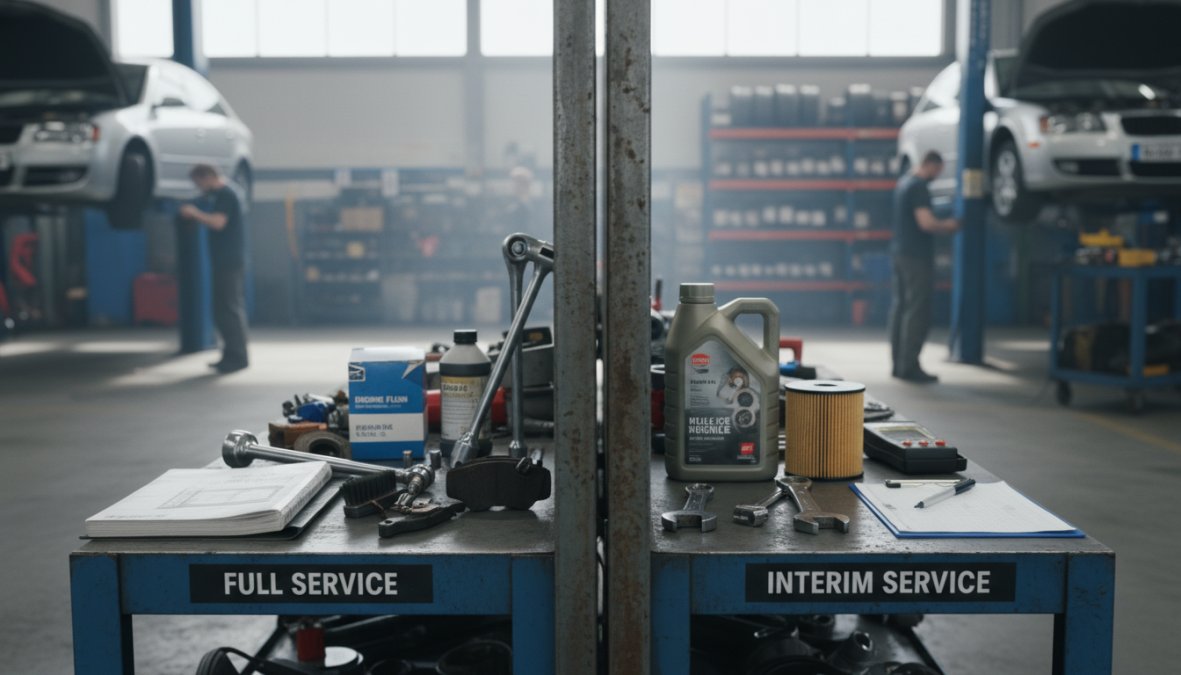
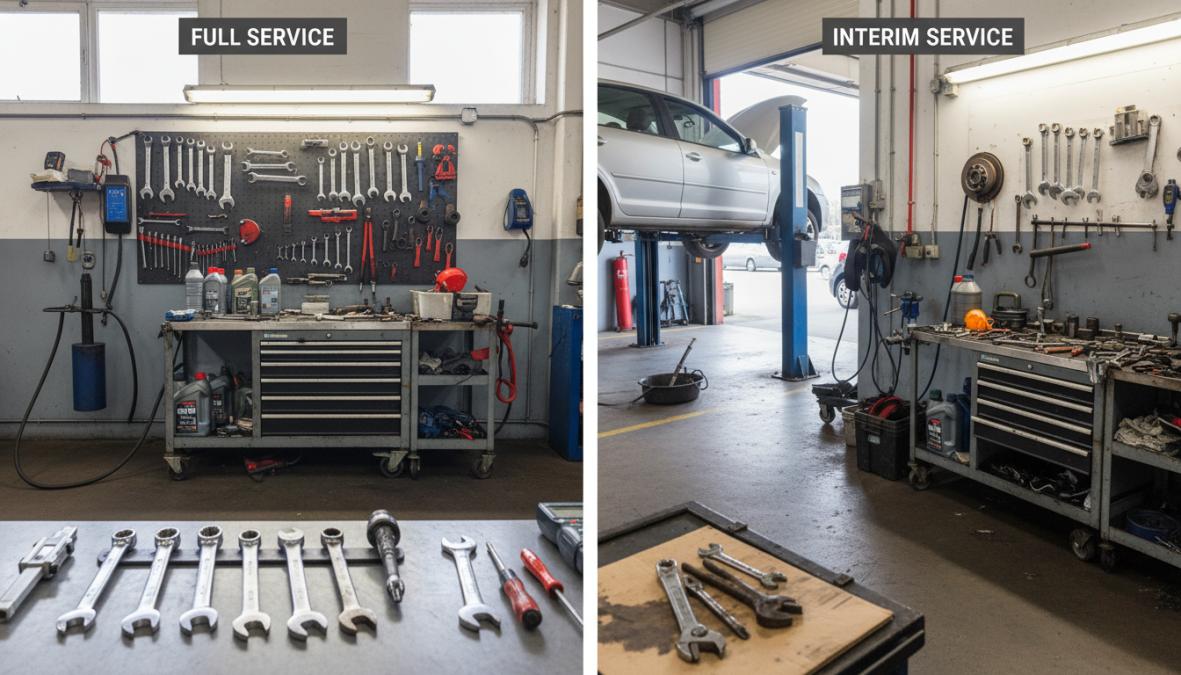
Side-by-side comparison of mechanic and clean and workshop concepts for full service vs interim service explained
Here's the part most guides get wrong: interim and full services aren't competing options. They're designed to work together. High-mileage drivers or those making frequent short journeys often need both, alternating between the two to maintain engine performance without the cost of a full service every six months.
What Is an Interim Service?
An interim service is a mid-year maintenance check typically recommended every six months or every 6,000 miles, whichever comes first. It covers the most time-sensitive items: an oil change, oil filter replacement, fluid level checks, tyre pressure inspection, and a visual inspection of key safety components including brakes and lights.
The interim service exists because engine oil degrades faster than most drivers realise, particularly on short journeys where the engine never fully warms up. Skipping it doesn't just reduce engine performance; it increases the risk of engine damage that a full service six months later can't undo.
What Is a Full Service?
A full service is a thorough vehicle health check carried out annually or every 12,000 miles. It includes everything in an interim service plus a much wider inspection: air filter and pollen filter replacement, brake fluid checks, drive belt inspection, suspension and steering component assessment, exhaust system checks, and a detailed examination of the entire braking system.
Your Car Service Checklist: What Each Service Actually Covers
The difference between interim and full service checklists is more significant than most drivers expect. Many assume the full service is just "more of the same", it isn't. Several components only get inspected or replaced during a full service, and those components are often the ones that cause expensive failures when neglected.
Interim Service Checklist (Typical 39-Point Inspection)
A standard interim service covers approximately 39 inspection points. The core items include:
Pro TipIf you drive more than 12,000 miles per year, treat the interim service as non-negotiable, not optional. Short journeys under five miles are particularly hard on engine oil because the engine never reaches full operating temperature, meaning contaminants don't burn off.
Full Service Checklist (Typical 45-Point Inspection and Beyond)
A full service typically covers 45 or more inspection points. Everything in the interim service applies, plus:
Air filter replacement
Pollen filter replacement
Spark plug inspection (replacement if needed)
Brake fluid replacement (if degraded)
Drive belt condition and tension check
Comprehensive brake system assessment including callipers and brake lines
Full suspension and steering component inspection
Fuel system and throttle body check
Detailed exhaust system inspection
Diagnostic scan for fault codes
The full service is where preventative maintenance earns its keep. Catching a worn drive belt or degraded brake fluid during a routine service is dramatically cheaper than dealing with the failure those components cause when left unchecked.
Interim Service vs Full Service Cost: Is the Price Difference Worth It?
The price gap between an interim and full service is real, but framing it purely as a cost comparison misses the point. The better question is: what does skipping the right service actually cost you?
Many independent garages across Northamptonshire price interim services in the range of £80-£130 and full services between £150-£250, though prices vary by vehicle make, engine size, and oil specification. Dealership pricing typically sits higher.
Cost-Benefit Analysis by Vehicle Age and Value
Vehicle age changes the calculation significantly:
Newer vehicles (0-3 years): Manufacturer service schedules often specify only an annual full service. Deviating from this schedule risks voiding your warranty. The cost of skipping a service is not just mechanical; it's contractual.
Mid-age vehicles (3-7 years): This is where alternating interim and full services makes the most financial sense. The vehicle is past its warranty period but still has significant resale value. A documented service history with regular interim services can meaningfully increase trade-in value.
Older, higher-mileage vehicles (7+ years): The interim service becomes more important, not less. Older engines are more sensitive to degraded oil, and the cost of an interim service is trivial compared to the engine damage that contaminated oil can cause over time.
Watch OutSkipping an interim service on a high-mileage vehicle to "save money" is one of the most common mistakes we see. The oil degrades faster in older engines, and the repair bill for a seized engine component will far exceed the cost of several years of interim services combined.
A useful rule of thumb: if your annual mileage exceeds 12,000 miles, budget for both an interim and a full service each year. If you drive under 12,000 miles annually, a single annual full service is likely sufficient.
How Often Should You Service Your Car?
The right service interval depends on three factors: your annual mileage, your driving pattern, and your manufacturer's schedule.
The general guidance from most approved garages and vehicle manufacturers is:
Low mileage drivers (under 6,000 miles per year): One full service annually is typically sufficient.
Average mileage drivers (6,000-12,000 miles per year): One full service per year, with an interim service at the halfway point if driving conditions are demanding.
High mileage drivers (over 12,000 miles per year): Alternate between an interim service every six months and a full service annually.
Short journey drivers: Even low annual mileage doesn't mean infrequent servicing is safe. Short journeys are disproportionately hard on engine oil and brakes.
Service intervals in your owner's manual are a starting point, not a ceiling. Vehicles used in stop-start urban traffic, towing, or extreme temperatures may need more frequent attention than the manual suggests.
Manufacturer Warranty, Insurance, and Service History: What's at Stake
Most drivers know that missing a service can affect their warranty. Fewer understand exactly how the rules work in practice, or what the knock-on effects are for insurance and resale value. This is the area where choosing between an interim and full service stops being a mechanical question and becomes a financial and legal one.
Manufacturer Warranty: What the Block Exemption Regulation Actually Means
The single most persistent myth in car servicing is that you must use a franchised main dealer to keep your new car warranty valid. This is not true, and it hasn't been true since the EU Block Exemption Regulation was adopted into UK law, a position the Competition and Markets Authority has confirmed applies in the UK post-Brexit under retained legislation.
What the regulation actually requires is this: your vehicle must be serviced at the manufacturer's specified intervals, using parts and lubricants that meet the manufacturer's published specifications. The garage performing the work does not need to be a franchised dealer. It does need to be a VAT-registered business that can provide a stamped service record and itemised invoice showing the parts and oil grades used.
Using the wrong oil specification. Modern engines, particularly turbocharged petrols and diesel particulate filter-equipped diesels, require oils to a specific ACEA or manufacturer standard (for example, VW 504.00/507.00, BMW Longlife-04, or Ford WSS-M2C913). Using a generic oil that doesn't meet the published spec gives a manufacturer legitimate grounds to reject an engine warranty claim. This is one reason DIY oil changes carry real risk.
Missing an interim service when the manufacturer schedule requires one. Some manufacturers, particularly those with variable service interval systems like BMW's Condition Based Servicing or Volkswagen Group's ASSYST system, specify service intervals based on actual oil condition rather than fixed mileage. If the onboard system flags a service and you delay it, the manufacturer has a documented record of the missed interval.
No stamped service book or digital record. A verbal assurance that a service was done is worthless for warranty purposes. Every service must be recorded in the physical service book or the manufacturer's digital service record system, with the garage's stamp and date.
Interim service and warranty interaction: For most new vehicles, the manufacturer schedule specifies an annual full service. An interim service at six months is typically supplementary, it isn't required by the warranty schedule, but it doesn't conflict with it either. Where it becomes relevant is for high-mileage drivers: if your vehicle reaches the mileage trigger for a scheduled service before the annual date, the service is due at that mileage point regardless of when the last one was. Ignoring a mileage-triggered service interval is a warranty risk.
Service History and Insurance: The Overlooked Connection
Missing a service doesn't automatically invalidate your motor insurance policy. However, the relationship between service history and insurance is more nuanced than most drivers realise, and it matters most at the point of a claim.
UK motor insurance policies typically include a condition requiring the vehicle to be maintained in a roadworthy condition. If a mechanical failure contributes to an accident, for example, brake fade linked to degraded brake fluid that a full service would have identified and replaced, an insurer may investigate the vehicle's maintenance history as part of the claims process. A gap in service records doesn't automatically mean a claim is rejected, but it removes a layer of documented evidence that the vehicle was properly maintained.
For breakdown cover, the picture is slightly different. Most breakdown providers, including the RAC and AA, do not require a full service history to provide roadside assistance. However, some policies exclude breakdowns caused by a known pre-existing fault or neglected maintenance. If a vehicle breaks down due to a component that routine servicing would have flagged, the provider may decline to cover recovery costs beyond the roadside call-out.
Watch OutIf you drive a vehicle for business purposes, even occasionally, your commercial motor insurance or fleet policy may have explicit maintenance requirements. Missing a scheduled service on a business-use vehicle can create a coverage gap that personal motor policies don't carry. Check your policy schedule if this applies to you.
Resale Value: Service History as a Financial Asset
A complete, documented service history is consistently one of the top three factors used by used car dealers and private buyers to assess vehicle value, alongside mileage and condition. The financial impact of an incomplete service history is not theoretical.
Used car valuations from major trade guides treat full service history (FSH) as a distinct value category. A vehicle with FSH will typically achieve a higher trade-in offer and a faster private sale than an equivalent vehicle with partial or no history. The gap is most pronounced for vehicles between three and seven years old, where the service record is recent enough to be verifiable and the vehicle is still worth enough for the difference to be material.
Every missed service creates a gap in that record. A single missing stamp is often less damaging than a pattern of irregular servicing, but both will be noticed by any buyer conducting due diligence. Dealers will use gaps to negotiate the price down; private buyers may walk away entirely.
The practical implication for interim services: An interim service stamp in your service book is not just a maintenance record, it's evidence of ownership care. For high-mileage vehicles where the annual mileage significantly exceeds 12,000 miles, a service book showing only annual full services with large mileage gaps between them can actually raise questions, even if every full service was completed on time. Regular interim service stamps tell a more credible story of consistent maintenance.
Key TakeawayService history is a financial asset with a measurable return. Every documented service, interim or full, adds to your vehicle's provenance, protects your warranty position, and supports your resale price. Treating any scheduled service as optional is a false economy that compounds over time.
DIY vs Professional Servicing: When Each Makes Sense
Side-by-side comparison of OBD for full service vs interim service explained
The question of whether to service your own car sits at the intersection of mechanical confidence, available tools, and something most DIY guides ignore entirely: the documentary consequences. A competently performed home oil change that leaves no verifiable record is not the same as a garage-stamped service, not for warranty purposes, not for insurance, and not for resale value. Understanding where the line falls between sensible home maintenance and tasks that genuinely require professional equipment is the starting point. Understanding why the paper trail matters is the part that changes the calculation.
What DIY Can Reasonably Cover
There is a category of maintenance tasks that are genuinely within reach for any driver, regardless of mechanical experience, and that carry no meaningful risk to warranty or vehicle systems:
Screen wash top-up: No tools required, no specification risk, no documentation needed.
Tyre pressure checks: A quality digital gauge costs under £20 and gives accurate readings. Checking pressures monthly, and before long journeys, is straightforward and important.
Wiper blade replacement: Most modern wiper arms use a simple clip or hook fitting. Replacement blades are widely available and fitting takes minutes.
Visual fluid level checks: Coolant, brake fluid (level only, not condition), and power steering fluid reservoirs are accessible on most vehicles without tools. Checking levels between services is sensible preventative behaviour.
Cabin air (pollen) filter replacement on accessible vehicles: On some older or simpler vehicles, the pollen filter is located behind the glovebox and can be swapped without tools. On others, it requires partial dashboard disassembly. Know which category your vehicle falls into before attempting this.
These tasks are appropriate for home completion because they carry no oil specification risk, require no torque-specific tools, and, critically, are not the items that appear on a service stamp. Doing them yourself doesn't create a gap in your service record.
What Requires a Professional: The Mechanisms That Matter
The following tasks appear straightforward but carry real risks when performed without the correct equipment, data access, or training:
Oil and filter changes, oil specification is the critical variable. This is the task most home mechanics feel confident performing, and it's also the one most likely to cause warranty problems when done incorrectly. Modern engines, particularly turbocharged units, engines with variable valve timing, and diesels with diesel particulate filters (DPFs), require oils meeting specific manufacturer standards. Using an oil that meets a general ACEA grade but not the manufacturer's specific approval (for example, using a standard 5W-30 in an engine requiring a low-SAPS oil for DPF compatibility) can accelerate DPF blockage and, in a worst case, give a manufacturer grounds to reject a warranty claim on related components. The correct oil specification is listed in the owner's manual and on the manufacturer's website, but interpreting it correctly requires familiarity with the approval system.
Service interval reset, requires a diagnostic interface on most post-2010 vehicles. Most modern vehicles use an onboard service interval monitoring system that must be reset after an oil change. On older vehicles, this was a simple button sequence in the instrument cluster. On the majority of vehicles built in the last decade, resetting the service indicator requires a compatible OBD-II diagnostic tool with the correct software for that manufacturer. Without the reset, the service warning light remains active, the vehicle's onboard record shows the service as overdue, and, on vehicles with condition-based service monitoring, the system continues calculating oil degradation from the wrong baseline. A professional garage resets this as a standard part of every service.
Brake fluid testing, condition cannot be assessed visually. Brake fluid absorbs moisture from the atmosphere over time, which lowers its boiling point and increases the risk of brake fade under heavy use. The fluid level in the reservoir can look perfectly normal while the fluid itself is significantly degraded. Testing brake fluid condition requires a dedicated brake fluid tester, a low-cost tool, but one most home mechanics don't own. Replacing brake fluid that doesn't need replacing wastes money; failing to replace fluid that does is a safety risk.
Drive belt inspection, tension and condition assessment requires experience. A drive belt (or cam belt on timing-belt-equipped engines) that looks intact to a visual check can be at the end of its service life. Assessing belt condition requires checking for glazing, cracking, fraying at the edges, and correct tension, all of which require hands-on experience to evaluate accurately. The consequences of a missed cam belt failure are severe: on interference engines, a snapped timing belt typically causes catastrophic engine damage. This is not a task where a visual check from above the engine bay is sufficient.
Suspension and steering component assessment, requires a ramp. Meaningful inspection of ball joints, track rod ends, anti-roll bar drop links, and shock absorber condition requires the vehicle to be on a lift with the wheels hanging freely. Checks performed with the vehicle on the ground, or on axle stands, cannot replicate the movement range needed to identify worn components. This is one of the primary reasons professional servicing catches safety-critical wear that home checks miss.
Pro TipIf you want to perform basic maintenance between professional services, tyre pressure checks, fluid level monitoring, visual brake pad inspection through the wheel spokes, do it. These habits are genuinely useful. Just don't substitute them for a scheduled service. They're supplementary, not equivalent.
The Documentation Problem: Why DIY Servicing Carries Hidden Costs
This is the part most DIY servicing guides don't address directly: a home service, however competently performed, produces no verifiable record.
For vehicles under manufacturer warranty, a DIY oil change, even using the correct specification oil, cannot be documented in a way that satisfies a warranty claim investigation. There is no stamped service book entry, no VAT-registered business invoice, no record of the parts used. If an engine warranty claim arises and the manufacturer's investigation reveals a gap in the service record, the burden of proof falls on the owner to demonstrate the service was completed correctly. A receipt for oil and a filter from a motor factor is not the same as a professional service record.
For resale value, the same logic applies. A service book with gaps, or with handwritten entries rather than garage stamps, will be treated with scepticism by dealers and informed private buyers. The discount applied to a vehicle with an incomplete service history will, in most cases, exceed the cumulative cost of the professional services that were skipped.
For insurance purposes, documented professional servicing provides clear evidence that the vehicle was maintained in a roadworthy condition. DIY maintenance, even when done correctly, provides no equivalent paper trail if a claim is ever investigated.
Watch OutIf your vehicle is still within its manufacturer warranty period, DIY servicing beyond the basic checks listed above carries a genuine warranty risk. The cost of a professional service is modest compared to the cost of a rejected warranty claim on a major component. Wait until the warranty period ends before considering home servicing for anything beyond the basics.
The Honest Summary
DIY maintenance has a legitimate role between professional services, checking pressures, topping up fluids, replacing wipers. It does not have a legitimate role as a substitute for scheduled interim or full services on any vehicle where warranty, insurance documentation, or resale value are relevant considerations. For most drivers, that means all of them.
Which Service Do You Actually Need? A Practical Decision Framework
Here's a direct decision framework based on the most common driver profiles:
Use an interim service if:
You drive more than 6,000 miles every six months
You make frequent short journeys under five miles
Your last service was six months ago and you're not due a full service yet
You drive an older, higher-mileage vehicle that is hard on engine oil
Use a full service if:
You haven't had a service in 12 months or more
Your vehicle is approaching 12,000 miles since the last service
You're buying or selling the vehicle and want a complete health check
Your manufacturer schedule specifies an annual full service
Use both (alternating) if:
Your annual mileage exceeds 12,000 miles
You drive in demanding conditions: urban stop-start, towing, or motorway commuting
For drivers in and around Kettering, the driving mix of rural A-roads and urban town centre traffic puts vehicles squarely in the "both" category for most. Short trips into Kettering town centre followed by longer runs on the A14 or A43 create exactly the kind of variable load that benefits from more frequent oil changes.
As a practical rule: if you're unsure which service your car needs, a vehicle health check at a local approved garage will give you a clear picture without committing to a full service upfront.
For electric and hybrid vehicle owners in Northamptonshire, the service picture is different again. EVs don't need oil changes, but they do require brake system checks, tyre inspections, and battery health assessments. Kettering Motorist Centre offers specialist servicing for electric and hybrid vehicles, with the same transparent, no-upfront-payment booking process available online.
Choosing between an interim and full service isn't complicated once you understand what each one actually covers. The challenge is that most drivers default to whatever the previous owner did or whatever the garage suggests, without considering their own mileage, driving habits, or vehicle age. Kettering Motorist Centre takes a straightforward approach: transparent advice, specialist expertise for all vehicle types including electric and hybrid, and a hassle-free online booking system with no payment required upfront. Book your next service or MOT with Kettering Motorist Centre and get a clear, honest assessment of exactly what your vehicle needs.
Frequently Asked Questions
What is the difference between an interim and a full car service?
An interim service is a lighter, more frequent check covering essential items like an oil change, oil filter replacement, fluid top-ups, tyre pressure, and basic safety checks. A full service is a more comprehensive check — typically a 45-point inspection or more — that includes everything in an interim service plus additional component checks such as drive belts, brake fluid, air filter, pollen filter, suspension, steering components, and the exhaust system. Full service vs interim service explained simply: interim maintains, full inspects thoroughly.
How often should you service your car with an interim or full service?
A common recommended schedule is an interim service every 6 months or 6,000 miles and a full service every 12 months or 12,000 miles — whichever comes first. However, your service interval may vary depending on your vehicle's manufacturer guidelines, your driving habits, and mileage. High mileage drivers and those who frequently make short journeys may benefit from more frequent interim services to prevent engine damage from degraded oil and accumulated wear and tear.
Does a full service include everything in an interim service?
Yes, in virtually all cases a full service includes all the checks and component replacements carried out in an interim service, plus a wider range of inspections. This typically means the oil change, oil filter, fluid levels check, and visual inspection from the interim are all repeated, with additional work covering items such as the air filter, brake fluid condition, drive belts, and a more detailed assessment of the suspension and steering components. Always confirm the specific checklist with your approved garage before booking.
Does my service history affect my car insurance or resale value?
A full and documented service history can positively influence both your car's resale value and, in some cases, insurance considerations. A complete service history demonstrates that the vehicle has received regular preventative maintenance, which reassures buyers and can command a higher price at sale. Some insurers may also view a well-maintained vehicle more favourably. Conversely, gaps in service history — particularly missed full services — can raise questions about the car's long-term reliability and condition.
Can skipping a service affect my manufacturer warranty?
Yes, it can. Most manufacturer warranties require you to follow the recommended service schedule and have work carried out at an approved garage or by a qualified technician. Failing to service your car at the correct intervals — or using a non-approved mechanic who doesn't document the work properly — can give manufacturers grounds to reduce or void warranty claims. Always keep your service records and ensure stamps are entered in your vehicle's service book to protect your warranty.
How do I know whether I need an interim service or a full service?
The simplest guide is time and mileage: if it has been around 6 months or 6,000 miles since your last service, an interim service is typically appropriate. If it has been 12 months or 12,000 miles, a full service is recommended. You should also consider your car's age and condition — older, higher-mileage vehicles generally benefit more from the comprehensive check of a full service. If you are unsure, a vehicle health check at a trusted local garage like Kettering Motorist Centre can help you decide.
Your booking Failed
Please try again or please call 01536 410142
Thank you for placing a booking with Kettering Motorist Centre Limited for vehicle
PLEASE TAKE YOUR BOOKING REFERENCE NUMBER WITH YOU TO THE MOT CENTRE
Your items
MOT Test
×
Terms and Conditions
These terms and conditions form the basis on which you can visit and use this website. Please read them carefully as they contain important information.
General terms and conditions
This website is owned and operated by Kettering Motorist Centre Ltd (company registration number: 4485858) operating at Trafalgar Road, Kettering, Northamptonshire, NN16 8DB (the "MOT Centre", the "Company", "we" or "us"). If you have any queries about these terms and conditions or if you have any comments or complaints on or about this website, you can contact us at [email protected] or 01536 410142.
The website is to promote and offer for sale the products and services of Kettering Motorist Centre Limited.
1. The contract between us
This website does not take payment for products or services online. The website enables you to view products and services online and to make a booking for later delivery and payment. The vehicle and provision of other products and services promoted by this website and the payment by you of the price of those products and services will take place at the MOT Centre. The booking does not constitute a contract.
The booking process on the site provides details of the booked MOT order. Please take the time to read and check your booking. It is your responsibility to make sure the order is correct and for the correct vehicle.
2. Ownership of rights
All rights, including copyright, in this website are owned by or licensed to the Company. Any use of this website or its contents, including copying or storing it or them in whole or part, other than for your own personal, non commercial use, is prohibited without our permission. You may not modify, distribute or repost anything on this website for any purpose.
3. Accuracy of content
We have taken care in the preparation of the content of this website, in particular to ensure that prices quoted are correct at the time of publishing and that all goods have been fairly described. However, bookings will only be accepted if there are no material errors in the description of the goods or their prices as advertised on this website. Any weights, dimensions and capacities given about the goods are approximate only.
4. Damage to your computer
We try to ensure that this website is free from viruses or defects. However, we cannot guarantee that your use of this website or any websites accessible through it will not cause damage to your computer. It is your responsibility to ensure that the right equipment is available to use the website. Except in the case of negligence on our part, we will not be liable to any person for any loss or damage which may arise to computer equipment as a result of using this website.
5. Availability
All bookings are subject to acceptance and availability. If the MOT date you have requested are is not available, the Centre will contact you by e-mail or phone. You will have the option either to wait until another slot is available or to cancel your booking.
6. Booking errors
You are able to correct errors on your booking up to the point on which you click on “Place Booking” during the booking process.
7. Price
The prices payable for goods that you order are as set out in our website. All prices are inclusive of VAT at the current rates and are correct at the time of entering information, errors and omissions excepted.
Whenever it is not possible to accept your booking to buy goods of the specification and description at the price indicated, the MOT Centre will advise you by email or phone or when you visit the centre.
8. Payment terms
You will be required to pay for the goods or services to the Centre at time of a completed MOT.
9. Delivery charges
N/A
10. Cancellation
The MOT Centre reserves the right to cancel the booking if:
10.1 There is insufficient stock to deliver the goods you have booked.
10.2 One or more of the goods you booked was listed at an incorrect price.
If your booking is cancelled the Centre will notify you by e-mail or phone.
You have the right to cancel your booking at any time up to the point of the MOT. If you do cancel your booking you should inform the centre by phone.
11. Liability
Notwithstanding the foregoing, nothing in these terms and conditions is intended to limit any rights you might have as a consumer under applicable local law or other statutory rights that may not be excluded nor in any way to exclude or limit our liability to you for any death or personal injury resulting from our negligence.
12. Notices
Unless otherwise expressly stated in these terms and conditions, all notices from you to us must be in writing and sent to our contact address given above and all notices from us to you will be displayed on our website from time to time.
13. Changes to legal notices
We reserve the right to change these terms and conditions from time to time and you should look through them as often as possible.
14. Law, jurisdiction and language
This website, any content contained therein and any contract brought into being as a result of usage of this website are governed by and construed in accordance with English law. Parties to any such contract agree to submit to the exclusive jurisdiction of the courts of England and Wales.
15. Invalidity
If any part of these terms and conditions is unenforceable (including any provision in which we exclude our liability to you) the enforceability of any other part of these conditions will not be affected.
16. Privacy
You acknowledge and agree to be bound by the terms of our privacy policy
17. Third party rights
Nothing in this Agreement is intended to, nor shall it confer any rights on a third party.