Understanding why car servicing is essential for hybrid vehicles is not as straightforward as it sounds, and most owners get it wrong from the start. At Kettering Motorist Centre, we work with hybrid owners across Kettering, Northamptonshire every week, and the same misconception comes up repeatedly: because hybrids are more efficient, they must need less attention. The opposite is often true. Hybrids combine a high-voltage battery pack, an electric motor, and a conventional internal combustion engine into one powertrain, and each system has its own maintenance demands. Below, we'll show you exactly what those demands are, when they arise, and what happens when they're ignored.
Here's what most guides get wrong: they treat hybrid servicing as a slightly modified version of standard car maintenance. It isn't. The regenerative braking system changes how brake pads wear. The inverter cooling system requires its own coolant flush schedule. The high-voltage battery needs state of health (SOH) monitoring that a standard OBD reader simply cannot provide. Miss any of these, and you're not just shortening the life of a component. You're potentially voiding your warranty coverage and creating a safety risk.
Why Car Servicing Is Essential for Hybrid Vehicles: The Core Differences
Hybrid vehicles are fundamentally different from conventional cars, and that difference starts at the powertrain level. A hybrid does not simply add an electric motor to a petrol engine. It integrates two separate drive systems, each with distinct thermal management requirements, fluid specifications, and wear patterns, all managed by sophisticated software that requires specialized diagnostic tools to interrogate properly.
How Hybrids Differ from Internal Combustion Engine Vehicles
The internal combustion engine in a hybrid runs differently from the one in a conventional car. Because the electric motor handles low-speed driving and acceleration, the petrol engine spends more time switched off, which means it reaches operating temperature less frequently. That sounds like a benefit, but it creates a real problem: engine oil degrades through chemical breakdown, not just mechanical wear, and an engine that cycles on and off repeatedly without reaching full operating temperature accumulates moisture and fuel contamination in the oil faster.
The electric drive system also introduces components that a standard ICE vehicle simply doesn't have: the inverter, the DC-to-DC converter, the battery management system, and the electric motor itself. Each of these generates heat, requires cooling, and can fail in ways that a conventional mechanic without hybrid training will not catch.
Understanding the High-Voltage Battery and Electric Drive System
The high-voltage battery is the most expensive single component in any hybrid vehicle. It is also the most misunderstood. Battery degradation is a gradual process, not a sudden failure, which means owners often don't notice it until fuel efficiency drops noticeably or the electric drive range shrinks.
State of health (SOH) is the metric that matters here. SOH measures the battery's current capacity as a percentage of its original design capacity. A battery at 80% SOH is not failing, but it is delivering meaningfully less electric assist, which increases fuel consumption and places more load on the internal combustion engine. Monitoring SOH requires certified hybrid technician equipment, not a standard diagnostic scanner.
Watch OutNever assume a hybrid's high-voltage battery is safe to handle without proper training and equipment. High-voltage battery systems carry enough current to be lethal. DIY inspection of these components is not a calculated risk, it is a serious safety hazard.
Hybrid Car Maintenance Schedule: What Needs Doing and When
A hybrid car maintenance schedule is not a single list. It is two overlapping schedules: one for the conventional drivetrain components, and one for the hybrid-specific systems. The intervals are different, the fluids are different, and the diagnostic requirements are different.
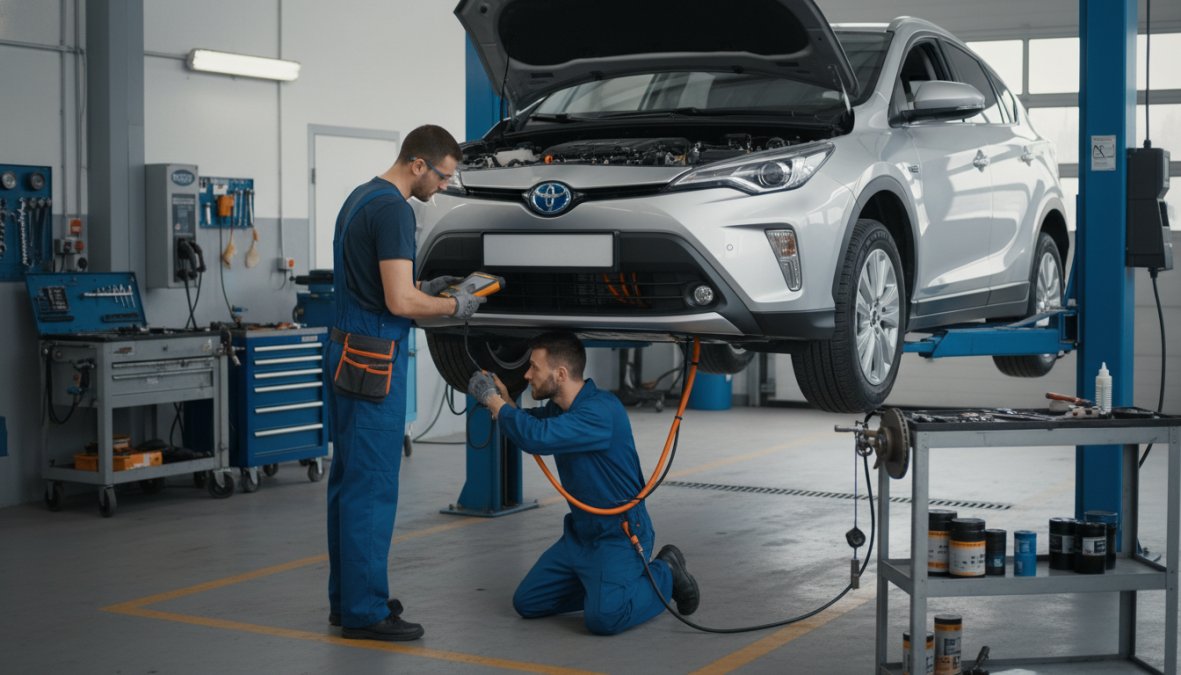
Professional illustration showing why car servicing is essential for hybrid vehicles
Here is a practical breakdown by mileage and time:
Service Item
Interval
Notes
Engine oil change
Every 5,000-7,500 miles or 12 months
Shorter interval due to stop-start cycling
Tyre rotation
Every 5,000-7,500 miles
Even wear across all four positions
Cabin air filter
Every 12-15,000 miles
More critical in hybrids with cabin air recirculation
Engine air filter
Every 15-30,000 miles
Per manufacturer recommendations
Transmission fluid
Every 30-40,000 miles
CVT fluid in many hybrid models
Inverter coolant flush
Every 50,000 miles or 5 years
Often overlooked entirely
High-voltage battery check (SOH)
Annually
Requires specialist equipment
Brake fluid change
Every 2 years
Regardless of mileage
Routine Tasks: Oil Changes, Tyre Rotation, and Transmission Fluid
Oil change intervals for hybrids are a point of genuine debate. Some manufacturers publish longer intervals because the engine runs less. In practice, the stop-start nature of hybrid operation means the engine never fully purges combustion byproducts from the oil the way a continuously running engine does. Many hybrid technicians recommend erring on the shorter side of the manufacturer's stated range.
Tyre rotation matters more in hybrids than most owners expect. The added weight of the battery pack increases tyre wear, and regenerative braking creates uneven deceleration forces compared to conventional braking. Skipping tyre rotation on a hybrid leads to premature wear on specific axles, which directly affects fuel efficiency and handling.
Transmission fluid is another overlooked item. Many hybrids use a continuously variable transmission (CVT) or a power-split device rather than a conventional automatic gearbox. These units have their own fluid specifications, and using the wrong fluid, or neglecting the change interval, causes progressive damage that is expensive to repair.
Coolant System and Inverter Cooling System Maintenance
This is the part most standard service schedules miss entirely. Hybrids have two separate cooling circuits: one for the internal combustion engine, and one for the inverter and electric drive system. The inverter cooling system uses a different coolant formulation, operates at different temperatures, and has its own reservoir and pump.
A coolant flush on the engine circuit does nothing for the inverter cooling circuit. If a service centre does not specifically address both circuits, the inverter cooling system is being neglected. Over time, degraded coolant in the inverter circuit causes overheating, which triggers protective shutdowns and, eventually, inverter failure. Inverter replacement is one of the most costly repairs on any hybrid vehicle.
Pro TipWhen booking a hybrid service, specifically ask whether the inverter cooling system is included in the coolant check. If the service centre looks uncertain, that tells you everything you need to know about their hybrid expertise.
Regenerative Braking: Why Brake Pad Wear Is Different in Hybrids
Most people assume hybrid brake pads last about the same as conventional ones. The reality is more nuanced, and getting it wrong creates both a safety issue and an unexpected cost.
Regenerative braking is the process by which a hybrid's electric motor acts as a generator during deceleration, converting kinetic energy back into electrical energy stored in the high-voltage battery. Because the electric motor handles most of the braking force at low speeds, the physical brake pads engage far less frequently than they would on a conventional vehicle. The result is that brake pads on hybrids often last significantly longer than expected.
Here's the problem that creates: brake pads that sit unused for extended periods can corrode, seize, or glaze, even when they still have plenty of material remaining. Brake discs can develop surface rust that a conventional service interval would catch through normal pad wear, but that a hybrid's light pad usage leaves untreated. According to guidance from the Driver and Vehicle Standards Agency on brake system maintenance, brake system integrity is a primary MOT failure point, and degraded discs or seized callipers are common causes of failure regardless of pad thickness.
The practical implication: hybrid brake inspections must assess disc condition and calliper function, not just pad wear. A pad that looks fine may be sitting against a corroded disc with a seized calliper behind it.
How Long Do Hybrid Car Batteries Last and What Affects Their Lifespan
Hybrid car batteries last, in most cases, between 8 and 15 years under normal operating conditions, though this range varies considerably based on climate, driving patterns, and maintenance history. The high-voltage battery is not a component that fails suddenly in most cases. It degrades gradually, and that gradual degradation is entirely manageable with the right monitoring.
Battery Degradation and State of Health (SOH) Monitoring
Battery degradation in hybrid vehicles follows a predictable curve. Capacity drops relatively quickly in the first year or two as the battery settles, then stabilises for an extended period, then begins declining again as the battery ages. The speed of that final decline depends heavily on how the battery has been managed.
SOH monitoring is the diagnostic process that tracks this curve. A certified hybrid technician uses specialist equipment to query the battery management system, measuring actual capacity against design capacity and identifying cells within the pack that are degrading faster than others. Early identification of a weak cell allows for targeted intervention before the problem cascades.
What most guides miss is that warranty coverage on hybrid batteries in the UK typically extends to 8 years or 100,000 miles for the high-voltage system, depending on the manufacturer. Maintaining a documented service history, including annual SOH checks, is often a condition of claiming under that warranty. Gaps in service records can complicate warranty claims considerably.
Impact of Climate on Battery Life and Thermal Management
Climate is one of the most significant factors in hybrid battery longevity, and it is one that drivers in Northamptonshire should take seriously. Lithium-ion and nickel-metal hydride battery chemistry both degrade faster at temperature extremes. Prolonged exposure to high heat accelerates chemical breakdown inside the cells. Repeated deep cold causes temporary capacity loss and, over time, structural stress on cell components.
Thermal management systems in modern hybrids actively regulate battery temperature using a combination of liquid cooling, air cooling, and heating elements. These systems only work if the coolant is clean and the cooling circuits are functioning correctly. A neglected inverter cooling system does not just affect the inverter: it affects the battery thermal management system as well, accelerating degradation across the entire high-voltage pack.
Drivers who regularly park in direct sunlight in summer, or who leave their vehicle in unheated outdoor spaces through winter, should factor climate exposure into their service planning.
Plug-in Hybrid (PHEV) Specifics: Extra Servicing Considerations
A plug-in hybrid (PHEV) is not simply a hybrid with a larger battery. It is a vehicle that spends a meaningful portion of its operating life running on electric power alone, which changes the maintenance picture in several important ways that standard hybrid servicing guides, and most service centres, do not account for.
The distinction matters because PHEV owners who charge regularly and drive short daily distances can go weeks without the internal combustion engine running at all. That usage pattern creates a specific set of maintenance risks that are different from both conventional hybrids and pure electric vehicles, and that sit in a gap most service schedules do not address.
Engine Oil Degradation Without Engine Use
The oil degradation problem present in all hybrids is significantly more acute in PHEVs. A PHEV owner who charges overnight and drives a 20-mile daily commute entirely on electric power may cover 3,000 miles over 12 months with the petrol engine running for only a fraction of that distance. The engine oil in that vehicle has been sitting in a cold, damp environment for the better part of a year.
Engine oil degrades through two mechanisms: mechanical wear contamination and chemical breakdown. The chemical breakdown, oxidation, additive depletion, moisture absorption, occurs with time regardless of mileage. An engine that rarely reaches full operating temperature also fails to burn off the condensation and fuel vapour that accumulate in the oil during cold starts, meaning the oil in a low-mileage PHEV engine is often more contaminated than the mileage figure suggests.
The practical recommendation from most hybrid specialists is that PHEV owners who drive predominantly on electric power should treat oil changes as time-based rather than mileage-based, typically annually, regardless of how few miles the engine has covered. Checking the manufacturer's specific guidance for your model is important here, as some manufacturers have begun publishing PHEV-specific oil change intervals that reflect this reality.
Charging Port and Onboard Charger Maintenance
This is the maintenance item most specific to PHEVs and the one most comprehensively ignored by generic hybrid servicing guides.
The charging port on a PHEV is a high-use mechanical and electrical interface. On a vehicle charged daily, the port connector is engaged and released hundreds of times per year. Over time, the charging port can accumulate debris, moisture, and corrosion on the contact pins, which increases contact resistance. Increased contact resistance means the charging session runs hotter than designed, which accelerates wear on both the port and the charging cable connector.
Signs of charging port degradation include:
Charging sessions that fail to initiate on the first connection attempt
The vehicle reporting a slower-than-expected charge rate despite using the same cable and supply
Visible discolouration or pitting on the port's contact pins
A faint burning smell during charging, which indicates resistive heating at the connection point
The onboard charger, the AC-to-DC conversion unit that sits between the charging port and the high-voltage battery, is a separate component that also requires periodic attention. It generates heat during operation and relies on the vehicle's thermal management system to stay within operating temperature. A degraded inverter cooling circuit (the same one discussed in the coolant section above) affects the onboard charger's operating temperature, shortening its service life. Onboard charger health can be assessed through manufacturer-level diagnostic software during a specialist service.
Pro TipWhen booking a PHEV service, ask specifically whether the charging port contacts will be inspected and cleaned, and whether the onboard charger will be checked for fault codes and thermal performance. These are not items on a standard hybrid service checklist at most non-specialist garages.
EV-Mode Brake Wear: A More Extreme Version of the Hybrid Problem
The regenerative braking considerations that apply to standard hybrids are significantly amplified in PHEVs. Because a PHEV operating in EV mode uses regenerative braking for the vast majority of deceleration events, the physical brake pads and discs can go extended periods, sometimes many months, with minimal friction contact.
The consequence is not just extended pad life. It is accelerated disc corrosion and an increased risk of calliper seizure. Brake discs on PHEVs driven predominantly in EV mode can develop significant surface rust between services, and callipers that are not exercised regularly through friction braking can begin to seize. A seized calliper on a PHEV may not produce the obvious symptoms it would on a conventional car, the regenerative system continues to provide deceleration, masking the mechanical problem until it becomes severe.
PHEV brake inspections should specifically assess:
Disc surface condition, including rust depth and scoring, not just disc thickness
Calliper slide pin freedom of movement
Brake pad contact pattern, which can reveal whether the calliper is applying even pressure
Handbrake or electronic parking brake function, which uses the friction system independently of regenerative braking
The 12V Auxiliary Battery: A PHEV-Specific Vulnerability
Every hybrid and PHEV carries a conventional 12V auxiliary battery alongside the high-voltage traction battery. This 12V battery powers the vehicle's control systems, lighting, and accessories, and it is kept charged by the DC-to-DC converter that steps down voltage from the high-voltage pack.
In a conventional car, the 12V battery is charged by the alternator whenever the engine runs. In a PHEV driven predominantly on electric power, the engine may run infrequently, and the DC-to-DC converter handles all 12V charging duties. If the DC-to-DC converter develops a fault, or if the 12V battery itself ages and loses capacity, the vehicle may fail to start or may display a cascade of warning lights that appear to indicate a major hybrid system fault but are actually caused by low 12V supply voltage.
The 12V auxiliary battery in a PHEV is typically a standard lead-acid or AGM unit, and it ages on a time-based schedule regardless of how the vehicle is driven. Most hybrid specialists recommend checking 12V battery condition at every annual service, and replacing it proactively at around four to five years regardless of apparent condition. A failed 12V battery is an inexpensive fix; the diagnostic time spent chasing the warning lights it causes is not.
PHEV Maintenance Schedule Additions
In addition to the standard hybrid maintenance schedule covered earlier in this guide, PHEV owners should add the following items:
Service Item
Interval
Notes
Engine oil change
Annually (time-based)
Regardless of mileage if driven predominantly on EV power
Charging port inspection and cleaning
Every 12 months
Contact pin condition, debris, corrosion
Onboard charger diagnostic check
Every 12 months
Fault codes and thermal performance via specialist software
Brake disc and calliper inspection
Every 12 months
Disc corrosion and calliper seizure risk elevated in EV-mode driving
12V auxiliary battery condition check
Every 12 months
Proactive replacement recommended at 4-5 years
DC-to-DC converter check
Every 24 months
Via specialist diagnostic software
According to the Energy Saving Trust's guidance on plug-in hybrid vehicles, PHEV owners who do not maintain their vehicles correctly often see real-world fuel efficiency figures significantly below the manufacturer's stated figures, undermining the primary financial case for owning one. The maintenance items above are precisely the ones most likely to go unaddressed at a non-specialist garage, and the ones most likely to cause the efficiency and reliability shortfall that gives PHEVs an undeserved poor reputation among owners who bought them expecting lower running costs.
Key TakeawayPHEV owners who charge regularly and drive short distances should prioritise time-based service intervals over mileage-based ones, add charging port and onboard charger checks to their annual service, and treat brake disc condition as a higher-priority inspection item than pad wear alone. These three adjustments address the maintenance gaps most specific to PHEV ownership and the ones a standard hybrid service schedule will not cover.
Signs Your Hybrid Needs Service: What to Watch For
Recognising the signs your hybrid needs service early is the difference between a routine repair and a major one. Hybrids are good at masking problems because the electric motor compensates for powertrain issues that would be immediately obvious in a conventional car.
Watch for these specific warning signs:
A drop in displayed fuel efficiency over several weeks, not explained by seasonal changes or driving pattern shifts
The internal combustion engine running more frequently than usual at low speeds
Increased brake pedal travel or a spongy feel when the regenerative system hands off to the physical brakes
Warning lights on the hybrid system display, battery indicator, or electric motor status screen
Unusual sounds during acceleration from a standstill, particularly a grinding or whirring from the electric drive system
The vehicle taking longer than usual to charge (PHEV owners)
Cabin heating or cooling performance dropping, which can indicate battery thermal management issues
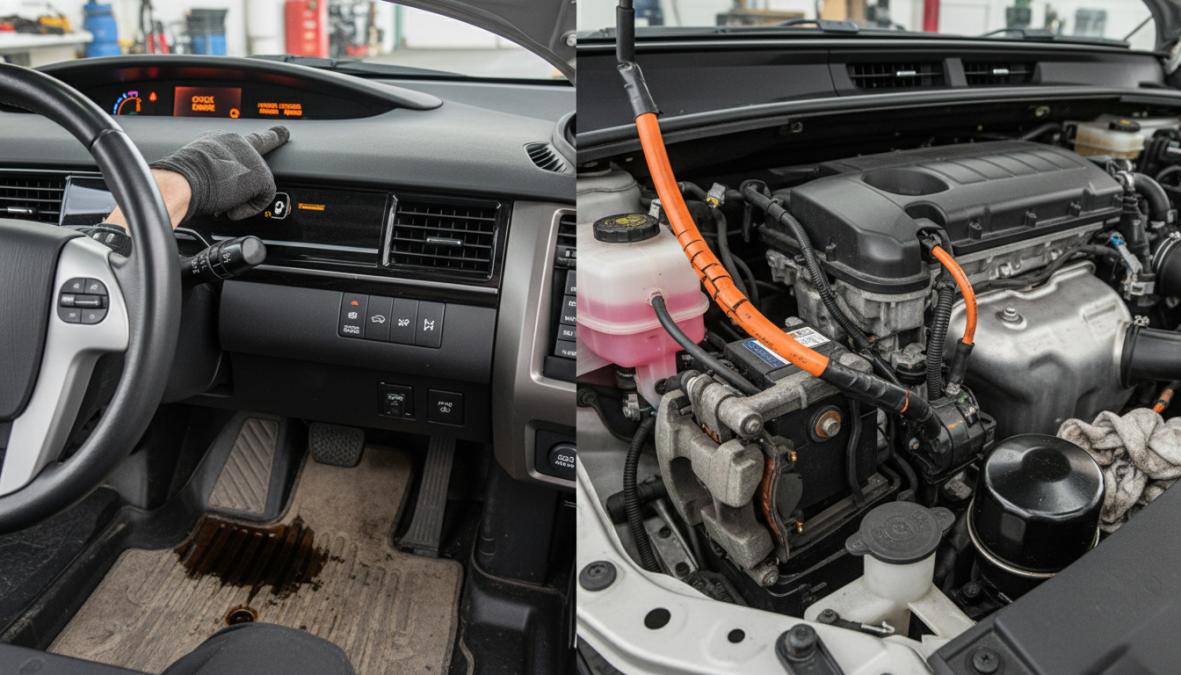
Professional illustration showing Close for why car servicing is essential for hybrid vehicles
None of these symptoms resolve themselves. A hybrid that is showing multiple warning signs simultaneously needs specialist attention promptly.
DIY vs. Professional Service: Why Hybrid Servicing Is Not a DIY Job
The common advice to handle basic car maintenance yourself makes sense for conventional vehicles. For hybrids, it carries risks that most DIY guides do not acknowledge clearly enough, and the gap between what those guides say and what actually happens when an untrained person opens the wrong panel is significant.
The High-Voltage System: What You Are Actually Dealing With
Every hybrid on UK roads carries a high-voltage battery system that operates at voltages ranging from approximately 100V in older parallel hybrids up to 650V or more in newer full hybrids and PHEVs. For context, the UK mains supply is 230V, a voltage most people already treat with serious respect. The high-voltage system in a modern hybrid can carry enough current to cause ventricular fibrillation and cardiac arrest in a fraction of a second.
The orange-coloured high-voltage cables routed through hybrid vehicles are not a styling choice. They are a mandatory visual warning system defined by international automotive safety standards, specifically to signal to emergency responders and technicians that these cables must not be cut, probed, or disturbed without proper isolation procedures. Orange cables run from the battery pack under the rear seat or boot floor, through the vehicle floor, to the inverter and electric motor in the engine bay. In many models, they pass directly alongside components a DIY mechanic might otherwise reach for without a second thought.
Watch OutThe high-voltage system in a hybrid vehicle does not de-energise when you turn the ignition off. Residual charge can remain in the inverter capacitors for several minutes after shutdown. Certified hybrid technicians follow a specific lockout/tagout procedure, disconnecting the service plug or manual service disconnect (MSD), then waiting a defined period before touching any orange-cable component. Skipping this step is how serious injuries occur.
The Service Plug and Manual Service Disconnect
Most hybrid vehicles include a manual service disconnect (MSD), a removable plug or switch, typically located in the boot or under the rear seat, that physically breaks the high-voltage circuit. Removing the MSD is step one of any safe high-voltage work. What is less widely understood is that removing the MSD does not immediately make the system safe. The inverter contains large capacitors that store charge independently of the battery pack, and these take time to discharge to a safe level. Toyota's own hybrid safety training specifies a waiting period after MSD removal before any high-voltage component contact, a step that requires knowing the procedure exists in the first place.
For a DIY mechanic who has not completed high-voltage safety training, none of this is intuitive. The vehicle looks off. The system feels inert. The risk is invisible until it is not.
What Standard OBD Tools Cannot See
Beyond the safety issue, there is a fundamental capability gap that makes DIY hybrid diagnostics unreliable even for tasks that appear straightforward.
Standard OBD-II readers, including the popular Bluetooth dongles used with smartphone apps, access a standardised set of generic fault codes covering the engine and transmission. They do not access the battery management system (BMS), the inverter control unit, the motor generator control module, or the hybrid system's proprietary communication network. On a Toyota Prius, for example, the hybrid system communicates over a separate CAN bus that generic OBD tools cannot read. On a Honda Jazz Hybrid, the Intelligent Power Unit (IPU) has its own diagnostic protocol.
This means a DIY diagnosis of a hybrid warning light is, at best, incomplete. A fault that appears as a generic engine code may originate in the hybrid system's thermal management, the DC-to-DC converter, or a degrading cell within the battery pack. Acting on an incomplete diagnosis, replacing parts that are not the root cause, wastes money and leaves the actual fault in place.
The Role of Specialized Diagnostic Tools and Certified Hybrid Technicians
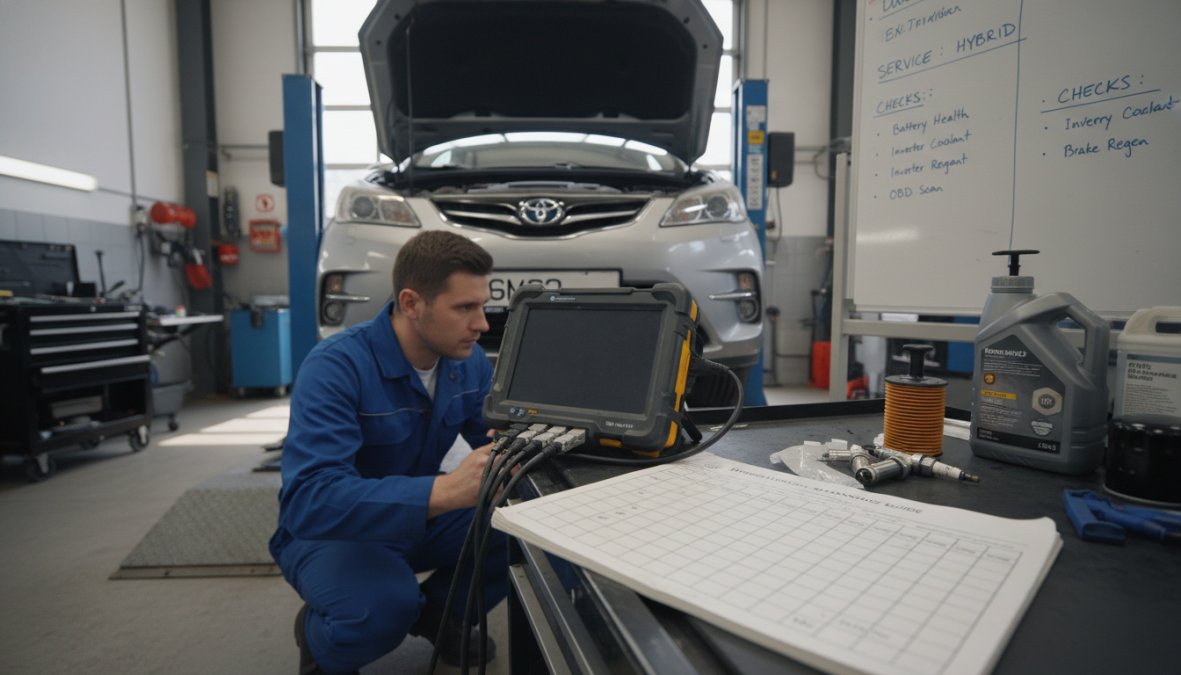
A certified hybrid technician has completed specific training covering high-voltage safety procedures, hybrid system architecture, and the manufacturer-level diagnostic software required to interrogate these vehicles properly. In practice, this means access to tools such as Toyota Techstream, Honda HDS, or equivalent dealer-level software that reads live data from every control module in the vehicle, not just the engine.
With the right equipment, a hybrid technician can:
Read state of health (SOH) data directly from the battery management system, identifying individual cells within the pack that are degrading faster than others
Assess inverter health through live temperature and current data, not just fault codes
Check regenerative braking calibration and confirm the blend between regenerative and friction braking is within specification
Verify that the thermal management system, both the inverter cooling circuit and the battery cooling circuit, is operating within the manufacturer's temperature range
Confirm that the high-voltage insulation resistance is within safe limits, a check that requires a dedicated insulation resistance tester and is entirely invisible to standard diagnostic tools
Insulation resistance testing is worth highlighting specifically. Over time, the insulation on high-voltage cables and components can degrade due to heat cycling, vibration, and age. A vehicle with degraded insulation may show no fault codes and drive normally, until a fault to chassis occurs, at which point the risk to anyone touching the vehicle increases sharply. This is a check that only specialist equipment can perform, and it is one that a non-specialist service will not include.
What This Means for Owners in Kettering
The practical implication is straightforward: choosing a service centre based on price alone, without confirming hybrid-specific expertise and equipment, is a false economy. A service that misses inverter coolant degradation, a failing battery cell, or deteriorating high-voltage insulation because the technician lacked the tools or training to find it is not a service, it is a liability.
For routine items that do not involve the high-voltage system, windscreen washer fluid, cabin air filters, visual tyre checks, DIY remains reasonable. The moment a task involves anything connected to the orange cables, the battery pack, the inverter, or the hybrid system warning lights, professional intervention is not a preference. It is the only safe option.
Key TakeawayA useful rule of thumb: if the component you are working near has an orange cable running to it, or if the task requires you to access the area under the rear seat or boot floor where the high-voltage battery typically sits, stop. Book a specialist. The cost of a professional inspection is a fraction of the cost of an inverter replacement, and an immeasurable fraction of the cost of a high-voltage injury.
Why Car Servicing Is Essential for Hybrid Vehicles: Cost of Ownership and Long-Term Value
Preventative maintenance on a hybrid vehicle is not a cost. It is an investment with a calculable return. The high-voltage battery is the most expensive component to replace, and regular SOH monitoring, thermal management upkeep, and correct charging habits can meaningfully extend its service life.
The cost of ownership argument for hybrids rests on fuel efficiency and lower running costs. That argument only holds if the vehicle is maintained correctly. A hybrid with a degraded battery, neglected inverter cooling, and worn brake discs is not delivering the fuel efficiency its owner expects, and it is accumulating repair costs that will eventually outweigh the fuel savings.
Warranty coverage is the other financial consideration. Most hybrid battery warranties in the UK require documented service history with a competent service provider. An owner who has skipped services or used a non-specialist garage may find that a battery warranty claim is contested on the grounds of inadequate maintenance. The cost of regular specialist servicing is trivial compared to an out-of-warranty battery replacement.
Long-term performance and resale value are also directly tied to service history. A hybrid with a complete, specialist service record commands a stronger resale price than one with gaps or generic servicing entries. Buyers of used hybrids are increasingly aware of battery condition, and a documented SOH history is a genuine differentiator.
Conclusion: Keep Your Hybrid Running at Its Best in Kettering
Hybrid vehicles demand more from their owners than conventional cars, not more effort, but more informed decisions about who services them and when. The consequences of getting this wrong range from reduced fuel efficiency to expensive component failures and voided warranty coverage.
Kettering Motorist Centre provides specialist servicing for hybrid and electric vehicles across Kettering and Northamptonshire, with the diagnostic expertise and equipment to address every aspect of hybrid maintenance correctly. Booking is straightforward through the hassle-free online system, with no upfront payment required, and the transparent approach means you know exactly what is being done and why. Book your MOT or hybrid service with Kettering Motorist Centre and protect the long-term performance and value of your vehicle.
Frequently Asked Questions
Do hybrid cars need more maintenance than regular cars?
Hybrid cars do not necessarily need more maintenance than regular internal combustion engine vehicles, but they do need different maintenance. Components like the high-voltage battery, inverter cooling system, and regenerative braking system require specialist attention that standard garages may not provide. Following your manufacturer recommendations and using a certified hybrid technician ensures your powertrain stays in peak condition without unnecessary extra cost.
How often should a hybrid car be serviced?
Most hybrid vehicles follow a hybrid car maintenance schedule similar to conventional cars — typically every 12 months or every 10,000 to 12,000 miles, whichever comes first. However, specific checks such as coolant flush intervals, transmission fluid changes, and high-voltage battery health assessments may follow different mileage intervals. Always refer to your vehicle's handbook and consult a specialist who understands hybrid-specific service requirements.
What are the most common signs your hybrid needs service?
Key signs your hybrid needs service include a dashboard warning light related to the hybrid system, reduced fuel efficiency, unusual noises during braking (which may indicate a regenerative braking issue), sluggish acceleration, and a noticeable drop in electric-only range. If your battery charge depletes faster than usual, this could signal battery degradation. Addressing these signs early helps prevent costly repairs and protects your warranty coverage.
Is hybrid car maintenance more expensive than for petrol or diesel cars?
Overall cost of ownership for hybrids is often comparable to or lower than traditional vehicles, largely due to better fuel efficiency and less brake pad wear thanks to regenerative braking. However, certain specialist services — such as high-voltage battery diagnostics or inverter cooling system maintenance — can cost more if carried out incorrectly. Choosing a garage with certified hybrid technicians and proper specialized diagnostic tools helps keep costs predictable and fair.
Do hybrid batteries need special maintenance?
Yes. Hybrid high-voltage batteries benefit from regular state of health (SOH) checks to monitor battery degradation over time. Thermal management systems that regulate battery temperature also need periodic inspection, especially in climates with extreme heat or cold. Plug-in hybrid (PHEV) owners should additionally ensure charging systems and connections are checked during each service. Preventative maintenance by a qualified technician is the most effective way to extend battery life.
Your booking Failed
Please try again or please call 01536 410142
Thank you for placing a booking with Kettering Motorist Centre Limited for vehicle
PLEASE TAKE YOUR BOOKING REFERENCE NUMBER WITH YOU TO THE MOT CENTRE
Your items
MOT Test
×
Terms and Conditions
These terms and conditions form the basis on which you can visit and use this website. Please read them carefully as they contain important information.
General terms and conditions
This website is owned and operated by Kettering Motorist Centre Ltd (company registration number: 4485858) operating at Trafalgar Road, Kettering, Northamptonshire, NN16 8DB (the "MOT Centre", the "Company", "we" or "us"). If you have any queries about these terms and conditions or if you have any comments or complaints on or about this website, you can contact us at [email protected] or 01536 410142.
The website is to promote and offer for sale the products and services of Kettering Motorist Centre Limited.
1. The contract between us
This website does not take payment for products or services online. The website enables you to view products and services online and to make a booking for later delivery and payment. The vehicle and provision of other products and services promoted by this website and the payment by you of the price of those products and services will take place at the MOT Centre. The booking does not constitute a contract.
The booking process on the site provides details of the booked MOT order. Please take the time to read and check your booking. It is your responsibility to make sure the order is correct and for the correct vehicle.
2. Ownership of rights
All rights, including copyright, in this website are owned by or licensed to the Company. Any use of this website or its contents, including copying or storing it or them in whole or part, other than for your own personal, non commercial use, is prohibited without our permission. You may not modify, distribute or repost anything on this website for any purpose.
3. Accuracy of content
We have taken care in the preparation of the content of this website, in particular to ensure that prices quoted are correct at the time of publishing and that all goods have been fairly described. However, bookings will only be accepted if there are no material errors in the description of the goods or their prices as advertised on this website. Any weights, dimensions and capacities given about the goods are approximate only.
4. Damage to your computer
We try to ensure that this website is free from viruses or defects. However, we cannot guarantee that your use of this website or any websites accessible through it will not cause damage to your computer. It is your responsibility to ensure that the right equipment is available to use the website. Except in the case of negligence on our part, we will not be liable to any person for any loss or damage which may arise to computer equipment as a result of using this website.
5. Availability
All bookings are subject to acceptance and availability. If the MOT date you have requested are is not available, the Centre will contact you by e-mail or phone. You will have the option either to wait until another slot is available or to cancel your booking.
6. Booking errors
You are able to correct errors on your booking up to the point on which you click on “Place Booking” during the booking process.
7. Price
The prices payable for goods that you order are as set out in our website. All prices are inclusive of VAT at the current rates and are correct at the time of entering information, errors and omissions excepted.
Whenever it is not possible to accept your booking to buy goods of the specification and description at the price indicated, the MOT Centre will advise you by email or phone or when you visit the centre.
8. Payment terms
You will be required to pay for the goods or services to the Centre at time of a completed MOT.
9. Delivery charges
N/A
10. Cancellation
The MOT Centre reserves the right to cancel the booking if:
10.1 There is insufficient stock to deliver the goods you have booked.
10.2 One or more of the goods you booked was listed at an incorrect price.
If your booking is cancelled the Centre will notify you by e-mail or phone.
You have the right to cancel your booking at any time up to the point of the MOT. If you do cancel your booking you should inform the centre by phone.
11. Liability
Notwithstanding the foregoing, nothing in these terms and conditions is intended to limit any rights you might have as a consumer under applicable local law or other statutory rights that may not be excluded nor in any way to exclude or limit our liability to you for any death or personal injury resulting from our negligence.
12. Notices
Unless otherwise expressly stated in these terms and conditions, all notices from you to us must be in writing and sent to our contact address given above and all notices from us to you will be displayed on our website from time to time.
13. Changes to legal notices
We reserve the right to change these terms and conditions from time to time and you should look through them as often as possible.
14. Law, jurisdiction and language
This website, any content contained therein and any contract brought into being as a result of usage of this website are governed by and construed in accordance with English law. Parties to any such contract agree to submit to the exclusive jurisdiction of the courts of England and Wales.
15. Invalidity
If any part of these terms and conditions is unenforceable (including any provision in which we exclude our liability to you) the enforceability of any other part of these conditions will not be affected.
16. Privacy
You acknowledge and agree to be bound by the terms of our privacy policy
17. Third party rights
Nothing in this Agreement is intended to, nor shall it confer any rights on a third party.