Knowing what is included in a full car service is something every driver should understand before handing over their keys. This guide from Kettering Motorist Centre covers every check, fluid, filter, and component inspection that forms part of a comprehensive full service, so you can walk into any garage in Kettering, Northamptonshire with confidence. Most drivers assume a service is just an oil change. It is not, and that misunderstanding costs people money every year. Below, we will show you exactly what a full service covers, how it differs from an interim or major service, and the warning signs that tell you your car needs attention now.
A full car service is a thorough inspection and maintenance procedure covering a vehicle's engine, brakes, tyres, suspension, electrical systems, and all critical fluid levels. It goes well beyond a basic oil and filter change to include checks that directly affect vehicle safety and long-term reliability.
Here is what most guides get wrong: they list items without explaining why each one matters. This guide does both.
What Is a Full Car Service and Why Does It Matter?
A full car service is a scheduled preventative maintenance procedure in which a certified mechanic inspects, tests, and replaces components across all major vehicle systems to ensure the car operates safely and efficiently.
The distinction between "service" and "repair" is important. A repair fixes something already broken. A service catches problems before they become failures. Preventative maintenance is significantly cheaper than emergency repair work, and according to the UK government's vehicle safety guidance, poorly maintained vehicles are a leading factor in roadside breakdowns and avoidable accidents.
Regular servicing also protects your warranty. Most manufacturer warranties require evidence of scheduled maintenance at specified intervals. Skip a service, and you may find a warranty claim rejected when you need it most.
For drivers in Kettering and the surrounding Northamptonshire area, where rural roads and variable weather put additional strain on suspension, tyres, and braking systems, keeping to a service schedule is not optional. It is sound financial sense.
Key TakeawayA full car service is not just an oil change. It is a comprehensive safety and maintenance check covering dozens of individual components, and it is the single most effective way to prevent costly breakdowns.
Interim vs Full Service: Understanding the Difference
The popular advice here is to "just get whatever the garage recommends." That is not good enough. Understanding the three service tiers means you can make an informed decision based on your mileage, driving habits, and vehicle age.
Service Type
Typical Interval
Checks Included
Best For
Interim Service
Every 6 months or 6,000 miles
Oil, filter, fluid top-ups, basic safety checks
High-mileage drivers
Full Service
Every 12 months or 12,000 miles
All interim checks plus brakes, tyres, suspension, filters, electrics
Most drivers
Major Service
Every 24 months or 24,000 miles
All full service checks plus spark plugs, transmission fluid, timing belt review
Older vehicles, high mileage
Interim Service: What It Covers
An interim service is a lighter check designed for drivers who cover high mileage and need more frequent oil changes between full services. A typical interim service includes an engine oil and oil filter change, a check of all fluid levels (brake fluid, coolant, windscreen wash), tyre pressure and tread depth inspection, and a visual check of the exhaust system and lights.
It is not a substitute for a full service. Think of it as maintenance between maintenance.
Full Service: What It Covers
A full service includes everything in the interim service plus a significantly broader range of inspections. This is where what is included in a full car service becomes genuinely comprehensive: brake pads, brake discs, suspension components, steering components, the air filter, pollen filter, battery testing, a diagnostic scan for fault codes, and a detailed check of all warning lamps.
Most drivers on a standard 12-month or 12,000-mile schedule should use a full service as their primary maintenance appointment.
Major Service: When You Need the Full Works
A major service adds to the full service by addressing components with longer wear cycles. Spark plugs are replaced. Transmission fluid is changed. The timing belt or chain is inspected, and in many cases replaced if it is approaching the manufacturer's recommended interval. For any vehicle over four years old or approaching 50,000 miles, a major service is worth the additional investment.
A common mistake is skipping the major service to save money short-term, then facing a timing belt failure that can destroy an engine entirely.
Complete Car Service Checklist: Every Check Explained
Every full service follows a structured checklist. The specific items vary slightly by vehicle make and model, but the core checks remain consistent across most manufacturers.
Software tools interface for certified and mechanic and well-lit concepts for what is included in a full car service
Fluids and Filters
Fluid condition and filter cleanliness are the foundation of any car service checklist. Here is what a full service covers in this category:
Engine oil: Drained and replaced with the correct viscosity grade for the vehicle
Oil filter: Replaced at every service to prevent contaminated oil circulating through the engine
Air filter: Inspected and replaced if clogged, which directly affects fuel efficiency and engine performance
Pollen filter (cabin air filter): Checked and replaced if blocked, improving air quality inside the vehicle
Brake fluid: Tested for water contamination using a moisture tester; replaced if the boiling point has dropped below safe levels
Coolant: Level checked and concentration tested to ensure adequate freeze and boil protection
Transmission fluid: Inspected on full and major services; degraded fluid accelerates gearbox wear
Power steering fluid: Checked for level and condition
Fluid checks are where many budget services cut corners. Always confirm that brake fluid testing, not just a visual level check, is included.
Watch OutSkipping brake fluid replacement when moisture contamination is detected can cause brake fade under hard braking. Brake fluid absorbs water over time, which lowers its boiling point and reduces stopping power in exactly the situations where you need it most.
Brakes, Tyres, and Suspension
Brake pad and brake disc wear are measured against manufacturer tolerances. Pads are measured for remaining thickness; discs are checked for scoring, warping, and minimum thickness. A full service will also check brake callipers for seizure and brake lines for corrosion or leaks.
Tyre pressure is set to the manufacturer's specification for the vehicle's load rating. Tread depth is measured across the tyre width at multiple points. The legal minimum in the UK is 1.6mm, but most tyre safety organisations recommend replacement at 3mm for wet weather safety, as documented by the UK's Tyre Safety Month guidance.
Suspension components, including shock absorbers, springs, anti-roll bar bushes, and ball joints, are inspected visually and by feel during a road test. Worn suspension affects handling, tyre wear, and braking distance.
Electrical Systems and Diagnostic Scan
A diagnostic scan connects to the vehicle's OBD-II port to read stored fault codes across all electronic control units. This is one of the most valuable parts of a full service because it surfaces problems that have not yet triggered a warning lamp on the dashboard.
Battery testing uses a conductance tester to measure cold cranking amps and state of health. A battery that tests poorly in summer will very likely fail in winter. All warning lamps are checked for correct operation. Lights, indicators, and horn are tested. On vehicles with advanced driver assistance systems, sensors may be checked for obstruction or calibration drift.
How Long Does a Car Service Take?
A full car service typically takes between two and four hours at a professional garage. But that headline figure tells you very little about what is actually happening during those hours, or why the time can vary so significantly between vehicles and garages. Understanding the workflow helps you plan your day and sets realistic expectations for what a thorough service actually involves.
All interim checks plus brakes, suspension, electrics, diagnostic scan
Major Service
3 - 5 hours
All full service checks plus spark plugs, transmission fluid, timing belt inspection
Full Service + MOT
3 - 5 hours combined
Sequential or parallel workflow depending on garage capacity
These ranges assume a vehicle in reasonable condition. If the mechanic identifies worn brake pads, a failing battery, or a fault code during the diagnostic scan, additional time will be needed to discuss findings with you and carry out any approved repair work.
What Actually Happens During a Full Service: The Workflow
Most drivers hand over their keys and receive a call a few hours later. Very few understand what happens in between. Here is the sequence a professional garage follows during a full service:
1. Vehicle intake and initial inspection (15 - 20 minutes) The mechanic records the current mileage, checks for any pre-existing damage, and reviews the service history to identify which manufacturer-specified items are due. This step is where a garage using OEM repair data, such as Snap-on ShopKey Pro or Autodata, will cross-reference the vehicle's make, model, and mileage against the manufacturer's specific service schedule rather than applying a generic checklist.
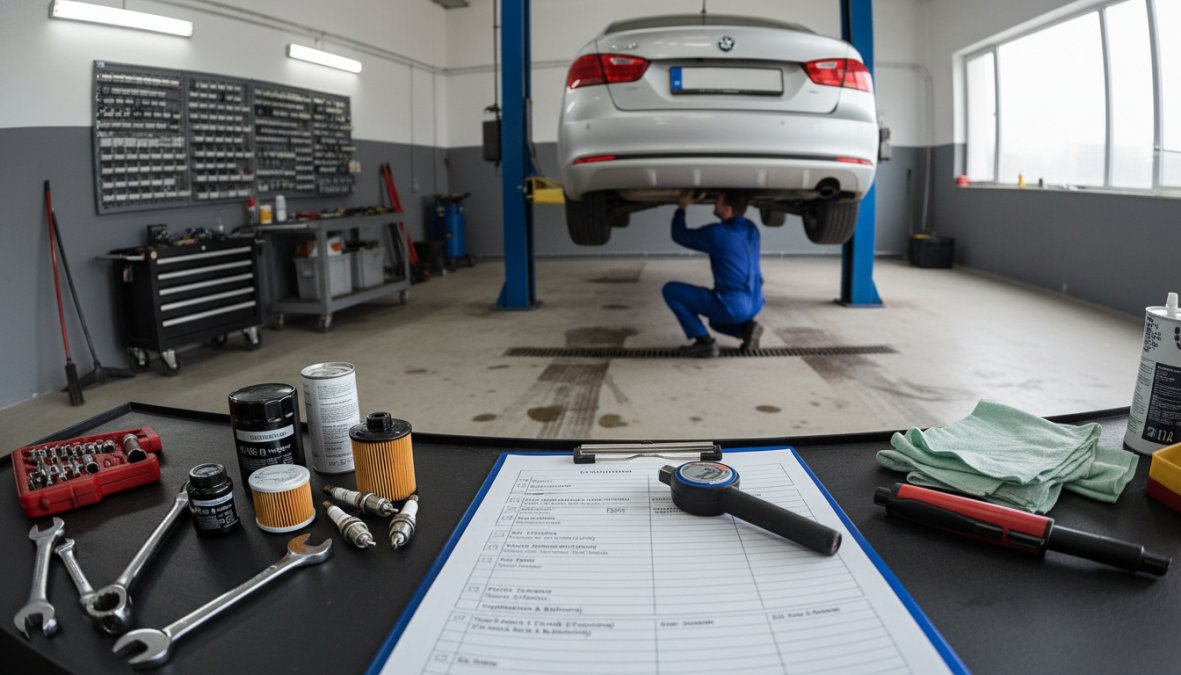
2. Vehicle raised on a lift (ongoing throughout) A proper inspection of brake lines, suspension components, exhaust system, and underside corrosion requires the vehicle to be raised. Checks done only from above or with the vehicle on the ground will miss corrosion on brake pipes, leaking shock absorber seals, and worn anti-roll bar bushes, all of which are safety-critical.
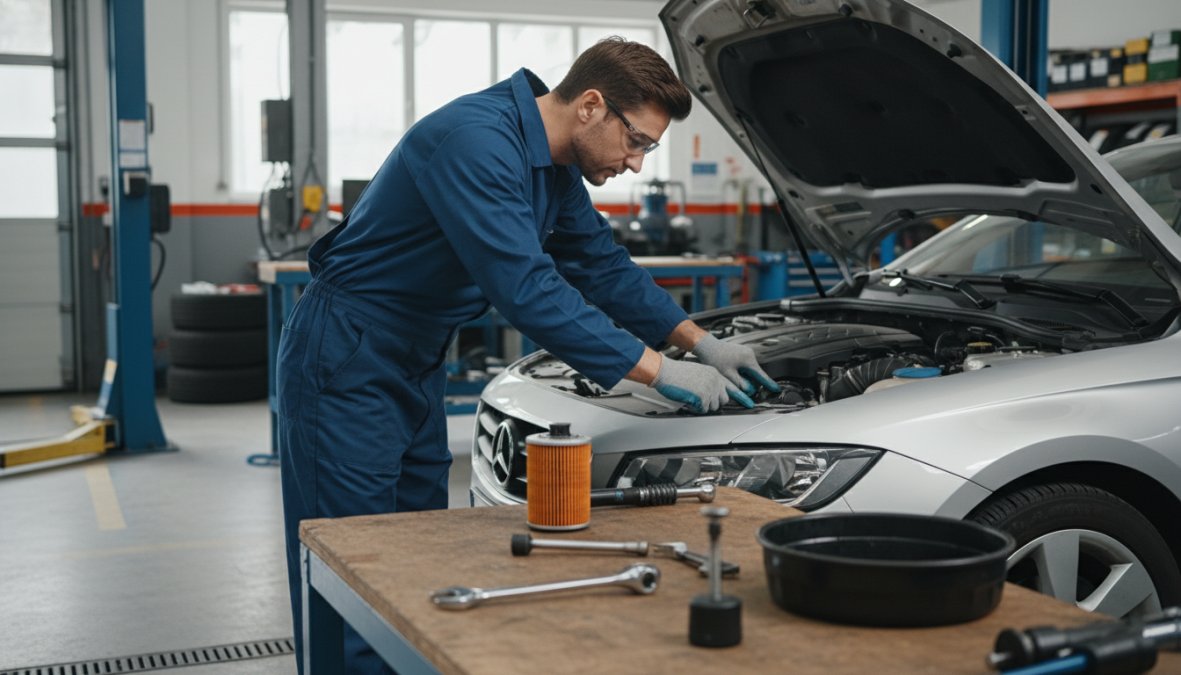
3. Fluid drain and filter removal (20 - 30 minutes) Engine oil is drained while the vehicle is warm to ensure complete drainage. The oil filter is removed. On a full service, the air filter and pollen filter are also removed for inspection. Brake fluid is drawn from the reservoir for moisture testing using a dedicated tester, not just a visual level check.
4. Component inspection (45 - 90 minutes) This is the most time-variable stage. Brake pad thickness is measured with a calliper gauge against the manufacturer's minimum. Disc thickness and surface condition are checked. Tyre tread depth is measured at multiple points across the tread width. Suspension components are inspected for play, corrosion, and rubber degradation. Lights, indicators, horn, and wiper blades are tested.
5. Diagnostic scan (15 - 20 minutes) The OBD-II port is connected to a diagnostic tool that reads stored fault codes from all electronic control units, engine, transmission, ABS, airbag, and any advanced driver assistance systems fitted to the vehicle. This step surfaces faults that have not yet triggered a dashboard warning lamp. Battery health is tested using a conductance tester, which measures cold cranking amps and state of health rather than just voltage.
6. Fluid refill and filter installation (15 - 20 minutes) Fresh engine oil of the correct viscosity grade for the vehicle is added. New filters are installed. Fluid levels are topped up to specification. Tyre pressures are set to the manufacturer's recommended figure for the vehicle's load rating, not a generic pressure.
7. Road test and final check (15 - 30 minutes) A short road test confirms that the brakes operate correctly, the steering feels accurate, and no new warning lamps have illuminated following the service. The service interval indicator is reset. The service record is stamped or updated digitally.
8. Customer communication and handover A transparent garage will provide a written report of everything inspected, the condition found, and any advisory items, work that is not yet urgent but should be monitored or addressed at the next service. This report is your record of what was checked and when.
Why Some Services Take Longer Than Others
Several factors extend service time beyond the standard range:
Vehicle age and condition: Corroded fasteners on brake callipers or oil drain plugs take significantly longer to remove safely than those on a newer vehicle.
Manufacturer complexity: Some vehicles require specific procedures for oil filter access, air filter housing removal, or battery registration after replacement. A garage with access to manufacturer-specific repair data handles these correctly; one working from a generic checklist may not.
Additional work approval: If the mechanic identifies worn brake pads or a failing component, the garage should contact you before carrying out any additional work. This communication step adds time but is a mark of a trustworthy garage. A garage that carries out unapproved work and presents you with a larger bill at collection is one to avoid.
Combined MOT appointment: When a full service and MOT are booked together, the total time depends on whether the garage runs them sequentially or in parallel. Many garages can run the MOT while the service is in progress, keeping the combined time closer to three hours than five.
Pro TipBook your service for early morning drop-off. This gives the garage the full working day to complete the service, carry out any approved additional work, and contact you with findings before you need to collect the vehicle. Same-day collection is realistic for most full services booked before 9am.
What to Do While Your Car Is Being Serviced
Most professional garages in Kettering and the surrounding area offer a waiting area with refreshments for shorter appointments. For a full service, many customers prefer to drop the vehicle off and arrange collection later in the day. Some garages offer a courtesy car or a collection and delivery service, worth asking about when booking if you need to remain mobile during the day.
If you are waiting at the garage, a reputable service centre will provide an update partway through the appointment if any advisory items or additional work are identified, rather than presenting everything at collection when you have less time to ask questions.
The Benefits of Regular Car Servicing
Regular servicing delivers three concrete outcomes: improved safety, lower long-term costs, and a measurable impact on resale value. Most guides stop at the first two. This section covers all three in the depth they deserve.
Safety: The Checks That Prevent Accidents
The safety case for regular servicing is not abstract. Brake pads worn below the manufacturer's minimum thickness increase stopping distances in a way that is not perceptible to the driver until an emergency stop reveals the difference. Shock absorbers that have lost damping efficiency allow the tyre to bounce on uneven surfaces, reducing the contact patch available for braking and cornering. A blocked air filter reduces the oxygen available for combustion, which affects throttle response and, in turbocharged engines, can cause the turbo to work harder than designed.
Each of these failures develops gradually. A driver who covers 12,000 miles between services will not notice the incremental degradation. A mechanic who measures brake pad thickness against the manufacturer's minimum, tests shock absorber rebound with a calibrated bounce test, and reads a diagnostic scan for misfires or boost pressure faults will catch the problem before it becomes a hazard.
According to the RAC's breakdown data and vehicle maintenance guidance, a significant proportion of roadside breakdowns are attributable to maintenance items that would have been identified during a routine service, battery failure, tyre blowouts, and cooling system failures among the most common.
Long-Term Cost: Why Prevention Is Always Cheaper Than Repair
The cost comparison between preventative servicing and reactive repair is not close. Consider the chain of failure that follows a missed oil change:
Engine oil degrades past its service life, losing viscosity and contaminating with combustion by-products.
Oil pressure drops as the oil becomes less effective at forming a hydrodynamic film between moving metal surfaces.
Bearing surfaces in the crankshaft and camshaft begin to wear at an accelerated rate.
In the worst case, sludge formation blocks oil galleries, causing localised oil starvation and catastrophic engine damage.
An oil and filter change during a full service costs a fraction of even a partial engine rebuild. The same logic applies to coolant maintenance: a cooling system that is not flushed at the correct interval develops internal corrosion, which can lead to a head gasket failure, one of the most expensive non-engine-replacement repairs a vehicle can require.
Fuel efficiency is a secondary but real financial benefit. A clean air filter allows the engine management system to maintain the correct air-to-fuel ratio. Fresh engine oil of the correct viscosity reduces internal friction. Both factors contribute to improved fuel economy, which partially offsets the cost of the service itself over the following 12 months of driving.
Service History and Resale Value: The Financial Case Most Guides Ignore
This is the benefit that most service guides fail to quantify, and it is the one with the most direct financial impact for the majority of drivers who will eventually sell their vehicle.
A complete, stamped service history, whether in a physical logbook or a verified digital record, is one of the strongest signals a used car buyer has that a vehicle has been maintained correctly. Private buyers and trade buyers alike use service history to assess risk. A car with a full service history from a recognised garage is a lower-risk purchase than an identical car with gaps in its record, and the market prices that risk accordingly.
The practical impact works in two directions:
When you sell: A verifiable service history reduces the buyer's ability to negotiate the price down on the grounds of unknown maintenance history. It also widens your pool of buyers, because many private buyers and all reputable dealers will walk away from a vehicle with no service record rather than take on the uncertainty.
When you buy: Understanding service history means you can identify whether a vehicle has been maintained to the manufacturer's schedule or whether corners have been cut. A car serviced every 6,000 miles by an independent garage with stamped records is a better buy than one with a single dealer stamp at 18,000 miles, even if the asking prices are similar.
For drivers who want to maintain a verifiable digital record between physical stamps, apps such as Drivvy and MyCarNeedsA allow you to log service dates, mileage, and work carried out. These do not replace a stamped logbook for resale purposes, but they provide a useful personal maintenance record and reminder system.
Key TakeawayThe financial case for regular servicing is strongest when you consider the full ownership cycle, not just the cost of the service itself. A complete service history protects the resale value of a vehicle that may be worth tens of thousands of pounds. The cost of skipping a service is not just the repair bill when something fails, it is also the negotiating leverage you hand to every future buyer.
According to the Society of Motor Manufacturers and Traders, vehicles with consistent maintenance records demonstrate higher roadworthiness standards and pass their MOT test at a higher rate than those with gaps in their service history. That correlation is not coincidental: the same discipline that produces a complete service record also produces a vehicle that is mechanically sound when it reaches the MOT bay.
Pro TipBook your full service and MOT test together. Many garages, including Kettering Motorist Centre, can combine both appointments, saving you time and ensuring that any items flagged during the service are addressed before the MOT inspection.
Warning Signs Your Car Needs a Service Now
Do not wait for the service interval light to act. Several warning signs indicate your vehicle needs attention immediately, regardless of when the last service was.
Professional illustration showing what is included in a full car service
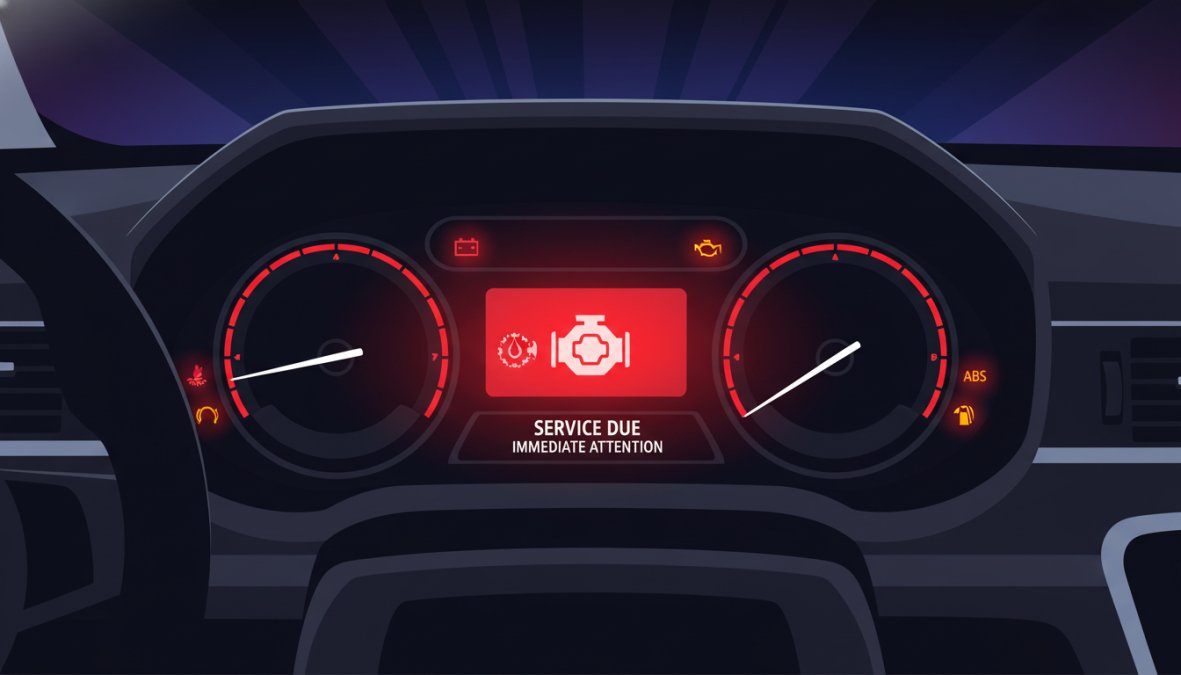
Warning lamps: Any illuminated warning lamp on the dashboard should be investigated promptly. The check engine light, oil pressure warning, and brake system warning are the three that require the fastest response.
Unusual noises: Grinding when braking indicates worn brake pads contacting the disc. Knocking from the suspension suggests worn bushes or shock absorbers. A rattling exhaust system needs inspection before it fails completely.
Fluid leaks: Any puddle under a parked car, whether oil, coolant, or brake fluid, is a reason to book a vehicle health check immediately.
Changes in handling or braking: If the car pulls to one side under braking, takes longer to stop, or feels vague through the steering, do not delay. These are safety-critical symptoms.
Excessive fuel consumption: A sudden increase in fuel use often points to a blocked air filter, degraded engine oil, or a fault detected in the diagnostic scan.
Smoke from the exhaust: Blue smoke indicates burning oil. White smoke can signal coolant entering the combustion chamber. Both require urgent investigation.
The thing nobody tells you about warning signs is that multiple small symptoms appearing together often point to a single underlying cause. A diagnostic scan will identify it faster than guessing.
Service History, Resale Value, and DIY vs Professional Servicing
How a Full Service History Affects Resale Value
A complete, stamped service history is one of the most undervalued assets on a used car. Buyers and dealers use service records to assess how a vehicle has been maintained, and a car with verifiable service history consistently commands a higher price than an identical car without one.
The logbook service record, whether physical or digital, tells the story of the car's maintenance. Each entry shows the date, mileage, and work carried out. Gaps in the record raise questions. A complete record builds buyer confidence and reduces negotiating use for anyone trying to lower the price.
For drivers who want to track their service history digitally, apps such as CARFAX Car Care and Drivvo offer automatic service history population and customisable maintenance reminders. CARFAX Car Care is particularly useful for maintaining a verifiable service log, as it automatically pulls service records from participating garages.
DIY vs Professional Servicing: Which Is Right for You?
The honest answer is that DIY servicing is appropriate for a narrow range of tasks and a specific type of driver. Changing engine oil and an oil filter at home is achievable with basic tools and the correct oil grade. Checking and topping up fluid levels is straightforward. Replacing an air filter on most vehicles takes minutes.
Where DIY falls short is on anything requiring calibrated equipment. Brake fluid moisture testing, battery conductance testing, and a full diagnostic scan all require tools that most home mechanics do not own. Suspension inspection requires a lift or ramp for a proper view of all components. And critically, a DIY service does not produce a stamped service record, which means it does not contribute to your vehicle's service history in any way a future buyer can verify.
For drivers in Kettering looking for a professional full service with a transparent process and no-obligation online booking, professional servicing is the clear choice for maintaining both vehicle safety and resale value.
Watch OutDIY oil changes that use the incorrect viscosity grade, or that leave the old oil filter in place, can cause engine damage within a few thousand miles. Always cross-reference the vehicle handbook before purchasing oil or filters.
Manufacturer-Specific Service Schedules
Every manufacturer publishes a service schedule in the vehicle handbook, specifying which components should be checked or replaced at each mileage or time interval. These schedules differ significantly between brands and even between models within the same brand.
For example, some manufacturers specify a spark plug replacement interval of 30,000 miles; others extend this to 60,000 miles or more on iridium-tipped plugs. Timing belt replacement intervals vary from 40,000 to over 100,000 miles depending on the engine design. Using a generic service schedule rather than the manufacturer's specific recommendations is a common mistake that leads to either premature replacement (wasted money) or delayed replacement (component failure).
Professional tools such as Snap-on ShopKey Pro give certified mechanics access to OEM repair information and factory-recommended maintenance schedules for specific vehicles, which is why a professional service is more likely to follow the correct manufacturer schedule than a generic checklist. As documented in the RAC's vehicle maintenance guidance, following manufacturer-specific intervals is the most reliable way to maintain a vehicle's mechanical integrity over its full service life.
For electric and hybrid vehicles, the service schedule differs further. There is no engine oil to change, but brake fluid, coolant, cabin air filters, and tyre condition still require regular attention. Battery health monitoring becomes a priority check. Kettering Motorist Centre provides specialist servicing for electric and hybrid vehicles, covering the specific maintenance requirements these vehicles demand.
Understanding what is included in a full car service is the first step. Acting on that knowledge is what keeps your vehicle safe and your costs predictable.
Drivers across Kettering and Northamptonshire who want a professional, transparent full service without the uncertainty of what will be found or charged should book with a garage that communicates clearly at every stage. Kettering Motorist Centre is a family-run business offering expert diagnostic and repair services, specialist expertise for electric and hybrid vehicles, and a hassle-free online booking system with no upfront payment required. Book your MOT or full service online today and keep your vehicle in the condition it deserves.
Frequently Asked Questions
What is the difference between an interim and a full car service?
An interim service is a lighter check typically recommended every 6 months or 6,000 miles, covering essentials like engine oil, oil filter, and tyre pressure. A full car service goes much further — inspecting brake pads, brake discs, coolant, air filter, pollen filter, steering components, suspension, exhaust system, and more. It is generally recommended annually or every 12,000 miles and provides a much more thorough vehicle health check.
How long does a full car service take?
A full car service typically takes between 3 and 4 hours, though this can vary depending on the vehicle, its age, and whether any additional repairs are identified during the inspection. If a diagnostic scan reveals fault codes or worn components such as brake pads or spark plugs that need replacing, the service time may extend. It is worth booking in advance and planning for a full half-day.
Is a full car service the same as an MOT test?
No — a full car service and an MOT test are two different things. An MOT is a legal roadworthiness test that checks your vehicle meets minimum safety and emissions standards. A full car service is preventative maintenance carried out by a certified mechanic to keep your car running efficiently and safely. A service often catches wear and tear issues before they become MOT failures, so having both is strongly recommended.
Why is a full service history important for my car?
A complete service history — recorded in your logbook service record or digitally — demonstrates that your vehicle has been properly maintained at the correct service intervals. This builds buyer confidence and can meaningfully increase resale value. It also helps a mechanic identify recurring issues and ensures your warranty remains valid. Cars with a full service history are generally considered lower risk and more reliable by used car buyers and dealers alike.
How often should you get a full car service?
Most manufacturers recommend a full car service once a year or every 12,000 miles, whichever comes first. However, manufacturer-specific schedules vary — some modern vehicles with variable service intervals may extend this to 18,000 miles or more. Always consult your owner's manual or ask a certified mechanic for guidance based on your specific make, model, and driving habits to determine the right service interval for your car.
Does a full car service include repairs?
A standard full car service covers inspection, adjustment, and replacement of routine consumables such as engine oil, oil filter, and air filter. If a mechanic identifies additional issues — such as worn brake pads, low brake fluid, or failing spark plugs — these will typically be quoted as separate repair items for your approval. A service is primarily a preventative maintenance check, not an all-inclusive repair package.
Your booking Failed
Please try again or please call 01536 410142
Thank you for placing a booking with Kettering Motorist Centre Limited for vehicle
PLEASE TAKE YOUR BOOKING REFERENCE NUMBER WITH YOU TO THE MOT CENTRE
Your items
MOT Test
×
Terms and Conditions
These terms and conditions form the basis on which you can visit and use this website. Please read them carefully as they contain important information.
General terms and conditions
This website is owned and operated by Kettering Motorist Centre Ltd (company registration number: 4485858) operating at Trafalgar Road, Kettering, Northamptonshire, NN16 8DB (the "MOT Centre", the "Company", "we" or "us"). If you have any queries about these terms and conditions or if you have any comments or complaints on or about this website, you can contact us at [email protected] or 01536 410142.
The website is to promote and offer for sale the products and services of Kettering Motorist Centre Limited.
1. The contract between us
This website does not take payment for products or services online. The website enables you to view products and services online and to make a booking for later delivery and payment. The vehicle and provision of other products and services promoted by this website and the payment by you of the price of those products and services will take place at the MOT Centre. The booking does not constitute a contract.
The booking process on the site provides details of the booked MOT order. Please take the time to read and check your booking. It is your responsibility to make sure the order is correct and for the correct vehicle.
2. Ownership of rights
All rights, including copyright, in this website are owned by or licensed to the Company. Any use of this website or its contents, including copying or storing it or them in whole or part, other than for your own personal, non commercial use, is prohibited without our permission. You may not modify, distribute or repost anything on this website for any purpose.
3. Accuracy of content
We have taken care in the preparation of the content of this website, in particular to ensure that prices quoted are correct at the time of publishing and that all goods have been fairly described. However, bookings will only be accepted if there are no material errors in the description of the goods or their prices as advertised on this website. Any weights, dimensions and capacities given about the goods are approximate only.
4. Damage to your computer
We try to ensure that this website is free from viruses or defects. However, we cannot guarantee that your use of this website or any websites accessible through it will not cause damage to your computer. It is your responsibility to ensure that the right equipment is available to use the website. Except in the case of negligence on our part, we will not be liable to any person for any loss or damage which may arise to computer equipment as a result of using this website.
5. Availability
All bookings are subject to acceptance and availability. If the MOT date you have requested are is not available, the Centre will contact you by e-mail or phone. You will have the option either to wait until another slot is available or to cancel your booking.
6. Booking errors
You are able to correct errors on your booking up to the point on which you click on “Place Booking” during the booking process.
7. Price
The prices payable for goods that you order are as set out in our website. All prices are inclusive of VAT at the current rates and are correct at the time of entering information, errors and omissions excepted.
Whenever it is not possible to accept your booking to buy goods of the specification and description at the price indicated, the MOT Centre will advise you by email or phone or when you visit the centre.
8. Payment terms
You will be required to pay for the goods or services to the Centre at time of a completed MOT.
9. Delivery charges
N/A
10. Cancellation
The MOT Centre reserves the right to cancel the booking if:
10.1 There is insufficient stock to deliver the goods you have booked.
10.2 One or more of the goods you booked was listed at an incorrect price.
If your booking is cancelled the Centre will notify you by e-mail or phone.
You have the right to cancel your booking at any time up to the point of the MOT. If you do cancel your booking you should inform the centre by phone.
11. Liability
Notwithstanding the foregoing, nothing in these terms and conditions is intended to limit any rights you might have as a consumer under applicable local law or other statutory rights that may not be excluded nor in any way to exclude or limit our liability to you for any death or personal injury resulting from our negligence.
12. Notices
Unless otherwise expressly stated in these terms and conditions, all notices from you to us must be in writing and sent to our contact address given above and all notices from us to you will be displayed on our website from time to time.
13. Changes to legal notices
We reserve the right to change these terms and conditions from time to time and you should look through them as often as possible.
14. Law, jurisdiction and language
This website, any content contained therein and any contract brought into being as a result of usage of this website are governed by and construed in accordance with English law. Parties to any such contract agree to submit to the exclusive jurisdiction of the courts of England and Wales.
15. Invalidity
If any part of these terms and conditions is unenforceable (including any provision in which we exclude our liability to you) the enforceability of any other part of these conditions will not be affected.
16. Privacy
You acknowledge and agree to be bound by the terms of our privacy policy
17. Third party rights
Nothing in this Agreement is intended to, nor shall it confer any rights on a third party.