Common MOT Failure Points 2026: What You Need to Know
Understanding common MOT failure points is essential for any UK vehicle owner. At Kettering Motorist Centre, we've helped hundreds of motorists understand exactly what DVSA inspectors look for during an MOT test. Most failures aren't surprises, they're preventable issues that drivers either miss or ignore until test day. Below, we'll walk you through the most common reasons vehicles fail their MOT and how to prevent each one.
Why Failure Rates Matter for Drivers
When a car fails its MOT, it signals that something on your vehicle isn't roadworthy. The DVSA (Driver and Vehicle Standards Agency) sets the standards, and test centres apply them consistently. Understanding common failure points means you can take action now rather than facing a retest fee and the stress of being unable to drive legally.
MOT Failure Rates UK 2026 and Key Trends
MOT failure rates remain relatively stable across the UK, though they vary by vehicle age and condition. Older vehicles naturally fail at higher rates than newer ones, simply because components wear out over time. In 2026, the most common reasons for failure remain linked to safety-critical systems: brakes, tyres, lighting, and suspension. Cars over 10 years old fail at significantly higher rates than those under five years old, particularly on emissions and structural integrity. The good news is that many of these failures are avoidable with basic preventive maintenance.
The 10 Most Common MOT Failure Points Explained
1. Brake System Performance and Wear
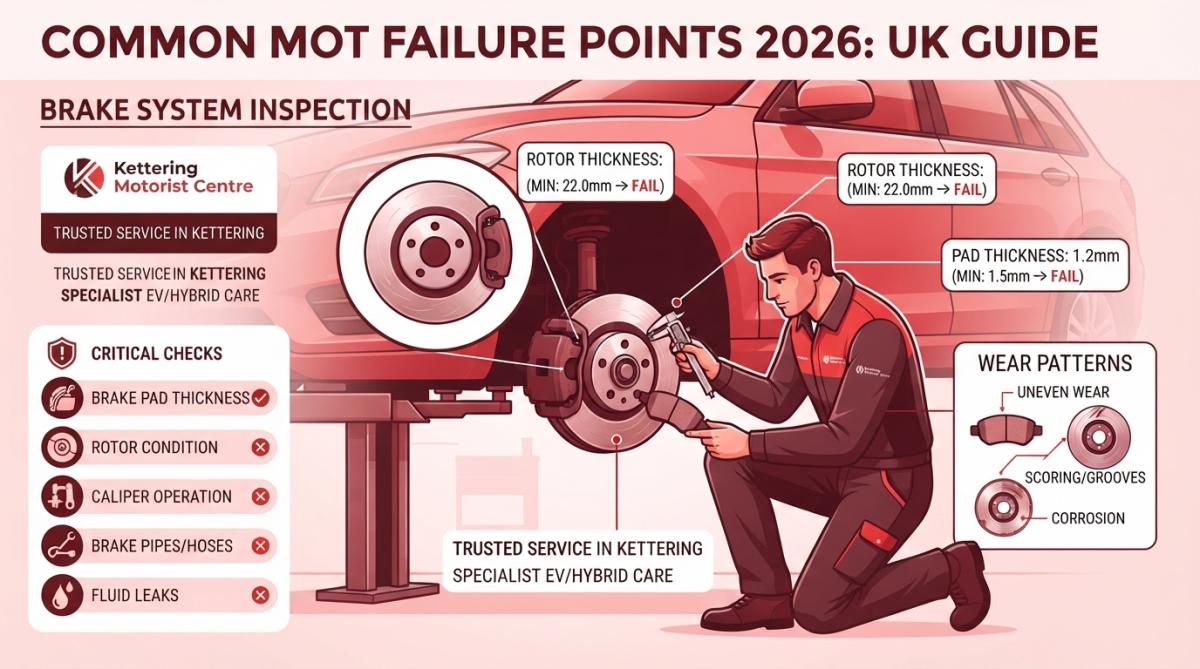
Brake failure is the single most common reason vehicles don't pass their MOT. The DVSA inspection requires brake pads with sufficient thickness, brake pipes free from corrosion and leaks, and an effective handbrake. During the test, inspectors measure brake efficiency using a rolling brake tester. Your vehicle must achieve a minimum threshold, and if either the service brake or handbrake falls short, you fail.
Brake pipes corrode from the inside out, particularly on older vehicles or those exposed to salt spray. A pre-MOT inspection from Kettering Motorist Centre can measure your brake pad thickness and inspect pipes for corrosion before test day.
What to check: Listen for grinding or squealing when braking. Feel for a soft or spongy brake pedal. Check that your handbrake holds the vehicle securely on a slope.
2. Tyre Condition and Tread Depth
Tyre failure is the second most common MOT issue. The UK legal minimum tread depth is 1.6mm across the central three-quarters of the tyre. Inspectors also look for cuts, bulges, uneven wear patterns, and sidewall damage. A tyre with adequate tread but visible damage will still fail.
What to check: Use a tread depth gauge or the penny test (insert a 1p coin into the tread; if you can see the top of the coin, your tread is below 1.6mm). Inspect the entire tyre surface for cuts, bulges, or uneven wear. Check tyre pressure monthly.
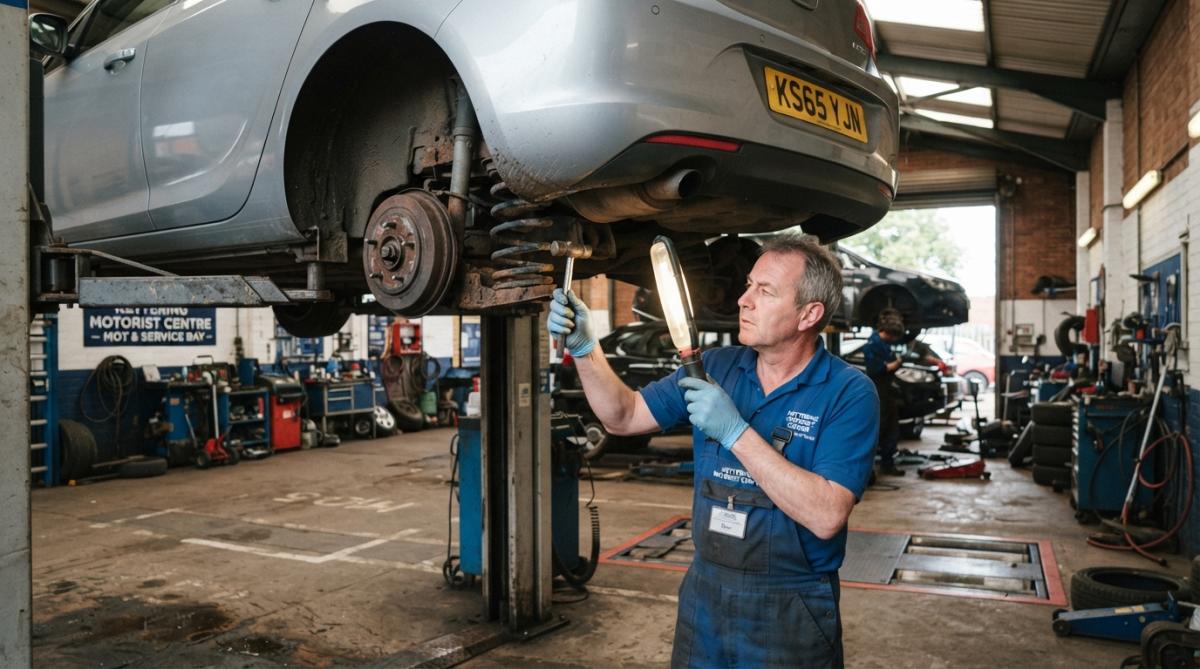
Mechanic measuring tyre tread depth with a digital gauge on a vehicle mounted on a lift, showing clear wear patterns on the tyre surface
3. Lighting and Signalling Issues
Headlamps, brake lights, indicators, and number plate lights must all work correctly. The DVSA test includes checks for headlamp aim, brightness, and colour. A blown bulb is an instant fail. Headlamp aim is critical, if your headlamps point too high or too low, you'll fail even if the bulbs are bright.
What to check: Turn on each light and walk around your vehicle to confirm everything works. Check headlamp aim by parking against a wall at night and observing where the beam falls. Test your number plate lights with a torch.
4. Suspension and Steering Faults
Suspension bushes, shock absorbers, and steering components are safety-critical. The DVSA inspection checks for excessive play in the steering wheel, worn suspension bushes, and leaking shock absorbers. A worn suspension bush might feel like a slight clunk when turning or going over bumps.
What to check: Listen for clunking sounds when turning corners or going over bumps. Feel for excessive movement in the steering wheel before the wheels respond. Visually inspect shock absorbers for fluid leaks.
5. Driver Visibility and Windscreen Obstructions
The DVSA requires that your windscreen is free from damage that impairs visibility. A chip or crack in the driver's line of sight is an automatic fail. Windscreen wipers must also work effectively and leave no unwiped areas.
What to check: Inspect your windscreen for chips or cracks in the driver's line of sight. Test your wipers at different speeds and check that they cover the full width without streaking. Clean your windscreen thoroughly before the test.
6. Exhaust and Emissions
Your vehicle must meet the Euro standard for its registration year. The DVSA uses a gas analyser to measure CO, CO₂, and other pollutants. If your engine management light is on or you've noticed poor fuel economy, you're at risk of failure. Exhaust leaks are also checked, a visible hole or rust perforation is a fail.
What to check: If your engine management light is on, have it diagnosed and cleared before your MOT. Get your vehicle serviced according to the manufacturer's schedule. Listen for rattling or holes in the exhaust as you drive.
7. Body and Structural Integrity
The DVSA checks for structural corrosion that affects safety, including rust that has eaten through the floor, sills, or other load-bearing parts. Surface rust is acceptable, but corrosion that creates holes or weakens the structure is not. Doors and bonnet must open and close properly. Seatbelts must be present and functional.
What to check: Look underneath your vehicle for holes or severe rust, particularly on the floor and sills. Check that all doors and the bonnet open and close smoothly. Test all seatbelts to ensure they lock and release properly.
Pre-MOT Checklist 2026: Avoid Failure Before Test Day
How to Conduct Your Own Pre-MOT Inspection
A thorough pre-MOT inspection takes about 30 minutes and can save you the cost and inconvenience of a retest. Start with the basics: lights, wipers, and tyres. Check all exterior lights: headlamps, brake lights, indicators, reversing lights, and number plate lights. Inspect your tyres for tread depth using a gauge or the penny test, and look for cuts or bulges.
Check your windscreen for chips or cracks in the driver's line of sight. Test your wipers at different speeds. Inspect the brake pads by looking through the wheel spokes, you should see at least 3mm of friction material. Test your brakes by driving slowly and feeling for responsiveness. Look under the vehicle for signs of leaks, corrosion, or damage. Shine a torch on the exhaust pipe and look for holes or rust perforation. Check the suspension by looking for fluid leaks on the shock absorbers.
What DVSA Inspectors Look For During Testing
DVSA inspectors follow a detailed inspection manual covering over 70 individual checks. The test takes about 45 minutes and covers everything from brake efficiency to emissions to structural integrity. The inspection begins with an exterior walk-around checking all lights, wipers, mirrors, and bodywork condition. Then the inspector moves to the underbody, checking the exhaust, suspension, and structural integrity. Next comes the brake test using a rolling brake tester to measure brake efficiency, followed by the emissions test. Finally, the inspector checks the interior: seatbelts, steering wheel play, dashboard warning lights, and the horn.
MOT Rules 2026 for Electric Vehicles: New Failure Points
EV-Specific MOT Failure Points and Battery Safety Checks
Electric vehicles face an evolving MOT landscape. The DVSA introduced specific checks for EVs in 2021, and these continue to develop in 2026. EVs have no traditional engine, so emissions testing doesn't apply. Instead, inspectors focus on battery safety, high-voltage systems, and the electric drivetrain.
Battery safety is paramount. The DVSA checks for signs of damage to the battery pack, corrosion of high-voltage connectors, and proper insulation of high-voltage cables. A damaged battery is a fire risk and an automatic fail. Regenerative braking systems must also function correctly; if they fail, the vehicle reverts to traditional friction brakes, which must be sufficient to stop the vehicle safely.
At Kettering Motorist Centre, we've expanded our MOT services to include EV-specific checks. Our team is trained in electric vehicle systems and understands the unique requirements of battery-powered cars. For more information about our electric vehicle services, visit KMC Electric.
What to check: If you drive an EV, inspect the battery pack for visible damage or corrosion. Check the charging port and cable for signs of wear or damage. Ensure there are no warning lights on your dashboard related to the battery or drivetrain.
Zero Emission Goods Vehicles (ZEGV) and Class 7 Vehicle Requirements
Zero emission goods vehicles (ZEGVs) and heavy goods vehicles classified as class 7 have additional MOT requirements. These vehicles must meet the same safety standards as passenger cars, with additional checks for load capacity and braking systems designed for heavier weights. Kettering Motorist Centre can advise on MOT requirements for commercial vehicles. Contact us for guidance specific to your vehicle type.
Cost of Common MOT Repairs UK: Budget for Fixes
Which Repairs Are Most Expensive and Why
The cost of MOT repairs varies widely depending on what's wrong. Brake system work is often expensive because it involves multiple components: pads, discs, calipers, and potentially brake lines. Suspension work is also expensive, requiring labour and specialist parts. Windscreen replacement can be surprisingly costly, especially if your vehicle has a laminated windscreen with a heating element or acoustic coating.
Battery replacement on an electric vehicle is the most expensive repair possible, but it's rare before 8-10 years of ownership. Most EV batteries are covered by extended warranties. Structural repairs involving welding or panel replacement are expensive and time-consuming, which is why prevention through regular maintenance is crucial.
Cost-Benefit Analysis: Repair Now vs. Retest Fees
When you fail your MOT, you face a choice: repair immediately and retest, or delay and risk driving an unroadworthy vehicle. Driving a vehicle that's failed its MOT is illegal, you cannot use it on public roads except to drive directly to a test centre for repair and retest.
A pre-MOT inspection from Kettering Motorist Centre can reveal issues you can fix before the official test. This approach saves money and stress.
Issue
Typical Repair Cost Range
Brake pads
£80-150
Windscreen chip
£150-400
Worn tyres
£50-150 per tyre
Exhaust repair
£100-300
Suspension bushes
£200-500
How to Avoid MOT Failures: Maintenance Tips
Regular Servicing and Dashboard Warning Light Checks
The single most effective way to avoid MOT failure is regular servicing. Your vehicle's manufacturer specifies a service schedule, typically every 6 months or 6,000 miles, whichever comes first. During a service, a technician checks all the systems that the DVSA will inspect during your MOT.
Dashboard warning lights are your vehicle's way of telling you something needs attention. An engine management light, brake warning light, or battery light should never be ignored. Kettering Motorist Centre offers comprehensive servicing that covers all the MOT-critical areas. By servicing regularly with us, you're essentially pre-screening for MOT failures.
What to do: Follow your vehicle's service schedule. Don't ignore dashboard warning lights, have them diagnosed immediately. Check your fluid levels monthly: oil, coolant, and brake fluid.
When to Seek Professional Diagnostic Help
Some issues require specialist equipment to diagnose. If your engine management light is on, you need a diagnostic scanner to read the fault code. If your brakes feel spongy, you may have air in the brake lines. If your suspension sounds wrong, a professional inspection is necessary.
Don't guess or delay when something feels wrong. A small issue caught early is always cheaper and easier to fix than the same issue left to worsen.
Why Choose KMC for Your MOT and Pre-Test Preparation
Kettering Motorist Centre has built a reputation for reliable, transparent vehicle care across Kettering and Northamptonshire. Our team includes technicians trained in electric and hybrid vehicle diagnostics, which means we're equipped to handle the evolving MOT landscape for all vehicle types.
What sets us apart is our commitment to transparency. Our hassle-free online booking system for MOT and tyre appointments requires no upfront payment, so you book with confidence. When you arrive, we conduct a thorough inspection and explain any issues we find in plain language. If repairs are needed, we discuss options and costs before we start work.
We also offer pre-MOT inspections that identify issues before your official test. Our experienced technicians know exactly what the DVSA looks for, and we'll advise you on whether to proceed to your MOT or address issues first. For electric and hybrid vehicle owners, our expertise is particularly valuable. For more information about our electric vehicle services, visit KMC Electric services.
Frequently Asked Questions
What are the most common MOT failure points in 2026?
The most common MOT failure points include brake system wear, tyre tread depth below the legal 1.6mm limit, faulty lighting and signalling, suspension issues, windscreen damage, exhaust leaks, and structural corrosion. According to DVSA inspection standards, these seven areas account for the majority of test failures across the UK. KMC can conduct a comprehensive pre-MOT check to identify these issues before your official test.
How can I check my car for common MOT failure points before the test?
Use a pre-MOT checklist covering brake pads, tyre tread depth (use the 20p test), headlamp aim, windscreen wipers, number plate lights, and fluid leaks. Check all dashboard warning lights are off, inspect for visible rust or damage, and ensure your handbrake works smoothly. For hybrid and electric vehicles, also verify battery safety indicators and zero-emission systems. KMC offers detailed pre-MOT inspections to catch issues early.
Are there new MOT rules or changes in 2026 that affect failure points?
Yes, 2026 brings stricter EV-specific MOT requirements, particularly for battery safety and zero emission goods vehicles (ZEGV). Class 7 vehicles face enhanced structural and emissions testing. The DVSA continues to focus on roadworthiness and safety, with updated failure codes and advisories. KMC specialises in electric and hybrid vehicle MOT preparation, ensuring compliance with the latest regulations.
How much do common MOT repairs cost in the UK?
MOT repair costs vary significantly by issue type. Tyre replacements, brake pad changes, and light bulb replacements are typically lower-cost fixes, while suspension repairs, exhaust work, and structural welding can be substantially more expensive. Rather than guessing costs, we recommend booking a pre-MOT diagnostic with KMC for transparent pricing on any issues found. Our hassle-free online booking requires no upfront payment.
What happens if my car fails its MOT, can I get a retest?
Yes, you can retest after repairs. You have up to 10 working days to retest at the same test centre without paying the full fee again. However, only the specific failures must be fixed; advisories do not cause failure. KMC can advise on which repairs are critical for passing and help prioritise work to keep costs manageable.
Do dashboard warning lights always cause MOT failure?
Not all warning lights cause automatic failure, but some do. Brake warning lights, engine management lights, and airbag indicators will typically result in failure. Other advisory lights may not fail the test but should be investigated. It's essential to have any warning light diagnosed before your MOT. KMC's diagnostic services can identify the root cause quickly.
What should I do if I'm worried about MOT failure for my electric or hybrid vehicle?
Electric and hybrid vehicles have specific MOT requirements that standard garages may not fully understand. KMC specialises in EV and hybrid diagnostics and maintenance, with expertise in battery safety checks, emissions systems for hybrids, and zero-emission vehicle compliance. Visit kmcelectric.co.uk to learn more about our specialist EV MOT preparation services.
Understanding common mot failure points 2026 puts you in control of your vehicle's roadworthiness. Most failures are preventable with basic maintenance and awareness. Book your MOT with Kettering Motorist Centre and benefit from our expert pre-test preparation, transparent pricing, and specialist knowledge of electric and hybrid vehicles. We'll ensure your vehicle is ready for test day, no surprises, no retests. Get started with a hassle-free online MOT booking today.
Your booking Failed
Please try again or please call 01536 410142
Thank you for placing a booking with Kettering Motorist Centre Limited for vehicle
PLEASE TAKE YOUR BOOKING REFERENCE NUMBER WITH YOU TO THE MOT CENTRE
Your items
MOT Test
×
Terms and Conditions
These terms and conditions form the basis on which you can visit and use this website. Please read them carefully as they contain important information.
General terms and conditions
This website is owned and operated by Kettering Motorist Centre Ltd (company registration number: 4485858) operating at Trafalgar Road, Kettering, Northamptonshire, NN16 8DB (the "MOT Centre", the "Company", "we" or "us"). If you have any queries about these terms and conditions or if you have any comments or complaints on or about this website, you can contact us at [email protected] or 01536 410142.
The website is to promote and offer for sale the products and services of Kettering Motorist Centre Limited.
1. The contract between us
This website does not take payment for products or services online. The website enables you to view products and services online and to make a booking for later delivery and payment. The vehicle and provision of other products and services promoted by this website and the payment by you of the price of those products and services will take place at the MOT Centre. The booking does not constitute a contract.
The booking process on the site provides details of the booked MOT order. Please take the time to read and check your booking. It is your responsibility to make sure the order is correct and for the correct vehicle.
2. Ownership of rights
All rights, including copyright, in this website are owned by or licensed to the Company. Any use of this website or its contents, including copying or storing it or them in whole or part, other than for your own personal, non commercial use, is prohibited without our permission. You may not modify, distribute or repost anything on this website for any purpose.
3. Accuracy of content
We have taken care in the preparation of the content of this website, in particular to ensure that prices quoted are correct at the time of publishing and that all goods have been fairly described. However, bookings will only be accepted if there are no material errors in the description of the goods or their prices as advertised on this website. Any weights, dimensions and capacities given about the goods are approximate only.
4. Damage to your computer
We try to ensure that this website is free from viruses or defects. However, we cannot guarantee that your use of this website or any websites accessible through it will not cause damage to your computer. It is your responsibility to ensure that the right equipment is available to use the website. Except in the case of negligence on our part, we will not be liable to any person for any loss or damage which may arise to computer equipment as a result of using this website.
5. Availability
All bookings are subject to acceptance and availability. If the MOT date you have requested are is not available, the Centre will contact you by e-mail or phone. You will have the option either to wait until another slot is available or to cancel your booking.
6. Booking errors
You are able to correct errors on your booking up to the point on which you click on “Place Booking” during the booking process.
7. Price
The prices payable for goods that you order are as set out in our website. All prices are inclusive of VAT at the current rates and are correct at the time of entering information, errors and omissions excepted.
Whenever it is not possible to accept your booking to buy goods of the specification and description at the price indicated, the MOT Centre will advise you by email or phone or when you visit the centre.
8. Payment terms
You will be required to pay for the goods or services to the Centre at time of a completed MOT.
9. Delivery charges
N/A
10. Cancellation
The MOT Centre reserves the right to cancel the booking if:
10.1 There is insufficient stock to deliver the goods you have booked.
10.2 One or more of the goods you booked was listed at an incorrect price.
If your booking is cancelled the Centre will notify you by e-mail or phone.
You have the right to cancel your booking at any time up to the point of the MOT. If you do cancel your booking you should inform the centre by phone.
11. Liability
Notwithstanding the foregoing, nothing in these terms and conditions is intended to limit any rights you might have as a consumer under applicable local law or other statutory rights that may not be excluded nor in any way to exclude or limit our liability to you for any death or personal injury resulting from our negligence.
12. Notices
Unless otherwise expressly stated in these terms and conditions, all notices from you to us must be in writing and sent to our contact address given above and all notices from us to you will be displayed on our website from time to time.
13. Changes to legal notices
We reserve the right to change these terms and conditions from time to time and you should look through them as often as possible.
14. Law, jurisdiction and language
This website, any content contained therein and any contract brought into being as a result of usage of this website are governed by and construed in accordance with English law. Parties to any such contract agree to submit to the exclusive jurisdiction of the courts of England and Wales.
15. Invalidity
If any part of these terms and conditions is unenforceable (including any provision in which we exclude our liability to you) the enforceability of any other part of these conditions will not be affected.
16. Privacy
You acknowledge and agree to be bound by the terms of our privacy policy
17. Third party rights
Nothing in this Agreement is intended to, nor shall it confer any rights on a third party.