Car juddering during slow acceleration is one of the most common complaints mechanics hear. The sensation ranges from a mild stutter to violent shaking, and the root cause varies enormously depending on whether the fault lies in the engine, fuel system, or transmission. Understanding why your car judders can save you from a costly breakdown.
Why Does My Car Judder When Accelerating Slowly: Engine vs Transmission
Car juddering during slow acceleration falls into two broad categories: engine-related and transmission-related. Correctly identifying which system is responsible determines whether you need an ignition service, a fuel system clean, or a gearbox inspection.
Engine-Specific Juddering and Misfires
An engine misfire is the most frequent cause of juddering at low RPM. A misfire occurs when one or more cylinders fail to combust fuel correctly, producing uneven power delivery that feels as a stutter or shake. The engine management light often illuminates, and an OBD-II scanner will typically log misfire codes such as P0300 to P0308.
Engine-specific juddering tends to worsen at idle and during gentle throttle input from low speeds, often improving at higher RPM. This pattern is the clearest diagnostic signal that the fault is ignition or fuel-related rather than mechanical.
Transmission-Specific Juddering
Transmission juddering feels different. It typically presents as a shudder at a specific speed or during gear changes rather than continuously. In automatic vehicles, torque converter shudder produces a high-frequency vibration between roughly 40 and 65 mph during light acceleration. In manual cars, a worn or slipping clutch creates a judder most pronounced when pulling away from a standstill.
The key distinction: engine juddering is usually present at idle and worsens with throttle input from rest, while transmission juddering tends to appear at a specific point in the gear change or at a consistent road speed.
Worn Spark Plugs and Ignition Coil Failure
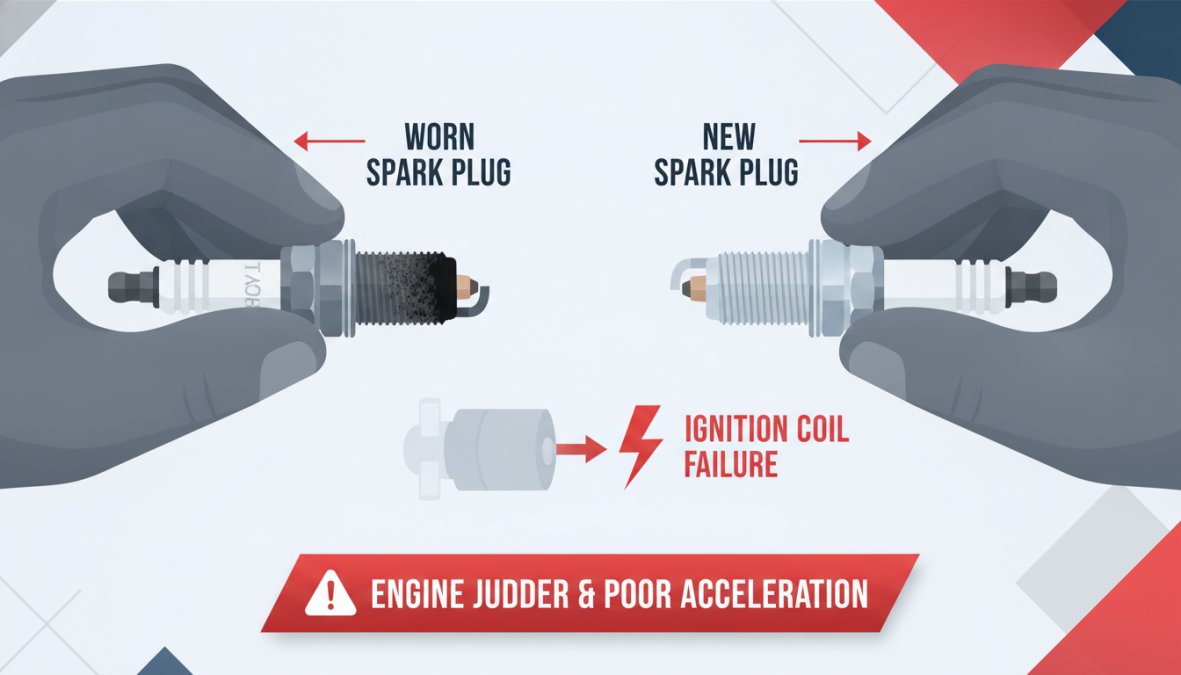
Worn spark plugs are the single most common reason why a car judders when accelerating slowly. Spark plugs ignite the air-fuel mixture in each cylinder; when they degrade, the spark becomes weak or inconsistent, leading directly to misfires.
Close-up of a mechanic's hands holding a worn spark plug next to a new one on a workshop bench, showing visible carbon buildup, eroded electrode, and dark deposits under bright overhead lighting
Most manufacturers recommend spark plug replacement every 30,000 to 60,000 miles for standard copper plugs, and up to 100,000 miles for iridium or platinum variants. A plug past its service interval will show a worn or rounded electrode, heavy carbon deposits, or visible cracking on the ceramic insulator.
Ignition coil failure produces identical symptoms. Each coil delivers high-voltage current to its corresponding spark plug; a failing coil causes intermittent or complete misfires in that cylinder. The fault often appears mainly during cold starts or under light throttle load.
How to check: An OBD-II scanner will flag the specific cylinder misfiring. Swap the suspected coil with a known-good coil from an adjacent cylinder and rescan. If the misfire code follows the coil, the coil is faulty. If it stays on the same cylinder, the spark plug or injector is more likely at fault.
Watch OutNever ignore a flashing engine management light alongside juddering. A continuous misfire can overheat and permanently damage the catalytic converter within minutes of driving. Stop safely and get the vehicle diagnosed before continuing.
Fuel System Issues: Injectors, Pump, and Filter Problems
Fuel delivery problems are the second major cause of juddering during slow acceleration. The fuel system must deliver a precise volume of atomised fuel to each cylinder at exactly the right moment. Any disruption creates hesitation, stuttering, and rough running, particularly at low RPM.
Three components are most commonly at fault: fuel injectors (carbon deposits restrict fuel flow), fuel pump (weakening pump struggles to maintain adequate pressure), and fuel filter (blocked filter starves the engine of fuel). As documented in the Society of Automotive Engineers' technical resources on fuel system maintenance, injector deposits are a leading contributor to driveability complaints in high-mileage vehicles.
How to Clean Fuel Injectors and Restore Performance
Mild injector fouling can often be addressed with a concentrated fuel system cleaner added to the fuel tank. Products using Polyetheramine (PEA) technology are most effective at dissolving carbon deposits.
Step-by-step process:
Add cleaner to a near-empty tank at the start of a long motorway run.
Drive at sustained motorway speeds for at least 30 minutes to allow the cleaner to work through the system.
Repeat for two to three consecutive fill-ups if symptoms persist.
For severe injector fouling, a professional ultrasonic injector clean or on-car injector flush using dedicated equipment is the more reliable solution.
Pro TipIf you suspect a weak fuel pump, check fuel pressure with a gauge connected at the fuel rail. A healthy petrol pump typically holds pressure within the manufacturer's specified range even with the engine off. A pump that bleeds down rapidly points to a faulty check valve or failing pump unit.
Air Intake and Mass Airflow Sensor Faults
The engine needs a precise ratio of air to fuel for clean combustion. A blocked air filter is the most straightforward cause of juddering, a heavily fouled filter restricts airflow, forcing a rich mixture that burns poorly.
The mass airflow (MAF) sensor measures incoming air volume and temperature, sending data to the engine control unit. A contaminated or failing MAF sensor sends inaccurate readings, causing the ECU to miscalculate fuelling. The result is hesitation and juddering during gentle acceleration, particularly from cold.
MAF sensor contamination often comes from over-oiled aftermarket air filters. Cleaning the sensor with dedicated MAF sensor cleaner spray often resolves the issue without replacement.
Key TakeawayA dirty MAF sensor is frequently misdiagnosed as an injector or ignition fault. Before replacing expensive components, clean the MAF sensor and rescan. It takes ten minutes and costs almost nothing.
Signs of a Bad Clutch and Transmission Fluid Issues
Clutch judder during slow acceleration is most pronounced when pulling away from rest. The clutch plate grabs and releases unevenly, producing a rhythmic shudder through the drivetrain. Other signs include a high biting point, slipping under load, and a burning smell after hill starts. A clutch that has reached the end of its service life requires replacement.
Transmission fluid condition is equally important in automatic vehicles. Degraded automatic transmission fluid loses its friction-modifier properties, causing torque converter shudder during light acceleration. A transmission fluid service often resolves this without mechanical work. According to the AA's guidance on automatic transmission maintenance, many automatic gearbox problems are caused by neglected fluid changes rather than mechanical failure.
Symptom
Most Likely Cause
First Check
Judder on pull-away from rest
Worn clutch plate
Clutch biting point height
Shudder at 40-65 mph (automatic)
Torque converter / fluid
Transmission fluid condition
Judder with gear changes (automatic)
Low or degraded fluid
Fluid level and colour
Vibration through gear lever (manual)
Worn gearbox mounts
Mount inspection
Vacuum Leaks, Distributor Cap Damage, and Catalytic Converter Blockages
Three less obvious causes of juddering deserve attention because they are frequently overlooked.
Vacuum leaks occur when air enters the intake manifold through a cracked hose, failed gasket, or split brake servo pipe. The unmetered air disrupts the air-fuel ratio, causing lean misfires and rough running. Smoke testing the intake system is the most reliable detection method.
Distributor cap damage applies to older vehicles using a distributor-based ignition system. Moisture inside the cap causes tracking, where the high-voltage spark jumps to the wrong terminal. The result is misfires worse on cold, damp mornings.
Catalytic converter blockages develop when the converter's internal substrate breaks down and restricts exhaust flow. A blocked converter creates back-pressure that reduces engine performance and causes hesitation under acceleration. A back-pressure test at the exhaust manifold confirms whether restriction is present.
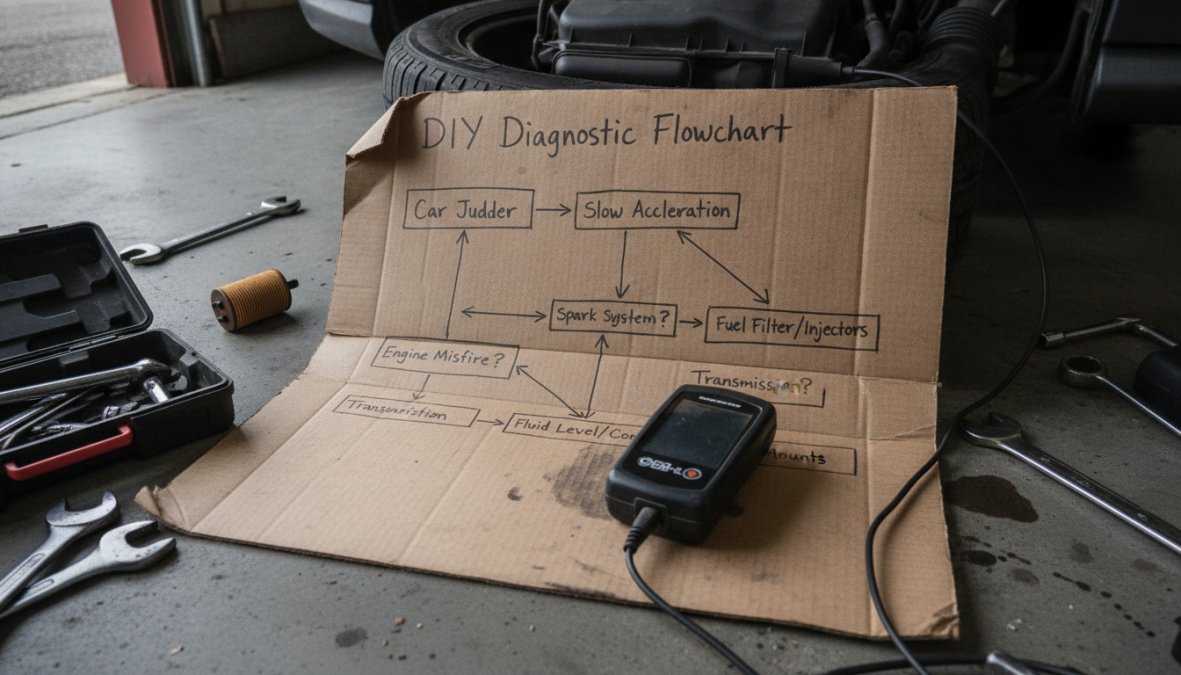
DIY Diagnostic Flowchart: Pinpointing the Root Cause
Here is a structured approach that narrows the fault down without unnecessary parts replacement.
A mechanic in a blue uniform connecting an OBD-II scanner to a vehicle's diagnostic port under the dashboard, with the scanner's screen showing live data readouts, workshop lighting overhead
Step 1: Read the fault codes first.
Connect an OBD-II scanner before touching anything. Misfire codes (P0300 series) point to ignition or injectors. MAF sensor codes (P0100 series) point to air intake. Transmission codes point to the gearbox.
Step 2: Note when the juddering occurs.
Juddering at idle and during slow acceleration: likely ignition, injectors, or vacuum leak.
Juddering only during gear changes or at a specific speed: likely clutch or transmission.
Juddering that improves when warm: likely ignition coils, distributor cap, or MAF sensor.
Juddering that worsens under load at all speeds: likely catalytic converter or fuel pump.
Step 3: Check the basics before replacing components.
Inspect the air filter visually. Check spark plug condition. Check fuel filter service history. Inspect vacuum hoses for cracks or splits.
Step 4: Test individual components.
Swap ignition coils between cylinders and rescan. Clean the MAF sensor. Add a fuel system cleaner. These interventions cost very little and eliminate common causes before committing to parts replacement.
Step 5: Seek professional diagnostics if the fault persists.
Some faults, particularly intermittent misfires, weak fuel pump pressure, and internal transmission issues, require specialist equipment to diagnose accurately.
Pro TipIf you own a Bluetooth OBD-II adapter, pair it with a live data app that shows misfire counts per cylinder in real time. You will see exactly which cylinder is misfiring and how frequently, making the diagnosis far more precise.
Is It Safe to Drive a Car That Judders During Acceleration?
The short answer: it depends on the cause, but the risk is almost always higher than drivers assume.
Juddering caused by a worn spark plug or dirty air filter is unlikely to cause immediate danger, though continued driving will worsen the fault and risk catalytic converter damage. Juddering caused by a failing clutch, weak fuel pump, or significant misfire carries more serious risk. The car may stall unexpectedly, particularly at junctions or on hills.
Transmission-related juddering left unaddressed can escalate from a fluid service into a full gearbox rebuild. The financial difference between those two outcomes is substantial.
If your car judders during acceleration and the engine management light is on, do not drive it further than necessary until the fault is diagnosed. A car that judders intermittently today can fail completely tomorrow, often at the worst possible moment. As outlined in the RAC's guidance on warning lights and driveability faults, a flashing engine management light indicates an active misfire severe enough to damage the catalytic converter and should be treated as a stop-and-diagnose situation.
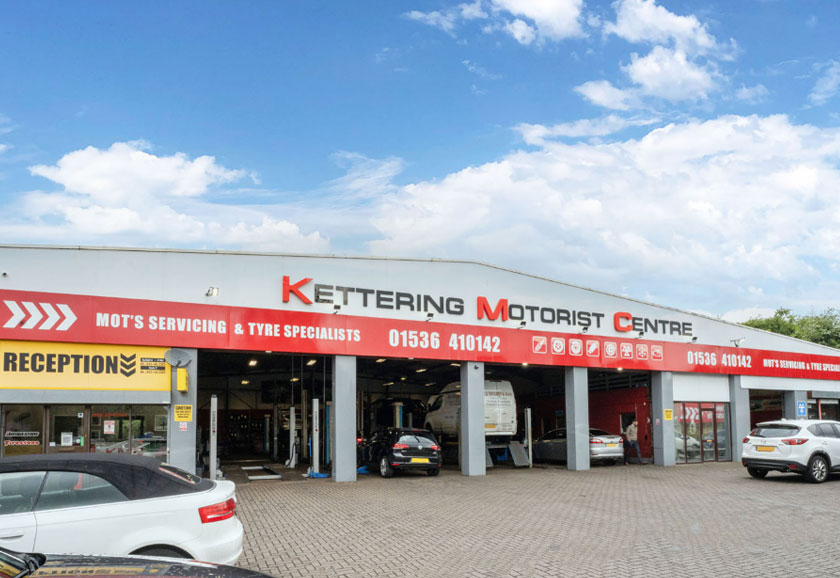
Persistent juddering during acceleration is a fault that rarely resolves itself and typically worsens with every mile driven. Kettering Motorist Centre provides expert diagnostic and repair services for exactly this type of problem, with no-upfront-payment online booking available for MOT and servicing appointments. Our family-run team in Kettering, Northamptonshire has the equipment and experience to identify whether the fault lies in the ignition system, fuel delivery, air intake, or transmission, and to fix it correctly the first time. Book your diagnostic appointment with Kettering Motorist Centre today and drive away with confidence.
Frequently Asked Questions
Can bad spark plugs cause a car to judder at low speeds?
Yes, worn or fouled spark plugs are a common cause of juddering during slow acceleration. Spark plugs that have reached the end of their service life fail to ignite the fuel-air mixture reliably, causing misfires in one or more cylinders. This creates the characteristic jerking sensation, especially noticeable at low RPM when throttle response is critical. Replacing spark plugs typically resolves this issue within minutes.
How do I know if my transmission is causing my car to judder?
Transmission-related juddering differs from engine misfires. If juddering occurs smoothly throughout the acceleration range and feels like the drivetrain is slipping or struggling to engage, it's likely transmission-related. Engine-specific juddering feels more like stuttering or hesitation. Check your transmission fluid level and colour, dark or burnt-smelling fluid suggests internal wear. A professional diagnostic scan can confirm transmission fault codes.
Is it safe to drive a car that judders when accelerating slowly?
Driving a juddering car is risky. Misfires reduce engine power, making acceleration unpredictable and limiting your ability to merge safely or respond to traffic. Continued driving with ignition or fuel system faults can damage the catalytic converter, leading to expensive repairs. Transmission problems worsen with use. Have the issue diagnosed promptly to avoid safety risks and costlier damage.
Does a clogged fuel filter cause jerking during acceleration?
Yes, a clogged fuel filter restricts fuel delivery to the engine, causing hesitation and jerking during acceleration. The engine struggles to receive the fuel it needs, particularly under load. This is one of the more straightforward issues to resolve, fuel filter replacement is inexpensive and quick. If juddering persists after filter replacement, the problem likely lies with fuel injectors or the fuel pump itself.
Your booking Failed
Please try again or please call 01536 410142
Thank you for placing a booking with Kettering Motorist Centre Limited for vehicle
PLEASE TAKE YOUR BOOKING REFERENCE NUMBER WITH YOU TO THE MOT CENTRE
Your items
MOT Test
×
Terms and Conditions
These terms and conditions form the basis on which you can visit and use this website. Please read them carefully as they contain important information.
General terms and conditions
This website is owned and operated by Kettering Motorist Centre Ltd (company registration number: 4485858) operating at Trafalgar Road, Kettering, Northamptonshire, NN16 8DB (the "MOT Centre", the "Company", "we" or "us"). If you have any queries about these terms and conditions or if you have any comments or complaints on or about this website, you can contact us at [email protected] or 01536 410142.
The website is to promote and offer for sale the products and services of Kettering Motorist Centre Limited.
1. The contract between us
This website does not take payment for products or services online. The website enables you to view products and services online and to make a booking for later delivery and payment. The vehicle and provision of other products and services promoted by this website and the payment by you of the price of those products and services will take place at the MOT Centre. The booking does not constitute a contract.
The booking process on the site provides details of the booked MOT order. Please take the time to read and check your booking. It is your responsibility to make sure the order is correct and for the correct vehicle.
2. Ownership of rights
All rights, including copyright, in this website are owned by or licensed to the Company. Any use of this website or its contents, including copying or storing it or them in whole or part, other than for your own personal, non commercial use, is prohibited without our permission. You may not modify, distribute or repost anything on this website for any purpose.
3. Accuracy of content
We have taken care in the preparation of the content of this website, in particular to ensure that prices quoted are correct at the time of publishing and that all goods have been fairly described. However, bookings will only be accepted if there are no material errors in the description of the goods or their prices as advertised on this website. Any weights, dimensions and capacities given about the goods are approximate only.
4. Damage to your computer
We try to ensure that this website is free from viruses or defects. However, we cannot guarantee that your use of this website or any websites accessible through it will not cause damage to your computer. It is your responsibility to ensure that the right equipment is available to use the website. Except in the case of negligence on our part, we will not be liable to any person for any loss or damage which may arise to computer equipment as a result of using this website.
5. Availability
All bookings are subject to acceptance and availability. If the MOT date you have requested are is not available, the Centre will contact you by e-mail or phone. You will have the option either to wait until another slot is available or to cancel your booking.
6. Booking errors
You are able to correct errors on your booking up to the point on which you click on “Place Booking” during the booking process.
7. Price
The prices payable for goods that you order are as set out in our website. All prices are inclusive of VAT at the current rates and are correct at the time of entering information, errors and omissions excepted.
Whenever it is not possible to accept your booking to buy goods of the specification and description at the price indicated, the MOT Centre will advise you by email or phone or when you visit the centre.
8. Payment terms
You will be required to pay for the goods or services to the Centre at time of a completed MOT.
9. Delivery charges
N/A
10. Cancellation
The MOT Centre reserves the right to cancel the booking if:
10.1 There is insufficient stock to deliver the goods you have booked.
10.2 One or more of the goods you booked was listed at an incorrect price.
If your booking is cancelled the Centre will notify you by e-mail or phone.
You have the right to cancel your booking at any time up to the point of the MOT. If you do cancel your booking you should inform the centre by phone.
11. Liability
Notwithstanding the foregoing, nothing in these terms and conditions is intended to limit any rights you might have as a consumer under applicable local law or other statutory rights that may not be excluded nor in any way to exclude or limit our liability to you for any death or personal injury resulting from our negligence.
12. Notices
Unless otherwise expressly stated in these terms and conditions, all notices from you to us must be in writing and sent to our contact address given above and all notices from us to you will be displayed on our website from time to time.
13. Changes to legal notices
We reserve the right to change these terms and conditions from time to time and you should look through them as often as possible.
14. Law, jurisdiction and language
This website, any content contained therein and any contract brought into being as a result of usage of this website are governed by and construed in accordance with English law. Parties to any such contract agree to submit to the exclusive jurisdiction of the courts of England and Wales.
15. Invalidity
If any part of these terms and conditions is unenforceable (including any provision in which we exclude our liability to you) the enforceability of any other part of these conditions will not be affected.
16. Privacy
You acknowledge and agree to be bound by the terms of our privacy policy
17. Third party rights
Nothing in this Agreement is intended to, nor shall it confer any rights on a third party.