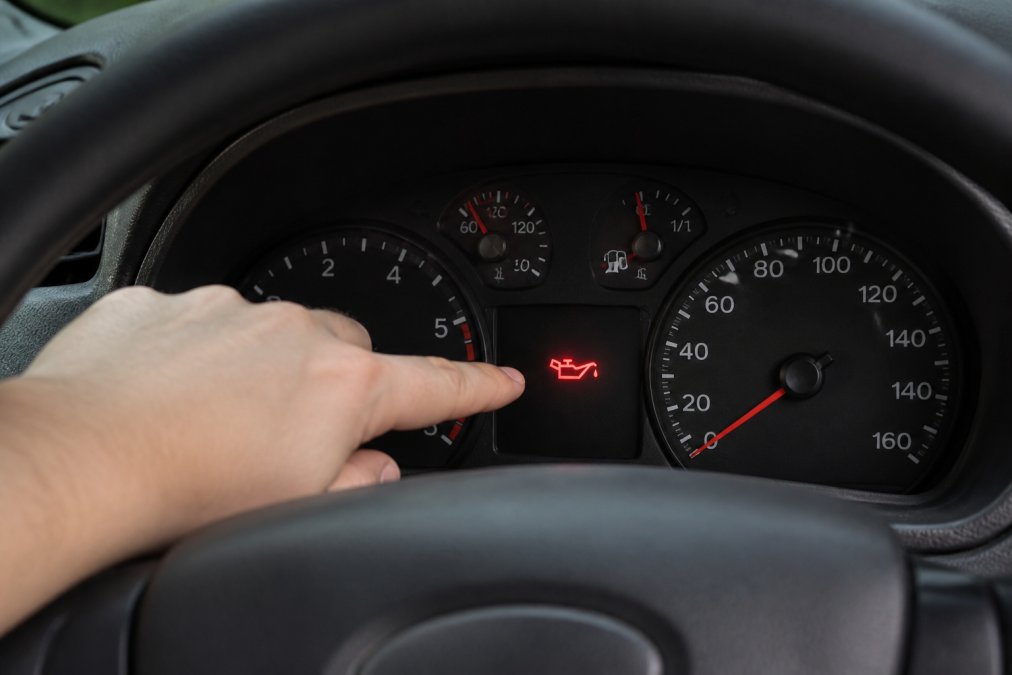
The red oil pressure warning light indicates your engine's lubrication system is failing to maintain adequate pressure, meaning oil isn't circulating properly through your engine block and bearings. Without sufficient oil pressure, internal components grind together without proper lubrication, leading to rapid mechanical failure. This guide from Kettering Motorist Centre explains the critical difference between an oil level warning and an oil pressure alert, a distinction many drivers miss until it's too late.
When the red oil pressure light illuminates, your engine is at immediate risk. Unlike the amber oil level light (which indicates low oil but not necessarily danger), the red oil pressure warning demands urgent attention. According to the RAC, ignoring an oil pressure warning for even short distances can result in thousands of pounds in engine repairs.
Understanding oil pressure versus oil level
These two systems operate independently, and confusing them is a common mistake. Oil level refers to the quantity of oil in your sump; oil pressure is the force at which that oil circulates through your engine's internal passages and bearings.
You could have a full tank of oil but zero pressure if your oil pump fails. Conversely, low oil level often causes low pressure, but the two aren't automatically linked. The oil pressure sensor monitors circulation force continuously. When pressure drops below safe operating levels (typically around 10 PSI at idle, 25-65 PSI under load), the warning light triggers.
Why your engine needs oil pressure
Oil pressure keeps moving metal parts separated by a thin lubricant film. Your engine's crankshaft, connecting rods, camshaft, and valve lifters rotate or reciprocate thousands of times per minute. Without adequate oil pressure, these components make direct metal-to-metal contact, generating heat and friction that destroys them within minutes.
The oil pump, driven by your engine, forces oil through galleries (internal passages) in your engine block. This circulation removes heat, flushes away metal particles and combustion byproducts, and maintains the protective film between moving surfaces. When pressure is insufficient, that protective film breaks down.
Common Causes of Red Oil Pressure Warning Lights
Several mechanical and electrical faults trigger the oil pressure warning. Identifying the root cause quickly determines whether you need immediate roadside assistance or can safely reach a garage.
Low oil level and leaks
The most common cause of low oil pressure is insufficient oil in the sump. As oil level drops, the pump struggles to draw sufficient fluid, pressure falls, and the warning light activates. Check your dipstick immediately when the light comes on; many drivers find the problem is this simple.
Oil leaks gradually deplete your oil reserve. A slow leak from the oil pan, gaskets, or seals drips onto the road as you drive, but the symptom is unmistakable: the oil pressure light comes on, and your dipstick shows low oil. Common leak sources include the oil pan gasket, valve cover gasket, and crankshaft seals. Kettering Motorist Centre's diagnostic service includes a full visual inspection for leaks. Repairing a leaking gasket costs far less than replacing an engine seized from oil starvation.
Faulty oil pressure sensor
The oil pressure sensor can fail, triggering a false warning. This electrical component screws into the engine block and sends a signal to your dashboard. If the sensor malfunctions due to a short circuit, corrosion, or internal failure, it reports zero pressure even when the engine is running normally.
A faulty sensor is actually good news: your engine is fine, but you need a replacement. Using an OBD-II scanner reveals a diagnostic trouble code pointing to the sensor circuit, confirming this diagnosis.
Oil pump failure
The oil pump is a mechanical device that wears over time. Impellers (rotating blades inside the pump) can fracture, internal gears can strip, or the pump inlet can become clogged with sludge. When the pump fails, it can no longer generate adequate pressure regardless of oil level. Pump failure requires engine disassembly to replace, but if caught early via the warning light, you can prevent further damage by stopping the engine immediately.
Worn bearings and internal engine wear
As engines age, bearing surfaces wear and clearances increase. Oil pressure drops because oil leaks past worn bearings instead of maintaining a tight seal. This wear develops gradually; you might notice the oil pressure light flickering at idle before it stays on permanently. Continuing to drive with low pressure from worn bearings accelerates wear exponentially.
Immediate Actions: What to Do When the Light Comes On
Your response in the first few minutes determines whether you prevent engine damage or cause it.
Step 1: Pull over safely and switch off the engine
The moment the red oil pressure light illuminates, treat it as an emergency. Pull over to a safe location, a lay-by, car park, or quiet side street, and switch off the engine immediately. Continuing to drive with low oil pressure causes metal-to-metal friction, heat buildup, and compounding damage. Stopping the engine stops the damage.
Step 2: Check your oil level with the dipstick
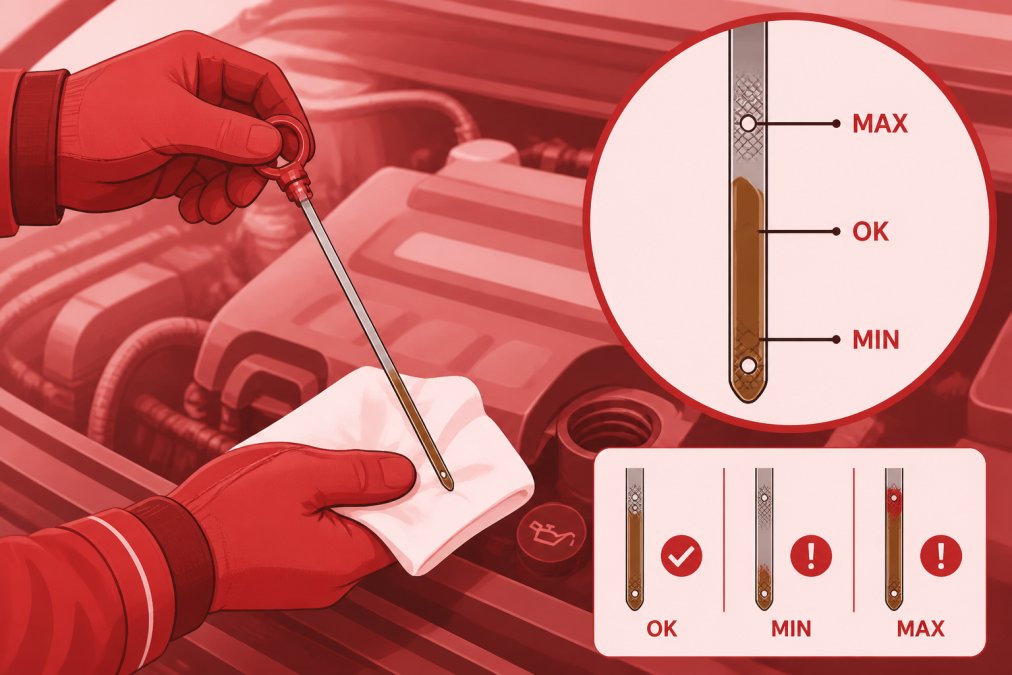
Once the engine has cooled for 2-3 minutes, locate your dipstick (usually a yellow or orange handle). Pull it out completely, wipe it clean with a rag, reinsert it fully, then withdraw it again to read the level. The dipstick has minimum and maximum marks. If the oil level is below the minimum mark, you've found the problem and need an oil top-up before restarting. If the level is adequate, the issue is mechanical (pump, sensor, or bearing wear).
Step 3: Look for visible leaks
While the engine cools, inspect underneath the car for fresh oil drips or pooling. Check the oil pan, valve covers, and around the oil filter. A visible leak confirms that low oil pressure resulted from oil loss. Do not attempt to drive anywhere except directly to a garage if you spot a leak.
How to Check Oil Pressure and Oil Level Safely
Distinguishing between a sensor fault and actual low pressure requires diagnostic tools and knowledge.
Checking oil level with a dipstick
Always check oil when the engine is cold (before starting the car in the morning) or at least 5 minutes after running. Hot oil gives a false high reading because it expands. Pull the dipstick fully, wipe it clean, reinsert it completely until it seats, then withdraw it. The oil should reach the maximum mark or slightly below. If significantly below the minimum mark, top it up with the correct oil type and viscosity for your vehicle (check your owner's manual).
After topping up, wait 30 seconds for the oil to settle, then recheck with the dipstick. Restart the engine and see if the warning light extinguishes. If it does, you've solved the problem. If it remains on despite adequate oil level, the fault is not low oil.
Understanding oil viscosity and type
Your vehicle requires a specific oil viscosity, a measure of how thick or thin the oil is. Common grades are 5W-30, 10W-40, and 0W-20. The first number (before the W, which stands for winter) indicates cold-start viscosity; the second indicates viscosity at operating temperature. Using the wrong viscosity can affect oil pressure. Always use the viscosity specified in your owner's manual. Synthetic oils offer better viscosity stability across temperature ranges compared to mineral oils.
When to use an OBD-II scanner for diagnostics
An OBD-II scanner reads diagnostic trouble codes from your vehicle's onboard computer. If the oil pressure light is on, the computer has stored a fault code. A code like P0520 indicates an oil pressure sensor circuit fault; other codes point to different issues. Many garages scan for free, but interpreting codes requires knowledge. At Kettering Motorist Centre, we use professional diagnostic equipment to read codes and perform additional tests (like a manual oil pressure gauge reading) to confirm the diagnosis.
Close-up of mechanic's hands checking engine oil dipstick against natural light, showing clear oil level markings on the stick
Is It Safe to Drive with the Oil Pressure Light On?
The short answer is no, not safely, and not for any distance beyond reaching a garage.
Short distances versus extended driving
You might be tempted to drive a few miles to your local garage if the light comes on. A few miles at low oil pressure can cause bearing damage that costs thousands to repair. If you must move the car (from a motorway to a safe lay-by, for example), drive slowly at low RPM and listen for knocking sounds. Knocking, a metallic pinging or rattling, indicates bearing wear accelerating. Stop immediately if you hear it. The safest option is to call roadside assistance (such as the RAC or AA) and have your vehicle transported to a garage without running the engine.
False positives: electrical gremlins and sensor faults
Not every oil pressure light means your engine is failing. Faulty sensors, corroded connectors, and electrical gremlins can trigger false warnings. If your oil level is correct, the engine sounds normal, and you see no leaks, you likely have a sensor fault rather than a mechanical problem. However, you cannot assume this without proper diagnosis. The light must be investigated.
Engine Damage Risks from Low Oil Pressure
Understanding what happens inside your engine when pressure drops explains why this warning is non-negotiable.
How inadequate lubrication causes mechanical failure
Oil under pressure creates a hydrodynamic film, an invisible layer of fluid that separates moving metal surfaces. When pressure drops, the film collapses. Metal touches metal. Friction generates extreme heat (hundreds of degrees Celsius in microseconds). The metal begins to weld together, creating resistance the engine cannot overcome.
This process accelerates exponentially. The first few seconds of low-pressure running might cause minor scoring on bearing surfaces. Continue running for a minute, and the scoring deepens. Continue for five minutes, and the bearing material begins to transfer from one surface to the other, a process called galling. The bearing loses its smooth geometry and begins to bind.
Engine seizure and catastrophic failure
If you ignore the warning and keep driving, the engine eventually seizes, it simply stops turning because the resistance is too great. The piston rod can snap, punching through the engine block. The crankshaft can fracture. The damage is total and irreversible. An engine that seizes while you're driving can also cause loss of power steering and braking, creating a dangerous situation on the road.
Post-incident engine health assessment
If your warning light came on and you drove for several minutes before stopping, a mechanic at Kettering Motorist Centre can perform a compression test (measuring pressure in each cylinder) and listen for abnormal sounds indicating bearing wear. If damage is minimal (caught early), you might only need an oil change and filter replacement. If damage is severe, the engine requires rebuilding or replacement. Early diagnosis is the difference between a minor repair and a major replacement.
When to Call a Mechanic: DIY Versus Professional Diagnostics
Knowing what you can safely diagnose yourself prevents unnecessary garage visits and catches serious problems early.
What you can safely diagnose yourself
Checking your oil level with a dipstick is safe and requires no special tools. If the level is low and you top it up, and the light extinguishes, you've solved the problem. You can also visually inspect for obvious leaks underneath the car. Beyond this, you're in professional territory.
When professional diagnostic tools are essential
If your oil level is adequate but the light remains on, you need professional diagnosis. A mechanic uses a manual oil pressure gauge (a dial gauge connected to the engine) to measure actual pressure. This confirms whether the sensor is faulty or whether pressure genuinely is low. Professional equipment also includes compression testers and ultrasonic leak detectors, which identify bearing wear, pump failure, and internal leaks that visual inspection cannot detect.
Choosing a garage for diagnosis
For oil pressure diagnostics, Kettering Motorist Centre offers excellent value. We have the diagnostic equipment needed and can perform repairs at transparent pricing. Our online booking system makes scheduling convenient, book your diagnostic appointment without upfront payment, and we'll contact you with findings and a repair quote before proceeding with work. We serve the Kettering and Northamptonshire area and specialise in both petrol and hybrid vehicles, so we can diagnose oil pressure issues across the full range of modern engines.
Conclusion: Protecting Your Engine from Oil Pressure Problems
The red oil pressure light is your engine's final warning before catastrophic failure occurs. Responding immediately, pulling over, switching off the engine, and arranging professional diagnosis, can mean the difference between a simple repair and a complete engine replacement.
Most oil pressure warnings result from low oil level (easily fixed), faulty sensors (inexpensive to replace), or slow leaks (caught early before damage spreads). The key is not to ignore the light and not to assume it will resolve itself. A few minutes of low-pressure running can cause bearing damage that persists even after you top up the oil.
At Kettering Motorist Centre in Northamptonshire, we diagnose oil pressure faults quickly and transparently. Our professional diagnostic equipment identifies whether you have a mechanical problem or an electrical fault, and we explain findings clearly before recommending repairs. Book your diagnostic appointment online today, no upfront payment required, and protect your engine from preventable damage.
Frequently Asked Questions
What is the difference between a red oil pressure light and a yellow oil light?
A red oil pressure light signals an immediate, critical problem with oil pressure, the force pushing oil through your engine's lubrication system. A yellow or amber light typically indicates a less urgent maintenance issue. The red light demands immediate action: pull over, switch off the engine, and check your oil level. Ignoring a red oil pressure light risks engine seizure and catastrophic mechanical failure. If unsure, contact a professional mechanic or call roadside assistance.
Can I drive with the red oil pressure light on?
No, not safely or for long distances. A red oil pressure light indicates inadequate lubrication reaching your engine's bearings and internal components. Continuing to drive risks catastrophic engine damage within minutes. If the light comes on, pull over immediately, switch off the engine, and check your oil level. If it's low, top it up with the correct viscosity oil. If the level is normal, do not restart the engine; arrange professional diagnostics or roadside assistance instead.
What should I do if the red oil light comes on but my oil level is fine?
If your oil level is normal but the red oil pressure light remains on, the problem likely lies with the oil pressure sensor, oil pump, or internal engine wear rather than low oil itself. Do not ignore this. Switch off the engine and contact a professional mechanic. They can use an OBD-II scanner to read diagnostic trouble codes and determine whether the sensor is faulty or if there is genuine oil circulation failure. Continuing to drive risks bearing wear and mechanical failure.
What are the common causes of a red oil pressure light?
Common causes include low oil level (often from leaks or neglected oil changes), a faulty oil pressure sensor, oil pump failure, worn engine bearings, or a blocked oil filter. Less commonly, the oil pressure relief valve may be stuck. The only way to diagnose accurately is to check your oil level first, then have a mechanic perform a full diagnostic using professional tools. At Kettering Motorist Centre, we can identify the exact cause and recommend the right repair.
Your booking Failed
Please try again or please call 01536 410142
Thank you for placing a booking with Kettering Motorist Centre Limited for vehicle
PLEASE TAKE YOUR BOOKING REFERENCE NUMBER WITH YOU TO THE MOT CENTRE
Your items
MOT Test
×
Terms and Conditions
These terms and conditions form the basis on which you can visit and use this website. Please read them carefully as they contain important information.
General terms and conditions
This website is owned and operated by Kettering Motorist Centre Ltd (company registration number: 4485858) operating at Trafalgar Road, Kettering, Northamptonshire, NN16 8DB (the "MOT Centre", the "Company", "we" or "us"). If you have any queries about these terms and conditions or if you have any comments or complaints on or about this website, you can contact us at [email protected] or 01536 410142.
The website is to promote and offer for sale the products and services of Kettering Motorist Centre Limited.
1. The contract between us
This website does not take payment for products or services online. The website enables you to view products and services online and to make a booking for later delivery and payment. The vehicle and provision of other products and services promoted by this website and the payment by you of the price of those products and services will take place at the MOT Centre. The booking does not constitute a contract.
The booking process on the site provides details of the booked MOT order. Please take the time to read and check your booking. It is your responsibility to make sure the order is correct and for the correct vehicle.
2. Ownership of rights
All rights, including copyright, in this website are owned by or licensed to the Company. Any use of this website or its contents, including copying or storing it or them in whole or part, other than for your own personal, non commercial use, is prohibited without our permission. You may not modify, distribute or repost anything on this website for any purpose.
3. Accuracy of content
We have taken care in the preparation of the content of this website, in particular to ensure that prices quoted are correct at the time of publishing and that all goods have been fairly described. However, bookings will only be accepted if there are no material errors in the description of the goods or their prices as advertised on this website. Any weights, dimensions and capacities given about the goods are approximate only.
4. Damage to your computer
We try to ensure that this website is free from viruses or defects. However, we cannot guarantee that your use of this website or any websites accessible through it will not cause damage to your computer. It is your responsibility to ensure that the right equipment is available to use the website. Except in the case of negligence on our part, we will not be liable to any person for any loss or damage which may arise to computer equipment as a result of using this website.
5. Availability
All bookings are subject to acceptance and availability. If the MOT date you have requested are is not available, the Centre will contact you by e-mail or phone. You will have the option either to wait until another slot is available or to cancel your booking.
6. Booking errors
You are able to correct errors on your booking up to the point on which you click on “Place Booking” during the booking process.
7. Price
The prices payable for goods that you order are as set out in our website. All prices are inclusive of VAT at the current rates and are correct at the time of entering information, errors and omissions excepted.
Whenever it is not possible to accept your booking to buy goods of the specification and description at the price indicated, the MOT Centre will advise you by email or phone or when you visit the centre.
8. Payment terms
You will be required to pay for the goods or services to the Centre at time of a completed MOT.
9. Delivery charges
N/A
10. Cancellation
The MOT Centre reserves the right to cancel the booking if:
10.1 There is insufficient stock to deliver the goods you have booked.
10.2 One or more of the goods you booked was listed at an incorrect price.
If your booking is cancelled the Centre will notify you by e-mail or phone.
You have the right to cancel your booking at any time up to the point of the MOT. If you do cancel your booking you should inform the centre by phone.
11. Liability
Notwithstanding the foregoing, nothing in these terms and conditions is intended to limit any rights you might have as a consumer under applicable local law or other statutory rights that may not be excluded nor in any way to exclude or limit our liability to you for any death or personal injury resulting from our negligence.
12. Notices
Unless otherwise expressly stated in these terms and conditions, all notices from you to us must be in writing and sent to our contact address given above and all notices from us to you will be displayed on our website from time to time.
13. Changes to legal notices
We reserve the right to change these terms and conditions from time to time and you should look through them as often as possible.
14. Law, jurisdiction and language
This website, any content contained therein and any contract brought into being as a result of usage of this website are governed by and construed in accordance with English law. Parties to any such contract agree to submit to the exclusive jurisdiction of the courts of England and Wales.
15. Invalidity
If any part of these terms and conditions is unenforceable (including any provision in which we exclude our liability to you) the enforceability of any other part of these conditions will not be affected.
16. Privacy
You acknowledge and agree to be bound by the terms of our privacy policy
17. Third party rights
Nothing in this Agreement is intended to, nor shall it confer any rights on a third party.