Is MOT Required for New Cars? The Complete 2026 Guide
Last Updated: July 4, 2026
Is MOT Required for New Cars? Understanding the Three-Year Rule
Most new vehicles don't need an MOT test until three years after their first registration, according to DVLA vehicle testing guidance. This three-year exemption applies to most passenger vehicles registered in the UK. However, driving without a valid MOT when one is required carries real penalties, and many drivers mistakenly assume "new" means perpetually exempt.
Pro TipYour MOT clock starts on your vehicle's first registration date, not the manufacturing date. A car made in 2025 but registered in 2026 has a different MOT deadline than one registered earlier in 2025.
When Does Your First MOT Become a Legal Requirement?
Your first MOT becomes mandatory three years from the date your vehicle was first registered at the DVLA. You can book and complete the test up to one month before the deadline without penalty. The registration date is what matters, not the purchase date or when you collected the vehicle.
What Triggers the MOT Clock?
The MOT clock begins the moment your vehicle receives its first registration with the DVLA. For company vehicles, leased vehicles, and imported cars, the registration date on the V5C registration document determines the MOT schedule.
Watch OutIf you delay registering a new vehicle, the registration date will be later, pushing your MOT deadline forward. However, you must register the vehicle within a specific timeframe after purchase.
What Is an MOT Test and Why Does It Matter?
An MOT, or Ministry of Transport test, is an annual safety and emissions inspection that checks whether your vehicle meets UK legal standards for roadworthiness. Driving a car without a valid MOT certificate when one is required is illegal and can result in fines up to £1,000.
The MOT serves a genuine safety function by catching mechanical problems that could put you or other road users at risk. Many drivers confuse the MOT with a service, they're different. A service is preventative maintenance you arrange voluntarily; an MOT is a legal inspection that certifies your vehicle meets minimum safety standards.
Safety Inspection and Roadworthiness Standards
The MOT test examines your vehicle's braking system, steering, suspension, lights, tyres, and seatbelts. An authorised examiner conducts a detailed inspection that typically takes 45 minutes to an hour.
The test checks brake performance by measuring stopping distances and brake pad thickness. Tyres must have a minimum tread depth of 1.6mm across the central three-quarters of the tyre width. Headlights and visibility systems are tested for correct alignment and brightness. Suspension components are inspected for wear or damage, and the examiner checks for corrosion that might affect safety.
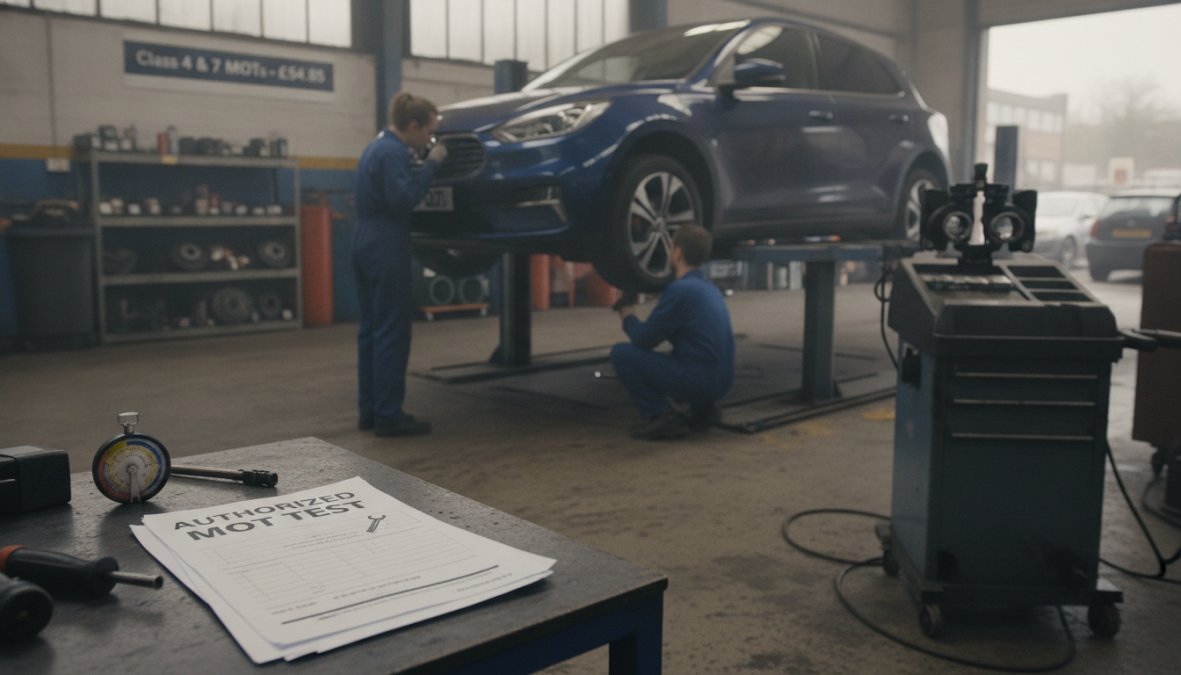
Authorised MOT examiner conducting safety inspection on a vehicle, checking brake components and undercarriage in a professional test centre with workshop lighting
Emissions Testing and Environmental Compliance
Modern MOT tests include an emissions check that measures your vehicle's exhaust output to ensure it isn't releasing excessive pollutants. Petrol cars are tested for carbon monoxide and hydrocarbons; diesel vehicles are checked for smoke opacity and nitrogen oxides. Electric and hybrid vehicles have different testing protocols since they produce zero tailpipe emissions.
The emissions test is straightforward, your car is connected to testing equipment while running at idle and then at higher revs. Failing an emissions test typically means your engine needs tuning or your catalytic converter requires attention.
Vehicles Exempt from MOT Testing
Historic and classic vehicles registered as such with the DVLA are exempt from MOT testing. Disabled people's vehicles adapted for mobility purposes, agricultural tractors, and certain off-road vehicles can also be exempt. However, exemptions are narrowly defined, your car almost certainly requires an MOT unless it falls into one of these specific categories.
New cars in their first three years are temporarily exempt. Once that three-year period ends, the exemption expires and you must have a valid MOT certificate to drive legally.
Imported Vehicles and Special Circumstances
Imported vehicles must be registered with the DVLA before they can be driven on UK roads. Once registered, they follow the standard MOT rules, no test required for three years from the registration date. The import process itself doesn't change when your first MOT is due.
Vehicles imported from Europe or other left-hand-drive countries are treated the same way as any other imported vehicle. The registration date determines the MOT schedule, regardless of where the car came from.
How to Check Your MOT Status Online and Find Your First MOT Due Date
The DVLA provides a free online MOT checker tool that shows your vehicle's MOT history and due date. Visit the DVLA MOT checker at DVLA MOT checker tool and enter your vehicle registration mark and either your registration document reference number or postcode. The system instantly displays when your next MOT is due and your previous test results.
To use the online MOT checker, gather your V5C registration document, which contains the reference number the system requires. Your vehicle registration mark is the number plate on your car. If you've moved recently and haven't updated your address with the DVLA, use your current postcode when checking.
What Happens During an MOT Test: Key Components Checked
An MOT test covers around 70 different checks across your vehicle's major systems and takes roughly 45 minutes to an hour. The examiner works through a structured checklist beginning with visible checks, lights, wipers, mirrors, and number plates, then moves to under-bonnet checks and brake testing.
Most MOT tests pass without issues. If the examiner finds a fault, they'll categorise it as either a major defect (which causes a fail), a minor issue (which doesn't fail the test but should be addressed), or an advisory note (something to watch).
Brake Performance and Tyre Tread Depth
Brake performance is one of the most critical checks during an MOT. Your vehicle is driven onto a brake testing machine that measures stopping distances and brake balance. The examiner also checks brake pad thickness by visual inspection, brake pads should be at least 1.5mm thick.
Tyre tread depth must be at least 1.6mm across the central three-quarters of the tyre width. The examiner uses a tread depth gauge to measure this precisely. Tyres that are cracked, bulging, or showing signs of uneven wear can fail the test even if the tread depth is technically acceptable.
Key TakeawayTyre condition is one of the most common reasons vehicles fail their first MOT. Check your tread depth before booking your test and replace tyres if they're borderline.
Headlight Alignment and Visibility Systems
Headlights must be correctly aligned and bright enough to illuminate the road ahead safely. The examiner checks both dipped and main beam settings. All other lights are checked too, brake lights, fog lights, number plate lights, and indicator lights must be working and the correct colour.
Windscreen wipers must work on both settings, and the windscreen washer system must spray water effectively. The windscreen itself is checked for damage that might obstruct the driver's view. Cracks or chips in the driver's line of sight can result in an MOT failure.
Seatbelts, Wipers, and Structural Integrity
Seatbelts are tested for damage, wear, and proper operation. They must retract smoothly and lock under sudden deceleration. Windscreen wipers must operate smoothly without chattering or leaving streaks.
Structural integrity checks look for corrosion that might affect the vehicle's safety. The examiner inspects under the car for rust that has weakened the chassis or bodywork. Severe corrosion can cause an MOT failure, though minor surface rust is usually acceptable.
The Difference Between MOT and Service: Why Both Matter
An MOT is a legal safety inspection that happens once a year (after the first three years). A service is preventative maintenance you arrange voluntarily, typically every 12 months or based on mileage. They serve different purposes and both are important.
The MOT checks whether your car meets minimum legal safety standards at a specific moment in time. A service, by contrast, is about keeping your car running smoothly and preventing breakdowns. Regular servicing prevents problems that might cause an MOT failure later and keeps your car more reliable.
Legal Requirement vs. Maintenance Best Practice
Driving without a valid MOT certificate when one is required is illegal and carries a £1,000 fine. However, the MOT doesn't prevent breakdowns or keep your car in peak condition. Best practice is to service your car annually regardless of whether an MOT is due, following your manufacturer's service schedule.
A good service history makes MOT preparation easier. When your car is serviced regularly, technicians spot and fix small issues before they become MOT failures. Service records also provide evidence of proper maintenance if you ever need to prove your car's condition.
Driving Without a Valid MOT: Legal Consequences and Risks
Driving a car without a valid MOT when one is required is illegal. The penalty is a fine up to £1,000, and you can be prosecuted even for a single day of driving without a valid certificate. Police can stop your vehicle and check your MOT status immediately.
Beyond the legal penalty, driving without an MOT is risky because your vehicle hasn't been safety-checked. If you're involved in an accident while driving without a valid MOT, your insurance may be invalidated, leaving you liable for all costs from the accident.
Preparing Your New Car for Its First MOT: A Practical Checklist
Your first MOT is coming up, and preparation makes the difference between passing easily and facing unexpected failures. Start preparing at least two weeks before your test date.
Begin with a visual inspection of your vehicle. Check all lights work, test your windscreen wipers and washer system, and ensure your mirrors are clean and undamaged. Top up all fluids, engine oil, coolant, brake fluid, and windscreen washer. Check that all hoses are intact and not leaking.
Inspect your tyres carefully. Check tread depth using a 20p coin; if the coin's outer ring disappears when inserted into the tread, your tread depth is acceptable. Look for cracks, bulges, or uneven wear patterns. Test your brakes by driving slowly in a safe area and checking that stopping feels normal.
Preparation Area
Check
Timeline
Lights
All lights working (headlights, brake, fog, indicators)
2 weeks before
Tyres
Tread depth minimum 1.6mm, no damage or uneven wear
2 weeks before
Brakes
Pad thickness, fluid condition, stopping performance
2 weeks before
Fluids
Oil, coolant, brake fluid, washer fluid topped up
1 week before
Wipers
Blades in good condition, both settings working
1 week before
Seatbelts
All belts retracting smoothly, no damage
1 week before
Mirrors
Clean, undamaged, properly adjusted
1 week before
Pre-MOT Maintenance Checks You Can Do Yourself
You don't need specialist equipment to prepare for an MOT. Check all exterior lights by turning them on and walking around the vehicle. Have someone press the brake pedal while you watch the brake lights. Inspect your tyres for obvious damage, cracks, bulges, or foreign objects. Use a 20p coin to check tread depth.
Check your windscreen wipers by turning on the ignition and operating them on both settings. They should move smoothly without chattering. Open your bonnet and check fluid levels, engine oil, coolant, and brake fluid should all be at appropriate levels. Look for obvious leaks under the car and check hoses for cracks or loose connections.
Pro TipClean your windscreen thoroughly before your MOT. A dirty windscreen can affect how the examiner assesses visibility, and it's a quick fix that takes minutes.
When to Book Early and What to Expect
Book your MOT test at least two weeks before your due date. This gives you time to address any issues if problems are found and ensures you have an appointment slot available. When you arrive for your test, bring your V5C registration document or a document showing your appointment details.
The test typically takes 45 minutes to an hour. Once complete, you'll either receive your MOT certificate (if you pass) or a failure notice with details of what needs fixing. If you fail, you can rebook the test once you've addressed the issues.
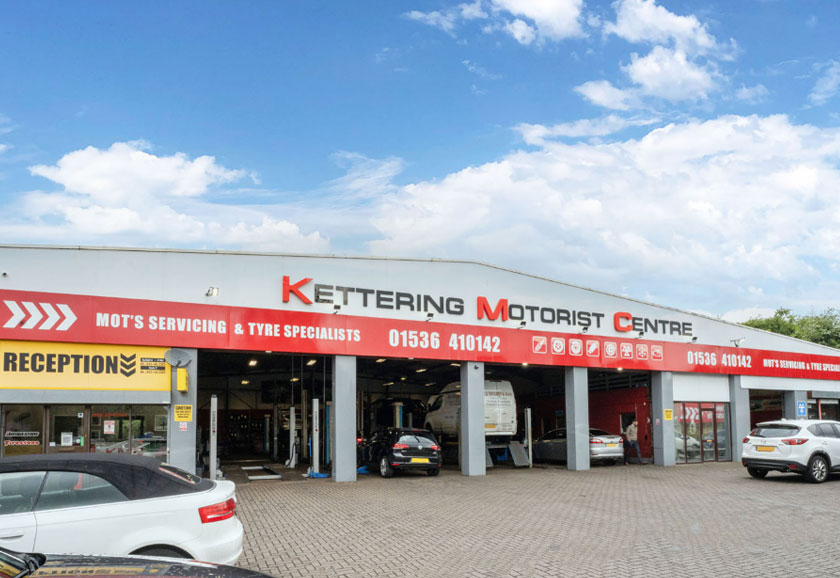
Understanding when is MOT required for new cars removes uncertainty from vehicle ownership. Your first MOT becomes due three years after registration, and preparation beforehand makes passing straightforward. Book your MOT well in advance, follow the preparation checklist, and address any issues promptly. When you're ready to schedule your test, contact your local MOT test centre or book with Kettering Motorist Centre using our online system for expert service and transparent scheduling.
Frequently Asked Questions
When is the first MOT due for a new car in the UK?
Your first MOT is due three years from the date your vehicle is registered with the DVLA. This applies to nearly all new cars. The three-year rule means a car registered on 15 March 2024 would need its first MOT by 14 March 2027. After that, annual MOT tests are required to keep your vehicle roadworthy and legally compliant.
Can I drive my new car without a valid MOT certificate?
No. Once your MOT becomes due, driving without a valid MOT certificate is illegal and can result in a fine of up to £1,000. Your vehicle excise duty may also be affected, and your insurance could be invalidated. It's important to book your test before the expiry date to avoid penalties and ensure your car remains safe and roadworthy.
What is the difference between an MOT and a service?
An MOT is a legal safety and emissions inspection required annually (after the first three years). A service is preventative maintenance that checks your car's mechanical condition and performance. Both are important: the MOT ensures roadworthiness compliance, while servicing maintains your vehicle's reliability and longevity. Regular servicing can help your car pass its MOT more easily.
How do I check when my car's first MOT due date is?
You can check your MOT status online using the DVLA MOT checker tool at mot.dvlaonline.org. You'll need your vehicle registration mark (number plate) and registration number. The checker shows your MOT history and when your next test is due. Alternatively, contact your local MOT test centre or check your vehicle registration documents for your registration date.
Your booking Failed
Please try again or please call 01536 410142
Thank you for placing a booking with Kettering Motorist Centre Limited for vehicle
PLEASE TAKE YOUR BOOKING REFERENCE NUMBER WITH YOU TO THE MOT CENTRE
Your items
MOT Test
×
Terms and Conditions
These terms and conditions form the basis on which you can visit and use this website. Please read them carefully as they contain important information.
General terms and conditions
This website is owned and operated by Kettering Motorist Centre Ltd (company registration number: 4485858) operating at Trafalgar Road, Kettering, Northamptonshire, NN16 8DB (the "MOT Centre", the "Company", "we" or "us"). If you have any queries about these terms and conditions or if you have any comments or complaints on or about this website, you can contact us at [email protected] or 01536 410142.
The website is to promote and offer for sale the products and services of Kettering Motorist Centre Limited.
1. The contract between us
This website does not take payment for products or services online. The website enables you to view products and services online and to make a booking for later delivery and payment. The vehicle and provision of other products and services promoted by this website and the payment by you of the price of those products and services will take place at the MOT Centre. The booking does not constitute a contract.
The booking process on the site provides details of the booked MOT order. Please take the time to read and check your booking. It is your responsibility to make sure the order is correct and for the correct vehicle.
2. Ownership of rights
All rights, including copyright, in this website are owned by or licensed to the Company. Any use of this website or its contents, including copying or storing it or them in whole or part, other than for your own personal, non commercial use, is prohibited without our permission. You may not modify, distribute or repost anything on this website for any purpose.
3. Accuracy of content
We have taken care in the preparation of the content of this website, in particular to ensure that prices quoted are correct at the time of publishing and that all goods have been fairly described. However, bookings will only be accepted if there are no material errors in the description of the goods or their prices as advertised on this website. Any weights, dimensions and capacities given about the goods are approximate only.
4. Damage to your computer
We try to ensure that this website is free from viruses or defects. However, we cannot guarantee that your use of this website or any websites accessible through it will not cause damage to your computer. It is your responsibility to ensure that the right equipment is available to use the website. Except in the case of negligence on our part, we will not be liable to any person for any loss or damage which may arise to computer equipment as a result of using this website.
5. Availability
All bookings are subject to acceptance and availability. If the MOT date you have requested are is not available, the Centre will contact you by e-mail or phone. You will have the option either to wait until another slot is available or to cancel your booking.
6. Booking errors
You are able to correct errors on your booking up to the point on which you click on “Place Booking” during the booking process.
7. Price
The prices payable for goods that you order are as set out in our website. All prices are inclusive of VAT at the current rates and are correct at the time of entering information, errors and omissions excepted.
Whenever it is not possible to accept your booking to buy goods of the specification and description at the price indicated, the MOT Centre will advise you by email or phone or when you visit the centre.
8. Payment terms
You will be required to pay for the goods or services to the Centre at time of a completed MOT.
9. Delivery charges
N/A
10. Cancellation
The MOT Centre reserves the right to cancel the booking if:
10.1 There is insufficient stock to deliver the goods you have booked.
10.2 One or more of the goods you booked was listed at an incorrect price.
If your booking is cancelled the Centre will notify you by e-mail or phone.
You have the right to cancel your booking at any time up to the point of the MOT. If you do cancel your booking you should inform the centre by phone.
11. Liability
Notwithstanding the foregoing, nothing in these terms and conditions is intended to limit any rights you might have as a consumer under applicable local law or other statutory rights that may not be excluded nor in any way to exclude or limit our liability to you for any death or personal injury resulting from our negligence.
12. Notices
Unless otherwise expressly stated in these terms and conditions, all notices from you to us must be in writing and sent to our contact address given above and all notices from us to you will be displayed on our website from time to time.
13. Changes to legal notices
We reserve the right to change these terms and conditions from time to time and you should look through them as often as possible.
14. Law, jurisdiction and language
This website, any content contained therein and any contract brought into being as a result of usage of this website are governed by and construed in accordance with English law. Parties to any such contract agree to submit to the exclusive jurisdiction of the courts of England and Wales.
15. Invalidity
If any part of these terms and conditions is unenforceable (including any provision in which we exclude our liability to you) the enforceability of any other part of these conditions will not be affected.
16. Privacy
You acknowledge and agree to be bound by the terms of our privacy policy
17. Third party rights
Nothing in this Agreement is intended to, nor shall it confer any rights on a third party.