Deciding whether to repair an old car with high mileage is one of the most financially consequential choices a driver can face. A well-maintained high-mileage vehicle often outperforms a neglected newer one. Preventative maintenance is the real variable that determines whether an old car is worth keeping.
Is It Worth Repairing an Old Car With High Mileage?
The core question: repair, replace, or retire
Repairing an old car with high mileage is worth it when the total repair cost stays well below the vehicle's current market value and the car has a documented maintenance history. Repair makes sense when the fault is isolated and the rest of the drivetrain is sound. Replacement suits drivers who need reliability guarantees or whose repair bills are accumulating faster than the car depreciates. Retirement is the right call when structural integrity is compromised or the cost of bringing the vehicle to roadworthy standard exceeds what any buyer would pay for it.
A car with 150,000 miles that has been regularly serviced, with fresh motor oil, clean air filters, and healthy spark plugs, will almost always be a better financial proposition than a newer car with an unknown maintenance history. According to guidance from the RAC on vehicle running costs, the total cost of ownership, including depreciation, insurance, and fuel consumption, often makes keeping an older car significantly cheaper than financing a replacement.
Key TakeawayThe repair-or-replace decision is not just about the size of the bill. It is about the car's overall mechanical condition, its maintenance history, and how the repair cost compares to what the vehicle is actually worth today.
The Role of Regular Maintenance in Extending Vehicle Longevity
How preventative maintenance reduces major repairs
Preventative maintenance is the single most effective way to extend the life of a high-mileage vehicle. Routine servicing, including oil changes at correct intervals, air filter replacements, and spark plug checks, directly reduces the likelihood of catastrophic failures that make repair uneconomical.
Engine performance degrades when maintenance is deferred. Dirty motor oil loses its lubrication properties, increasing friction between moving components and accelerating wear on the crankshaft, camshaft, and cylinder walls. A simple oil change at the correct viscosity costs a fraction of what an engine rebuild demands.
Tyre pressure and wheel alignment also play a larger role in vehicle longevity than many drivers appreciate. Incorrect tyre pressure increases rolling resistance and fuel consumption, while misalignment accelerates tyre wear and stresses suspension components. Both are cheap to correct and expensive to ignore.
A car with 120,000 miles and a full service history is fundamentally different from one with 80,000 miles and no maintenance record.
Engine sludge, corrosion, and long-term wear
Engine sludge is thickened, oxidised residue that forms when motor oil degrades and is not changed at correct intervals. Sludge restricts oil flow through the engine's lubrication channels, causing localised overheating and accelerated wear on bearings and valve train components.
Corrosion is a separate concern, particularly relevant for vehicles exposed to road salt during winter months. It attacks brake lines, fuel lines, and the exhaust system from the outside, while moisture ingress can compromise the ECU and electrical systems internally.
Addressing both issues early through regular oil changes and annual underbody inspections is far cheaper than the repairs that follow neglect. According to vehicle maintenance advice from the AA, engine-related failures are among the most common causes of roadside breakdowns, and the majority are attributable to deferred servicing rather than age or mileage alone.
Signs a Car Is Not Worth Fixing
Critical mechanical failures and transmission issues
Some signs a car is not worth fixing are clear enough that no cost-benefit analysis is needed. A seized engine, a failed automatic transmission on a vehicle with low residual value, or a blown head gasket on a car with significant body corrosion all point toward retirement rather than repair.
Key indicators include white smoke from the exhaust combined with coolant loss (head gasket failure), transmission slipping or loss of drive, knocking from the bottom end of the engine (bearing failure), brake pedal fade, and multiple warning lights appearing simultaneously.
When these faults appear together, the repair cost almost always exceeds the vehicle's market value.
Rust, frame damage, and structural concerns
Structural integrity is non-negotiable. A car with significant chassis corrosion or accident-related frame damage presents a safety risk that no mechanical repair can resolve. Rust that has penetrated the structural sills, floor pans, or subframe mounting points means the car cannot be made roadworthy without repairs that are almost never economically viable.
Surface rust on body panels is cosmetic and does not affect the repair-or-replace calculation. Structural rust does.
Watch OutNever rely on a visual inspection alone to assess structural corrosion. Rust progresses from the inside outward, meaning a car can look presentable while the chassis is severely compromised underneath. A proper ramp inspection is essential before committing to major repairs.
Cost of Car Repairs vs Buying New: The Financial Framework
Calculating the 50% rule and repair cost thresholds
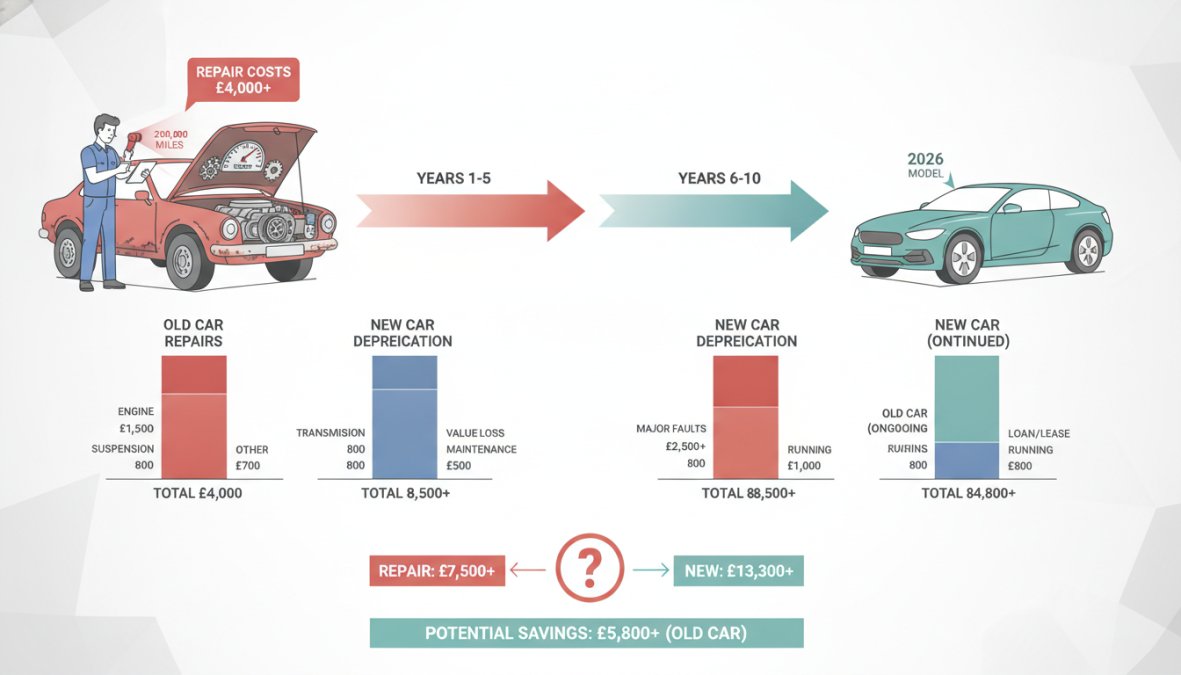
The cost of car repairs vs buying new is the central calculation in any repair-or-replace decision. A widely used benchmark is the 50% rule: if the estimated repair cost exceeds 50% of the car's current market value, replacement is generally the more rational financial choice.
This threshold is a starting point, not an absolute rule. A car worth £4,000 with a £2,500 repair bill sits right at the boundary. Whether repair makes sense depends on the car's overall condition, the likelihood of further repairs in the near term, and the driver's financial circumstances.
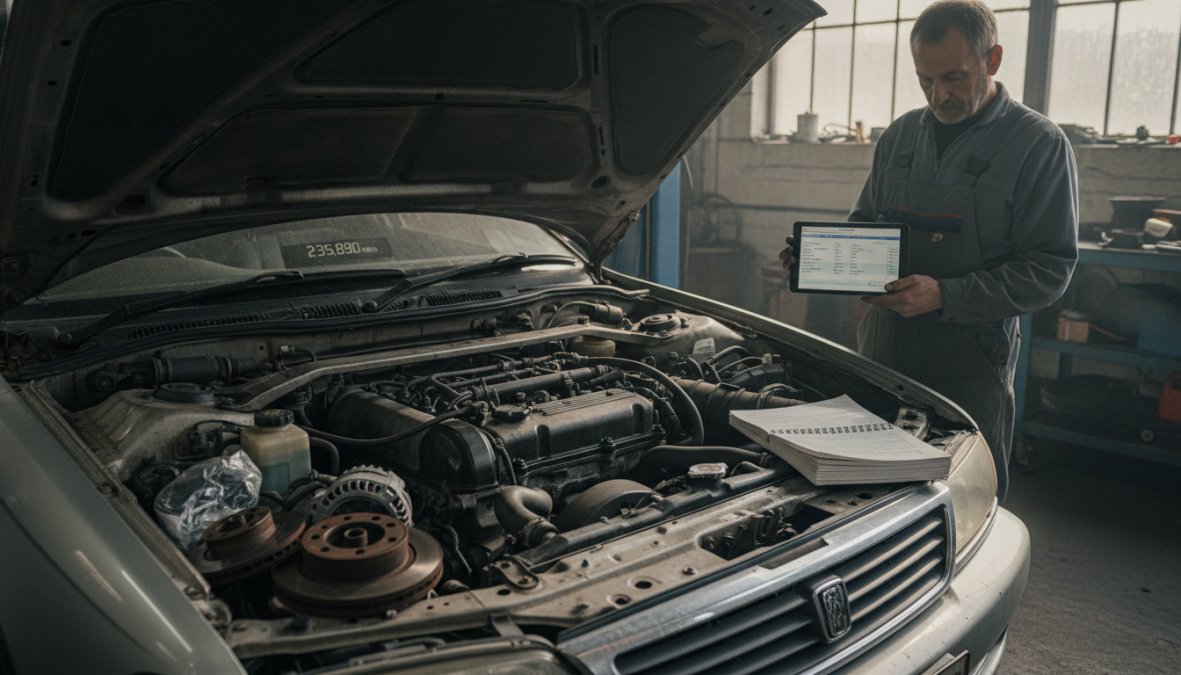
A mechanic inspects the worn engine bay of an older high-mileage saloon car using a handheld diagnostic scanner, workshop lighting overhead, oil residue visible on the engine cover.
Mechanic in blue overalls using a handheld diagnostic scanner on the engine bay of an older high-mileage saloon car, workshop fluorescent lighting overhead, oil residue visible on the engine cover
The table below summarises the key decision thresholds:
Repair Cost vs Car Value
Typical Recommendation
Key Consideration
Under 25% of value
Repair
Strong case to keep the car
25-50% of value
Repair with caution
Assess overall condition first
50-75% of value
Borderline
Weigh remaining lifespan carefully
Over 75% of value
Replace or retire
Financial case rarely stacks up
Exceeds car value
Retire
No economic justification for repair
Depreciation, residual value, and resale impact
Depreciation works in favour of the high-mileage car owner: the steepest depreciation curve has already passed. A ten-year-old vehicle has lost the majority of its value in the first three to five years of its life. Spending £800 on a car worth £3,500 does not trigger further depreciation the way the same spend on a new car would.
A well-maintained older car with a full service history commands a meaningfully higher resale price than the same model with a patchy record.
Is It Worth Fixing a Transmission on an Old Car?
Transmission repair costs and vehicle value
Whether it is worth fixing a transmission on an old car depends almost entirely on the ratio between the transmission repair cost and the vehicle's current value. Transmission work is among the most expensive repairs a car can require.
A full automatic transmission rebuild or replacement typically represents a substantial proportion of the car's market value. Manual transmission repairs tend to be less costly, but still significant. If the vehicle has low body corrosion, a sound engine with good oil pressure, healthy tyres, and a clean MOT history, a transmission repair can make economic sense.
When a transmission overhaul makes economic sense
A transmission overhaul makes economic sense when three conditions are met: the car's market value after repair exceeds the total repair cost, the rest of the vehicle is mechanically sound, and the owner intends to keep the car for at least two to three further years.
The real risk with transmission repairs is the discovery of additional faults during the work. A competent diagnostic assessment before committing to the repair is essential.
Pro TipBefore authorising any transmission repair on a high-mileage car, ask for a full vehicle health check alongside the transmission diagnosis. The additional cost is minimal compared to the risk of approving expensive work on a car with hidden concurrent faults.
Fuel Economy and Engine Performance: Hidden Repair Benefits
Spark plugs, air filters, and fuel injector maintenance
One of the least-discussed benefits of repairing and maintaining a high-mileage vehicle is the direct improvement in fuel economy. Worn spark plugs cause incomplete combustion, which wastes fuel and reduces engine performance. Replacing them restores the combustion efficiency the engine was designed to deliver.
A clogged air filter restricts airflow to the engine, forcing the ECU to compensate by adjusting the fuel mixture. A new air filter is one of the cheapest maintenance items available and one of the most impactful for fuel efficiency.
Fuel injectors accumulate deposits over time, particularly in engines that have run on lower-quality fuel. Professional fuel system cleaning restores injector performance without the cost of replacement.
Oxygen sensors, RPM stability, and throttle response
Oxygen sensors monitor exhaust gas composition and feed real-time data to the ECU, which uses it to maintain the correct air-fuel ratio. A failing oxygen sensor causes the ECU to run the engine rich or lean, both of which increase fuel consumption. Replacing a faulty sensor is a relatively low-cost repair with a direct positive impact on fuel economy.
An engine that hunts at idle, fluctuating between high and low RPM, typically signals a vacuum leak, dirty throttle body, or sensor fault. Addressing these issues restores smooth combustion and reduces fuel consumption. According to fuel economy guidance from the Energy Saving Trust, keeping a vehicle properly maintained is one of the most practical steps drivers can take to reduce running costs and emissions.
DIY vs Professional Repairs: Cost-Benefit for High-Mileage Vehicles
When professional diagnostics save money long-term
DIY repairs on high-mileage vehicles carry a specific risk: the fault you can see is often not the fault causing the problem. A DIY replacement of a sensor based on a generic error code can waste money if the root cause lies elsewhere in the system.
The cost-benefit calculation shifts decisively toward professional work when the fault involves the ECU, transmission, or fuel system; multiple warning lights are active simultaneously; the vehicle has not been serviced recently; or the repair requires specialist tooling or calibration equipment.
Routine maintenance tasks, including air filter changes, spark plug replacements, and tyre pressure checks, are well within the capability of a competent DIY mechanic. Complex diagnostics and drivetrain work are not.
Specialist services for electric and hybrid vehicles
Electric and hybrid vehicles present a different maintenance profile to conventional petrol or diesel cars. The drivetrain is fundamentally different: fewer moving parts mean lower mechanical wear, but the battery management system, regenerative braking components, and high-voltage systems require specialist knowledge and equipment.
For hybrid owners, the combustion engine still requires oil changes, air filter maintenance, and spark plug replacement at correct intervals. However, the regenerative braking system means conventional brake pads wear more slowly, and the battery health check is an additional diagnostic requirement with no equivalent in a conventional vehicle.
Specialist services for electric and hybrid vehicles ensure owners have access to the diagnostic expertise and tooling that modern hybrid and EV systems demand.
Making the Final Decision: Repair or Replace
A practical checklist for evaluating your situation
The final decision on whether to repair or replace a high-mileage car benefits from a structured approach. Emotional attachment and sunk cost thinking are the two most common reasons drivers make the wrong call in either direction.
Use this checklist to assess your situation objectively:
Obtain a written estimate for the repair and compare it against the car's current market value
Apply the 50% rule as an initial filter: if the repair exceeds 50% of the car's value, scrutinise carefully
Review the vehicle's service history: a documented maintenance record significantly changes the risk profile
Request a full vehicle health check to identify any concurrent faults before committing to the primary repair
Assess the car's MOT history: a vehicle with a clean recent MOT and no advisories is a stronger candidate for repair
Calculate the total cost of replacement, including finance charges, insurance changes, and registration costs
Consider your usage pattern: a car used for short urban journeys depreciates differently to one covering motorway miles
For transmission or engine work, confirm the rest of the drivetrain is sound before authorising the repair
The signs a car is not worth fixing are clearest when structural damage, multiple concurrent major failures, or repair costs that exceed the vehicle's value all point in the same direction. Short of those conditions, a well-maintained high-mileage car is often the most cost-effective vehicle a driver can own.
Deciding whether it is worth repairing an old car with high mileage ultimately comes down to a clear-eyed assessment of repair cost versus residual value, maintenance history, and the car's overall mechanical condition.
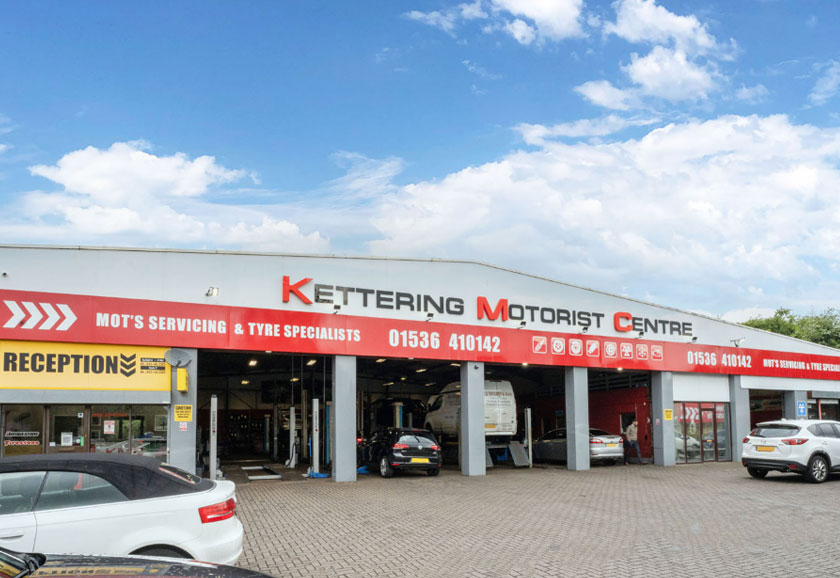
Facing a significant repair bill on an older vehicle is stressful. Kettering Motorist Centre provides expert diagnostic and repair services that give you a complete picture of your vehicle's condition before you commit to any work. Our transparent approach means you receive a clear assessment rather than a list of unnecessary recommendations. Book your MOT with Kettering Motorist Centre and get the informed, honest evaluation your vehicle deserves.
Frequently Asked Questions
At what mileage is a car not worth repairing?
There's no fixed mileage threshold, it depends on the repair cost, vehicle condition, and your financial situation. Generally, if repair costs exceed 50% of the car's current market value, or if the vehicle requires multiple major repairs (engine, transmission, suspension) within a short timeframe, it may not be worth repairing. A high-mileage car with sound engine performance and routine maintenance history may still be worth fixing, whilst one with frame damage or severe corrosion typically isn't.
How do I know if my car is a money pit?
Watch for recurring failures in the same system, escalating repair costs, and declining fuel economy despite maintenance. If you're spending more than 50% of the car's value annually on repairs, or if critical components like the transmission, engine, or frame are failing, it's likely a money pit. Also assess whether the vehicle requires specialist repairs (electrical, emissions systems) that are costly and prone to repeat issues.
Is it worth fixing a transmission on an old car with high mileage?
Transmission repairs are expensive, often costing thousands of pounds. Evaluate whether the repair cost exceeds 40-50% of your car's current value. If the vehicle is otherwise sound and you plan to keep it several more years, a transmission rebuild or replacement may be justified. However, if other major systems are failing or the car has extensive rust and frame damage, investing in transmission repair is usually not economically sensible.
Will my car's fuel economy improve after major repairs?
Yes, often significantly. Repairs to spark plugs, air filters, fuel injectors, and oxygen sensors can restore fuel efficiency by 10-20% if these components were degraded. However, you may experience a temporary fuel economy dip immediately post-service as the engine adjusts and the ECU recalibrates. This typically resolves within 50-100 miles of normal driving as the vehicle settles into optimal combustion and throttle response patterns.
Should I repair my old car or buy a newer model?
Compare the repair cost against the car's remaining lifespan and your replacement budget. If repairs cost less than 50% of the vehicle's value and you can expect 3+ more years of reliable use, repair is usually the better choice. However, if the car has multiple failing systems, poor fuel economy despite maintenance, or safety concerns, buying a newer vehicle, even a used model, may offer better long-term value and reliability.
Your booking Failed
Please try again or please call 01536 410142
Thank you for placing a booking with Kettering Motorist Centre Limited for vehicle
PLEASE TAKE YOUR BOOKING REFERENCE NUMBER WITH YOU TO THE MOT CENTRE
Your items
MOT Test
×
Terms and Conditions
These terms and conditions form the basis on which you can visit and use this website. Please read them carefully as they contain important information.
General terms and conditions
This website is owned and operated by Kettering Motorist Centre Ltd (company registration number: 4485858) operating at Trafalgar Road, Kettering, Northamptonshire, NN16 8DB (the "MOT Centre", the "Company", "we" or "us"). If you have any queries about these terms and conditions or if you have any comments or complaints on or about this website, you can contact us at [email protected] or 01536 410142.
The website is to promote and offer for sale the products and services of Kettering Motorist Centre Limited.
1. The contract between us
This website does not take payment for products or services online. The website enables you to view products and services online and to make a booking for later delivery and payment. The vehicle and provision of other products and services promoted by this website and the payment by you of the price of those products and services will take place at the MOT Centre. The booking does not constitute a contract.
The booking process on the site provides details of the booked MOT order. Please take the time to read and check your booking. It is your responsibility to make sure the order is correct and for the correct vehicle.
2. Ownership of rights
All rights, including copyright, in this website are owned by or licensed to the Company. Any use of this website or its contents, including copying or storing it or them in whole or part, other than for your own personal, non commercial use, is prohibited without our permission. You may not modify, distribute or repost anything on this website for any purpose.
3. Accuracy of content
We have taken care in the preparation of the content of this website, in particular to ensure that prices quoted are correct at the time of publishing and that all goods have been fairly described. However, bookings will only be accepted if there are no material errors in the description of the goods or their prices as advertised on this website. Any weights, dimensions and capacities given about the goods are approximate only.
4. Damage to your computer
We try to ensure that this website is free from viruses or defects. However, we cannot guarantee that your use of this website or any websites accessible through it will not cause damage to your computer. It is your responsibility to ensure that the right equipment is available to use the website. Except in the case of negligence on our part, we will not be liable to any person for any loss or damage which may arise to computer equipment as a result of using this website.
5. Availability
All bookings are subject to acceptance and availability. If the MOT date you have requested are is not available, the Centre will contact you by e-mail or phone. You will have the option either to wait until another slot is available or to cancel your booking.
6. Booking errors
You are able to correct errors on your booking up to the point on which you click on “Place Booking” during the booking process.
7. Price
The prices payable for goods that you order are as set out in our website. All prices are inclusive of VAT at the current rates and are correct at the time of entering information, errors and omissions excepted.
Whenever it is not possible to accept your booking to buy goods of the specification and description at the price indicated, the MOT Centre will advise you by email or phone or when you visit the centre.
8. Payment terms
You will be required to pay for the goods or services to the Centre at time of a completed MOT.
9. Delivery charges
N/A
10. Cancellation
The MOT Centre reserves the right to cancel the booking if:
10.1 There is insufficient stock to deliver the goods you have booked.
10.2 One or more of the goods you booked was listed at an incorrect price.
If your booking is cancelled the Centre will notify you by e-mail or phone.
You have the right to cancel your booking at any time up to the point of the MOT. If you do cancel your booking you should inform the centre by phone.
11. Liability
Notwithstanding the foregoing, nothing in these terms and conditions is intended to limit any rights you might have as a consumer under applicable local law or other statutory rights that may not be excluded nor in any way to exclude or limit our liability to you for any death or personal injury resulting from our negligence.
12. Notices
Unless otherwise expressly stated in these terms and conditions, all notices from you to us must be in writing and sent to our contact address given above and all notices from us to you will be displayed on our website from time to time.
13. Changes to legal notices
We reserve the right to change these terms and conditions from time to time and you should look through them as often as possible.
14. Law, jurisdiction and language
This website, any content contained therein and any contract brought into being as a result of usage of this website are governed by and construed in accordance with English law. Parties to any such contract agree to submit to the exclusive jurisdiction of the courts of England and Wales.
15. Invalidity
If any part of these terms and conditions is unenforceable (including any provision in which we exclude our liability to you) the enforceability of any other part of these conditions will not be affected.
16. Privacy
You acknowledge and agree to be bound by the terms of our privacy policy
17. Third party rights
Nothing in this Agreement is intended to, nor shall it confer any rights on a third party.