Electric vehicle servicing Kettering drivers need has changed significantly as EV ownership across Northamptonshire continues to grow. At Kettering Motorist Centre, we work with electric and hybrid vehicle owners every week, and one thing stands out: most drivers are unsure what an EV service actually involves, how often they need one, or what it costs. This guide answers all of that directly.
Most guides treat electric vehicle maintenance as a simplified version of petrol servicing. It is not. EVs have fewer moving parts, yes, but high-voltage systems, battery state of health, and regenerative braking components require specialist knowledge and equipment that a standard garage simply does not have.
According to the Society of Motor Manufacturers and Traders (SMMT), electric vehicle registrations in the UK continue to rise year on year, meaning demand for qualified EV servicing is growing faster than the supply of properly trained technicians. That gap matters for Kettering drivers choosing where to take their car.
Why Choose Kettering Motorist Centre for Electric Vehicle Servicing
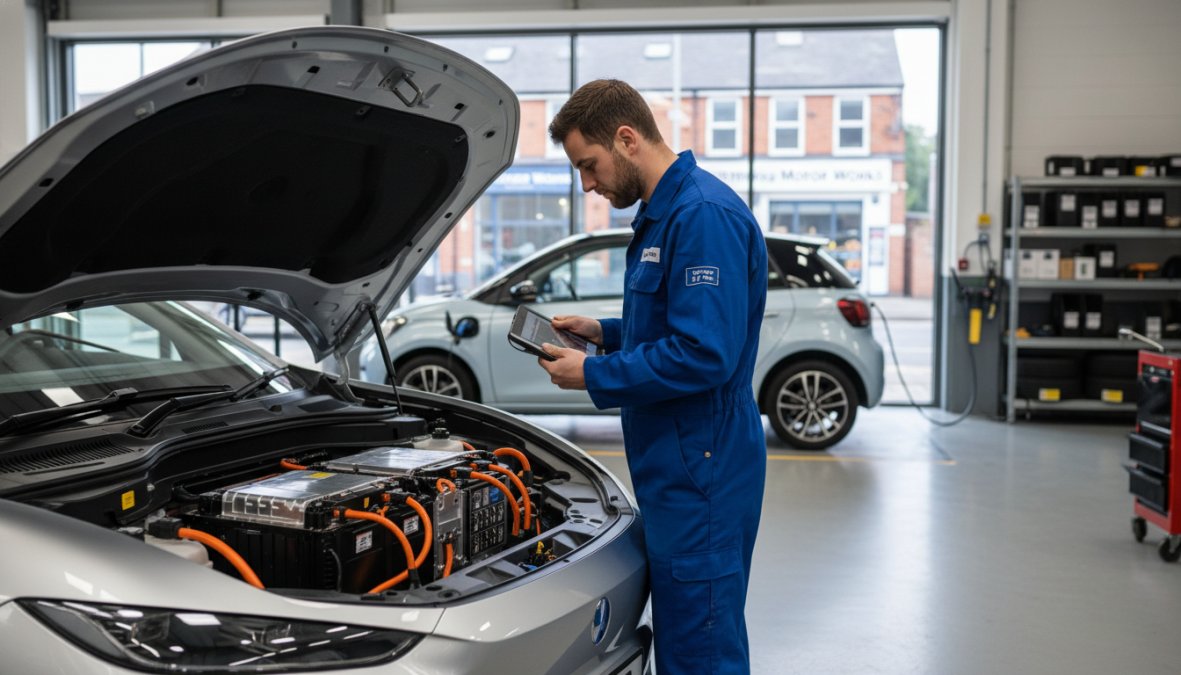
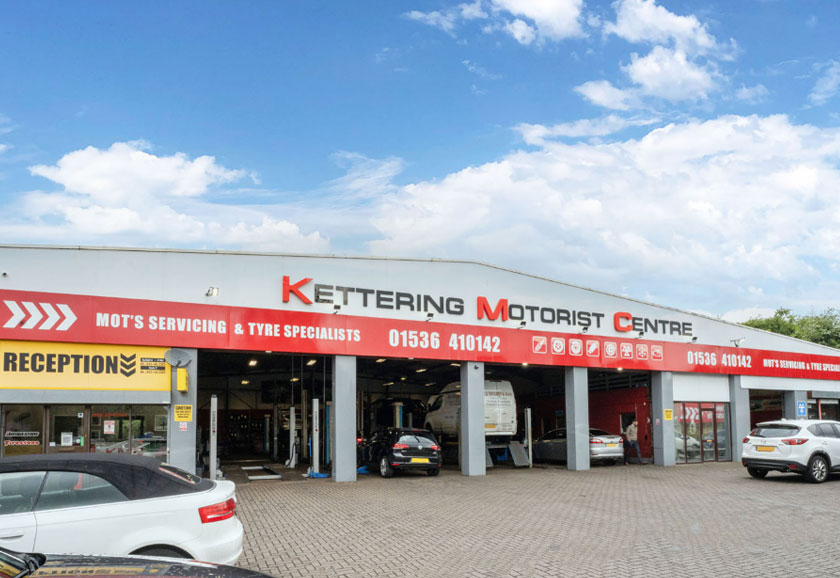
Kettering Motorist Centre is a family-run business built around three things: technical competence, transparency, and convenience. Our technicians handle fully electric and hybrid vehicles, covering everything from high-voltage system checks to MOT testing and tyre inspection. Unlike national chains that route EV work to distant specialist centres, we carry out this work locally, meaning faster turnaround and direct communication with the people actually working on your vehicle.
The booking process requires no upfront payment, removing the friction that puts many drivers off scheduling maintenance before a problem develops.
Pro TipFamily-run garages often provide more consistent service quality than franchise chains because the same technicians handle your vehicle repeatedly. Ask who specifically will be working on your EV when you book.
What most drivers searching for EV servicing near me overlook is the importance of IMI-qualified technicians for high-voltage systems. Working on EV electrical systems without proper accreditation is not just poor practice; it is a safety risk.
What Is Checked During an EV Service at Our Kettering Garage
An EV service is not a shortened traditional service. The checklist, diagnostic equipment, and technical knowledge required are all different.
A standard electric vehicle service at our Kettering garage covers:
High-voltage battery inspection and state of health report
Cooling system and cooling fluids check
Regenerative braking system and conventional brake fluid inspection
Tyre tread depth measurement and tyre pressure check
Suspension and steering geometry assessment
Cabin air filter and pollen filter replacement (where due)
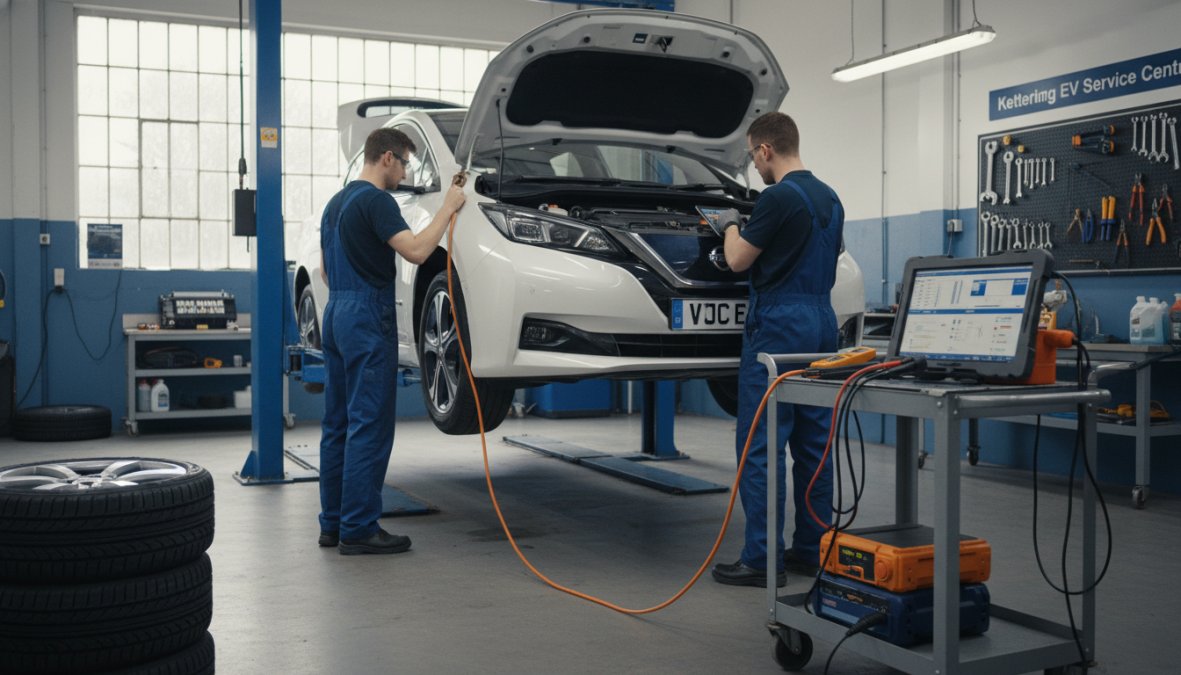
A qualified technician in a well-lit workshop inspecting the underside of a white electric vehicle elevated on a hydraulic ramp, with a laptop running diagnostic software visible on a nearby workbench
The road test is often undervalued. Driving under normal conditions surfaces issues that static diagnostics miss, particularly with regenerative braking behaviour. A technician who only plugs in a scanner and hands back the keys has not completed a thorough EV service.
High-Voltage Battery and System Checks
The battery is the most expensive component in any electric vehicle, and its state of health directly determines range, resale value, and reliability. Technicians assess cell balance, charge capacity relative to original specification, and thermal management system performance.
Cooling fluids that regulate battery temperature degrade over time. Most manufacturers specify replacement intervals, but many drivers are unaware this fluid even exists. Neglecting it accelerates battery degradation and can cause thermal management failures.
The inverter and on-board charger are also inspected. Fault codes related to these systems often appear before any noticeable driving symptoms, which is why a diagnostic scan is essential rather than optional.
Regenerative Braking and Brake Fluid Inspection
Regenerative braking uses the electric motor to slow the vehicle, converting kinetic energy back into stored battery charge. This means conventional brake pads and discs are used far less frequently than on a petrol car, but the consequence is counterintuitive: infrequent use allows moisture and corrosion to build up on discs, accelerating deterioration. A thorough brake inspection checks disc surface condition alongside pad depth.
Brake fluid absorbs moisture over time regardless of how often the brakes are physically applied. Most manufacturers recommend replacement every two years, an interval that applies to EVs just as it does to petrol cars, and one of the most commonly skipped items on an EV service.
Watch OutSkipping brake fluid replacement because "EVs barely use their brakes" is a common and dangerous mistake. Moisture-contaminated brake fluid lowers its boiling point, which can cause brake fade in emergency stops.
Tyre Tread Depth, Suspension, and Cabin Air Filter
Electric vehicles are heavier than equivalent petrol models due to battery weight, which accelerates tyre wear, particularly on the driven axle. EV-specific tyres compensate with reinforced sidewalls and lower rolling resistance compounds, but still require regular checks against the legal minimum of 1.6mm.
Suspension components bear the additional battery load throughout the vehicle's life. Worn bushes, dampers, and steering components are more common on EVs than many drivers expect, and a suspension check at every service catches these before they affect handling or create MOT failure points.
The cabin air filter filters air entering the passenger compartment through the climate control system. On EVs, the climate system runs directly from the battery, so a blocked filter forces it to work harder and reduces range. Replacement is inexpensive but frequently overlooked.
How Often Do Electric Cars Need Servicing?
Electric cars generally need servicing once a year or every 12,000 miles, whichever comes first. This interval is less frequent than many petrol vehicles, but it is not optional. The reduced frequency reflects the absence of engine oil changes, timing belt replacements, and spark plug renewals, what remains is a focused inspection of safety-critical systems. Skipping annual servicing because "there is less to check" leads to avoidable failures and, in some cases, voided manufacturer warranty.
Hybrid vehicles follow a slightly different schedule. Because they combine a petrol engine with an electric drivetrain, hybrid car servicing intervals typically align more closely with conventional petrol schedules, with the addition of high-voltage system checks.
For Tesla servicing and other premium EV brands, manufacturer guidance often specifies annual inspections even when mileage is low, particularly relevant for Kettering drivers using their vehicle primarily for shorter local journeys.
Vehicle Type
Typical Service Interval
Key Additional Checks
Full EV
12 months or 12,000 miles
Battery SoH, inverter, regen braking
Plug-in Hybrid
12 months or 10,000 miles
Engine oil, battery, both drivetrains
Mild Hybrid
12 months or 10,000 miles
Engine service + electrical systems
Tesla (Model 3/Y)
Annual inspection
Brake fluid every 2 years, cabin filter
EV Maintenance Cost in Kettering: What to Expect
Electric vehicle servicing costs less over the vehicle's lifetime than petrol equivalents, but the individual service visit is not always cheaper. A standard annual EV service at a qualified Kettering garage covers the inspection checklist above, a diagnostics scan, and a road test. Costs vary by make and model. Fixed-price servicing removes the uncertainty of open-ended labour charges, and Kettering Motorist Centre operates on a transparent pricing basis so drivers know what they are paying before work begins.
EV vs. ICE Servicing Costs: The Real Difference
The long-term cost advantage of electric vehicles comes from eliminating engine oil services, timing belt replacements, exhaust repairs, and clutch replacements. What EV owners do pay for: tyres (more frequently due to vehicle weight), brake fluid (same interval as ICE vehicles), battery health checks, and any high-voltage system repairs. The last category is where costs can be significant if problems are identified late, which reinforces the value of annual servicing.
According to the RAC Foundation's analysis of EV running costs, electric vehicles typically cost less to maintain annually than petrol equivalents, but this advantage narrows considerably if battery or high-voltage component issues are left unaddressed.
Key TakeawayThe real cost saving from EV ownership comes from avoiding major engine-related repairs. Annual servicing protects that saving by catching high-voltage and battery issues before they escalate.
Electric Car MOT in Kettering: What You Need to Know
Electric cars require an MOT in the same way as petrol and diesel vehicles, starting from their third year of registration. The electric car MOT Kettering drivers need covers most of the same categories as a standard MOT. The emissions test is effectively a pass by default since there are no exhaust emissions, but all other categories, electrical systems, lighting, braking, tyres, and suspension, apply in full.
EV-Specific MOT Failure Points Most Drivers Miss
Many drivers assume that fewer mechanical components means a lower chance of MOT failure. The data does not support this. Several EV-specific failure points catch drivers off guard every year:
Brake disc corrosion: Infrequent use of conventional brakes allows surface rust to develop, affecting braking performance under test conditions
Tyre condition: EV weight increases tyre wear rates; many vehicles present for MOT with borderline tread depth
Suspension wear: Battery weight accelerates wear on bushes and dampers, checked during the vehicle safety inspection
Lighting and electrical faults: High-voltage systems can interfere with auxiliary electrical circuits, causing lighting failures
Windscreen and visibility: No EV-specific issue, but frequently failed alongside other items
As documented in the DVSA's MOT testing guide for electric vehicles, testers follow specific procedures for EV brake testing and electrical system assessment that differ from petrol vehicle protocols. A pre-MOT inspection at Kettering Motorist Centre identifies these issues before the official test, saving the cost and inconvenience of a retest.
Battery Health Reporting: Understanding Your EV's State of Health
Battery state of health is the single most important metric for any electric vehicle owner. It measures the battery's current capacity as a percentage of its original specification, a battery at 80% SoH delivers approximately 80% of the manufacturer's advertised range. Most drivers have no idea what their battery's SoH actually is, because the vehicle's range display adjusts gradually to current capacity, making degradation easy to miss without a dedicated diagnostic report.
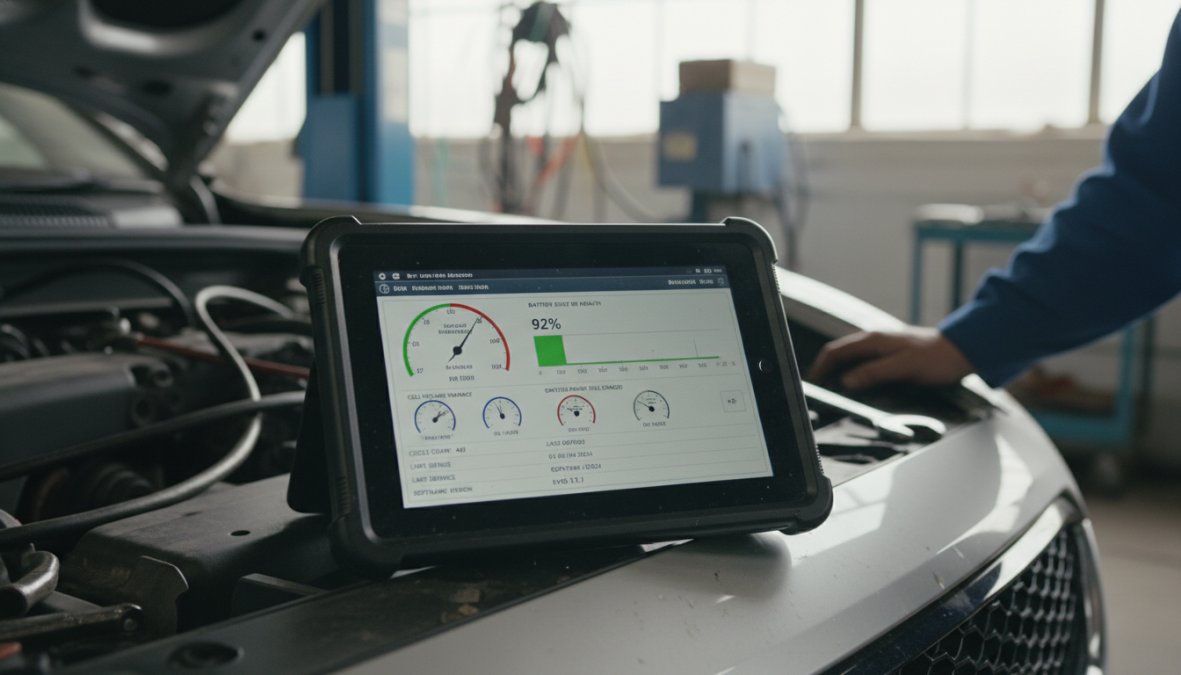
Close-up of a technician's hands holding a tablet displaying a battery state-of-health diagnostic report with percentage readings and cell balance data, in a clean garage workshop environment with an electric vehicle visible in the background
During an EV service at our Kettering garage, we provide a battery health report showing:
Current capacity as a percentage of original specification
Cell balance across the battery pack
Thermal management system performance
Charge and discharge rate capability
This report identifies early-stage degradation before it accelerates and provides documentation that supports resale value. According to Recurrent Auto's battery health research database, most electric vehicles retain over 90% of their original battery capacity after five years of normal use, but this varies significantly by model and charging habits. Frequent rapid charging and consistently charging to 100% are the two habits most associated with accelerated degradation.
Electric Vehicle Servicing Kettering: How to Book and What to Prepare
Booking electric vehicle servicing Kettering at Kettering Motorist Centre takes under five minutes online. No upfront payment is required.
How to book your EV service:
Visit the Kettering Motorist Centre website and select the service booking option
Choose your service type (EV service, MOT, or combined)
Enter your vehicle registration to confirm make and model
Select your preferred date and time from available slots
Confirm your contact details and submit, with no payment taken at this stage
What to prepare before your appointment:
Note any warning lights currently showing on your dashboard
Record your current estimated range so the technician can compare post-service
Check when your last brake fluid replacement was carried out
Bring your service history if available in paper format
If your vehicle is approaching its first or second MOT, a combined EV service and pre-MOT check is the most efficient option and avoids two separate visits. For drivers across Kettering and the wider Northamptonshire area, local specialist servicing removes the need to travel to a main dealer for routine maintenance.
Finding a garage that genuinely understands electric vehicles is harder than it should be for most Northamptonshire drivers. Kettering Motorist Centre offers specialist EV and hybrid servicing with transparent pricing, a no-payment-required online booking system, and the diagnostic capability to produce a full battery health report alongside every service. Book your MOT or EV service today and leave with documentation that protects both your vehicle and its resale value.
Frequently Asked Questions
Do electric cars need servicing?
Yes, electric vehicles still require regular servicing even though they have fewer moving parts than petrol or diesel cars. EV maintenance covers high-voltage system checks, battery state of health, brake fluid, regenerative braking inspection, tyre tread depth, suspension, cooling fluids, and cabin air filter replacement. Skipping service intervals can affect manufacturer warranty validity and compromise vehicle safety.
How often should an electric vehicle be serviced?
Most electric vehicles follow a service schedule of once a year or every 12,000-18,000 miles, whichever comes first. However, service intervals vary by manufacturer, so always check your vehicle handbook. Some components, such as brake fluid and EV-specific tyres, may need attention more frequently depending on driving conditions around Kettering and the surrounding Northamptonshire area.
Are EV services cheaper than petrol car services?
Generally, electric vehicle servicing tends to cost less over time because EVs have no oil changes, fewer brake replacements thanks to regenerative braking, and simpler drivetrains. However, specialist diagnostics for high-voltage components and battery health reporting can influence upfront costs. At Kettering Motorist Centre, we offer fixed price servicing with transparent costs so you know exactly what you're paying before any work begins.
Can any garage service an electric vehicle in Kettering?
Not all garages are equipped to safely service electric vehicles. EVs contain high-voltage components that require IMI-qualified technicians and specialist diagnostic tools. When searching for EV maintenance in Kettering, confirm the garage has trained staff and the correct equipment for electrical systems integration, battery diagnostics, and inverter and on-board charger checks. Kettering Motorist Centre is fully equipped for both electric and hybrid car servicing.
What happens during an electric car MOT in Kettering?
An electric car MOT in Kettering follows the standard MOT testing framework but includes EV-specific checks such as high-voltage warning labels, electrical systems integration, condition of the charging port, and vehicle safety inspection of braking and suspension systems. EV-specific MOT failure points, like exposed high-voltage cables or faulty warning lights, are often overlooked by drivers. Booking with a specialist garage helps ensure your EV passes first time.
Your booking Failed
Please try again or please call 01536 410142
Thank you for placing a booking with Kettering Motorist Centre Limited for vehicle
PLEASE TAKE YOUR BOOKING REFERENCE NUMBER WITH YOU TO THE MOT CENTRE
Your items
MOT Test
×
Terms and Conditions
These terms and conditions form the basis on which you can visit and use this website. Please read them carefully as they contain important information.
General terms and conditions
This website is owned and operated by Kettering Motorist Centre Ltd (company registration number: 4485858) operating at Trafalgar Road, Kettering, Northamptonshire, NN16 8DB (the "MOT Centre", the "Company", "we" or "us"). If you have any queries about these terms and conditions or if you have any comments or complaints on or about this website, you can contact us at [email protected] or 01536 410142.
The website is to promote and offer for sale the products and services of Kettering Motorist Centre Limited.
1. The contract between us
This website does not take payment for products or services online. The website enables you to view products and services online and to make a booking for later delivery and payment. The vehicle and provision of other products and services promoted by this website and the payment by you of the price of those products and services will take place at the MOT Centre. The booking does not constitute a contract.
The booking process on the site provides details of the booked MOT order. Please take the time to read and check your booking. It is your responsibility to make sure the order is correct and for the correct vehicle.
2. Ownership of rights
All rights, including copyright, in this website are owned by or licensed to the Company. Any use of this website or its contents, including copying or storing it or them in whole or part, other than for your own personal, non commercial use, is prohibited without our permission. You may not modify, distribute or repost anything on this website for any purpose.
3. Accuracy of content
We have taken care in the preparation of the content of this website, in particular to ensure that prices quoted are correct at the time of publishing and that all goods have been fairly described. However, bookings will only be accepted if there are no material errors in the description of the goods or their prices as advertised on this website. Any weights, dimensions and capacities given about the goods are approximate only.
4. Damage to your computer
We try to ensure that this website is free from viruses or defects. However, we cannot guarantee that your use of this website or any websites accessible through it will not cause damage to your computer. It is your responsibility to ensure that the right equipment is available to use the website. Except in the case of negligence on our part, we will not be liable to any person for any loss or damage which may arise to computer equipment as a result of using this website.
5. Availability
All bookings are subject to acceptance and availability. If the MOT date you have requested are is not available, the Centre will contact you by e-mail or phone. You will have the option either to wait until another slot is available or to cancel your booking.
6. Booking errors
You are able to correct errors on your booking up to the point on which you click on “Place Booking” during the booking process.
7. Price
The prices payable for goods that you order are as set out in our website. All prices are inclusive of VAT at the current rates and are correct at the time of entering information, errors and omissions excepted.
Whenever it is not possible to accept your booking to buy goods of the specification and description at the price indicated, the MOT Centre will advise you by email or phone or when you visit the centre.
8. Payment terms
You will be required to pay for the goods or services to the Centre at time of a completed MOT.
9. Delivery charges
N/A
10. Cancellation
The MOT Centre reserves the right to cancel the booking if:
10.1 There is insufficient stock to deliver the goods you have booked.
10.2 One or more of the goods you booked was listed at an incorrect price.
If your booking is cancelled the Centre will notify you by e-mail or phone.
You have the right to cancel your booking at any time up to the point of the MOT. If you do cancel your booking you should inform the centre by phone.
11. Liability
Notwithstanding the foregoing, nothing in these terms and conditions is intended to limit any rights you might have as a consumer under applicable local law or other statutory rights that may not be excluded nor in any way to exclude or limit our liability to you for any death or personal injury resulting from our negligence.
12. Notices
Unless otherwise expressly stated in these terms and conditions, all notices from you to us must be in writing and sent to our contact address given above and all notices from us to you will be displayed on our website from time to time.
13. Changes to legal notices
We reserve the right to change these terms and conditions from time to time and you should look through them as often as possible.
14. Law, jurisdiction and language
This website, any content contained therein and any contract brought into being as a result of usage of this website are governed by and construed in accordance with English law. Parties to any such contract agree to submit to the exclusive jurisdiction of the courts of England and Wales.
15. Invalidity
If any part of these terms and conditions is unenforceable (including any provision in which we exclude our liability to you) the enforceability of any other part of these conditions will not be affected.
16. Privacy
You acknowledge and agree to be bound by the terms of our privacy policy
17. Third party rights
Nothing in this Agreement is intended to, nor shall it confer any rights on a third party.