Electric Vehicle Maintenance Tips for Beginners: What's Actually Different
Electric vehicle maintenance tips for beginners often start in the wrong place: by listing everything you no longer need to do. At Kettering Motorist Centre, we work with EV and hybrid owners across Kettering, Northamptonshire every week, and the most common problem we see is not neglect of old tasks, it is confusion about the new ones.
Electric vehicles are not maintenance-free. They are maintenance-different. The powertrain has far fewer moving parts, which reduces service frequency. But the battery pack, thermal management system, tyres, and auxiliary systems all require careful attention. Get these wrong and you face expensive repairs, reduced range, and accelerated battery degradation.
Key TakeawayElectric vehicles require less frequent servicing than petrol or diesel cars, but the maintenance tasks that remain are more consequential. Battery health, charging behaviour, and tyre wear demand consistent attention.
EV Battery Health Tips: How to Protect Your Most Expensive Component
The battery pack is the most expensive single component in any electric vehicle, and owner behaviour directly affects its long-term value. Battery degradation is a gradual, irreversible reduction in capacity, every kilowatt-hour lost is range you will never recover without replacing cells.
Close-up of an electric vehicle charging port connected to a home wall charger in a softly lit domestic garage, with the charging status light glowing green
What actually matters for battery health:
Keep the state of charge between 20% and 80% for daily use
Avoid leaving the battery at 0% or 100% for extended periods
Use scheduled charging to time charge completion with your departure
Pre-condition the cabin while still plugged in, rather than drawing from the battery pack
A common mistake is treating an EV battery like a smartphone: charging to 100% every night and running it flat before recharging. Most modern EVs let you set a charge limit in the app or infotainment system. Set it to 80% for daily driving; reserve 100% for long trips only.
Managing State of Charge to Reduce Battery Degradation
State of charge management is the single most effective EV battery health tip you can apply without specialist tools. Keeping the battery between 20% and 80% reduces electrochemical stress on cells during each charging cycle, over hundreds of cycles, this difference is significant.
Most manufacturers build charge-limiting features directly into the vehicle's software. Check your owner's manual or app settings for a "daily charge limit" or "maximum charge" option, and review these settings periodically as over-the-air updates may refine them.
The Impact of Extreme Temperatures on Your Battery Pack
Extreme temperatures are the second major threat to battery longevity, and particularly relevant in Northamptonshire where winters can be sharp. Cold weather temporarily reduces available capacity and slows charging; heat accelerates permanent degradation.
The thermal management system works best when the vehicle is plugged in. Pre-conditioning the battery before a cold-weather journey, while still connected to the charger, protects both range and battery service life at almost no cost.
EV Charging Best Practices: Getting the Most From Every Cycle
The core principle: slow charging is kinder to the battery than fast charging. A home wallbox at 7kW overnight is gentler on cells than a 150kW rapid charger at a motorway service station. That does not mean avoiding fast charging entirely, it means not relying on it daily.
A practical charging routine for most beginners in Kettering:
Charge at home overnight using a wallbox, set to a maximum of 80%
Use rapid chargers on long journeys when necessary
Avoid charging to 100% unless you need the full range that day
Do not let the battery deplete below 10% regularly
If storing the vehicle for more than two weeks, leave the battery at approximately 50%
Watch OutRelying on DC fast charging for daily top-ups rather than home charging accelerates battery degradation over time. Most manufacturers recommend limiting fast charging to occasional use, not routine practice.
When Fast Charging Helps and When It Hurts
Fast charging is not inherently damaging when used occasionally. The problem is frequency. High-power DC fast chargers push large amounts of current into the battery quickly, generating heat the thermal management system must dissipate. Over many cycles, this thermal stress compounds.
Use fast charging for long motorway journeys or time-critical situations. For daily commuting, home charging is almost always better for both battery health and running costs. As the Zap-Map guide to EV charging infrastructure in the UK notes, the majority of UK EV owners do the bulk of their charging at home, which aligns with best practice for battery longevity.
Electric Car Tyre Maintenance: What EV Owners Often Overlook
Tyres are where electric car owners are most frequently caught off guard. EVs are heavier than equivalent petrol cars due to the battery pack, and they deliver torque instantaneously from a standing start, both factors accelerate tyre wear considerably.
Check tyre pressures at least once a fortnight. Most EVs display real-time tyre pressure in the instrument cluster, but do not rely on the warning light alone, by the time it triggers, pressure may already be significantly low.
Key checks to perform regularly:
Tyre pressure: check cold, at least every two weeks
Tread depth: minimum 1.6mm legal limit, but replace at 3mm for safety
Uneven wear patterns: indicate alignment or suspension issues
Sidewall condition: look for bulges, cuts, or cracking
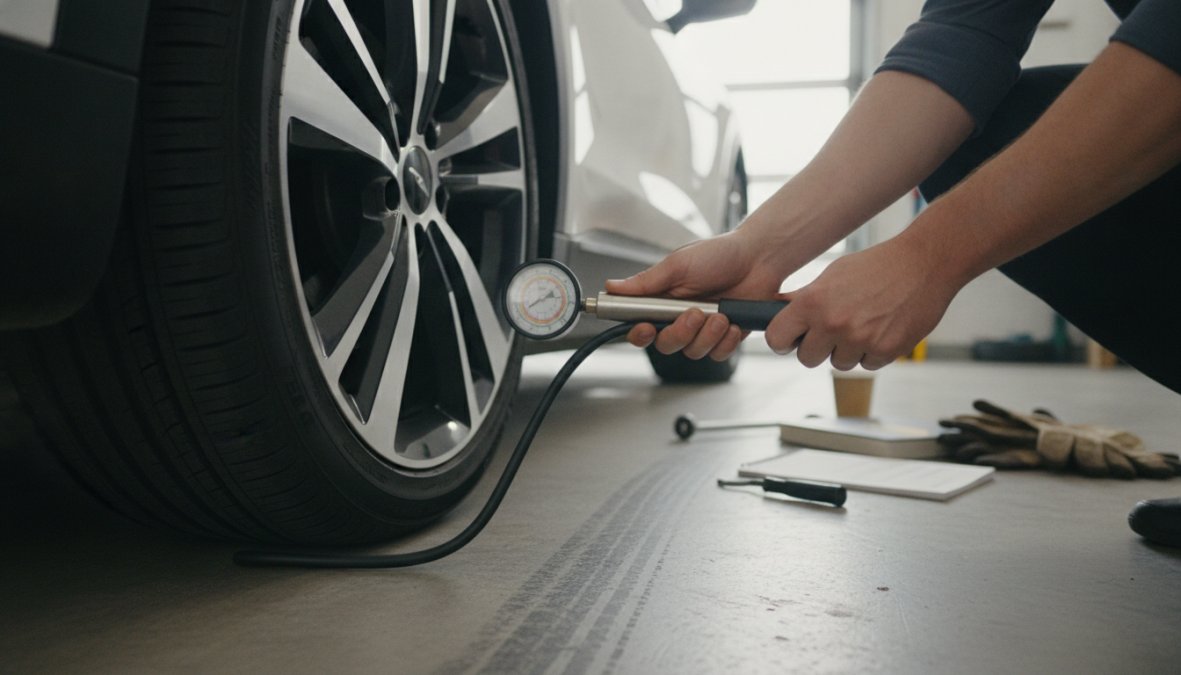
A mechanic in a professional workshop crouching beside an electric vehicle wheel, inspecting tyre tread depth with a gauge tool under bright workshop lighting
Tyre rotation every 6,000 to 8,000 miles is strongly recommended. Because the motor drives specific axles, wear distribution is uneven; rotation extends tyre life and keeps handling balanced.
Tyre Selection for EVs: Why Low-Rolling-Resistance Tyres Matter
Not all tyres are equal for electric vehicles. Low-rolling-resistance tyres reduce energy lost to friction, translating directly into extended range per charge. EV-specific tyres also handle greater load ratings and manage road noise more effectively, important in a cabin that lacks engine sound to mask it.
When replacing tyres, look for EV-specific designations from manufacturers such as Michelin, Continental, or Bridgestone. These are not always more expensive than standard equivalents, but they are meaningfully better suited to the vehicle.
Electric Vehicle Service Intervals: A Beginner's Maintenance Schedule
Electric vehicle service intervals are longer than those for petrol or diesel cars, but they are not zero. Several systems still require scheduled attention.
Task
Frequency
DIY or Professional
Tyre pressure check
Every 2 weeks
DIY
Tyre rotation
Every 6,000-8,000 miles
Professional
Cabin air filter
Every 1-2 years
DIY or Professional
Brake fluid check
Annually
Professional
Coolant flush
Every 3-5 years
Professional
Brake inspection
Annually
Professional
Windscreen washer fluid
As needed
DIY
Software/OTA updates
As released
DIY (in-vehicle)
Battery health check
Every 2 years
Professional
Always cross-reference with your vehicle manufacturer's specific recommendations in the owner's manual.
Brake System Maintenance and Regenerative Braking Explained
Regenerative braking converts kinetic energy back into electrical energy during deceleration, extending range and dramatically reducing wear on physical brake pads and discs. Because friction brakes are used far less frequently, components can corrode and seize from underuse rather than wear.
The practical fix is straightforward. Apply the brakes firmly to a full stop from moderate speed at least once per journey. Have the brake system inspected annually even if pads show minimal wear, and replace brake fluid on schedule regardless of mileage, it absorbs moisture over time, lowering its boiling point.
Fluid Checks: Coolant, Brake Fluid, and Washer Fluid
Coolant circulates through the battery pack's thermal management system and, in many EVs, through the motor and power electronics. A flush is typically recommended every three to five years; neglecting this allows coolant to degrade and reduces its ability to manage battery temperature.
Brake fluid is hygroscopic, it absorbs moisture, lowering its boiling point over time. Annual testing is inexpensive; most manufacturers recommend replacement every two years regardless of condition.
Washer fluid is the one fluid you will top up regularly. Use a screen wash rated for sub-zero temperatures during winter, particularly relevant in Kettering where overnight frosts are common from October through March.
Cabin Air Filter Replacement and Auxiliary Systems
The cabin air filter is one of the few DIY-accessible maintenance tasks on most EVs. A blocked filter reduces HVAC efficiency, which matters more in an EV because heating and cooling draws directly from the battery pack. Most manufacturers recommend replacement every one to two years.
Also watch the 12V auxiliary battery, which powers the vehicle's electronics, lights, and control systems independently of the main traction battery. This battery can fail like any conventional car battery and is often overlooked. Intermittent electrical faults or failure to respond to the key fob are common symptoms.
DIY vs Professional Service: Electric Vehicle Maintenance Tips for Beginners
Knowing which tasks are safe to handle yourself and which require specialist equipment is essential, getting this wrong can void your warranty, damage expensive components, or create safety risks.
Tasks suitable for DIY:
Tyre pressure checks and inflation
Windscreen washer fluid top-up
Cabin air filter replacement (on most models)
Wiper blade replacement
Monitoring tyre tread depth
Installing and reviewing over-the-air software updates
Tasks requiring professional service:
Brake fluid testing and replacement
Coolant flush and refill
Tyre rotation and wheel alignment
Battery health diagnostic
High-voltage system inspection or repair
Charging port inspection
The high-voltage systems in an EV operate at voltages that are immediately life-threatening. Never attempt to inspect, repair, or modify any component connected to the main battery pack without specialist training and equipment.
For EV owners near Kettering, Kettering Motorist Centre offers specialist diagnostics and repair for electric and hybrid vehicles with a straightforward online booking process and no upfront payment required.
Pro TipBefore any professional service, check whether your EV's warranty covers the repair or inspection. Many manufacturers offer battery warranty coverage for eight years or 100,000 miles. Understand what your warranty covers before paying out of pocket.
Winter-Specific Maintenance Tasks EV Owners Should Know
Cold temperatures reduce available battery capacity, slow charging speeds, and increase energy demand for cabin heating. Range in freezing conditions can drop considerably compared to mild-weather figures.
Winter-specific maintenance tasks for EV owners:
Switch to winter-rated or all-season tyres if temperatures regularly drop below 7°C, below this threshold, summer tyres lose grip significantly.
Use scheduled departure and pre-conditioning features to warm the cabin and battery while plugged in.
Top up windscreen washer fluid with a product rated to at least -20°C.
Inspect wiper blades before winter and replace if streaking.
Keep the battery above 20% state of charge more consistently, cold reduces buffer capacity and depletion happens faster than expected.
Use seat heaters and steering wheel heaters rather than maximum HVAC; they are more energy-efficient.
EV Maintenance Cost Comparison vs Petrol and Diesel Cars
The absence of oil changes, timing belt replacements, exhaust repairs, and clutch replacements removes several of the most expensive recurring service items. What remains is a shorter, more predictable list: tyres, brakes, cabin air filters, and periodic fluid replacements. The battery pack carries a significant replacement cost if it fails outside warranty, but most modern batteries are designed to retain the majority of their capacity well beyond the warranty period when managed correctly.
EV maintenance is less frequent and generally less expensive than equivalent petrol or diesel servicing. The savings are real, but they depend on following a consistent maintenance routine. Ignoring tyre wear, brake fluid, or thermal management does not eliminate costs, it defers them, usually at higher expense.
For EV and hybrid owners across Kettering and the surrounding area, Kettering Motorist Centre provides expert diagnostic and repair services with transparent pricing and convenient online booking. As the Electric Vehicle Association guidance on EV servicing standards notes, using a qualified technician familiar with high-voltage systems is essential for anything beyond basic owner maintenance.
Switching to an electric vehicle removes several familiar maintenance tasks but introduces a different set of priorities that many new owners are not prepared for. Battery management, charging discipline, and tyre care are the areas where attention pays off most directly. Kettering Motorist Centre specialises in electric and hybrid vehicle servicing across Kettering and Northamptonshire, offering expert diagnostics, a transparent booking process, and no upfront payment required online. Book your MOT or service with Kettering Motorist Centre and keep your EV running at full capacity for years to come.
Frequently Asked Questions
Do electric vehicles really require less maintenance than petrol or diesel cars?
Generally, yes. Electric vehicles have far fewer moving parts than an internal combustion engine, no oil changes, no timing belts, and no exhaust system to worry about. However, EVs still require regular tyre rotation, brake fluid checks, cabin air filter replacement, and battery thermal management care. The overall service burden is lower, but electric vehicle maintenance tips for beginners should make clear that EVs are not maintenance-free.
How can I extend the lifespan of my EV battery?
The most effective EV battery health tips are to keep your state of charge between 20% and 80% for everyday use, avoid frequent fast charging sessions, use pre-conditioning to warm or cool the battery before driving in extreme temperatures, and store the vehicle at a moderate charge level if leaving it unused for extended periods. These habits reduce battery degradation and help preserve full capacity across more charging cycles.
How often should I rotate the tyres on my electric vehicle?
As part of electric car tyre maintenance, most manufacturers recommend rotating EV tyres every 5,000 to 7,500 miles. EVs are heavier than equivalent petrol cars due to the battery pack, and instant torque delivery causes faster front tyre wear. Regular rotation evens out wear patterns, extends tyre service life, and maintains efficiency. Always check your vehicle handbook for the manufacturer's specific electric vehicle service intervals.
Do electric vehicles need brake fluid changes?
Yes. Even though regenerative braking reduces how often the physical brakes are used, brake fluid still absorbs moisture over time and must be replaced. Most manufacturers recommend checking and replacing brake fluid every two years regardless of mileage. Neglecting this is a common oversight, brake fluid condition affects both safety and warranty coverage, so it should always be part of your EV service schedule.
Can I perform DIY maintenance on my electric vehicle?
Some electric vehicle maintenance tips for beginners are perfectly suited to DIY: checking washer fluid, replacing the cabin air filter, monitoring tyre pressure, and keeping software up to date via over-the-air updates. However, anything involving the high-voltage battery pack, thermal management system, or coolant flush should be handled by a trained EV technician with specialist diagnostic tools. Attempting high-voltage work without proper training is dangerous and may void your warranty coverage.
What is the 12V auxiliary battery in an EV and why does it need maintenance?
Most EVs carry a separate 12V auxiliary battery that powers low-voltage auxiliary systems such as lights, infotainment, and door locks, separate from the main kilowatt-hour battery pack that drives the powertrain. This smaller battery can degrade and fail just like in a conventional car. It should be tested during routine servicing, typically every two to three years, and replaced when it shows signs of weakness to avoid being stranded despite a fully charged main battery.
Your booking Failed
Please try again or please call 01536 410142
Thank you for placing a booking with Kettering Motorist Centre Limited for vehicle
PLEASE TAKE YOUR BOOKING REFERENCE NUMBER WITH YOU TO THE MOT CENTRE
Your items
MOT Test
×
Terms and Conditions
These terms and conditions form the basis on which you can visit and use this website. Please read them carefully as they contain important information.
General terms and conditions
This website is owned and operated by Kettering Motorist Centre Ltd (company registration number: 4485858) operating at Trafalgar Road, Kettering, Northamptonshire, NN16 8DB (the "MOT Centre", the "Company", "we" or "us"). If you have any queries about these terms and conditions or if you have any comments or complaints on or about this website, you can contact us at [email protected] or 01536 410142.
The website is to promote and offer for sale the products and services of Kettering Motorist Centre Limited.
1. The contract between us
This website does not take payment for products or services online. The website enables you to view products and services online and to make a booking for later delivery and payment. The vehicle and provision of other products and services promoted by this website and the payment by you of the price of those products and services will take place at the MOT Centre. The booking does not constitute a contract.
The booking process on the site provides details of the booked MOT order. Please take the time to read and check your booking. It is your responsibility to make sure the order is correct and for the correct vehicle.
2. Ownership of rights
All rights, including copyright, in this website are owned by or licensed to the Company. Any use of this website or its contents, including copying or storing it or them in whole or part, other than for your own personal, non commercial use, is prohibited without our permission. You may not modify, distribute or repost anything on this website for any purpose.
3. Accuracy of content
We have taken care in the preparation of the content of this website, in particular to ensure that prices quoted are correct at the time of publishing and that all goods have been fairly described. However, bookings will only be accepted if there are no material errors in the description of the goods or their prices as advertised on this website. Any weights, dimensions and capacities given about the goods are approximate only.
4. Damage to your computer
We try to ensure that this website is free from viruses or defects. However, we cannot guarantee that your use of this website or any websites accessible through it will not cause damage to your computer. It is your responsibility to ensure that the right equipment is available to use the website. Except in the case of negligence on our part, we will not be liable to any person for any loss or damage which may arise to computer equipment as a result of using this website.
5. Availability
All bookings are subject to acceptance and availability. If the MOT date you have requested are is not available, the Centre will contact you by e-mail or phone. You will have the option either to wait until another slot is available or to cancel your booking.
6. Booking errors
You are able to correct errors on your booking up to the point on which you click on “Place Booking” during the booking process.
7. Price
The prices payable for goods that you order are as set out in our website. All prices are inclusive of VAT at the current rates and are correct at the time of entering information, errors and omissions excepted.
Whenever it is not possible to accept your booking to buy goods of the specification and description at the price indicated, the MOT Centre will advise you by email or phone or when you visit the centre.
8. Payment terms
You will be required to pay for the goods or services to the Centre at time of a completed MOT.
9. Delivery charges
N/A
10. Cancellation
The MOT Centre reserves the right to cancel the booking if:
10.1 There is insufficient stock to deliver the goods you have booked.
10.2 One or more of the goods you booked was listed at an incorrect price.
If your booking is cancelled the Centre will notify you by e-mail or phone.
You have the right to cancel your booking at any time up to the point of the MOT. If you do cancel your booking you should inform the centre by phone.
11. Liability
Notwithstanding the foregoing, nothing in these terms and conditions is intended to limit any rights you might have as a consumer under applicable local law or other statutory rights that may not be excluded nor in any way to exclude or limit our liability to you for any death or personal injury resulting from our negligence.
12. Notices
Unless otherwise expressly stated in these terms and conditions, all notices from you to us must be in writing and sent to our contact address given above and all notices from us to you will be displayed on our website from time to time.
13. Changes to legal notices
We reserve the right to change these terms and conditions from time to time and you should look through them as often as possible.
14. Law, jurisdiction and language
This website, any content contained therein and any contract brought into being as a result of usage of this website are governed by and construed in accordance with English law. Parties to any such contract agree to submit to the exclusive jurisdiction of the courts of England and Wales.
15. Invalidity
If any part of these terms and conditions is unenforceable (including any provision in which we exclude our liability to you) the enforceability of any other part of these conditions will not be affected.
16. Privacy
You acknowledge and agree to be bound by the terms of our privacy policy
17. Third party rights
Nothing in this Agreement is intended to, nor shall it confer any rights on a third party.