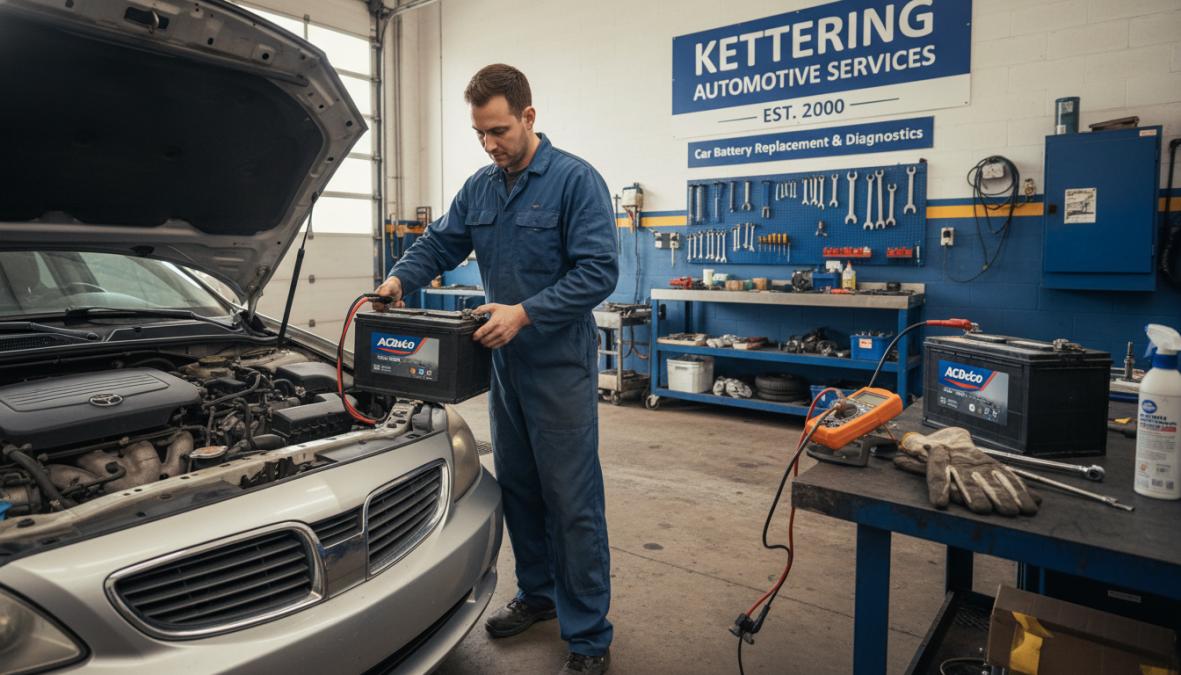
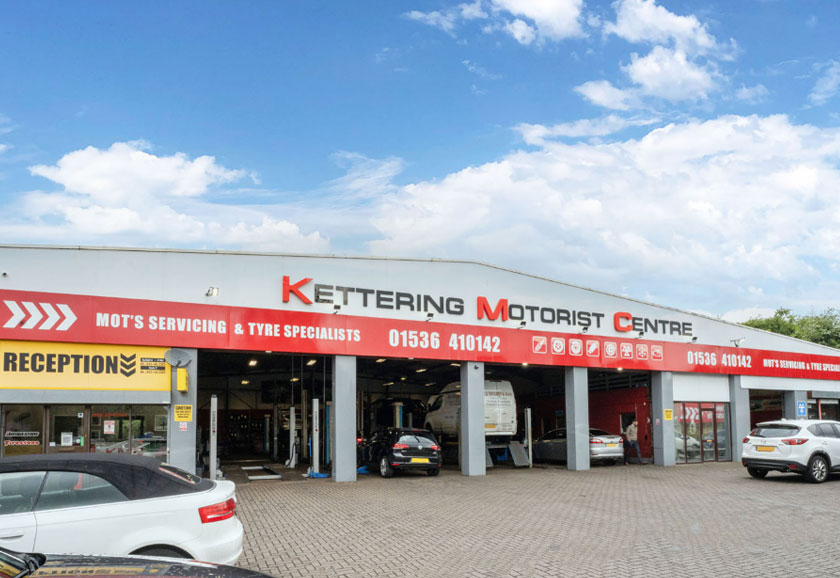
A dead car battery is one of the most common reasons drivers end up stranded, and finding a reliable car battery replacement service kettering residents can trust quickly becomes the priority. At Kettering Motorist Centre, we see this situation regularly, and the good news is that getting back on the road does not have to be complicated or expensive. Below, we compare your options across local independents, national chains, and mobile services, then cover everything you need to know about battery testing, compatibility, maintenance, and responsible disposal.
Here is what most guides get wrong: they focus entirely on price and ignore the diagnostic step. Fitting a new battery without checking the alternator and charging system first is a gamble that can leave you with a second failed battery within months.
Car Battery Replacement Services in Kettering:
The best car battery replacement service in Kettering depends on your situation: whether you need a mobile mechanic to come to you, prefer a trusted local garage, or want the convenience of a national chain.
The strongest case for using an independent local garage comes down to accountability and diagnostic depth. Kettering Motorist Centre uses the latest battery diagnostic and testing equipment, offers free battery health checks, and provides expert advice on battery types for modern vehicles including start-stop technology. As a family-run business, the service is personal rather than transactional.
What most reviews miss about independent garages: they are more likely to tell you that you do not need a replacement yet, because their reputation depends on honest advice rather than volume sales.
Best for: Local residents who want straightforward, honest service and specialised knowledge of modern vehicle electrical systems.
The trade-off with mobile platforms: availability depends on local mechanic schedules, and during peak periods that can mean a wait of a day or more.
Signs of a Dead Car Battery You Should Never Ignore
A failing car battery typically gives several warnings before it dies completely. Catching these signs of a dead car battery early saves you from an inconvenient breakdown and potential damage to other electrical components.
Watch for these warning signs:
Slow engine cranking: The starter motor turns the engine over sluggishly, particularly on cold mornings
Check engine light: Can indicate low battery voltage affecting engine management systems
Clicking sound when turning the key: A rapid clicking usually points to insufficient charge reaching the starter motor
Electrical gremlins: Dimming headlights, erratic dashboard displays, or power windows moving slowly
Battery warning light: The most direct signal that the charging system or battery health is compromised
Swollen or leaking battery case: A physical sign of internal damage, often caused by extreme heat or overcharging
Needing frequent jump starts: If you have jump-started the same vehicle more than twice in a week, the battery is failing
Software tools interface for Close for car battery replacement service kettering
Watch OutNever ignore a battery warning light and assume it will resolve itself. A battery operating at low voltage puts strain on the alternator, which can fail as a result. Replacing an alternator costs significantly more than replacing a battery.
How Long Does a Car Battery Last and When to Replace It
A standard car battery lasts between three and five years under normal driving conditions. How long a car battery lasts depends on several factors: climate, driving patterns, vehicle electrical load, and battery quality.
Short journeys are particularly damaging. A car battery recharges through alternator output during driving. If most of your journeys are under 15 minutes, the battery never fully recharges, shortening its lifespan considerably. According to Battery Council International's guidance on battery maintenance, regular long drives and periodic battery testing are the most effective ways to extend battery life.
Vehicles with start-stop technology, advanced driver assistance systems, or large infotainment setups place higher electrical demands on the battery. These vehicles often require AGM (Absorbent Glass Mat) or EFB (Enhanced Flooded Battery) types rather than a standard lead-acid unit. Fitting the wrong type is a common and costly mistake.
Replace your battery proactively if it is over four years old and showing any of the warning signs listed above. Waiting for a complete failure rarely saves money and often means being stranded at an inconvenient time.
Mobile Mechanic Kettering: Getting a Battery Fitted at Home
The mobile mechanic market in Kettering and the wider Northamptonshire area has grown considerably, and for straightforward battery replacements it is often the most practical option. A mobile fitting service removes the need to drive a vehicle that may not start reliably, eliminates waiting room time, and in most cases costs no more than a garage visit. But mobile fitting is not the right choice for every situation, and understanding when it works well, and when it does not, will save you time and money.
When Mobile Battery Fitting Makes Sense
Mobile fitting is the strongest option when:
Your vehicle will not start or is unreliable: Driving to a garage on a battery that may fail mid-journey is an unnecessary risk. A mobile mechanic brings the battery to you.
You are at home or at work during the day: Most mobile services in the Kettering area operate Monday to Saturday, with some offering early morning slots. If you can be present at the vehicle, the fitting typically takes 30 to 45 minutes.
Your vehicle has a straightforward battery replacement: Standard petrol and diesel vehicles without complex battery management systems are well-suited to mobile fitting.
You have already had a diagnostic check: If a garage has confirmed the battery is the only fault and the charging system is healthy, a mobile fitting for the replacement itself is a sensible and cost-effective step.
When to Choose a Garage Instead
Mobile fitting has genuine limitations that are worth understanding before you book:
Charging system faults: If your battery has failed repeatedly or your vehicle is showing electrical gremlins beyond slow cranking, the root cause may be an underperforming alternator or a high-draw starter motor. Mobile mechanics typically carry a portable battery analyser, but they may not carry the full oscilloscope or advanced charging system diagnostic equipment available in a workshop. A garage visit is the better starting point if you suspect a deeper electrical fault.
Battery registration requirements: Vehicles from BMW, Mercedes-Benz, Volkswagen Group (including Audi, SEAT, and Skoda), and Volvo manufactured after approximately 2008 often require battery registration after a replacement. This is a software procedure that tells the vehicle's battery management system a new battery has been fitted. Confirm with any mobile mechanic that they carry the appropriate diagnostic interface for your vehicle before booking, not all do.
Difficult battery locations: Some vehicles, particularly certain Renault, Peugeot, and Citroën models, locate the battery under the rear seat, in the boot, or behind a wheel arch liner. These replacements are more involved and are better handled in a workshop environment.
Hybrid and mild-hybrid vehicles: The 12V auxiliary battery in a hybrid is a standard replacement, but the high-voltage traction battery system requires specialist equipment and training. Confirm the mobile mechanic is qualified to work on your specific hybrid model before booking.
Practical Steps Before Your Mobile Mechanic Arrives
A small amount of preparation makes the appointment faster and reduces the risk of complications:
Confirm battery compatibility in advance: Provide your full vehicle registration number when booking. Ask the mechanic to confirm the battery group size, CCA rating, and chemistry (AGM, EFB, or standard) before they arrive. A mechanic who cannot confirm this in advance may arrive with the wrong battery.
Ask whether battery registration is included: If your vehicle requires it, confirm the mechanic carries the appropriate diagnostic tool. This is a five-minute procedure but requires the right software interface.
Clear access to the battery: Ensure the bonnet can be opened fully and that there is enough space around the vehicle for the mechanic to work safely.
Note any saved settings you want to preserve: Radio presets, electric window calibration, and steering angle sensor settings can be lost during a battery swap. Ask whether the mechanic uses a memory keeper (a small device that maintains a low-level power supply to the vehicle's electronics during the swap). This is particularly important for vehicles with keyless entry, adaptive headlights, or lane-keeping systems.
Pro TipIf your vehicle has a keyless entry system or advanced driver assistance features, ask the mobile mechanic whether they use a memory keeper during the battery swap. Without one, you may lose saved settings and need to recalibrate systems such as the electric windows or steering angle sensor. On some vehicles, recalibration requires a dealer visit.
Watch OutNever allow a mobile mechanic to work on your vehicle's battery in an enclosed space such as a garage or car park with poor ventilation. Lead-acid batteries produce hydrogen gas during charging and immediately after a deep discharge. The fitting itself should take place in the open air or a well-ventilated area.
What a Mobile Fitting Should Always Include
Regardless of which provider you use, a complete mobile battery replacement service in Kettering should cover:
Removal and safe disposal of the old battery (most providers include this; confirm before booking)
Fitting of the replacement battery with correct torque on terminal connections
A resting voltage check after fitting to confirm the new battery is at an adequate state of charge
A basic alternator output check to confirm the charging system is functioning correctly
Battery registration where required by the vehicle
A written or digital receipt showing the battery specification fitted and the warranty terms
If a provider does not include the alternator check and battery registration as standard, ask whether they can be added. A battery replacement without these steps is an incomplete service.
Battery Testing, Diagnostics, and OEM Quality Parts Explained
Battery testing is not optional, it is the foundation of a reliable replacement. A battery voltage check alone tells you whether the battery holds charge at rest. A proper load test tells you whether it can deliver sufficient current under the demands of engine starting, which is what actually matters. The distinction between these two tests is where most quick-swap operations cut corners.
The Three-Stage Diagnostic Process: What a Thorough Check Covers
A professional battery health check at a reputable Kettering garage should cover three distinct measurements, in sequence:
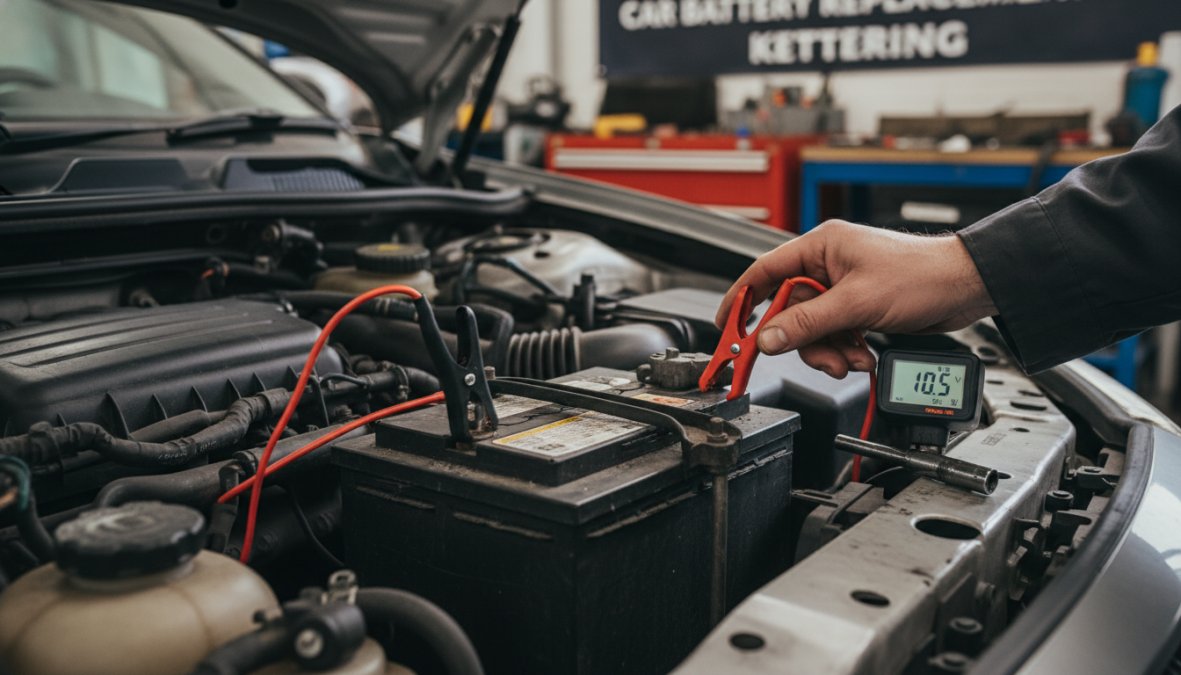
Stage 1, Resting voltage (open circuit voltage) With the engine off and no electrical loads active, a healthy 12V lead-acid battery should read between 12.6V and 12.7V. A reading of 12.4V indicates approximately 75% state of charge. Below 12.2V, the battery is significantly discharged or degraded. This test takes under a minute and is the starting point, not the conclusion.
Stage 2, Cold cranking amps (CCA) load test This is the test that actually predicts real-world reliability. A load tester applies a controlled current draw (typically half the battery's rated CCA) for 15 seconds and measures voltage under load. A healthy battery should maintain above 9.6V throughout. A battery that drops below this threshold under load will struggle to start the engine on a cold morning, even if its resting voltage looks acceptable. This is why drivers are sometimes surprised by a failure, the resting voltage appeared fine.
Stage 3, Internal resistance measurement As a battery ages, its internal resistance rises. High internal resistance means the battery cannot deliver current quickly enough for engine starting, even when it holds an adequate resting voltage. Modern battery analysers measure this directly and can flag a battery that is approaching end of life before it fails completely. This is the test most national chain quick-checks skip.
According to the AA's guidance on car battery testing and replacement, many drivers replace batteries unnecessarily because the real fault lies in the charging system rather than the battery itself. A three-stage diagnostic is the only reliable way to distinguish between a failing battery, an underperforming alternator, and a high-draw starter motor.
Alternator and Starter Motor Testing: Why It Matters
This is the part of the battery replacement process that separates thorough garages from quick-swap operations. The alternator charges the battery while the engine runs. If the alternator output is low, a new battery will discharge within days, sometimes within a single overnight period. The starter motor draws the highest current of any component during engine start; if it is drawing excessive current due to worn brushes or a failing solenoid, it will shorten battery life significantly.
What to expect from a competent charging system check:
Alternator output voltage: Should read between 13.8V and 14.4V at idle with no major electrical loads active. A reading below 13.5V suggests the alternator is not fully charging the battery. Above 14.7V indicates possible overcharging, which degrades battery cells over time.
Alternator output under load: The voltage should remain stable when the air conditioning, rear demister, and headlights are switched on simultaneously. A significant voltage drop under load points to a weakening alternator.
Starter motor current draw: Measured with a clamp meter during cranking. Excessive draw (the specific threshold varies by engine size and type, so a technician should compare against the manufacturer's specification) indicates a starter motor that is working harder than it should.
If a garage does not offer this check as part of a battery replacement, ask for it explicitly before agreeing to the work. Fitting a new battery without this step is the single most common reason drivers return to a garage within three months with the same symptoms.
OEM Quality Parts: What the Term Actually Means
OEM stands for Original Equipment Manufacturer. An OEM-quality battery meets the specification the vehicle manufacturer used when the car was built, covering physical dimensions, terminal position, voltage, capacity in amp-hours (Ah), and cold cranking amps (CCA) rating.
The practical implication: a battery labelled as OEM-quality should match or exceed every parameter on the original battery's label. This matters most for:
Start-stop vehicles: These require AGM (Absorbent Glass Mat) batteries rated for the high charge-discharge cycle count that start-stop systems demand. Fitting a standard flooded lead-acid battery as a cheaper alternative will result in failure within months.
Vehicles with battery management systems (BMS): Many post-2010 vehicles use a BMS that monitors battery condition and adjusts charging accordingly. Some of these systems require battery registration, a software procedure that tells the BMS a new battery has been fitted, after replacement. Without registration, the BMS may apply a charging profile suited to an aged battery, which can undercharge a new one.
High-electrical-load vehicles: SUVs and vehicles with large infotainment systems, heated seats, and multiple driver assistance systems draw more current at idle. Fitting a battery with a lower Ah rating than specified will result in faster discharge during short journeys.
Reputable garages and mobile services in Kettering use batteries that meet or exceed OEM standards. Always ask for the battery's CCA rating and Ah capacity before the work begins, and compare it against the specification shown on your existing battery or in your owner's manual.
Pro TipIf a garage cannot tell you the CCA rating of the battery they intend to fit, that is a red flag. The CCA rating is printed on every battery and is the most important single number for cold-weather starting reliability.
Watch OutBattery registration is required on most BMW, Mercedes-Benz, Volkswagen Group, and Volvo vehicles manufactured after approximately 2008. If your vehicle falls into this category and the garage does not mention battery registration, ask about it directly. Skipping this step can cause the alternator to overcharge the new battery, shortening its life.
Vehicle-Specific Battery Compatibility and DIY Safety Tips
Fitting the wrong battery is more common than most drivers realise, and the consequences range from poor performance to electrical system faults. Vehicle-specific battery compatibility is not just about physical size; it involves chemistry, capacity (Ah), and cold cranking amps (CCA) rating.
Choosing the Right Battery for Your Vehicle
Start with your vehicle's owner manual or the existing battery label, which will show the group size, CCA rating, and reserve capacity. For vehicles manufactured after 2012 with start-stop systems, an AGM battery is almost always required. Fitting a standard flooded lead-acid battery in a start-stop vehicle will result in rapid failure.
Key compatibility factors to check:
Physical dimensions (length, width, height) and terminal position
CCA rating at or above the OEM specification
Battery chemistry: AGM for start-stop, EFB as a minimum for vehicles with regenerative braking
Voltage: standard 12V for most petrol and diesel vehicles; 12V auxiliary batteries for hybrids
Safe Battery Maintenance and Terminal Corrosion Prevention
Battery terminal corrosion is one of the most overlooked maintenance tasks. White or blue-green powder on the terminals increases electrical resistance, which can mimic the symptoms of a failing battery and strain the charging system.
Safe DIY maintenance steps:
Disconnect the negative terminal first, then the positive
Clean terminals with a solution of bicarbonate of soda and water, using a stiff brush
Rinse with clean water and dry thoroughly
Apply petroleum jelly or terminal grease to prevent future corrosion
Reconnect the positive terminal first, then the negative
Expert tips illustration for car and person and wearing concepts for car battery replacement service kettering
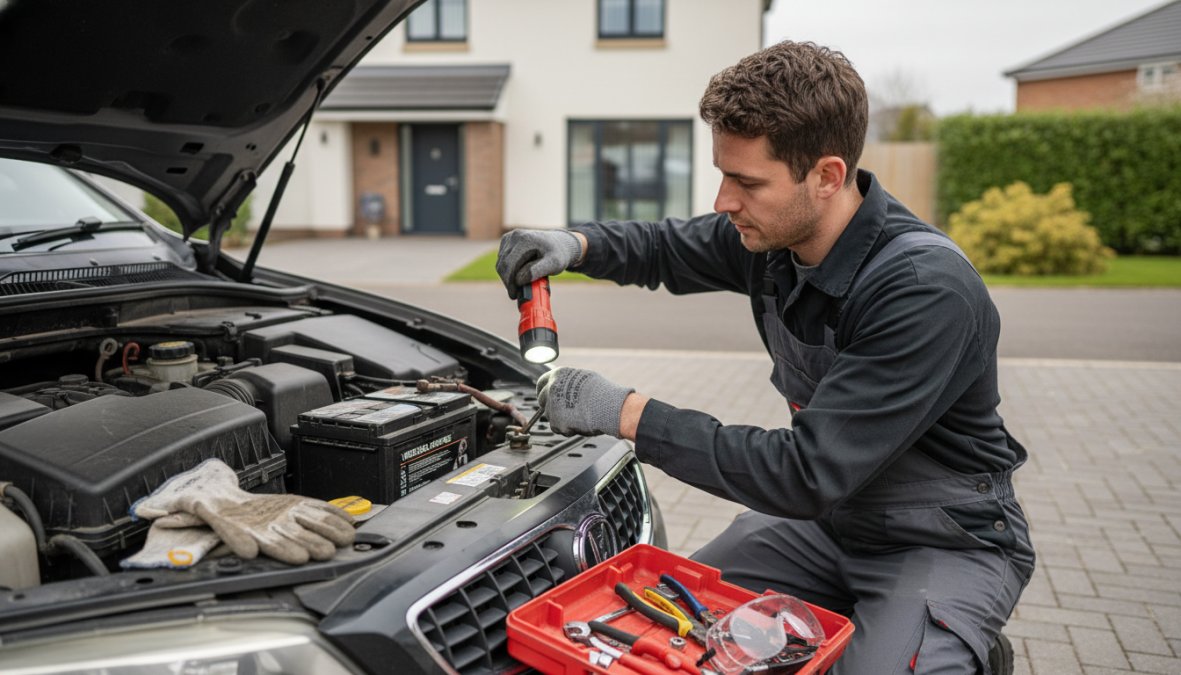
Watch OutNever work on a battery near an open flame or while smoking. Car batteries produce hydrogen gas during charging, which is highly flammable. Always wear eye protection and gloves when handling a battery.
Battery Recycling, Environmental Impact, and Responsible Disposal
Car battery recycling is not just an environmental consideration; in the UK it is a legal requirement. Lead-acid batteries are classified as hazardous waste and cannot be placed in standard household bins.
The good news: the recycling infrastructure for car batteries is well established. Most garages and national chains will take your old battery at no charge when fitting a replacement.
If you are replacing a battery yourself, your options for responsible disposal include:
Return it to the retailer where you purchased the replacement (most are legally required to accept it)
Drop it at a local household waste recycling centre
Take it to a local garage that accepts old batteries
According to the Environment Agency's guidance on waste battery disposal, lead-acid batteries have one of the highest recycling rates of any consumer product in the UK, with the vast majority of lead recovered and reused in new batteries. This is a genuinely closed-loop recycling system, which makes proper disposal both straightforward and impactful.
Never store an old battery in a vehicle or garage for extended periods. A damaged or leaking battery can release sulphuric acid, which is corrosive to surfaces and harmful to skin.
How to Book a Car Battery Replacement Service in Kettering
Booking a battery replacement near me in Kettering is straightforward regardless of which provider you choose. Here is the fastest route depending on your situation:
If your car starts but is showing warning signs: Book a free battery health check at a local garage first. Kettering Motorist Centre offers diagnostic testing, which will confirm whether the battery, alternator, or starter motor is the source of the problem.
Step-by-step booking checklist:
Note your vehicle registration, make, model, and year
Check whether your vehicle has start-stop technology (check the owner's manual or look for an "A" with a circular arrow on the dashboard)
Decide between mobile fitting and garage visit based on your vehicle's current condition
Request confirmation that the service includes a charging system check alongside the battery replacement
Ask for the warranty terms in writing before the work begins
Confirm that old battery disposal is included in the service
Kettering Motorist Centre's online booking system requires no upfront payment and covers MOT and tyre appointments, making it a convenient starting point for any vehicle health concerns alongside your battery service.
A failing car battery rarely gives much warning before it becomes a breakdown. The smartest approach is to get a diagnostic check before you are stranded, not after. Kettering Motorist Centre provides expert battery testing and vehicle diagnostics with the personalised service of a family-run business, transparent booking with no upfront payment required, and specialist knowledge covering modern vehicles including hybrids and electrics. Book your appointment with Kettering Motorist Centre and get a clear picture of your vehicle's electrical health before it becomes an emergency.
Frequently Asked Questions
How much does a car battery replacement cost in Kettering?
Costs vary depending on the provider and your vehicle type. Mobile mechanic services typically start from around £160 including fitting. Online platforms quote between £100 and £300 depending on the vehicle. Local independent garages and national chains like KMC generally ask you to contact them for a tailored quote. Always confirm whether fitting and disposal of the old battery are included in the price before booking.
How do I know if my car battery needs replacing?
Common signs include a slow or sluggish engine crank when starting, a check engine light appearing on your dashboard, dim headlights, and electrical components behaving erratically. If your car needs a jump start more than once, that is a strong indicator the battery health has deteriorated. A battery testing service at a local garage in Kettering can confirm the battery voltage and charging system performance, giving you a definitive answer before the battery fails completely.
How long does a car battery replacement take?
In most cases, a straightforward car battery replacement takes between 30 and 60 minutes at a garage or with a mobile mechanic. However, some modern vehicles with advanced electrical systems or start-stop technology may require additional time for battery registration and vehicle diagnostics after fitting. It is worth asking your chosen Kettering service provider whether any extra programming steps are needed for your specific make and model before your appointment.
What should I look for in a local car battery service in Kettering?
Look for a provider that offers battery testing and diagnostics before recommending a replacement, uses OEM-quality or equivalent parts, and includes a warranty on the new battery. Transparent pricing with fitting costs included is a key sign of a trustworthy garage. For added convenience, check whether the provider offers online booking. Local independent garages like Kettering Motorist Centre often provide more personalised service compared to larger national chains, and can advise on vehicle-specific compatibility.
Your booking Failed
Please try again or please call 01536 410142
Thank you for placing a booking with Kettering Motorist Centre Limited for vehicle
PLEASE TAKE YOUR BOOKING REFERENCE NUMBER WITH YOU TO THE MOT CENTRE
Your items
MOT Test
×
Terms and Conditions
These terms and conditions form the basis on which you can visit and use this website. Please read them carefully as they contain important information.
General terms and conditions
This website is owned and operated by Kettering Motorist Centre Ltd (company registration number: 4485858) operating at Trafalgar Road, Kettering, Northamptonshire, NN16 8DB (the "MOT Centre", the "Company", "we" or "us"). If you have any queries about these terms and conditions or if you have any comments or complaints on or about this website, you can contact us at [email protected] or 01536 410142.
The website is to promote and offer for sale the products and services of Kettering Motorist Centre Limited.
1. The contract between us
This website does not take payment for products or services online. The website enables you to view products and services online and to make a booking for later delivery and payment. The vehicle and provision of other products and services promoted by this website and the payment by you of the price of those products and services will take place at the MOT Centre. The booking does not constitute a contract.
The booking process on the site provides details of the booked MOT order. Please take the time to read and check your booking. It is your responsibility to make sure the order is correct and for the correct vehicle.
2. Ownership of rights
All rights, including copyright, in this website are owned by or licensed to the Company. Any use of this website or its contents, including copying or storing it or them in whole or part, other than for your own personal, non commercial use, is prohibited without our permission. You may not modify, distribute or repost anything on this website for any purpose.
3. Accuracy of content
We have taken care in the preparation of the content of this website, in particular to ensure that prices quoted are correct at the time of publishing and that all goods have been fairly described. However, bookings will only be accepted if there are no material errors in the description of the goods or their prices as advertised on this website. Any weights, dimensions and capacities given about the goods are approximate only.
4. Damage to your computer
We try to ensure that this website is free from viruses or defects. However, we cannot guarantee that your use of this website or any websites accessible through it will not cause damage to your computer. It is your responsibility to ensure that the right equipment is available to use the website. Except in the case of negligence on our part, we will not be liable to any person for any loss or damage which may arise to computer equipment as a result of using this website.
5. Availability
All bookings are subject to acceptance and availability. If the MOT date you have requested are is not available, the Centre will contact you by e-mail or phone. You will have the option either to wait until another slot is available or to cancel your booking.
6. Booking errors
You are able to correct errors on your booking up to the point on which you click on “Place Booking” during the booking process.
7. Price
The prices payable for goods that you order are as set out in our website. All prices are inclusive of VAT at the current rates and are correct at the time of entering information, errors and omissions excepted.
Whenever it is not possible to accept your booking to buy goods of the specification and description at the price indicated, the MOT Centre will advise you by email or phone or when you visit the centre.
8. Payment terms
You will be required to pay for the goods or services to the Centre at time of a completed MOT.
9. Delivery charges
N/A
10. Cancellation
The MOT Centre reserves the right to cancel the booking if:
10.1 There is insufficient stock to deliver the goods you have booked.
10.2 One or more of the goods you booked was listed at an incorrect price.
If your booking is cancelled the Centre will notify you by e-mail or phone.
You have the right to cancel your booking at any time up to the point of the MOT. If you do cancel your booking you should inform the centre by phone.
11. Liability
Notwithstanding the foregoing, nothing in these terms and conditions is intended to limit any rights you might have as a consumer under applicable local law or other statutory rights that may not be excluded nor in any way to exclude or limit our liability to you for any death or personal injury resulting from our negligence.
12. Notices
Unless otherwise expressly stated in these terms and conditions, all notices from you to us must be in writing and sent to our contact address given above and all notices from us to you will be displayed on our website from time to time.
13. Changes to legal notices
We reserve the right to change these terms and conditions from time to time and you should look through them as often as possible.
14. Law, jurisdiction and language
This website, any content contained therein and any contract brought into being as a result of usage of this website are governed by and construed in accordance with English law. Parties to any such contract agree to submit to the exclusive jurisdiction of the courts of England and Wales.
15. Invalidity
If any part of these terms and conditions is unenforceable (including any provision in which we exclude our liability to you) the enforceability of any other part of these conditions will not be affected.
16. Privacy
You acknowledge and agree to be bound by the terms of our privacy policy
17. Third party rights
Nothing in this Agreement is intended to, nor shall it confer any rights on a third party.