Understanding what causes MOT failure is the most practical thing any car owner can do. You'll save money by fixing problems before your test and avoid the frustration of a failed appointment. At Kettering Motorist Centre, we've seen every type of MOT failure imaginable, and the vast majority are preventable with basic maintenance and inspection.
The MOT test checks your vehicle's roadworthiness across multiple systems. When a component fails, it's classified as either a dangerous defect, a major defect, or an advisory. A dangerous defect means your vehicle cannot be driven. A major defect requires repair before the car can pass. An advisory is something to monitor but doesn't prevent your MOT pass.
Most failures cluster around a small number of systems. Focus your pre-MOT checks on these areas, and you'll eliminate the majority of potential issues.
Lighting and Signalling Systems
Headlights, brake lights, and indicators fail the MOT test more often than expected. A blown bulb is obvious, but alignment and lens damage are equally common culprits.
Your headlights must point in the correct direction. If they're misaligned, they won't pass the MOT even if bright. This happens after minor collisions, pothole impacts, or vibration over time. A technician uses a headlight beam setter to verify alignment precisely.
Check your lights regularly:
Turn on headlights in daylight and walk around your car
Look for cracks, discolouration, or condensation inside the lens
Test every bulb: headlights, brake lights, reversing lights, indicators, and fog lights
Verify that brake lights illuminate when you press the pedal
Confirm indicators flash at roughly one flash per second
Indicator bulbs that flash too slowly or too quickly will fail, usually indicating a bulb failure or faulty flasher unit. Lens damage is particularly common on older vehicles; even small cracks create a fail. Replacement is straightforward and inexpensive compared to retesting costs.
Brake System Performance and Wear
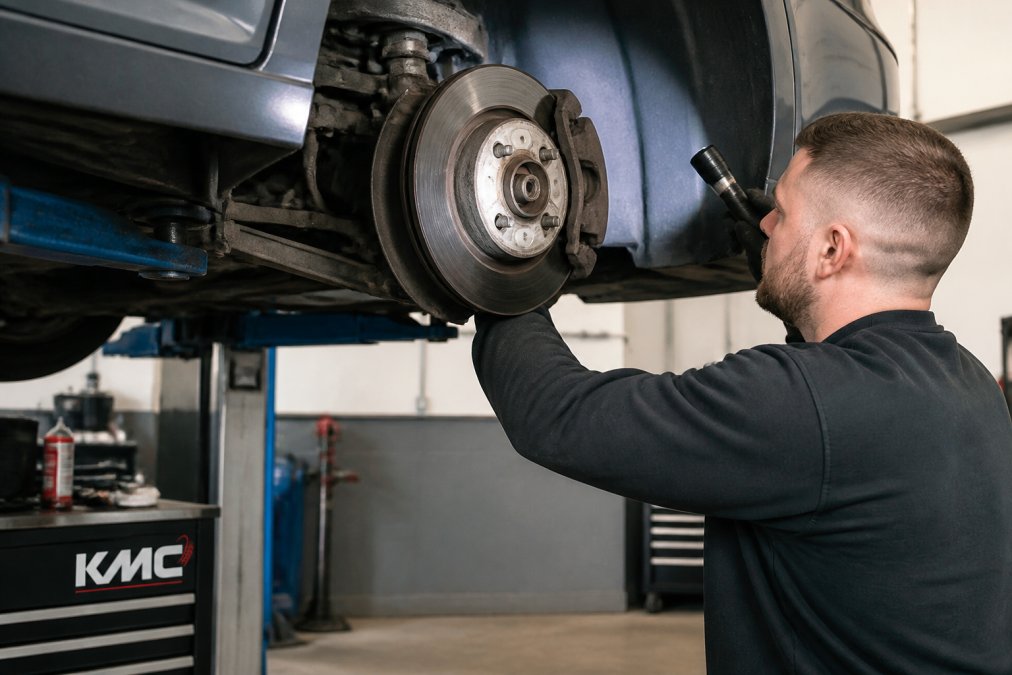
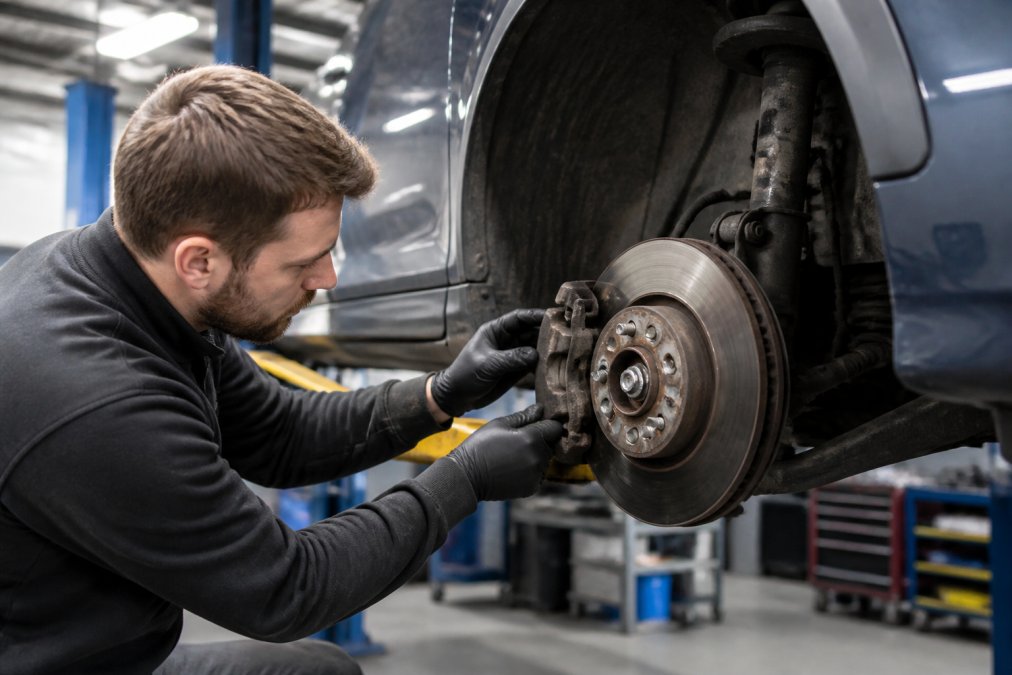
Brakes are safety-critical, so the MOT test is rigorous. Your brake discs must have sufficient thickness, brake pads must have adequate material, and the system must generate enough stopping power.
Brake disc thickness is measured with precision equipment. Most modern cars require at least 2mm of material remaining. If you hear a high-pitched squealing sound when braking, your pads are likely worn to the wear indicators, a metal tab designed to alert you.
Brake fluid also matters. Over time, brake fluid absorbs moisture from the air. When moisture content becomes too high, the boiling point drops and braking performance degrades. The MOT test uses a brake fluid tester to check moisture levels.
Common brake failures include worn pads below 1.5mm thickness, discs scored or below minimum thickness, uneven pad wear, contaminated brake fluid, excessive handbrake travel, and illuminated brake warning lights. Check your brakes monthly. Listen for squealing or grinding sounds and feel for soft or spongy brake pedal feedback. If the pedal travels too far before stopping the car, have the system inspected immediately.
Tyre Condition and Tread Depth
Tyres are inspected for tread depth, damage, and wear patterns. The legal minimum tread depth in the UK is 1.6mm across the central three-quarters of the tyre. Modern research suggests you should replace tyres at 3mm tread depth for better wet-weather grip.
The MOT test uses a tyre tread depth gauge to measure precisely. A manual gauge is inexpensive and simple to use at home. If any measurement reads 1.6mm or less, the tyre fails.
Look for uneven wear across the tyre width (suggesting alignment problems), excessive wear on outer edges (usually underinflation), excessive wear in the centre (usually overinflation), visible cords or canvas, bulges or blisters in the sidewall, cracks or cuts larger than 25mm, and incorrectly repaired punctures.
Check your tyre pressure monthly. Underinflated tyres wear faster, reduce fuel economy, and generate heat. Overinflated tyres wear unevenly and provide a harsher ride. Your vehicle's recommended pressure is printed on a sticker inside the driver's door.
Suspension and Steering Components
Suspension wear is checked by applying force to the wheel and measuring movement. Excessive play indicates wear in bushes, ball joints, or shock absorbers. A technician uses a suspension tester to measure this movement objectively.
Common suspension failures include worn suspension bushes, damaged or leaking shock absorbers, worn ball joints, steering rack damage, and loose anti-roll bar links. Grasp the wheel at the 3 o'clock and 9 o'clock positions and apply firm pressure. Excessive movement suggests worn components. Any clunking sound warrants professional inspection.
Steering play is also tested. Turn the steering wheel and feel for excessive movement before the wheels respond. If the steering wheel turns more than 40mm before the wheels move, the steering rack likely needs attention.
Emissions and Exhaust System
The emissions test measures carbon dioxide (CO2), carbon monoxide (CO), and hydrocarbon (HC) levels in your exhaust. Vehicles must meet Euro 6 standards. A diesel smokemeter also checks for visible smoke.
Exhaust system failures typically indicate engine problems. A faulty oxygen sensor, damaged catalytic converter, or engine tuning issues can cause high emissions. If your check engine light is illuminated, have the vehicle scanned before your MOT.
Common exhaust failures include visible leaks in the exhaust pipe or silencer, rust holes, loose or missing silencer, damaged catalytic converter, emissions levels exceeding legal limits, and visible smoke from the exhaust. A pre-MOT emissions scan can help identify issues before your official test.
Driver Visibility and Windscreen Issues
The windscreen must be free from damage that obstructs the driver's view. Cracks or chips in the driver's line of sight are automatic fails. Damage in other areas may pass if it doesn't obscure vision.
Windscreen wipers must work effectively. Worn wiper blades should be replaced every six to twelve months. Check that all mirrors are intact and correctly adjusted, and ensure rear window visibility isn't obscured. A small chip in the wrong location can fail your MOT. If you have damage to the driver's line of sight, have the windscreen replaced before testing.
MOT Checklist for Car Owners
A structured pre-MOT inspection saves time and money. Work through this checklist systematically to identify most common issues before your appointment.
What to Check Before Your Test
Start with the basics. These checks take thirty minutes and cover the most common failure points.
Exterior inspection:
Walk around the vehicle and look for visible damage
Check all lights function correctly
Inspect tyres for tread depth and damage
Look for rust holes in the exhaust system
Verify that the registration plate is visible and secure
Interior inspection:
Test the horn
Check all dashboard warning lights illuminate when you turn on the ignition
Verify that the handbrake holds the vehicle securely
Test all seatbelts for proper function
Ensure the fuel cap seals properly
Under the bonnet:
Check brake fluid level (should be between MIN and MAX marks)
If you identify any issues during this inspection, you have time to address them before your MOT appointment. Many problems are inexpensive to fix.
How to Spot Advisories vs Major Defects
Understanding the difference between advisory items and major defects helps you prioritise repairs.
An advisory is something to monitor. Your vehicle passes the MOT, but the item needs attention soon. Examples include worn brake pads that are still legal thickness or a minor oil leak. You should address advisories within a few months to prevent them from becoming major defects.
A major defect prevents your vehicle from passing. Examples include brake pads below legal thickness, emissions exceeding limits, or a cracked windscreen in the driver's line of sight. Major defects must be repaired before your vehicle can be retested.
A dangerous defect means your vehicle cannot be driven on public roads. Examples include complete brake failure, a severely damaged windscreen that obscures the driver's vision, or a steering system that doesn't respond. Your vehicle will be marked as unfit to drive.
Defect Type
Definition
Action Required
Retest Needed
Advisory
Item to monitor; vehicle passes
Repair within months
No
Major Defect
Prevents pass; safety concern
Repair immediately
Yes
Dangerous Defect
Vehicle unfit to drive
Do not drive; repair required
Yes
Electric Vehicle MOT Requirements
Electric vehicles have unique MOT requirements because they lack traditional engines and exhaust systems. However, they're tested for the same roadworthiness standards as petrol and diesel cars.
Battery safety is critical. The MOT test checks that high-voltage cables and connectors are properly insulated and not damaged. Thermal management systems must function correctly; if the battery cooling system is faulty, the vehicle fails.
Electric motor systems are checked for proper function. The regenerative braking system must work correctly. The suspension, steering, brakes, and lighting systems are tested identically to petrol vehicles. The main difference is that emissions testing is replaced with electrical system checks.
If you own an electric vehicle in Kettering, Kettering Motorist Centre has specialist expertise in EV diagnostics and servicing. For more information about electric vehicle maintenance and MOT preparation, visit our sister site for electric vehicle specialists.
The 10-Day Rule Explained
The 10-day rule is often misunderstood. If you book your MOT within 10 days of your current certificate expiring, you can take your test early. Your new certificate will be dated from when your old one expires, not from when you take the test. This means you don't lose any MOT validity by testing early.
For example, if your MOT expires on 15 August and you book a test on 10 August, your new certificate will be valid from 15 August, not from 10 August. This rule helps busy vehicle owners book tests in advance without losing validity.
However, if you test more than 10 days before your certificate expires, your new certificate will be dated from the day you take the test. You'll lose the remaining validity from your old certificate.
Book your MOT within 10 days of expiry to maximise your certificate validity.
DIY Pre-MOT Checks vs Professional Inspection
Deciding between DIY pre-MOT checks and professional inspection depends on your confidence and the complexity of your vehicle.
Brake system performance (requires specialist equipment)
Suspension wear measurement
Emissions testing
Steering system play measurement
Headlight alignment
Battery condition (for electric vehicles)
Many vehicle owners perform basic DIY checks, then book a professional pre-MOT inspection if they identify potential issues. At Kettering Motorist Centre, we offer professional pre-MOT inspections using specialist diagnostic equipment. This service identifies potential failures before your official test, giving you time to arrange repairs. Visit our MOT booking page to arrange your pre-test inspection.
How to Avoid MOT Failure
Prevention is far more cost-effective than remediation. A structured maintenance routine eliminates most MOT failures.
Monthly checks:
Tyre pressure and visual condition
All lights and indicators
Brake fluid level
Engine oil level
Windscreen washer fluid
Quarterly checks:
Brake pad thickness
Suspension for obvious wear
Steering responsiveness
Handbrake function
Wiper blade condition
Annual checks (before MOT):
Professional brake system inspection
Suspension system evaluation
Emissions test (if concerned)
Headlight alignment verification
Exhaust system inspection
Battery condition (electric vehicles)
Addressing minor issues immediately prevents them from becoming major defects. Vehicle age matters. Older vehicles accumulate wear across multiple systems. If your car is over ten years old, consider a professional pre-MOT inspection.
Keep maintenance records. If you perform repairs yourself or use an independent garage, document the work. This demonstrates that your vehicle has been properly maintained and helps identify patterns of wear or recurring issues.
Your MOT test is fundamentally about roadworthiness and safety. Understanding what the test checks and maintaining your vehicle accordingly makes the process straightforward. Most failures are preventable with basic maintenance and attention to common problem areas.
If you're in Kettering or Northamptonshire and want expert guidance before your MOT, Kettering Motorist Centre offers professional pre-test inspections and specialist diagnostic services. Our team has extensive experience identifying potential failures and advising on repairs. Book your MOT appointment online, and our transparent pricing means no surprises.
Frequently Asked Questions
What are the most common reasons for MOT failure?
The most common MOT failure points include worn brake pads and discs, defective lighting and signalling systems, and tyres with insufficient tread depth below the 1.6mm legal minimum. Suspension wear, including damaged shock absorbers and worn bushings, also causes frequent failures. Emissions test failures occur when exhaust systems leak or vehicles exceed emissions limits. Windscreen damage and worn wiper blades are also common advisories that can escalate to failures if not addressed.
How can I create an effective MOT checklist for car owners?
A practical MOT checklist for car owners should cover: checking all lights (headlights, indicators, brake lights, reverse lights), inspecting tyre tread depth and condition, testing your brakes for responsiveness and unusual noises, examining windscreen wipers and glass for damage, checking seat belts function properly, verifying your horn works, inspecting the exhaust for leaks, and ensuring your registration plate is clearly visible and secure. For electric vehicles, also check battery health warnings and cooling system functionality. Complete this checklist two weeks before your MOT test date.
What are the specific electric vehicle MOT requirements?
Electric vehicle MOT requirements are broadly similar to petrol and diesel vehicles, but with key differences. EVs are exempt from emissions testing, as they produce zero tailpipe emissions. Instead, inspectors focus on battery condition (checking for warning lights on the dashboard), high-voltage electrical systems, cooling systems for battery thermal management, and the integrity of the charging port. Suspension, braking, lighting, and visibility standards remain identical. If your EV has a combustion engine (hybrid), it undergoes standard emissions testing. Kettering Motorist Centre offers specialist EV MOT testing through our sister site kmcelectric.co.uk.
Can I drive my car if it fails its MOT?
If your vehicle fails its MOT, you can still drive it to a garage for repairs, but only if the failure is not classified as a 'dangerous defect'. Dangerous defects include failed brakes, severely damaged windscreens, or non-functional headlights. If your vehicle has a dangerous defect, you cannot drive it on public roads without risking a fine and six penalty points. Once you have failed your MOT, you have 10 days to book a retest after repairs are completed. You cannot use your vehicle for general driving during this period unless the defect is minor or advisory.
Thank you for placing a booking with Kettering Motorist Centre Limited for vehicle
PLEASE TAKE YOUR BOOKING REFERENCE NUMBER WITH YOU TO THE MOT CENTRE
Your items
MOT Test
×
Terms and Conditions
These terms and conditions form the basis on which you can visit and use this website. Please read them carefully as they contain important information.
General terms and conditions
This website is owned and operated by Kettering Motorist Centre Ltd (company registration number: 4485858) operating at Trafalgar Road, Kettering, Northamptonshire, NN16 8DB (the "MOT Centre", the "Company", "we" or "us"). If you have any queries about these terms and conditions or if you have any comments or complaints on or about this website, you can contact us at [email protected] or 01536 410142.
The website is to promote and offer for sale the products and services of Kettering Motorist Centre Limited.
1. The contract between us
This website does not take payment for products or services online. The website enables you to view products and services online and to make a booking for later delivery and payment. The vehicle and provision of other products and services promoted by this website and the payment by you of the price of those products and services will take place at the MOT Centre. The booking does not constitute a contract.
The booking process on the site provides details of the booked MOT order. Please take the time to read and check your booking. It is your responsibility to make sure the order is correct and for the correct vehicle.
2. Ownership of rights
All rights, including copyright, in this website are owned by or licensed to the Company. Any use of this website or its contents, including copying or storing it or them in whole or part, other than for your own personal, non commercial use, is prohibited without our permission. You may not modify, distribute or repost anything on this website for any purpose.
3. Accuracy of content
We have taken care in the preparation of the content of this website, in particular to ensure that prices quoted are correct at the time of publishing and that all goods have been fairly described. However, bookings will only be accepted if there are no material errors in the description of the goods or their prices as advertised on this website. Any weights, dimensions and capacities given about the goods are approximate only.
4. Damage to your computer
We try to ensure that this website is free from viruses or defects. However, we cannot guarantee that your use of this website or any websites accessible through it will not cause damage to your computer. It is your responsibility to ensure that the right equipment is available to use the website. Except in the case of negligence on our part, we will not be liable to any person for any loss or damage which may arise to computer equipment as a result of using this website.
5. Availability
All bookings are subject to acceptance and availability. If the MOT date you have requested are is not available, the Centre will contact you by e-mail or phone. You will have the option either to wait until another slot is available or to cancel your booking.
6. Booking errors
You are able to correct errors on your booking up to the point on which you click on “Place Booking” during the booking process.
7. Price
The prices payable for goods that you order are as set out in our website. All prices are inclusive of VAT at the current rates and are correct at the time of entering information, errors and omissions excepted.
Whenever it is not possible to accept your booking to buy goods of the specification and description at the price indicated, the MOT Centre will advise you by email or phone or when you visit the centre.
8. Payment terms
You will be required to pay for the goods or services to the Centre at time of a completed MOT.
9. Delivery charges
N/A
10. Cancellation
The MOT Centre reserves the right to cancel the booking if:
10.1 There is insufficient stock to deliver the goods you have booked.
10.2 One or more of the goods you booked was listed at an incorrect price.
If your booking is cancelled the Centre will notify you by e-mail or phone.
You have the right to cancel your booking at any time up to the point of the MOT. If you do cancel your booking you should inform the centre by phone.
11. Liability
Notwithstanding the foregoing, nothing in these terms and conditions is intended to limit any rights you might have as a consumer under applicable local law or other statutory rights that may not be excluded nor in any way to exclude or limit our liability to you for any death or personal injury resulting from our negligence.
12. Notices
Unless otherwise expressly stated in these terms and conditions, all notices from you to us must be in writing and sent to our contact address given above and all notices from us to you will be displayed on our website from time to time.
13. Changes to legal notices
We reserve the right to change these terms and conditions from time to time and you should look through them as often as possible.
14. Law, jurisdiction and language
This website, any content contained therein and any contract brought into being as a result of usage of this website are governed by and construed in accordance with English law. Parties to any such contract agree to submit to the exclusive jurisdiction of the courts of England and Wales.
15. Invalidity
If any part of these terms and conditions is unenforceable (including any provision in which we exclude our liability to you) the enforceability of any other part of these conditions will not be affected.
16. Privacy
You acknowledge and agree to be bound by the terms of our privacy policy
17. Third party rights
Nothing in this Agreement is intended to, nor shall it confer any rights on a third party.