What Happens During an MOT Test (And Why It Matters)
Understanding what happens during an MOT test is something every UK driver needs to know, yet most only discover the details after their car fails one. This guide from Kettering Motorist Centre breaks down every stage of the annual inspection, from the first check a tester performs to the moment you receive your MOT certificate. An MOT test is a legally required roadworthiness assessment for vehicles over three years old, conducted by a DVSA-approved tester to confirm the vehicle meets the minimum safety and environmental standards set for use on public roads in Great Britain. Fail to have a valid certificate and you risk a fine of up to £1,000, plus potential points on your licence.
Here is what most guides get wrong: they treat the MOT as a single pass/fail event rather than a structured, multi-stage inspection covering dozens of individual components. Below, we walk through every category a tester examines, what common MOT failure points look like before they become expensive, and exactly what to do if your car does not pass.
Key TakeawayAn MOT test does not assess the general mechanical condition of your vehicle in the same way a service does. It checks specific safety and emissions criteria only. A car can pass its MOT and still need significant maintenance work.
What Does MOT Stand For and What Is Its Legal Purpose?
MOT stands for Ministry of Transport, the government department that originally introduced the test in 1960. The Ministry of Transport no longer exists as a standalone body, but the name has stuck. Today, the scheme is administered by the Driver and Vehicle Standards Agency (DVSA), which sets the standards, approves test centres, and maintains the national MOT history database.
The legal purpose is straightforward: any car, van, or motorcycle over three years old must hold a valid MOT certificate to be driven legally on public roads in England, Scotland, and Wales. Northern Ireland operates a separate but equivalent scheme. The certificate confirms the vehicle met the required safety and emissions standards on the day of the test. It does not guarantee roadworthiness for the full twelve months that follow.
One point worth making clearly: an MOT is not the same as a vehicle service. A service addresses wear items and fluid changes to keep the car running well. An MOT checks whether specific components meet legal standards. You need both, and confusing the two is one of the most common mistakes drivers make.
Every Car Part Checked During an MOT Test
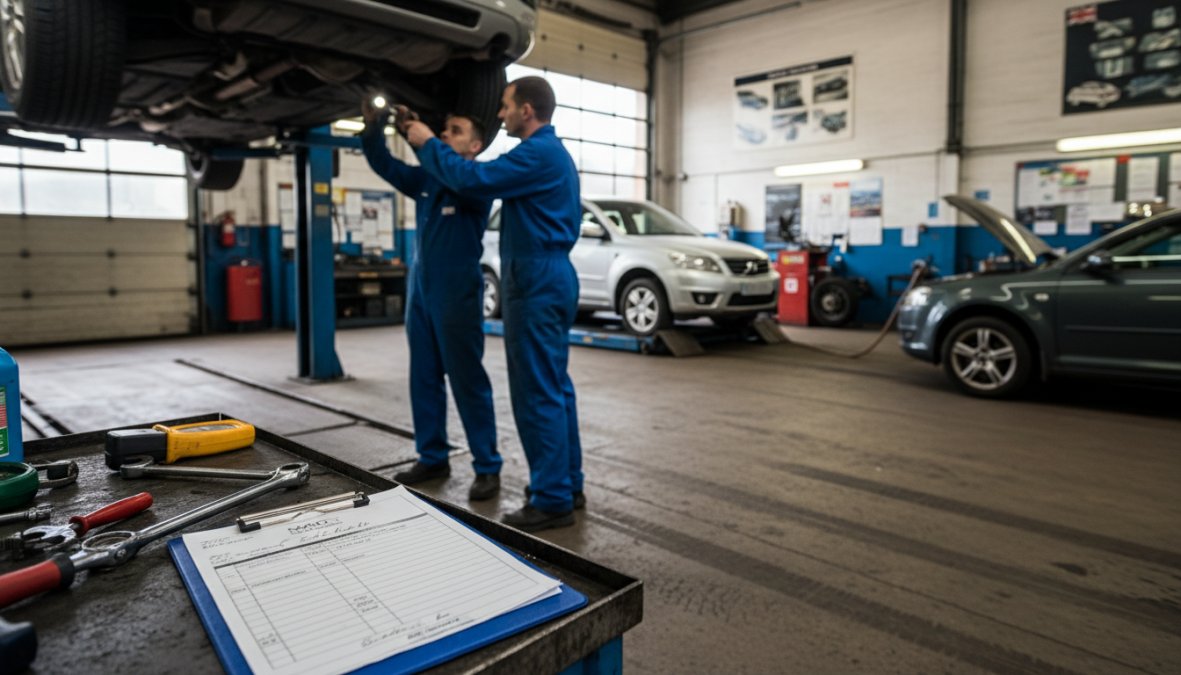
A qualified technician works through a structured checklist during every MOT test, covering well over 60 individual inspection points. The DVSA categorises defects as either Dangerous (immediate fail, vehicle must not be driven), Major (fail), or Minor (advisory, recorded but not a fail). Understanding these categories helps you prioritise any remedial work your car needs.
Software tools interface for MOT for what happens during an MOT test
Body, Vehicle Structure and General Items
The tester starts with a visual assessment of the vehicle's overall structure. Corrosion is a primary concern here, particularly rust that has penetrated load-bearing sections of the chassis or floor. Sharp edges caused by accident damage or advanced rust that could injure a pedestrian are also flagged. The VIN (Vehicle Identification Number) must be present, legible, and match the vehicle's registration documents. The registration plate itself must be secure, correctly formatted, and clearly readable.
Towbars, where fitted, are checked for secure attachment and correct operation. Fuel caps must seal properly to prevent vapour escape. The horn must function and produce a continuous, uniform sound.
Lights and Signals
Headlight alignment is one of the most frequently failed items in this category. Headlights that point too high dazzle oncoming drivers; too low and they fail to illuminate the road adequately. The tester uses a calibrated beam setter to check alignment precisely. All lights are checked for function: headlights on main and dipped beam, front and rear fog lights, brake lights, indicators, hazard lights, and reversing lights.
Condition matters as much as function. Cracked or heavily discoloured lenses that significantly reduce light output can result in a failure, even if the bulb itself is working.
Brakes and Braking Systems
The braking system receives one of the most thorough assessments of the entire inspection. The tester checks brake pads and discs for wear, condition, and even wear across each axle. A rolling road brake test measures braking efficiency and the balance between the left and right wheels on each axle. The handbrake is tested separately for holding efficiency.
Brake fluid condition is not tested during an MOT, which is another reason a separate service schedule matters. What is tested: the mechanical and hydraulic components that determine whether the car can actually stop safely.
Tyres and Wheels
Tyre tread depth must be at least 1.6mm across the central three-quarters of the tread width around the full circumference. The tester checks for cuts, bulges, and exposed cords, any of which result in an immediate failure. Tyres must also be the correct type for the vehicle and correctly matched on each axle. Mixing radial and cross-ply tyres on the same axle is a fail.
Wheels are checked for cracks and damage. Wheel nuts must all be present and secure.
Suspension and Steering
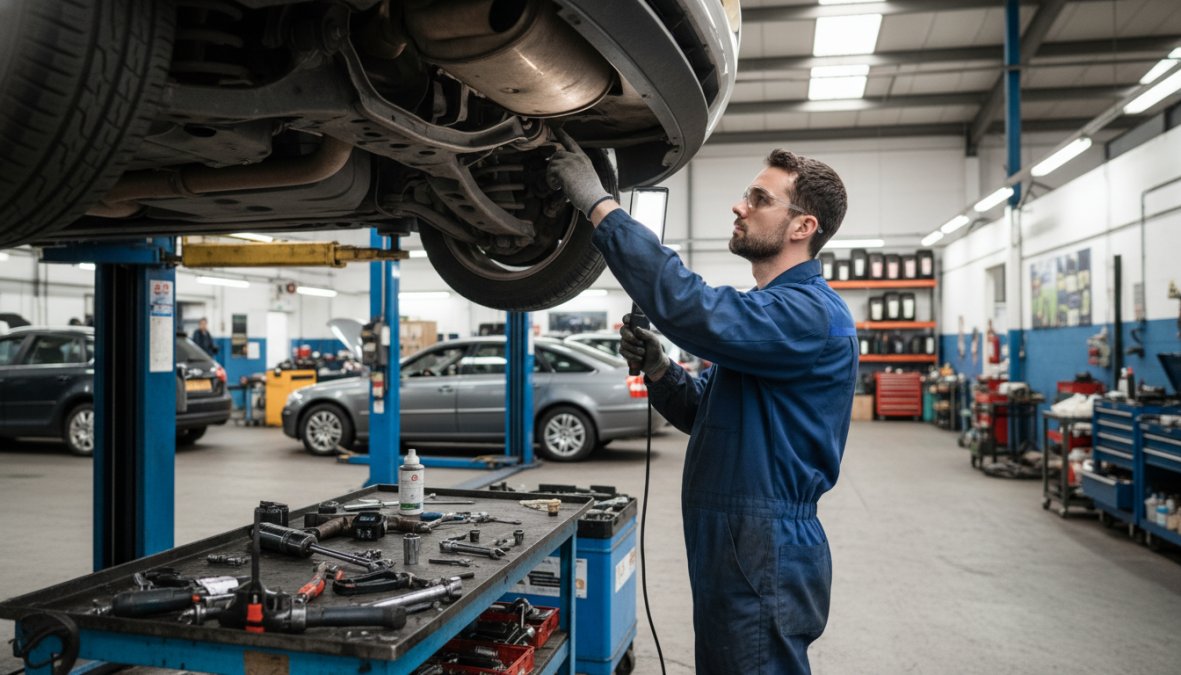
Suspension joints, shock absorbers, and steering components are checked for wear, play, and corrosion. The tester physically rocks the wheels to feel for excessive movement in ball joints, track rod ends, and wheel bearings. Shock absorbers are assessed for leaks and damping effectiveness.
Steering play is checked at the wheel, and the power steering system (hydraulic or electric) must function correctly throughout its range of movement.
Exhaust Emissions and Fuel Systems
The emissions test is a distinct phase of the MOT. Petrol vehicles are tested for hydrocarbons and carbon monoxide output at idle and at a higher rev range. Diesel vehicles are assessed using a smoke meter, which measures particulate density during a free acceleration test. Vehicles that exceed the permitted limits fail on emissions, regardless of how well the rest of the car performs.
The exhaust system itself is inspected for leaks, security, and condition. A blowing exhaust joint or a corroded section that is close to failure will appear as a major defect.
MOT Checks for Electric and Hybrid Vehicles
Electric and hybrid vehicles go through the same structural, lighting, braking, tyre, and suspension checks as petrol and diesel cars. The meaningful differences lie in what replaces the emissions test, how the braking system is assessed, and which high-voltage components fall within, and outside, the scope of a standard MOT inspection. This is an area most MOT guides treat as a footnote. It deserves more than that, because the differences have direct consequences for how you prepare.
Emissions: What Changes for EVs
Fully electric vehicles produce zero tailpipe emissions, so the traditional exhaust emissions test, the smoke meter run for diesels and the hydrocarbon/carbon monoxide check for petrols, does not apply. In its place, the tester checks:
Drivetrain noise. The vehicle must not emit excessive or abnormal noise from the electric motor or transmission during operation. This is a subjective but documented check.
Warning systems. All dashboard warning lights related to the powertrain must extinguish after start-up. Any illuminated warning light connected to the high-voltage battery system, the motor control unit, or the energy management system is an automatic failure, the same rule that applies to the engine management light on a petrol car.
Exhaust system (where applicable). Some range-extender EVs and plug-in hybrids have a small combustion engine. If a combustion engine is present, it is emissions-tested in the conventional way.
For plug-in hybrids (PHEVs) and full hybrids (HEVs), the petrol or diesel engine is tested on its emissions exactly as it would be in a conventional vehicle. The hybrid drivetrain is treated as an additional system, not a replacement for the standard test.
Regenerative Braking and the Rolling Road
This is the most technically nuanced area of an EV or hybrid MOT, and the one most likely to catch owners off guard.
Regenerative braking, where the electric motor acts as a generator to slow the vehicle and recover energy, applies braking force through the driven wheels. On a rolling road brake tester, this can create an imbalance reading if the tester does not account for it correctly. A well-equipped MOT centre will use a rolling road that can be set to the appropriate mode for vehicles with regenerative systems, or will conduct the brake efficiency assessment in a way that isolates the friction brakes from the regenerative system.
What the tester is checking:
Friction brake efficiency. The conventional disc and drum brakes must meet the minimum efficiency thresholds regardless of the regenerative system.
Brake balance across each axle. The difference in braking force between the left and right wheels on any axle must not exceed the permitted tolerance. Regenerative braking applied unevenly, for example, if one motor is underperforming, can trigger a failure here.
Brake pedal feel and travel. On vehicles with blended braking systems (where the pedal simultaneously activates friction brakes and regenerative braking), the tester checks that the pedal response is progressive and that the system does not exhibit abnormal behaviour.
If your EV or hybrid has a brake warning light illuminated, or if you have noticed the brake pedal feeling inconsistent, resolve this before the test. Blended braking faults are not always obvious during normal driving but will show up on a rolling road.
High-Voltage System: What Is and Is Not Inspected
Standard MOT testers are not authorised to physically inspect or test high-voltage components, the battery pack, high-voltage cabling, inverter, or charging system. This requires specialist training (typically IMI Level 3 Award in Electric/Hybrid Vehicle System Repair and Replacement, or equivalent) and appropriate personal protective equipment.
What this means in practice:
The tester will check that high-voltage warning labels are present and legible on the vehicle.
The tester will check that high-voltage cables are not visibly damaged, chafed, or incorrectly routed where they are accessible without dismantling components.
The tester will not open the battery enclosure, test cell voltage, or assess battery state of health.
Battery degradation, the gradual reduction in range and capacity that affects all EVs over time, is not assessed during an MOT. A vehicle with a battery retaining only 60% of its original capacity will pass its MOT without any advisory related to battery health, provided no warning lights are active. This is a known limitation of the current MOT framework for EVs, and one that the DVSA has acknowledged as the EV fleet ages.
Pre-MOT Checklist for EV and Hybrid Owners
In addition to the standard pre-MOT checks listed elsewhere in this guide, EV and hybrid owners should run through the following before their test:
Check that no battery, motor, or hybrid system warning lights are illuminated on the dashboard.
Confirm that the high-voltage warning labels on the vehicle (typically orange cable covers and under-bonnet labels) are present and readable.
Test the brake pedal for consistent feel across several stops. If the pedal feels spongy, inconsistent, or travels further than usual, have the braking system inspected before the MOT.
If your vehicle has a visible high-voltage cable run (common on some older hybrids where orange conduit is routed under the vehicle), visually check for damage or chafing.
Check that the 12V auxiliary battery, separate from the main traction battery, is in good condition. A failing 12V battery can trigger multiple warning lights and cause electrical system faults that result in MOT failures unrelated to the high-voltage system.
Pro TipThe 12V auxiliary battery in an EV or hybrid performs the same role as the standard battery in a petrol car, it powers the vehicle's electronics at start-up before the main system comes online. It degrades on the same schedule as a conventional battery and is one of the most commonly overlooked maintenance items on EVs. A failed 12V battery can trigger warning lights that cause an MOT failure even when the traction battery is perfectly healthy.
Kettering Motorist Centre holds specialist expertise for electric and hybrid vehicles. This means our team can identify EV-specific concerns, including 12V battery condition, brake system behaviour, and warning light diagnosis, that a general MOT centre without EV-trained technicians may not be equipped to assess accurately.
How Long Does an MOT Take from Start to Finish?
A standard MOT test on a car with no significant defects takes between 45 minutes and one hour of active inspection time. That figure is widely quoted, but it tells you very little about what is actually happening during those 45 minutes, why some tests run to 90 minutes or beyond, and how to plan your visit so the total time from arrival to departure is as short as possible.
What Happens in Each Phase of the Test
The inspection follows a structured sequence. Understanding the phases helps you interpret how long your specific vehicle is likely to take.
Phase 1, Pre-inspection and documentation (5-10 minutes) The tester checks the vehicle's registration against the booking, confirms the VIN, and records the odometer reading. Dashboard warning lights are checked at this stage. If any lights are illuminated that relate to a tested system, the tester may flag the failure before the physical inspection begins.
Phase 2, Static visual inspection (10-15 minutes) With the vehicle on level ground, the tester works through the exterior: lights, horn, registration plates, windscreen, mirrors, wiper blades, and bodywork condition. Tyres are inspected visually and with a tread depth gauge. This phase is methodical and rarely causes delays unless significant corrosion or structural damage requires closer examination.
Phase 3, Under-bonnet checks (5 minutes) The tester checks that the VIN plate is present and legible, inspects visible brake fluid reservoir levels (condition is not tested), and checks the steering system where accessible. On EVs and hybrids, high-voltage cable routing and warning labels are checked here.
Phase 4, Ramp inspection (10-15 minutes) The vehicle is raised on a hydraulic ramp. The tester inspects the underside: suspension joints, shock absorbers, steering rack, brake lines, exhaust system, fuel lines, and the vehicle's floor and chassis for corrosion. This is the phase most likely to extend if corrosion is found, because the tester must assess whether rust is surface-level or has penetrated load-bearing sections.
Phase 5, Rolling road brake test (5-10 minutes) The vehicle is driven onto a rolling road (also called a brake roller). Each axle is tested in turn. The machine measures braking force at each wheel and calculates efficiency and balance. Vehicles with regenerative braking systems may require additional time if the tester needs to conduct the assessment in a specific sequence to isolate the friction brakes.
Phase 6, Emissions test (5-10 minutes) For petrol vehicles, the engine must be at normal operating temperature before the emissions probe is inserted into the exhaust. If the car has been driven to the test centre, it is usually warm enough. A cold engine can produce elevated readings that do not reflect the vehicle's actual emissions performance, which is why driving to your MOT rather than trailering the vehicle is always advisable. Diesel vehicles undergo a free acceleration smoke test. EVs skip this phase entirely.
Phase 7, Documentation and result (5 minutes) The tester completes the inspection record, categorises any defects, and issues either a pass certificate or a VT30 failure notice. The result is uploaded to the DVSA database in real time. You can check the updated status immediately at DVSA vehicle enquiry service.
What Causes Tests to Run Long
Most tests that extend beyond 60 minutes do so for one of three reasons:
Corrosion requiring closer assessment. Rust on a chassis member or floor section that sits on the borderline between advisory and major defect takes time to assess properly. The tester may need to probe the metal or view it from multiple angles.
Emissions test complications. A petrol engine that has not reached operating temperature will need time to warm up before the emissions phase can be completed accurately. Arriving with a cold engine is one of the most avoidable causes of a longer visit.
Defects requiring a second opinion or documentation. If a tester identifies something unusual, a non-standard modification, a component that has been replaced with a non-OEM part, or damage that is difficult to categorise, they may consult with a senior tester before recording the result.
How to Minimise Your Total Visit Time
Book a specific time slot. Walk-in availability means your vehicle joins a queue. A booked slot means the ramp and rolling road are allocated to your vehicle at a set time.
Drive to the test centre rather than towing. A warm engine completes the emissions phase faster and more accurately.
Resolve known issues before you arrive. A blown bulb identified during the static inspection adds time and, if the centre carries the part, a repair and retest sequence before you can leave with a pass certificate.
Arrive five minutes early. Late arrival compresses the time available before the next booking and can push your vehicle back in the queue.
Key TakeawayThe 45-minute figure refers to active inspection time only. Factor in arrival, vehicle handover, and, if any defects are found, the time for a repair estimate conversation. For a straightforward vehicle with no defects, plan for 60-75 minutes total. If you know the car has issues that need same-day repair, allow half a day.
Kettering Motorist Centre's online booking system allocates a specific time slot to your vehicle, so your car goes onto the ramp at the time you booked rather than joining a walk-in queue. This is the single most reliable way to control how long your MOT visit takes from arrival to departure.
Common MOT Failure Points and How to Spot Them Early
The most frequently failed items in UK MOT tests fall into a consistent pattern year after year, according to DVSA MOT data and annual statistics. Lighting defects top the list, followed by tyre condition, brake performance, and suspension wear.
Your Pre-MOT Visual Inspection Checklist
Running through this checklist a week before your test gives you time to address straightforward issues without the pressure of a failed certificate.
Check all exterior lights: headlights, brake lights, indicators, fog lights, reversing lights. Ask someone to stand outside while you operate each one.
Inspect tyre tread depth using a 20p coin. If the outer band of the coin is visible when inserted into the tread groove, the depth is likely below 3mm and close to the legal limit.
Look for tyre sidewall bulges, cuts, or cracks. Run your hand along the sidewall with the car stationary.
Check that the horn works.
Confirm the windscreen has no cracks or chips in the driver's line of sight (zone A, directly in front of the steering wheel). Chips outside this zone may still fail if they exceed 40mm in diameter.
Check all mirrors are present, secure, and undamaged.
Test seatbelts in every seat: pull sharply to confirm the pretensioner locks, and check the webbing for cuts or fraying.
Look under the car for obvious fluid leaks or hanging exhaust components.
Confirm no dashboard warning lights are illuminated. If any are on, investigate before the test.
Check the registration plate is clean, undamaged, and correctly displayed.
Step-by-step visual guide for Close for what happens during an MOT test
Step-by-step visual guide for what happens during an MOT test
Watch OutIgnoring an illuminated dashboard warning light before an MOT is the single most avoidable reason for failure. Even a minor sensor fault that triggers a light will result in a fail if it relates to a system covered by the test. Clear the fault first.
What Happens If Your Car Fails Its MOT?
A failed MOT does not mean your car is immediately illegal to drive, but the situation depends on timing. If your current certificate is still valid when you take the test, you can drive the car away and arrange repairs before the expiry date. If the certificate has already expired, the vehicle must not be driven on public roads until it passes a retest, except to travel directly to a pre-booked repair appointment or retest.
The post-failure workflow runs as follows:
Review the failure report. The tester provides a VT30 document listing every major and dangerous defect. Read it carefully. Major defects are the ones preventing a pass; dangerous defects mean the vehicle should not be driven at all.
Get a repair estimate. You are not obliged to have repairs done at the test centre. You can take the failure report to any garage you choose.
Authorise the repairs. Once repairs are complete, the vehicle needs a retest. If the retest is done at the same centre within ten working days of the original test, a partial retest fee applies rather than the full MOT fee.
Confirm the new certificate. Once the vehicle passes, the tester issues a new MOT certificate and updates the DVSA database. You can check your MOT history and expiry date at any time through the DVSA vehicle enquiry service.
Minor defects recorded on the certificate do not cause a fail but should be addressed promptly. They indicate components approaching the point of failure and will likely become major defects at the next test if ignored.
MOT Cost Transparency: What to Expect in Kettering and the Surrounding Area
The maximum fee a test centre can charge for a standard car MOT is set by the government. As of 2026, this cap sits at £54.85 for cars and light vans. Many centres charge below this cap, and some offer promotional pricing. What matters beyond the headline price is what happens when defects are found.
In Kettering and across Northamptonshire, pricing for MOT tests is broadly consistent with the national structure, though repair costs for identified defects vary between centres. The most transparent approach is a centre that provides a written estimate before any remedial work begins and does not charge for a retest when repairs are carried out on-site within the qualifying window.
Kettering Motorist Centre operates with a no-upfront-payment online booking model, meaning you can secure your MOT slot without paying in advance. This approach reflects a straightforward philosophy: you pay for the test when you attend, with no hidden booking fees or deposits. For drivers in Kettering and the surrounding villages of Northamptonshire, this removes one of the common friction points in the booking process.
A useful comparison point: the cost of a failed MOT due to a preventable defect (a blown bulb, a worn tyre, a cracked windscreen) is the test fee plus the repair cost plus, potentially, a retest fee. The pre-MOT checklist above costs nothing and takes twenty minutes.
Pro TipBook your MOT with enough lead time that if the car fails, you have days remaining on your current certificate to arrange repairs without the vehicle being off the road. Booking on the last day of a valid certificate leaves no margin.
Most drivers only think about what happens during an MOT test when the reminder letter arrives, which leaves no time to address the issues that cause the majority of failures. Kettering Motorist Centre offers MOT testing with specialist expertise for electric and hybrid vehicles, a hassle-free online booking process that requires no upfront payment, and transparent repair estimates if defects are found. Book your MOT with Kettering Motorist Centre and arrive at your test date confident your vehicle is ready.
Frequently Asked Questions
What is checked during an MOT test?
During an MOT test, a DVSA-approved tester inspects a wide range of components to confirm your vehicle meets legal roadworthiness standards. Key areas include brakes and braking systems, tyres and tread depth, lights and signals, suspension joints and shock absorbers, steering, exhaust emissions, bodywork for corrosion or sharp edges, mirrors, seatbelts and seatbelt pretensioners, horn, registration plate visibility, and dashboard warning lights. The VIN (Vehicle Identification Number) may also be verified.
How long does an MOT test take?
A standard MOT test typically takes between 45 minutes and one hour for most cars. However, the total time at the garage can be longer if the tester discovers items that need closer inspection, or if minor advisories are discussed with you afterwards. Electric and hybrid vehicles may take slightly longer due to additional checks on high-voltage systems. Booking in advance helps avoid waiting time and keeps the process as efficient as possible.
What are the most common reasons for MOT failure?
The most common MOT failure points include worn or incorrectly inflated tyres that fall below the legal 1.6mm tread depth, faulty or misaligned headlights, brake pads worn beyond safe limits, non-functioning lights or blown bulbs, dashboard warning lights that remain illuminated, and excessive exhaust emissions. Corrosion on the vehicle structure and issues with windscreen wipers or washers are also frequently flagged. Many of these can be spotted and resolved with a simple pre-MOT visual inspection before your test date.
What happens if my car fails its MOT?
If your car fails its MOT, the tester will provide a detailed list of the reasons for failure, categorised as either dangerous defects or major defects. You cannot legally drive a car with a dangerous defect. For major defects, you may be able to drive it home to arrange repairs, provided your previous MOT certificate has not expired. Once repairs are completed, you can book a partial or full re-test. It is worth checking whether the garage that carried out the MOT offers a free or reduced-cost re-test within a set timeframe.
Do I need to service my car before an MOT?
A service and an MOT are different things — a service is not a legal requirement, but it can help your car pass its MOT. A service typically covers engine oil, filters, and general mechanical condition, which can address issues that might otherwise cause an MOT failure. Having a service carried out shortly before your MOT is good practice, but it is not mandatory. The MOT itself only tests whether your vehicle meets minimum legal safety and emissions standards on the day of the test.
Can I drive my car if it fails its MOT?
Whether you can drive after an MOT failure depends on the type of defects recorded and whether your previous MOT certificate is still valid. If your car has a dangerous defect, you must not drive it on public roads. If it has major defects but a valid existing MOT certificate, you may drive it carefully to a garage for repair. If the MOT has expired on the same day as the failed test, driving it away — even for repairs — could be illegal. Always confirm with your tester before leaving the garage.
Your booking Failed
Please try again or please call 01536 410142
Thank you for placing a booking with Kettering Motorist Centre Limited for vehicle
PLEASE TAKE YOUR BOOKING REFERENCE NUMBER WITH YOU TO THE MOT CENTRE
Your items
MOT Test
×
Terms and Conditions
These terms and conditions form the basis on which you can visit and use this website. Please read them carefully as they contain important information.
General terms and conditions
This website is owned and operated by Kettering Motorist Centre Ltd (company registration number: 4485858) operating at Trafalgar Road, Kettering, Northamptonshire, NN16 8DB (the "MOT Centre", the "Company", "we" or "us"). If you have any queries about these terms and conditions or if you have any comments or complaints on or about this website, you can contact us at [email protected] or 01536 410142.
The website is to promote and offer for sale the products and services of Kettering Motorist Centre Limited.
1. The contract between us
This website does not take payment for products or services online. The website enables you to view products and services online and to make a booking for later delivery and payment. The vehicle and provision of other products and services promoted by this website and the payment by you of the price of those products and services will take place at the MOT Centre. The booking does not constitute a contract.
The booking process on the site provides details of the booked MOT order. Please take the time to read and check your booking. It is your responsibility to make sure the order is correct and for the correct vehicle.
2. Ownership of rights
All rights, including copyright, in this website are owned by or licensed to the Company. Any use of this website or its contents, including copying or storing it or them in whole or part, other than for your own personal, non commercial use, is prohibited without our permission. You may not modify, distribute or repost anything on this website for any purpose.
3. Accuracy of content
We have taken care in the preparation of the content of this website, in particular to ensure that prices quoted are correct at the time of publishing and that all goods have been fairly described. However, bookings will only be accepted if there are no material errors in the description of the goods or their prices as advertised on this website. Any weights, dimensions and capacities given about the goods are approximate only.
4. Damage to your computer
We try to ensure that this website is free from viruses or defects. However, we cannot guarantee that your use of this website or any websites accessible through it will not cause damage to your computer. It is your responsibility to ensure that the right equipment is available to use the website. Except in the case of negligence on our part, we will not be liable to any person for any loss or damage which may arise to computer equipment as a result of using this website.
5. Availability
All bookings are subject to acceptance and availability. If the MOT date you have requested are is not available, the Centre will contact you by e-mail or phone. You will have the option either to wait until another slot is available or to cancel your booking.
6. Booking errors
You are able to correct errors on your booking up to the point on which you click on “Place Booking” during the booking process.
7. Price
The prices payable for goods that you order are as set out in our website. All prices are inclusive of VAT at the current rates and are correct at the time of entering information, errors and omissions excepted.
Whenever it is not possible to accept your booking to buy goods of the specification and description at the price indicated, the MOT Centre will advise you by email or phone or when you visit the centre.
8. Payment terms
You will be required to pay for the goods or services to the Centre at time of a completed MOT.
9. Delivery charges
N/A
10. Cancellation
The MOT Centre reserves the right to cancel the booking if:
10.1 There is insufficient stock to deliver the goods you have booked.
10.2 One or more of the goods you booked was listed at an incorrect price.
If your booking is cancelled the Centre will notify you by e-mail or phone.
You have the right to cancel your booking at any time up to the point of the MOT. If you do cancel your booking you should inform the centre by phone.
11. Liability
Notwithstanding the foregoing, nothing in these terms and conditions is intended to limit any rights you might have as a consumer under applicable local law or other statutory rights that may not be excluded nor in any way to exclude or limit our liability to you for any death or personal injury resulting from our negligence.
12. Notices
Unless otherwise expressly stated in these terms and conditions, all notices from you to us must be in writing and sent to our contact address given above and all notices from us to you will be displayed on our website from time to time.
13. Changes to legal notices
We reserve the right to change these terms and conditions from time to time and you should look through them as often as possible.
14. Law, jurisdiction and language
This website, any content contained therein and any contract brought into being as a result of usage of this website are governed by and construed in accordance with English law. Parties to any such contract agree to submit to the exclusive jurisdiction of the courts of England and Wales.
15. Invalidity
If any part of these terms and conditions is unenforceable (including any provision in which we exclude our liability to you) the enforceability of any other part of these conditions will not be affected.
16. Privacy
You acknowledge and agree to be bound by the terms of our privacy policy
17. Third party rights
Nothing in this Agreement is intended to, nor shall it confer any rights on a third party.