Blog >
Car Brake Repair Cost Kettering: 2026 Price Guide Car Brake Repair Cost Kettering: 2026 Price Guide
15 May 2026
Table of Contents
Last Updated: May 15, 2026
Understanding car brake repair cost kettering is something every driver in Northamptonshire should have a firm grasp of before their brakes start showing trouble. At Kettering Motorist Centre, we work with local motorists every week who are surprised by quotes they receive, unsure whether they're being charged fairly, or simply unaware of what their brake system actually needs. Brake repair is not a place to cut corners, and knowing what to expect in terms of parts, labour, and timing puts you in control. Below, we'll show you exactly how brake costs break down in Kettering, what warning signs to watch for, and how to avoid paying more than necessary.
Brake failure is one of the leading causes of road traffic accidents in the UK, according to DVSA vehicle defect data and road safety guidance. That single fact should reframe how you think about brake maintenance: it's not a routine expense, it's a safety investment.
Car Brake Repair Cost in Kettering: What to Expect
Brake repair costs in Kettering vary depending on which components need attention, the make and model of your vehicle, and whether you choose a main dealer, national chain, or a local independent garage. Most drivers are quoted for one of two core jobs: brake pad replacement or brake disc replacement. These are often done together, but not always.
The good news is that Kettering has a competitive local market for automotive service, which generally keeps pricing more reasonable than major city centres. The key is knowing what a fair price looks like before you walk through any garage door.
Brake Pad Replacement Costs
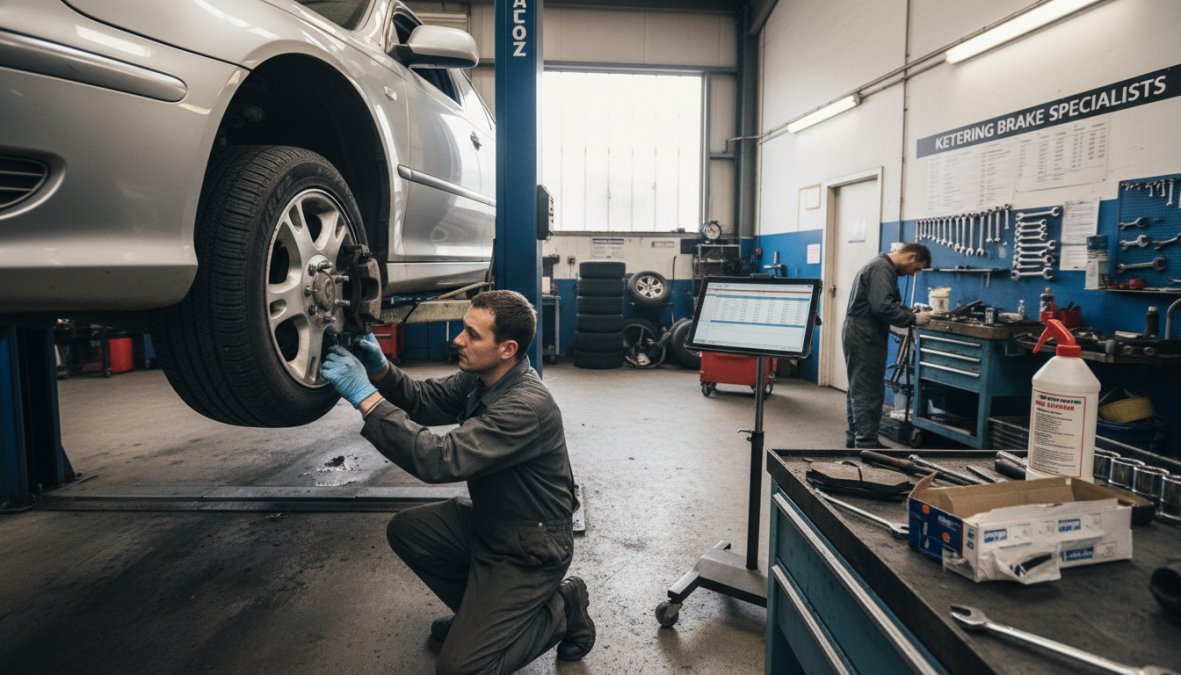
Brake pad replacement is the most common brake repair job. Pads wear down through normal use and typically need replacing more frequently than discs. For most standard passenger cars, a front axle brake pad replacement in Kettering will generally fall within a mid-range price bracket that covers both parts and labour.
A few variables drive the final figure:
Vehicle type: Budget hatchbacks use cheaper pads than SUVs or performance vehicles
Pad quality: Entry-level, mid-range, and premium pads carry different price points
Axle: Front pads typically cost more to replace than rear pads because fronts do more braking work
Labour rate: Independent garages usually charge lower hourly labour costs than national chains
Many drivers are surprised to learn that the parts themselves often cost less than the labour. Fitting brake pads on most vehicles takes between 30 minutes and an hour per axle, so labour costs are a significant part of the total invoice. Always ask for written estimates before authorising any work.
Brake Disc Replacement Costs
Brake discs last longer than pads, but they do wear. Discs can also warp under sustained heavy braking, causing that familiar steering wheel vibration when you slow down. Disc replacement costs more than pad replacement because the parts themselves are larger and more expensive, and the job takes longer.
On most standard vehicles, discs are replaced in pairs per axle to maintain balanced braking performance. Mixing a worn disc with a new one on the same axle is poor practice and can create uneven stopping distances.
Here's a simplified overview of typical brake component job types and their relative cost levels:
Brake Job | Relative Cost | Typical Timeframe |
|---|
Front brake pads only | Lower | 30-60 minutes per axle |
Rear brake pads only | Lower-mid | 30-60 minutes per axle |
Front pads and discs | Mid | 1-2 hours |
Rear pads and discs | Mid | 1-2 hours |
Full brake overhaul (all four) | Higher | 3-4 hours |
Always request an itemised repair order so you can see parts costs and labour costs listed separately.
Pro TipAsk any garage for a written estimate before work begins. In the UK, garages are required to provide this on request, and it protects you from unexpected charges appearing on the final invoice.
Signs of Worn Brake Pads You Should Never Ignore
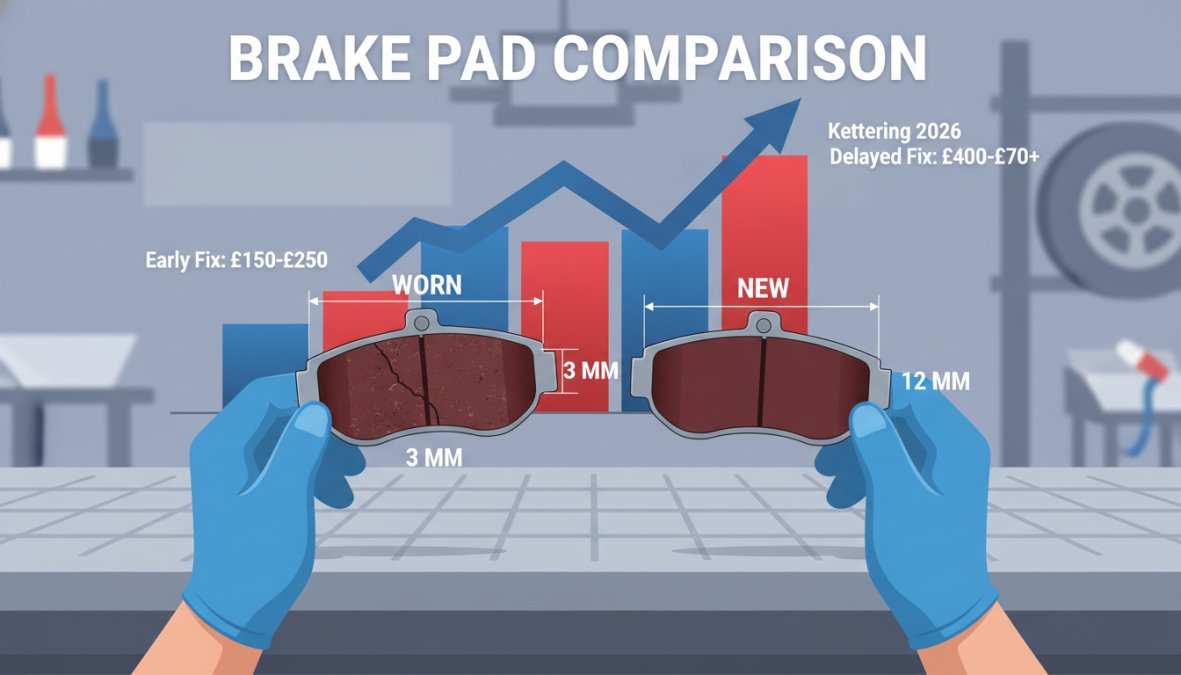
Signs of worn brake pads are often obvious once you know what to listen and feel for. The most reliable indicator is a high-pitched squealing sound when you apply the brakes. Most modern brake pads are fitted with a wear indicator, a small metal tab that contacts the disc once the pad material wears thin enough, producing that distinctive squeal.
Beyond the squeal, watch for these warning signs:
Grinding or metal-on-metal noise: This means the pad material is gone entirely. The metal backing plate is now contacting the disc, causing damage to both components. Repair costs increase significantly at this stage.
Increased stopping distance: If your car takes noticeably longer to stop, brake pad wear is a likely cause
Vibration through the brake pedal: Often indicates warped discs, which can accompany worn pads
Brake warning light: Many modern vehicles will trigger a dashboard warning when pads reach minimum thickness
Visual inspection: Through most alloy wheels, you can see the brake pad sitting against the disc. If the pad material looks very thin, it's time to act
The thing nobody tells you about worn brake pads is how quickly the situation escalates. A car that squeals mildly on Monday can be grinding metal by Friday if the pads are at their limit. Ignoring this warning costs significantly more in the long run because damaged discs need replacing alongside the pads.
Watch OutNever delay brake pad replacement once you hear grinding. Metal-on-disc contact can score and warp the disc beyond safe use, turning a straightforward pad replacement into a full disc and pad job at considerably higher cost.
How Long Do Brake Pads Last on UK Roads?
How long brake pads last depends on driving style, vehicle weight, road type, and the quality of the pads fitted. There is no single fixed answer, which is why vehicle-specific maintenance schedules matter more than generic mileage rules.
As a general guide, many drivers find that front brake pads on a typical family car need replacing somewhere between 25,000 and 60,000 miles. Rear pads often last longer because they handle less braking load. However, these figures shift considerably based on several real-world factors:
Urban driving: Stop-start traffic in towns like Kettering puts far more demand on brakes than motorway driving. Urban drivers often see pads wear faster.
Driving style: Drivers who brake late and hard wear pads much faster than those who anticipate traffic and slow gradually
Vehicle weight: Heavier vehicles, including SUVs, MPVs, and electric vehicles, place more load on brake components
Towing: Regularly towing trailers or caravans accelerates pad wear noticeably
Pad quality: Budget pads may wear faster than premium alternatives, even if the upfront cost is lower
The practical implication: don't rely on mileage alone to judge pad condition. A visual check at every service and a physical inspection whenever you hear unusual brake noise is the right approach. According to RAC guidance on brake maintenance and safety, regular brake inspections are one of the most important elements of preventative maintenance for UK drivers.
Brake Fluid Change Cost and Why It Matters
Brake fluid is the hydraulic medium that transfers your foot pressure into stopping force at each wheel. Most drivers overlook it entirely, yet degraded brake fluid is one of the few brake faults that can cause sudden, catastrophic brake fade with almost no prior warning from the driver's seat.
Understanding what the service actually costs, what it involves, and how to tell whether yours needs changing puts you in a much stronger position when a garage raises it during a service.
Why Brake Fluid Degrades, and Why It Matters More Than You Think
Brake fluid is hygroscopic, meaning it actively absorbs moisture from the atmosphere through microscopic permeation in rubber brake hoses and reservoir seals. This is not a fault, it is a physical property of glycol-ether-based fluids (DOT 3, DOT 4, and DOT 5.1), which are the types used in virtually all standard passenger cars on UK roads.
As moisture content rises, the fluid's wet boiling point drops. Fresh DOT 4 fluid has a minimum dry boiling point of 230°C and a minimum wet boiling point of 155°C under European standards. Once moisture content reaches around 3-4% by volume, which can happen within two to three years of normal use, that wet boiling point falls toward the point where sustained heavy braking (descending a long hill, repeated emergency stops) can cause localised boiling in the caliper. Boiling fluid produces vapour, and vapour compresses. The result is a suddenly spongy or unresponsive brake pedal under exactly the conditions when you need braking performance most.
This is brake fade caused by fluid vapourisation, and it is distinct from the more gradual pad fade that drivers sometimes notice. It can occur without any prior squealing, grinding, or warning light.
How to Check Whether Your Brake Fluid Needs Changing
You do not need to drain the system to get a meaningful indication of fluid condition. Brake fluid test strips, available from most motor factors and online retailers for a few pounds, measure the copper content of the fluid, which rises as the fluid ages and the corrosion inhibitors break down. Elevated copper content correlates reliably with degraded fluid that should be replaced.
A more precise method is a refractometer or electronic moisture tester, which measures moisture content directly. Many garages in Kettering will test your brake fluid free of charge as part of a general inspection or service check. If a garage recommends a fluid change, it is reasonable to ask them to show you the test result, a reading above 3% moisture content on a digital tester is a clear, objective indicator that replacement is warranted.
Visual inspection alone is not reliable. Brake fluid darkens with age, but dark fluid is not always degraded, and pale fluid is not always safe. Always use a test rather than colour as your guide.
What Grade of Brake Fluid Does Your Car Need?
Using the wrong grade is a common and potentially dangerous mistake. The three grades you will encounter in UK passenger cars are:
DOT 3: Older specification, lower boiling points, less common in modern vehicles. Minimum dry boiling point 205°C.
DOT 4: The most common specification for modern European passenger cars. Minimum dry boiling point 230°C. Many manufacturers specify a higher-performance variant sometimes labelled DOT 4 Plus or Super DOT 4, with a dry boiling point of 260°C or above.
DOT 5.1: Higher boiling points than standard DOT 4, still glycol-ether based and compatible with DOT 3 and DOT 4 systems. Used in some performance and heavy-duty applications.
DOT 5: Silicone-based, purple in colour, NOT compatible with glycol-ether systems. Rarely used in standard passenger cars. Never mix DOT 5 with any other grade.
Your vehicle's correct specification is printed on the brake fluid reservoir cap and in the owner's manual. A garage should always use the manufacturer-specified grade, if they propose a substitution, ask why.
What a Brake Fluid Change Costs in Kettering, and What You Get
A brake fluid change (also called a brake fluid flush or bleed) is one of the more affordable brake services. The job involves connecting a pressure bleeder or vacuum bleeder to each caliper bleed nipple in sequence, pushing fresh fluid through the system until the old fluid is fully expelled, then topping up the reservoir to the correct level and checking for leaks.
Labour time on most standard passenger cars is typically 30 to 60 minutes. The fluid itself is inexpensive, a litre of quality DOT 4 fluid costs a few pounds at trade prices. The majority of the cost is labour, which is why the total charge at an independent Kettering garage will generally be lower than at a main dealer for the same job.
For context, the cost of a brake fluid change is almost always a fraction of what a brake fade incident can cost: if vapourised fluid causes a loss of braking and results in even minor bodywork damage, the repair bill will be many times higher. If it contributes to a collision, the consequences extend well beyond repair costs.
Most vehicle manufacturers recommend a brake fluid change every two years regardless of mileage. Some modern vehicles with sealed or semi-sealed systems specify longer intervals, always check your service schedule rather than assuming the two-year rule applies universally.
Pro TipIf your car is approaching its two-year mark since the last fluid change, ask for a moisture test at your next service rather than waiting for a symptom. Most Kettering garages will test it at no charge, and the test takes under two minutes.
Watch OutNever top up a brake fluid reservoir without first identifying why the level has dropped. Low fluid is often a sign of worn brake pads (as the caliper pistons extend further, displacing fluid back into the reservoir), but it can also indicate a hydraulic leak. Adding fluid to a leaking system masks a safety-critical fault.
DIY vs. Professional Brake Repair: A Real Cost-Benefit Analysis
Here's where most guides get it wrong: they treat DIY brake repair as a straightforward money-saving option for anyone with a set of spanners. The reality is more nuanced.
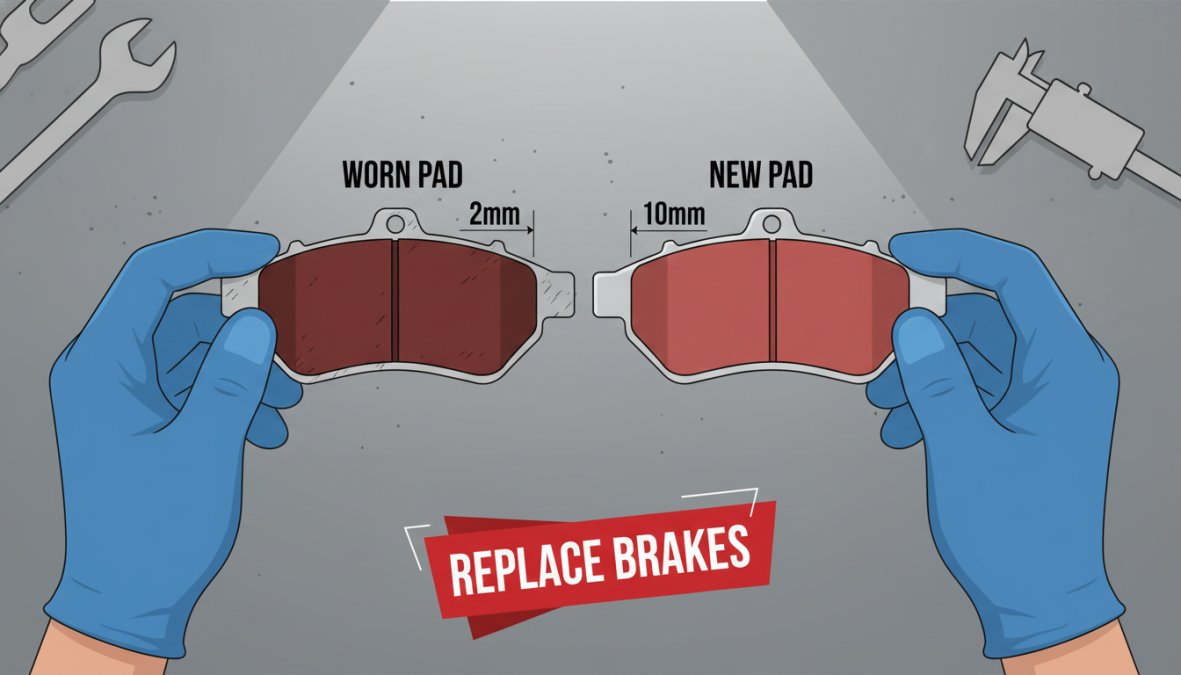
Brake pad replacement is technically achievable for a competent home mechanic with the right tools. You'll need a trolley jack, axle stands, a torque wrench, a brake piston rewind tool, and brake cleaner spray at minimum. The parts cost will be similar to what a garage pays, and you'll save on labour.
The cost-benefit calculation shifts when you factor in:
Diagnostic accuracy: A technician can identify whether you need pads only, pads and discs, or whether there's a caliper issue causing uneven wear. Misdiagnosis on a DIY job can mean doing the work twice.
Torque specifications: Brake caliper bolts, disc retaining screws, and wheel nuts all have specific torque values. Under or over-torquing any of these creates a safety risk.
Brake bleeding: If air enters the hydraulic system during the job, the brake pedal will feel spongy and stopping distances increase. Bleeding the system correctly requires either a second person or a pressure bleeding kit.
Warranty: Professional repairs from a qualified garage typically come with a parts and labour warranty. DIY work carries no such protection.
Electric and hybrid vehicles: Regenerative braking systems on electric and hybrid vehicles change how rear brakes behave and require specific knowledge. Standard DIY advice often doesn't apply.
The honest verdict: for a straightforward front pad replacement on a simple petrol hatchback, a competent DIYer can save money safely. For anything more complex, disc replacement, rear brakes with electronic parking brake actuators, or any brake work on an electric or hybrid vehicle, professional service is the right call. The labour cost is real protection against a more expensive mistake.
Key TakeawayDIY brake pad replacement can save money on simple vehicles, but any job involving electronic parking brakes, hybrid systems, or disc replacement is best left to a qualified technician. The risk of error outweighs the labour saving.
Understanding Your Brake Repair Invoice in Kettering
Repair invoices confuse more drivers than they should. A good repair order is a transparent document, and understanding it protects you from overcharging and helps you track your vehicle's service history accurately.
What Parts and Labour Should Appear on Your Repair Order
Every professional brake repair invoice should clearly separate parts costs from labour costs. This matters because it lets you verify that the parts fitted match what you were quoted, and that the labour time charged is reasonable for the job performed.
A well-structured repair order for a brake job should include:
Parts listing: Each component by name, part number, and individual price (e.g., front brake pads, front brake discs x2, brake cleaner)
Labour description: A clear description of the work done, not just "brake repair"
Labour hours: The number of hours charged and the hourly rate applied
VAT breakdown: Shown separately, not buried in the total
Warranty terms: What parts and labour warranty applies and for how long
Technician notes: Any additional observations, such as brake fluid condition or caliper wear
If an invoice arrives as a single lump sum with no itemisation, ask for the breakdown before paying. Any reputable garage will provide it. Keeping your repair orders builds a documented service history, which has real value at the point of vehicle sale.
How to Find a Reliable Brake Repair Shop in Kettering
Directory sites and comparison platforms dominate this search query, but they almost universally stop at 'here is a list of garages.' What they don't provide is a structured method for evaluating those garages before you hand over your keys and authorise work. This section fills that gap.
Finding a reliable brake repair shop in Kettering is not just about proximity or price. Brake work is safety-critical, and the cheapest quote is not always the best outcome. The framework below gives you a repeatable process for assessing any garage, local independent, national chain, or main dealer, before committing.
Step 1: Verify Qualifications Before You Book
In the UK, there is no legal requirement for a garage to employ qualified technicians. Anyone can legally open a garage and work on vehicles. This makes qualification verification your first filter, not an afterthought.
The relevant qualifications to ask about for brake work are:
IMI (Institute of the Motor Industry) accreditation: The IMI is the professional body for the UK automotive industry. Technicians can hold IMI-recognised qualifications at various levels, and garages can apply for IMI Approved Garage status, which requires them to employ a minimum number of qualified staff and meet ongoing standards.
City & Guilds Level 3 in Light Vehicle Maintenance and Repair: The standard vocational qualification route for UK automotive technicians. Level 3 is the full technician qualification.
Manufacturer-approved training: For vehicles with complex electronic braking systems, including most hybrids and all electric vehicles, manufacturer-specific training matters. A technician trained by the vehicle manufacturer on that brand's systems will have knowledge that a generalist may not.
ATA (Automotive Technician Accreditation): An IMI-administered competency assessment that tests working technicians against current industry standards. ATA-accredited technicians have been independently assessed, not just trained.
A reputable garage will answer qualification questions without hesitation. Evasion or vague answers ('all our guys are experienced') is a yellow flag.
Step 2: Understand the Estimate Before You Authorise Anything
Under the Consumer Rights Act 2015 and the Supply of Goods and Services Act 1982, a garage must carry out work with reasonable care and skill and charge a reasonable price if no price was agreed in advance. In practice, your strongest protection is a written estimate before any work begins.
When you receive an estimate for brake work, check for these specific elements:
Is it itemised? Parts and labour should be listed separately. If you see a single line reading 'brake repair, £X,' ask for the breakdown.
Does it specify part quality? Ask whether the quoted parts are OEM (original equipment manufacturer), OEM-equivalent, or aftermarket. Each tier has different price and longevity implications.
Does it include VAT? Estimates should state whether VAT is included or will be added. A quote that excludes VAT can look significantly cheaper than it is.
Is there a validity period? Parts prices can change. A written estimate is typically valid for 30 days; confirm this with the garage.
What triggers additional charges? Ask specifically: 'If you find something else when you open it up, what happens?' A good garage will tell you they will call you before doing any additional work. If they say they will 'just sort it,' that is a risk.
If a garage refuses to provide a written estimate, walk away. This is not standard practice, it is a protection you are entitled to request.
Step 3: Ask the Right Questions About the Specific Job
Generic questions about customer service tell you less than job-specific questions about brake repair. Before booking, ask:
'Will you show me the worn parts after the job?' A reputable garage will keep removed parts for you to inspect. This is one of the most reliable indicators of honest practice, it is very difficult to upsell unnecessary work when you can see the parts that came off the car.
'Do you replace discs in pairs?' The correct answer is yes, always per axle. A garage that offers to replace a single disc to save money is cutting a corner that affects braking balance and is likely to result in the second disc needing replacement very soon anyway.
'What warranty do you offer on this work?' Most reputable independent garages in Kettering offer a minimum 12-month or 12,000-mile warranty on parts and labour for brake work. National chains often offer longer warranty periods as a selling point. Main dealers typically match or exceed this. If a garage offers no warranty, that is a significant red flag.
'Is my vehicle type something you work on regularly?' This matters most for electric vehicles, hybrids, and vehicles with electronic parking brake actuators. These require specific tools and knowledge. A garage that works on them regularly will answer confidently and specifically.
Step 4: Use Reviews, But Read Them Correctly
Online reviews are useful, but most drivers read them incorrectly. A high average star rating tells you less than the pattern of negative reviews and how the garage responds to them.
When reading reviews for any Kettering brake repair garage, look for:
Negative reviews that mention unexpected charges: This is the most common legitimate complaint in automotive repair. Look for whether the garage responds to these and what they say.
Reviews that mention brake work specifically: General 'great service' reviews are less useful than reviews from drivers who had the same type of work you need.
Review recency: A garage with 200 reviews averaging 4.8 stars, but where the most recent 10 reviews average 3.2 stars, is showing a trend that matters more than the historical average.
Whether the garage responds to reviews at all: Garages that engage with both positive and negative reviews publicly are demonstrating accountability.
Google reviews, Trustpilot, and Which? Trusted Traders are the most reliable review platforms for UK garages. Facebook reviews are more susceptible to manipulation and should be weighted less heavily.
Step 5: Compare the Right Things When Getting Multiple Quotes
Getting two or three quotes for brake work is sensible, but only if you are comparing equivalent work. A quote for 'front brake pads' that uses budget aftermarket pads is not comparable to a quote using OEM-equivalent pads. When collecting quotes, specify:
The exact work you want quoted (e.g., front pads and discs, both sides)
The part quality tier you want (OEM-equivalent is a reasonable standard for most drivers)
That you want the quote to include VAT and any disposal fees
With those parameters fixed, price differences between garages reflect genuine differences in labour rate and margin, which is a fair basis for comparison.
Kettering Motorist Centre provides written, itemised estimates before any work begins, retains removed parts for customer inspection, and employs qualified technicians with experience across standard petrol and diesel vehicles as well as hybrid and electric systems. Booking requires no upfront payment.
Key TakeawayThe single most reliable indicator of a trustworthy brake repair garage is willingness to show you the parts they removed. Ask for this before you book, a good garage will confirm it without hesitation, and it makes upselling unnecessary work significantly harder.
Emergency Brake Repair Preparedness: What Kettering Drivers Should Know
Most brake failures don't happen without warning. The problem is that drivers either miss the early signs or choose to delay action. Emergency brake repair preparedness means knowing what to do when your brakes give you an urgent signal, and having a plan before that moment arrives.
Here's a practical emergency preparedness checklist for Kettering drivers:
Know your nearest qualified brake repair garage and have the number saved
Understand the difference between a brake warning light and a handbrake-on warning (both can look similar on some dashboards)
If you hear grinding brakes, reduce speed and avoid heavy braking until the vehicle is inspected
If the brake pedal sinks to the floor, pump it gently and pull over safely. This indicates a hydraulic issue requiring immediate attention.
Keep your vehicle's service history accessible so a technician can quickly assess when brakes were last serviced
Check whether your breakdown or roadside assistance cover includes towing to a local garage
The broader point is this: brake problems that are caught early are almost always cheaper and safer to fix than those that are left until failure. A squealing noise costs a pad replacement. Grinding costs pads and discs. A seized caliper can cost significantly more and create a genuinely dangerous situation on Northamptonshire roads.
Vehicle-specific maintenance schedules are your best defence. Check your owner's manual for the manufacturer's recommended brake inspection intervals and don't skip them. For drivers covering high mileage or doing a lot of urban driving around Kettering, shortening those intervals makes practical sense.
Brake repair is one of those jobs where the cost of delay almost always exceeds the cost of action. If you're looking for transparent, qualified brake service in Kettering, Kettering Motorist Centre offers expert diagnostic and repair services with a straightforward booking process that requires no upfront payment. The team handles everything from routine brake maintenance to complex hybrid and electric vehicle brake systems. Book your inspection with Kettering Motorist Centre and get back on the road with confidence in your vehicle's safety.
Frequently Asked Questions
How much does a brake pad replacement cost in Kettering?
Car brake repair cost in Kettering typically varies depending on your vehicle make, the quality of parts used, and whether discs need replacing at the same time. Budget brake pads with fitting can start from around £60-£100 per axle for common models, while premium parts and labour on larger or specialist vehicles can cost considerably more. Always request a written estimate from your local auto repair facility before work begins so you can compare fairly.
How do I know if my car needs new brakes?
The most common signs of worn brake pads include a high-pitched squealing or grinding noise when braking, a longer stopping distance, a vibrating or pulsating brake pedal, and a warning light on your dashboard. You may also notice the car pulling to one side under braking. If you experience any of these symptoms, book a brake inspection at a trusted service centre in Kettering as soon as possible to avoid more costly repairs.
How long do brake pads last on a typical UK car?
How long brake pads last depends on your driving style, vehicle weight, and road conditions. On average, brake pads can last anywhere from 25,000 to 60,000 miles. Town driving with frequent stops wears pads faster than motorway driving. Checking your vehicle-specific maintenance schedule and having fluid levels and brake components inspected during routine servicing helps catch wear early and avoids unexpected car brake repair costs.
What is included in a standard brake service?
A standard brake service at a reputable Kettering garage typically includes inspection of brake pads and discs for wear, checking brake fluid levels and condition, diagnostic testing of the braking system, and a road test to confirm performance. Depending on findings, the technician may recommend brake pad replacement, disc skimming or replacement, or a brake fluid change. Always ask for a detailed repair order listing all parts and labour charges before approving any work.
What does a brake fluid change cost in Kettering?
A brake fluid change cost in Kettering is generally one of the more affordable brake services, often ranging from around £30 to £60 depending on the garage and your vehicle type. Brake fluid should typically be replaced every two years as part of your preventative maintenance schedule, since moisture absorption degrades its performance over time. Neglecting it can lead to brake fade and more expensive repairs, so it represents excellent value for the safety benefit it provides.