Best Way to Charge Electric Car Battery: 7 Key Practices
Last Updated: July 10, 2026
Finding the best way to charge electric car battery is essential for maximising your EV's lifespan and efficiency. At Kettering Motorist Centre, we work with electric and hybrid vehicle owners across Northamptonshire who want to protect their battery investment while keeping charging costs manageable. The difference between optimal charging practices and careless habits can mean thousands of pounds in battery replacement costs down the line.
Understanding Charging Levels: Level 1 vs Level 2 vs DC Fast Charging
Three distinct charging methods exist for electric vehicles, each suited to different situations and offering vastly different speeds.
Level 1 Charging: Standard Household Outlet
Level 1 charging uses a standard 120-volt household outlet, delivering 2-5 miles of range per hour. A fully depleted 60 kWh battery would take 24-48 hours to reach full charge, making this impractical for daily use. Level 1 works best as a backup option or for plug-in hybrid vehicles with smaller batteries.
Level 2 Charging: Home and Public Networks
Level 2 charging operates at 240 volts and delivers 25-30 miles of range per hour, making it practical for overnight charging. Home Level 2 installation requires a dedicated circuit and professional electrician work, but enables full overnight charging without battery stress. Public Level 2 networks at car parks, shopping centres, and workplaces provide valuable top-up charging during the day.
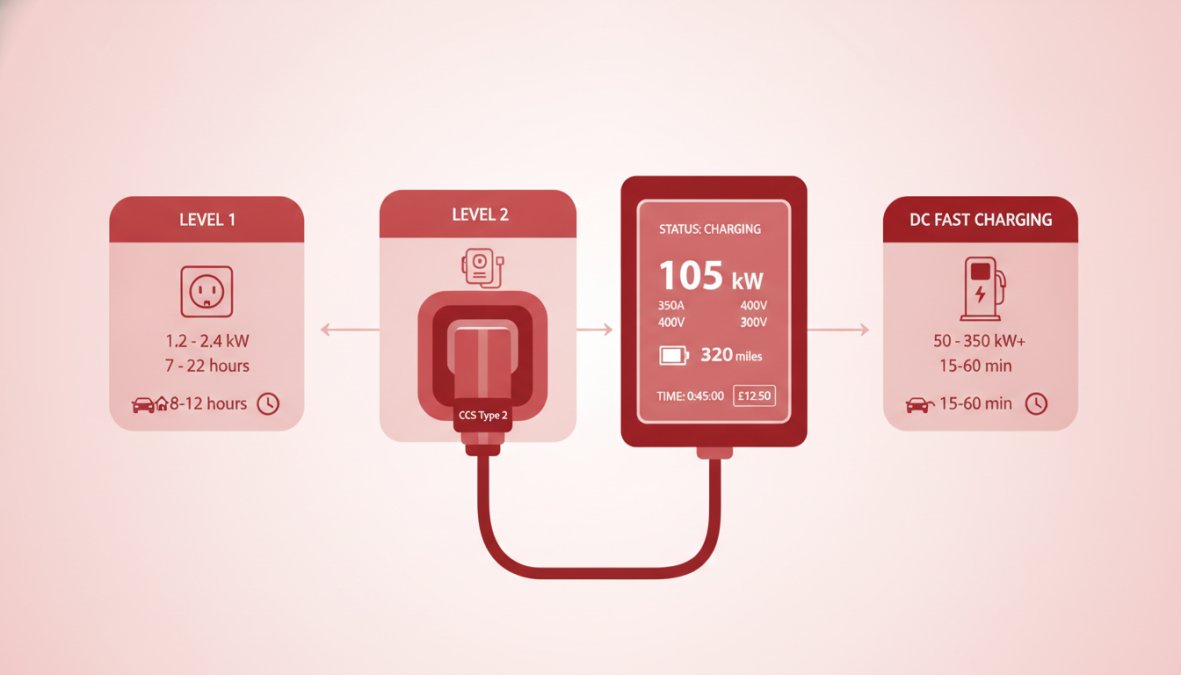
Close-up of an EV charging port with cable plugged into a modern charging station display showing kilowatt output and charging session duration
DC Fast Charging: Rapid Public Charging
DC fast chargers deliver 50-350 kW, adding 150-200 miles of range in 20-30 minutes. However, this speed generates significant heat within the battery pack, accelerating degradation. DC fast charging is best reserved for motorway journeys and urgent travel, not daily use. Regular reliance on fast charging noticeably reduces the number of charge cycles your battery can complete before capacity loss becomes significant.
How Long Does It Take to Charge an Electric Car?
Charging duration depends on the charger's power output, your battery's capacity, and current state of charge. A 60 kWh battery takes approximately 30 hours at Level 1, 8-10 hours at Level 2, and 30-45 minutes at a 150 kW DC fast charger.
Charging Speed and Efficiency Across Different Methods
Real-world charging is slower than theoretical maximums because of resistive losses and the charging curve, which reduces power delivery as the battery approaches full charge. Level 2 charging converts roughly 85-90% of grid energy into usable battery capacity, while DC fast charging operates at 70-80% efficiency due to greater heat generation.
Factors Affecting Charging Duration
Battery temperature dramatically affects charging speed. Temperatures below 5°C can reduce charging speed by 20-40% at Level 2. Many modern EVs include battery preconditioning features that warm the battery before charging begins, improving both speed and efficiency in winter conditions.
State of Charge (SoC) also influences charging speed. The first 20% of charge enters fastest, with speed declining as you approach full capacity. The final 10-20% can take as long as charging from 20% to 80%, which is why the 20-80% rule exists, it's the most efficient window for regular charging.
The Best Way to Charge Your EV Battery for Longevity
Battery degradation is inevitable, but the rate depends almost entirely on your charging habits.
The 20-80% Rule and State of Charge Optimisation
Lithium-ion batteries degrade faster when kept at extreme states of charge. The sweet spot for battery longevity is maintaining your battery between 20% and 80% State of Charge for daily use. Charging to 100% regularly stresses the battery chemistry and accelerates degradation.
Set your vehicle's charging limit to 80% for daily commuting, most modern EVs include this feature. Reserve full charges only for long journeys. Research from battery manufacturers shows that following the 20-80% rule can extend battery lifespan by 2-3 years compared to regularly charging to 100%.
Pro TipSet your home charger to stop at 80% and schedule charging to complete overnight when grid demand is lowest. Off-peak electricity rates are typically 30-50% cheaper than daytime rates.
Avoiding Deep Discharge and Overcharging
Deep discharge, allowing your battery to drop below 10% regularly, stresses the battery chemistry and should be avoided except in emergencies. Similarly, keeping the battery at 100% charge for extended periods stresses the cells. If you must charge to 100% for a long journey, do so shortly before departure rather than leaving the vehicle plugged in at full charge.
Is Fast Charging Bad for EV Battery Health?
DC fast charging generates substantial heat within the battery pack because of rapid energy transfer. The impact depends on frequency and context.
How DC Fast Charging Affects Battery Degradation
Occasional DC fast charging, perhaps once or twice monthly for long journeys, has minimal long-term impact on battery health. The battery's thermal management system actively cools the pack during fast charging, and the vehicle's software reduces power delivery if temperatures rise too high.
Regular reliance on DC fast charging, however, noticeably accelerates degradation. Research indicates that drivers who fast-charge daily experience 15-20% more capacity loss over five years compared to drivers using primarily Level 2 charging. Treat DC fast charging as a tool for specific situations rather than a daily charging method.
Watch OutNever fast-charge a cold battery. Always allow the battery to warm naturally or use preconditioning features before initiating a DC fast charge session.
Thermal Management and Battery Chemistry Considerations
Modern EV batteries use sophisticated thermal management systems that actively cool the pack during fast charging. Liquid cooling circulates coolant through channels in the battery pack, maintaining optimal temperature ranges even during 350 kW charging sessions.
Different battery chemistries respond differently to thermal stress. Lithium iron phosphate (LFP) batteries tolerate higher temperatures and faster charging with less degradation than traditional nickel-cobalt-aluminium (NCA) batteries. If you plan to fast-charge frequently, vehicles with LFP batteries offer better long-term durability.
EV Battery Health Tips: Best Practices for Long-Term Care
Preconditioning Your Battery in Cold Weather
Preconditioning uses the vehicle's heating system to warm the battery before you begin driving or charging, improving both efficiency and charging speed. Activate preconditioning 10-15 minutes before departing in winter conditions. This increases charging speed by 20-30% in cold weather and reduces thermal stress on the battery.
Overnight Charging and Scheduled Charging Strategies
Overnight charging at Level 2 represents the ideal daily charging scenario. The slow, steady power delivery is gentle on battery chemistry. Most drivers complete a full overnight charge from 20% to 80% in 6-8 hours.
Scheduled charging allows you to delay charging until off-peak hours when electricity rates are lowest. Many UK suppliers offer Economy 7 or similar schemes with significantly reduced rates during night hours (typically 11pm to 7am). Programming your vehicle to charge only during these windows reduces electricity costs by 40-50% while protecting your battery through slower charging.
Smart charging apps integrate with your vehicle and home charger to optimise charging based on electricity prices and renewable energy availability, saving money while supporting grid stability.
Setting Up Home Charging: Equipment and Installation
Choosing the Right Home Charging Equipment
A 7 kW charger (single-phase, 32 amps) is the standard recommendation for most UK homes and delivers 25-30 miles of range per hour. Upgrading to 11 kW or 22 kW requires three-phase electrical supply, available in some areas but not universally.
Smart charging equipment offers app-based monitoring, scheduled charging, and integration with home solar systems. Brands offering UK-compatible options include Easee One, which provides compact design and dynamic load balancing, and EVIQO Evipower Gen2, which includes a 25-foot cable and programmable charge times. For cost-conscious installers, the Grizzl-E Ultimate 48 provides strong durability and adjustable power settings without smart features.
Installation Requirements and Considerations
Home charger installation requires a qualified electrician and must comply with Building Regulations and local electrical standards. The electrician assesses your main electrical panel capacity, determines appropriate cable gauge and circuit protection, and installs the charging unit in a safe location.
Installation costs depend on distance from the electrical panel and whether your home requires electrical upgrades. Most installations range from straightforward to complex. Kettering Motorist Centre can advise on installation specialists and help coordinate electrical work with your charger supplier.
Charger Type
Power Output
Charging Speed
Best For
Level 1 (household outlet)
2-3 kW
2-5 miles/hour
Emergency backup only
Level 2 (7 kW)
7 kW
25-30 miles/hour
Daily home charging
Level 2 (11 kW)
11 kW
35-40 miles/hour
Fast home charging
DC Fast Charger
50-350 kW
150-200 miles/30 mins
Long-distance travel
Using Public Charging Networks Effectively
Navigating Public Charging Stations and Payment Methods
Major UK public charging networks include Instavolts, Gridserve, BP Pulse, and Tesla Supercharger locations. Each network uses different connector types (CCS, CHAdeMO, Type 2) and payment systems. Most modern EVs come with adapters for multiple connector types.
Smartphone apps from individual networks or aggregator apps like Zap-Map show real-time charger availability, pricing, and navigation. These tools are essential for journey planning, particularly on motorways where charger availability is limited.
Charging Etiquette and Cost Optimisation
Move your vehicle promptly once charging completes to free the charger for other drivers. Avoid leaving vehicles plugged in at Level 2 chargers longer than necessary.
Level 2 charging at public locations typically costs 30-50p per kWh, comparable to home charging rates. DC fast charging costs 40-60p per kWh, higher per unit but justified by time savings on long journeys. Many networks offer membership discounts that reduce per-kWh costs if you charge frequently.
Key TakeawayPlan long journeys around known fast-charging locations and charge to 80% at each stop rather than pursuing 100% charges. This reduces charging time, protects battery health, and maintains consistent travel pace.
Cost-Saving Strategies for EV Charging
Off-Peak Charging and Smart Charging Apps
Time-of-use electricity tariffs charge significantly lower rates during off-peak hours (typically 11pm to 7am). Shifting your charging to these windows reduces electricity costs from approximately 25-30p per kWh to 8-12p per kWh. Over a year, this difference amounts to hundreds of pounds in savings.
Smart charging apps like ev.energy and NeoCharge automate this process by scheduling charging during the cheapest hours available. Some apps also factor in renewable energy generation, charging your vehicle when wind or solar generation is high.
Understanding Kilowatt-Hours and Energy Costs
Your vehicle's efficiency is measured in miles per kilowatt-hour (kWh). A typical EV achieves 3-4 miles per kWh, meaning a 60 kWh battery provides 180-240 miles of range. At 10p per kWh (off-peak rate), charging costs £6 for 180-240 miles, or roughly 2.5-4p per mile, substantially cheaper than petrol vehicles at 12-15p per mile.
Monitoring your vehicle's efficiency through the infotainment system helps identify wasteful driving patterns. Smooth acceleration, moderate speeds (55-65 mph), and selective climate control use can improve efficiency by 15-20%, translating directly to lower charging costs.
Protecting your EV battery requires understanding charging methods, implementing protective practices, and optimising costs through strategic timing and equipment choices. The best way to charge electric car battery combines Level 2 home charging for daily use, the 20-80% rule for regular charging, and occasional DC fast charging only when necessary for longer journeys.
If you're uncertain about home charger installation or want expert guidance on charging strategies for your specific vehicle, Kettering Motorist Centre provides specialist advice for electric and hybrid vehicles across Kettering and Northamptonshire. Our team can assess your electrical infrastructure, recommend appropriate charging equipment, and help you establish charging routines that protect your battery investment. Book your MOT or schedule a consultation through our hassle-free online booking system, no upfront payment required.
Frequently Asked Questions
What is the best way to charge an electric car battery to maximise its lifespan?
The best way to charge your EV battery is to keep the state of charge (SoC) between 20% and 80% for daily use. This reduces stress on lithium-ion cells and slows battery degradation. Avoid deep discharges and overnight charging to 100% unless you need full range for a long journey. Use Level 2 charging at home when possible, as it's gentler than DC fast charging. Preconditioning your battery in cold weather also helps maintain long-term health and charging efficiency.
How long does it take to charge an electric car at home versus at a public station?
Level 1 charging (standard household outlet) takes 24-48 hours for a full charge. Level 2 home charging typically requires 6-10 hours, depending on battery capacity and charger amperage. DC fast charging at public stations can add 200 miles in 20-30 minutes, though charging speed slows as the battery approaches 80% state of charge. Home charging is more convenient for overnight use, whilst public DC fast chargers suit long-distance travel and rapid top-ups.
Is fast charging bad for my EV battery?
DC fast charging does generate more heat and stress on battery cells, which can accelerate degradation over time. However, modern EVs have thermal management systems that protect lithium-ion batteries during fast charging. Occasional fast charging is safe, but relying on it daily will reduce battery longevity faster than Level 2 charging. For best results, use DC fast charging strategically, during road trips or when you need quick top-ups, and rely on gentler Level 2 charging for regular daily use.
Should I charge my electric car every night?
You don't need to charge every night if your daily driving is modest. Charging to 80% every night is better than charging to 100%, as it reduces battery stress. If you drive less than 50 miles daily, charging 2-3 times per week may be sufficient. Use smart charging apps or your vehicle's scheduling feature to charge during off-peak hours (typically late evening or early morning) when electricity rates are lower, reducing your charging costs and grid load.
What percentage should I keep my EV battery at for optimal health?
For optimal battery health, maintain your state of charge between 20% and 80%. This range minimises stress on lithium-ion cells and extends overall battery lifespan. Only charge to 100% when you need full range for a long journey. Similarly, avoid letting the battery drop below 20% regularly, as deep discharges accelerate degradation. Modern EV software often allows you to set a daily charge limit, making it easy to follow this best practice without manual monitoring.
Your booking Failed
Please try again or please call 01536 410142
Thank you for placing a booking with Kettering Motorist Centre Limited for vehicle
PLEASE TAKE YOUR BOOKING REFERENCE NUMBER WITH YOU TO THE MOT CENTRE
Your items
MOT Test
×
Terms and Conditions
These terms and conditions form the basis on which you can visit and use this website. Please read them carefully as they contain important information.
General terms and conditions
This website is owned and operated by Kettering Motorist Centre Ltd (company registration number: 4485858) operating at Trafalgar Road, Kettering, Northamptonshire, NN16 8DB (the "MOT Centre", the "Company", "we" or "us"). If you have any queries about these terms and conditions or if you have any comments or complaints on or about this website, you can contact us at [email protected] or 01536 410142.
The website is to promote and offer for sale the products and services of Kettering Motorist Centre Limited.
1. The contract between us
This website does not take payment for products or services online. The website enables you to view products and services online and to make a booking for later delivery and payment. The vehicle and provision of other products and services promoted by this website and the payment by you of the price of those products and services will take place at the MOT Centre. The booking does not constitute a contract.
The booking process on the site provides details of the booked MOT order. Please take the time to read and check your booking. It is your responsibility to make sure the order is correct and for the correct vehicle.
2. Ownership of rights
All rights, including copyright, in this website are owned by or licensed to the Company. Any use of this website or its contents, including copying or storing it or them in whole or part, other than for your own personal, non commercial use, is prohibited without our permission. You may not modify, distribute or repost anything on this website for any purpose.
3. Accuracy of content
We have taken care in the preparation of the content of this website, in particular to ensure that prices quoted are correct at the time of publishing and that all goods have been fairly described. However, bookings will only be accepted if there are no material errors in the description of the goods or their prices as advertised on this website. Any weights, dimensions and capacities given about the goods are approximate only.
4. Damage to your computer
We try to ensure that this website is free from viruses or defects. However, we cannot guarantee that your use of this website or any websites accessible through it will not cause damage to your computer. It is your responsibility to ensure that the right equipment is available to use the website. Except in the case of negligence on our part, we will not be liable to any person for any loss or damage which may arise to computer equipment as a result of using this website.
5. Availability
All bookings are subject to acceptance and availability. If the MOT date you have requested are is not available, the Centre will contact you by e-mail or phone. You will have the option either to wait until another slot is available or to cancel your booking.
6. Booking errors
You are able to correct errors on your booking up to the point on which you click on “Place Booking” during the booking process.
7. Price
The prices payable for goods that you order are as set out in our website. All prices are inclusive of VAT at the current rates and are correct at the time of entering information, errors and omissions excepted.
Whenever it is not possible to accept your booking to buy goods of the specification and description at the price indicated, the MOT Centre will advise you by email or phone or when you visit the centre.
8. Payment terms
You will be required to pay for the goods or services to the Centre at time of a completed MOT.
9. Delivery charges
N/A
10. Cancellation
The MOT Centre reserves the right to cancel the booking if:
10.1 There is insufficient stock to deliver the goods you have booked.
10.2 One or more of the goods you booked was listed at an incorrect price.
If your booking is cancelled the Centre will notify you by e-mail or phone.
You have the right to cancel your booking at any time up to the point of the MOT. If you do cancel your booking you should inform the centre by phone.
11. Liability
Notwithstanding the foregoing, nothing in these terms and conditions is intended to limit any rights you might have as a consumer under applicable local law or other statutory rights that may not be excluded nor in any way to exclude or limit our liability to you for any death or personal injury resulting from our negligence.
12. Notices
Unless otherwise expressly stated in these terms and conditions, all notices from you to us must be in writing and sent to our contact address given above and all notices from us to you will be displayed on our website from time to time.
13. Changes to legal notices
We reserve the right to change these terms and conditions from time to time and you should look through them as often as possible.
14. Law, jurisdiction and language
This website, any content contained therein and any contract brought into being as a result of usage of this website are governed by and construed in accordance with English law. Parties to any such contract agree to submit to the exclusive jurisdiction of the courts of England and Wales.
15. Invalidity
If any part of these terms and conditions is unenforceable (including any provision in which we exclude our liability to you) the enforceability of any other part of these conditions will not be affected.
16. Privacy
You acknowledge and agree to be bound by the terms of our privacy policy
17. Third party rights
Nothing in this Agreement is intended to, nor shall it confer any rights on a third party.