Blog >
Benefits of Independent Car Servicing: A 2026 Guide Benefits of Independent Car Servicing: A 2026 Guide
22 May 2026
Table of Contents
Last Updated: May 21, 2026
Why the Benefits of Independent Car Servicing Are Worth Knowing
The benefits of independent car servicing are more substantial than most drivers realise, and Kettering Motorist Centre has helped hundreds of motorists in Kettering, Northamptonshire make informed decisions about where to take their vehicles. The core argument here is straightforward: dealership service departments have long traded on a myth, that only they can service your car properly. That myth costs drivers real money and is, in many cases, legally unfounded. Below, we'll show you exactly how independent garages compare on cost, quality, and legal protection, and give you a practical framework for choosing the right repair facility.
Independent car servicing is the practice of having your vehicle maintained or repaired by a non-franchised garage that operates independently of a vehicle manufacturer's official dealership network. These garages can service any make and model, use OEM or quality aftermarket parts, and provide a full service history, all without voiding your manufacturer warranty under UK consumer law.
What most guides get wrong is treating this as a simple cost comparison. The real story is about legal rights, service quality, and the long-term impact on your vehicle's resale value. According to the UK Government's guidance on consumer rights and vehicle warranties, consumers have strong protections that manufacturers cannot override. That changes the entire calculation.
How Much Does a Car Service Cost UK: Independent vs Dealership
Cost is the most immediate reason drivers explore independent servicing, and the difference is significant. A full service at a main dealer in the UK commonly runs between £150 and £350, depending on the brand and region. At an independent garage, the same service typically costs between £80 and £200. That gap compounds over a vehicle's lifetime.
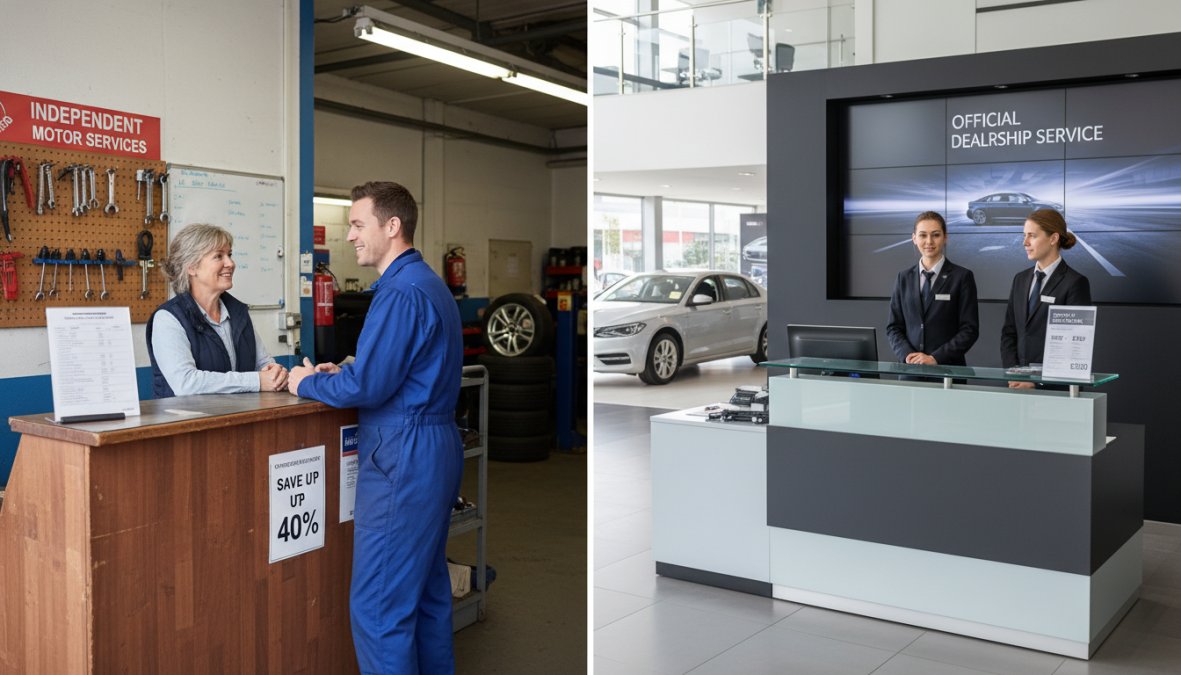
The reason for the difference comes down to overheads and margin structures, not service quality. Dealership service departments carry the cost of manufacturer branding, dedicated waiting areas, and franchise fees. Independent garages pass those savings directly to the customer.
Typical Service Cost Comparison Table
Service Type | Main Dealer (avg.) | Independent Garage (avg.) | Potential Saving |
|---|
Interim Service | £120 - £180 | £60 - £100 | Up to £80 |
Full Service | £180 - £350 | £90 - £200 | Up to £150 |
Major Service | £280 - £500 | £140 - £280 | Up to £220 |
MOT Test | £55 (max legal fee) | £40 - £55 | Up to £15 |
Brake Pad Replacement | £150 - £300 | £80 - £180 | Up to £120 |
Figures are approximate UK averages for 2026. Actual costs vary by vehicle make, model, and location.
Where Independent Garages Save You the Most Money
The biggest savings appear in labour rates. Dealership labour rates in the UK frequently sit between £100 and £200 per hour. Independent garages typically charge £60 to £120 per hour for the same work. On a job that takes three hours, that difference alone can be £120 to £240.
Parts pricing is the other lever. Dealerships are often required to use manufacturer-approved parts at manufacturer-set prices. Independent garages can source quality OEM parts from the same supply chains, or use reputable aftermarket parts that meet or exceed original specifications, often at 20 to 40 per cent lower cost.
Pro TipAsk your independent garage to show you the parts they're fitting, including the brand name and part number. A reputable repair facility will do this without hesitation. It's also worth keeping receipts for all parts, as this supports your service history for resale purposes.
Independent Garage vs Main Dealer Warranty: What the Law Actually Says
This is the part most people get wrong, and it's the most important section in this guide.
Servicing your vehicle at an independent garage does not void your manufacturer's warranty. This is not a loophole or a grey area. It is a legal right under UK and EU-derived consumer protection law, provided the servicing is carried out to the manufacturer's specified standards using appropriate parts.
The Magnuson-Moss Warranty Act Equivalent in the UK
The UK equivalent framework draws from the Competition and Markets Authority guidance on warranties and servicing and the Supply of Goods and Services Act. The principle is the same as the US Magnuson-Moss Warranty Act: a manufacturer cannot legally require you to use their own service network as a condition of maintaining your warranty, unless they provide that servicing free of charge.
What this means in practice:
Your vehicle's warranty remains valid if an independent garage services it according to the manufacturer's schedule
The garage must use parts of equivalent quality to OEM specifications
A full, stamped service history must be maintained in your logbook
The manufacturer bears the burden of proof if they claim a warranty repair was caused by independent servicing
Many dealerships imply otherwise, either through vague language or direct statements. That implication is misleading under UK consumer law. If a manufacturer refuses a warranty claim solely because you used an independent garage, you have grounds to challenge that refusal.
Extended Warranties and Independent Servicing
Extended warranties sold as add-on products (not manufacturer warranties) sometimes contain stricter clauses. Read the terms carefully before purchasing. Some extended warranty providers do require servicing at approved garages, which may or may not include independent repairers. Check the approved repairer list before committing.
Watch OutDo not assume an extended warranty follows the same rules as a manufacturer warranty. Some third-party extended warranty products include clauses that can be used to deny claims if servicing was performed outside their approved network. Always read the full terms before signing.
Car Service Logbook Requirements: Keeping Your History Intact
Car service logbook requirements are straightforward but frequently misunderstood, and the stakes are higher than most drivers realise. Your physical service logbook must record each service interval, the date, mileage, work carried out, and the stamp or signature of the garage performing the work. An independent garage can legally stamp your logbook, and that stamp carries exactly the same weight as a dealership stamp for both warranty and resale purposes under UK consumer law.
The practical risk is not legal, it is administrative. A poorly documented service history, whether from a dealership or an independent garage, reduces your vehicle's resale value and complicates warranty claims. The discipline of maintaining complete records is your responsibility as the vehicle owner, not the garage's.
Digital Service Records: How They Actually Work, and Why Independent Garages Now Match Dealers
This is the content gap that almost no guide covers, and it matters enormously for the 'dealerships have better records' myth that still circulates among drivers.
The UK automotive industry has shifted substantially toward digital service records over the past several years. The mechanism works like this: when an independent garage logs a service on a recognised digital platform, that record is tied to your vehicle's VIN (Vehicle Identification Number) or registration plate. When a future buyer, insurer, or finance provider runs a vehicle history check, using services such as HPI Check, MyCarCheck, or the AA's vehicle history product, that digitally logged service appears in the report alongside MOT history, mileage checks, and finance records.
This directly dismantles the assumption that a 'full dealer service history' is inherently more verifiable than an independent service history. What matters is not who stamped the book, it is whether the work is traceable, timestamped, and tied to the vehicle's identity.
Several independent garage management platforms now facilitate this integration. Garage management software widely used in the independent sector, including Garage Hive, Autowork Online, and MAM Software's Autopart, allows garages to generate itemised digital job cards that can be exported and retained as permanent records. Some garages also submit service data directly to vehicle history aggregators. When you are vetting an independent garage, asking whether they use a digital job management system is a practical and revealing question.
What a Complete Service Record Actually Needs to Include
Whether your record is physical, digital, or both, the following elements are what buyers, warranty providers, and insurers look for:
Record Element | Why It Matters |
|---|
Date and mileage at each service | Confirms intervals were met to manufacturer schedule |
Work carried out (itemised) | Distinguishes a full service from a basic oil change |
Parts fitted (brand and part number) | Supports warranty claims and demonstrates OEM or equivalent quality |
Garage name, address, and contact details | Allows future verification of the record |
Technician signature or garage stamp | Confirms a qualified person performed the work |
Digital job card or invoice reference | Links the physical record to a verifiable digital trail |
According to the Society of Motor Manufacturers and Traders guidance on used car values, a verifiable full service history is one of the most significant factors in used car pricing. The operative word is verifiable, not dealer-stamped.
The Practical Steps to Protect Your Record
Keep every invoice. A garage stamp in your logbook without a corresponding itemised invoice is a weaker record than a stamp plus invoice. The invoice is the evidence; the stamp is the summary.
Ask your garage whether they use digital job management software and whether they can provide a PDF or email copy of your job card. Most reputable independent garages will do this as standard.
Run a vehicle history check on your own car every two to three years. Services such as HPI Check or MyCarCheck will show you exactly what a future buyer will see, and you can identify any gaps in the digital record before they become a problem at point of sale.
Store physical logbooks and invoices together in a single folder. When you sell the vehicle, presenting a logbook, a set of invoices, and a clean vehicle history report is the strongest possible evidence of a well-maintained car, regardless of whether any of those stamps came from a dealership.
Pro TipIf you have a gap in your service history, perhaps from a period when servicing was done informally or records were lost, a reputable independent garage can help you reconstruct what is known and document it correctly going forward. A partial history with clear, honest documentation from the point of reconstruction is significantly better than no history at all.
The bottom line: the 'dealerships have better records' argument was always about perception, not legal or technical reality. With digital job management now standard across the independent sector, the gap has closed entirely for any garage that uses these systems. Your job as a vehicle owner is to choose a garage that documents work properly and to keep your own copies of everything they produce.
Key Benefits of Independent Car Servicing: A Practical Breakdown
The benefits of independent car servicing extend well beyond cost. Here is a structured breakdown of what drivers consistently gain by choosing an independent repair shop over a dealership service department.
Personalised Customer Service and Transparency
Independent garages live and die by customer loyalty in a way dealership service departments simply do not. A family-run garage in Kettering cannot rely on manufacturer brand recognition to fill its ramps. It relies on reputation, word of mouth, and the quality of its work.
This creates a fundamentally different service dynamic. At an independent garage, you are more likely to speak directly with the mechanic who worked on your car. You are more likely to receive a clear explanation of what was found, what was done, and why. Service transparency is not a marketing feature at an independent garage, it is a survival mechanism.
The experience signals are real: independent garages tend to offer faster turnaround times for standard maintenance, more flexible scheduling, and greater willingness to discuss repair options and out-of-pocket expenses before committing to work.
ASE Certified and Trained Technicians
A common misconception is that only dealership technicians have proper training. Many independent garage mechanics hold ASE certified qualifications or equivalent UK accreditations through bodies such as the Institute of the Motor Industry (IMI). Factory-trained technicians exist in both environments.
The difference is that dealership technicians are often trained narrowly on a single manufacturer's vehicles. An experienced independent mechanic who has worked across multiple makes and models frequently develops broader diagnostic knowledge. Make and model specialisation exists in the independent sector too, with many garages focusing on specific brands or vehicle types, including electric and hybrid vehicles.
Access to OEM and Quality Aftermarket Parts
Independent garages have access to the same OEM parts supply chains used by dealerships. They can also source quality aftermarket parts that meet manufacturer specifications, often at lower cost. The key question is not whether parts are OEM or aftermarket, but whether they meet the required specification for your vehicle.
A reputable independent garage will advise you on the difference and let you choose. That transparency is itself a benefit. Dealerships rarely offer the option of aftermarket parts, even when those parts are equivalent in quality and significantly cheaper.
The argument that only dealerships have the right diagnostic equipment is outdated. Professional-grade diagnostic tools capable of reading manufacturer-specific fault codes, accessing technical service bulletins, and performing software updates are now widely available to independent garages.
Proprietary diagnostic tools remain a genuine advantage for dealerships in specific scenarios, particularly for complex software updates on newer vehicles or for accessing systems locked behind manufacturer portals. This is a real limitation worth acknowledging. For most vehicles over three years old, however, independent garages have full diagnostic capability.
The practical implication for Kettering drivers: if your vehicle is under two years old and experiencing a complex software or electronics fault, a dealership visit may be warranted. For all standard preventative maintenance, service intervals, and the majority of mechanical repairs, an independent garage with professional diagnostic equipment is entirely capable.
Many independent garages now invest in manufacturer-level diagnostic platforms such as Delphi DS, Autel, or LAUNCH systems, which cover the vast majority of makes and models on UK roads. Ask your garage directly what diagnostic tools they use and whether those tools cover your specific vehicle.
Key TakeawayDiagnostic capability at independent garages has advanced significantly. For most vehicles, the gap between independent and dealership diagnostic tools is negligible for routine servicing and common fault codes. The proprietary advantage dealerships hold is narrowest on vehicles over three years old.
How to Vet an Independent Garage Before You Book
Not all independent garages are equal. The benefits of independent car servicing only materialise if you choose a competent, reputable repair facility. Here is a practical checklist for vetting any independent garage before you hand over your keys.
Independent Garage Vetting Checklist:
Check for IMI, RAC, or AA approved garage accreditation
Verify the garage is registered with Companies House or has a clear business address
Ask whether technicians hold relevant qualifications (IMI, City & Guilds, or equivalent)
Confirm they can stamp your manufacturer service logbook correctly
Ask what diagnostic tools they use and whether they cover your make and model
Request a written estimate before any work begins
Check Google reviews, Trustpilot, or local recommendations for consistent positive feedback
Ask whether they use OEM or quality-approved aftermarket parts, and whether you have a choice
Confirm their warranty on parts and labour (typically 12 months on parts, 3-12 months on labour)
Check whether they have experience with your specific vehicle type, including electric or hybrid if relevant
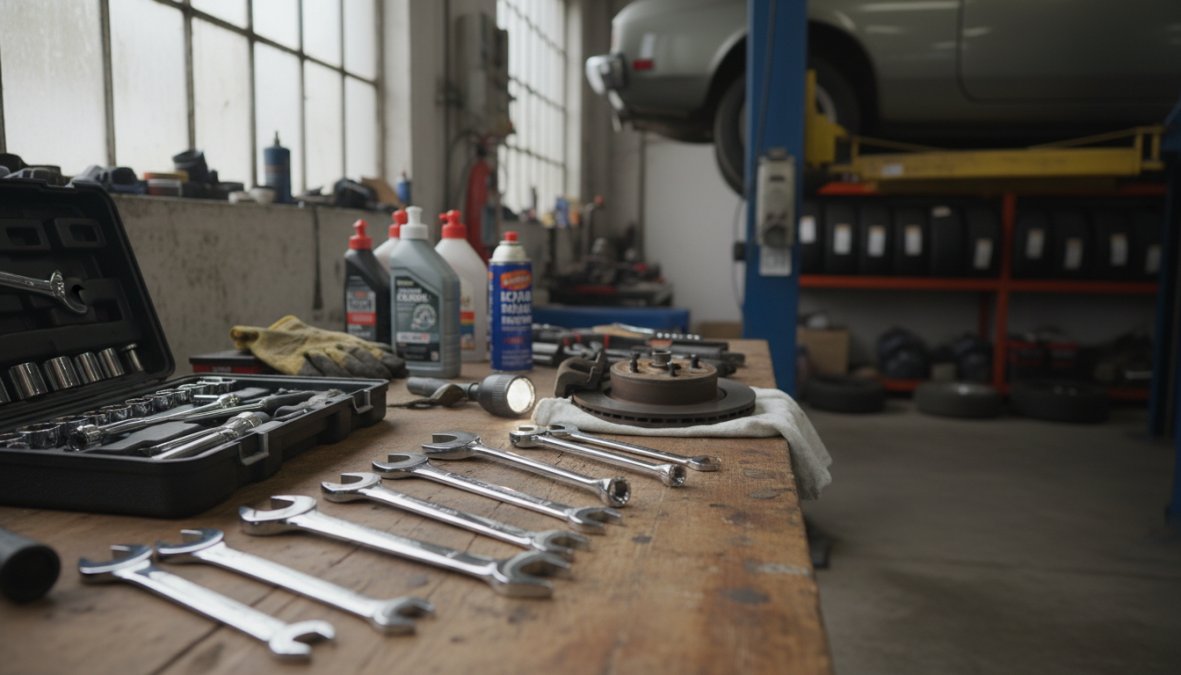
According to the Motor Ombudsman's guidance on finding approved garages, using a garage that subscribes to an approved code of practice provides an additional layer of consumer protection, including access to an alternative dispute resolution service if something goes wrong.
The thing nobody tells you about vetting a garage is that the most revealing test is how they handle your questions. A garage that answers questions about parts, qualifications, and estimates clearly and without defensiveness is almost always the better choice, regardless of other factors.
Is Independent Servicing Right for Your Vehicle's Age and Value?
The honest answer is: it depends on the vehicle, and the decision is more calculable than most guides admit. Below is a structured decision framework built around the three variables that actually drive the answer: warranty status, cumulative cost exposure, and resale value dynamics. Use this as a working tool, not a general guideline.
The Decision Matrix: Vehicle Age vs. Servicing Choice
Vehicle Age | Warranty Status | Recommended Approach | Key Reason |
|---|
0-2 years | Full manufacturer warranty active | Dealership or vetted independent | Warranty claims most likely; administrative simplicity has genuine value |
2-3 years | Manufacturer warranty active or expiring | Independent garage (with correct documentation) | Cost savings begin to compound; warranty rights fully protected if standards met |
3-5 years | Manufacturer warranty expired; extended warranty may apply | Independent garage | Labour rate gap delivers meaningful savings; no warranty risk if extended warranty terms allow |
5-8 years | All manufacturer coverage expired | Independent garage strongly preferred | Full cost benefit; dealer premium unjustifiable for most makes |
8+ years | No warranty coverage | Independent garage | Consistent, correctly-priced maintenance extends vehicle life more effectively than infrequent dealer visits |
Why the 2-3 Year Window Is the Most Important Decision Point
Most manufacturer warranties in the UK run for three years. The period between year two and year three is where the cost-benefit calculation shifts most decisively, and where drivers most often make the expensive mistake of staying with a dealership out of habit rather than necessity.
Consider a realistic example using the cost figures from earlier in this guide. A full service at a dealership costs approximately £180-£350. The same service at a reputable independent garage costs approximately £90-£200. On a vehicle serviced annually, the cumulative saving over years three through eight, six services, ranges from roughly £540 to over £900, before accounting for any additional repair work where labour rate differences are even more pronounced.
On a three-hour repair job, the labour rate gap between a dealership (£100-£200 per hour) and an independent garage (£60-£120 per hour) produces a saving of £120-£240 on that single job alone. Across a vehicle's out-of-warranty life, these figures accumulate into thousands of pounds.
The Warranty Trigger: What Actually Changes at the 3-Year Mark
The reason the 3-year mark matters is not just financial, it is structural. Once the manufacturer warranty expires, the primary argument for dealership servicing (administrative simplicity for warranty claims) disappears entirely. At that point, you are paying a dealership premium for brand association and waiting rooms, not for any legal or technical advantage.
If your vehicle has an extended warranty, either purchased separately or included by the manufacturer, check the approved repairer list before assuming independent servicing is covered. As noted in the warranty section of this guide, some third-party extended warranty products include clauses that restrict approved repairers. This is the one scenario where the 3-year rule does not automatically apply.
Watch OutIf you purchased an extended warranty as part of a finance agreement or dealer add-on, locate the full policy document and check Section 4 or the 'Conditions of Cover' section specifically for servicing requirements. Do not rely on verbal assurances from the selling dealer. The written terms are what bind the warranty provider.
High-Value and Specialist Vehicles: Where the Calculation Changes
For a small category of vehicles, the dealership service record adds demonstrable, quantifiable resale value that can justify the premium. This applies most clearly to:
Porsche: Full Porsche Centre service history is a recognised premium in the used market, particularly for 911 and Cayenne models, where buyers actively filter for it.
Ferrari and Lamborghini: Manufacturer service records are effectively a condition of the market at these price points.
Mercedes-Benz AMG and BMW M models: Full main dealer history commands a premium in the enthusiast market, though the gap is narrower than for the brands above.
Classic and appreciating vehicles: Where provenance documentation directly affects insurance valuation and auction estimates.
For the vast majority of vehicles on UK roads, mainstream family cars, SUVs, and light commercial vehicles from Ford, Vauxhall, Volkswagen, Toyota, Hyundai, and equivalent brands, a complete, correctly documented independent service history does not produce a lower sale price than a dealer history, provided the documentation is thorough and consistent.
The common mistake is assuming that a dealer stamp automatically signals quality to a buyer. What an informed buyer actually looks for is consistency of intervals, correct parts, and a traceable record. An independent garage that documents work properly delivers all three.
A Simple Decision Test
If you are unsure which route is right for your vehicle right now, apply this three-question test:
Is your vehicle within its original manufacturer warranty period? If yes, independent servicing is still legal and valid, but weigh the administrative simplicity of a single service record if you anticipate warranty claims.
Do you hold an extended warranty with a restricted approved repairer list? If yes, check the list before booking anywhere.
Is your vehicle a prestige or specialist model where manufacturer service history adds a documented resale premium? If yes, calculate whether that premium exceeds the cumulative cost saving over the remaining years you plan to own the vehicle.
If the answer to all three is no, the financial and practical case for independent servicing is clear.
Key TakeawayThe default assumption that dealership servicing is the 'safer' choice does not hold up once you apply specific numbers to specific vehicle ages. For most UK drivers with vehicles over three years old, independent servicing delivers equivalent quality at materially lower cost, with no legal disadvantage and no meaningful impact on resale value, provided the garage is reputable and the documentation is complete.
Conclusion: Making the Right Choice for Your Car and Budget
Choosing where to service your vehicle is a decision with real financial and legal consequences, and the default assumption that dealerships are the safer choice does not hold up to scrutiny. The benefits of independent car servicing are well-established: lower labour rates, transparent pricing, qualified technicians, access to OEM and quality aftermarket parts, and full legal protection of your manufacturer warranty.
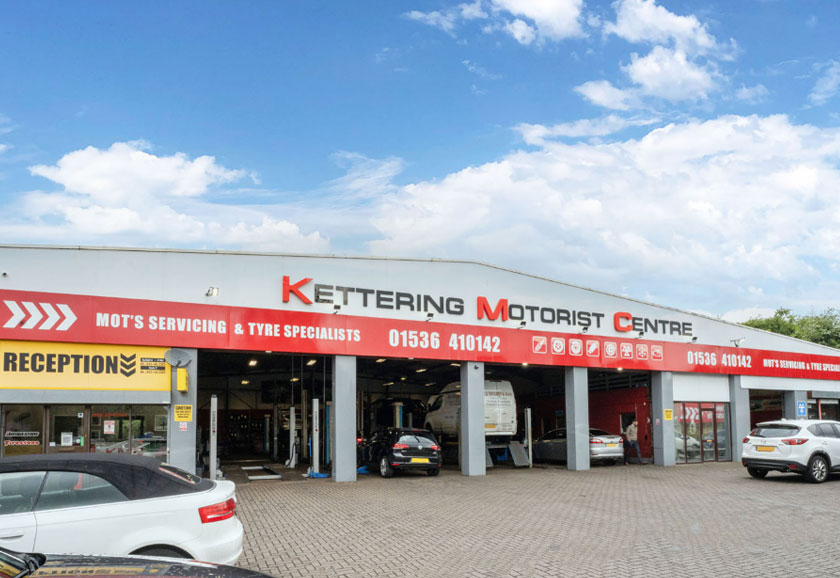
For drivers in Kettering and across Northamptonshire looking for a trusted independent repair facility, Kettering Motorist Centre offers expert diagnostic and repair services, specialist capability for electric and hybrid vehicles, and a transparent, hassle-free online booking system for MOT and tyre appointments with no upfront payment required. Book your MOT or next service through the straightforward online system and experience the difference that a genuinely customer-focused, family-run garage provides.
Frequently Asked Questions
Does independent car servicing affect my warranty?
No — under UK consumer law, having your car serviced at an independent garage will not void your manufacturer's warranty, provided the work is carried out to the manufacturer's standard and the correct parts are used. Manufacturers cannot legally require you to use their dealership for routine maintenance. Always ensure your independent garage stamps your logbook and keeps detailed service records to protect your warranty coverage.
Is independent car servicing cheaper than a main dealer?
In most cases, yes. Independent garages typically charge lower labour rates than dealership service departments and have more flexibility on parts sourcing. For common services such as an oil change, interim service, or brake replacement, the savings can be meaningful. The exact difference depends on your vehicle's make and model, the type of service required, and your location. Always request a written quote before committing to any repair facility.
What are the car service logbook requirements for an independent garage?
An independent garage must stamp and sign your vehicle's service logbook at each visit, recording the date, mileage, and work carried out. This maintains your full service history, which is important for warranty purposes and resale value. Many independent garages now also provide digital service records, which can be linked to vehicle history platforms. Always ask your garage to complete your logbook fully at every service interval.
Will independent servicing affect my car's resale value?
A complete, well-documented service history from a reputable independent garage is generally viewed positively by buyers and does not significantly reduce resale value compared to a dealer-stamped book. What matters most is consistency — regular servicing at the correct intervals, using quality OEM or equivalent parts, with clear records. Gaps in service history are far more damaging to resale value than the type of repair facility used.
Are independent garages as qualified as main dealers?
Many independent mechanics hold industry-recognised qualifications and have extensive experience across multiple makes and models. Reputable independent garages invest in professional diagnostic equipment and keep technicians up to date with technical service bulletins. When vetting an independent garage, look for accreditations, customer reviews, and transparency around parts and labour. A good independent repair facility can match dealership standards at a lower cost.