If you've ever turned on your car's climate control on a warm day and felt nothing but warm air blowing back at you, you already know how frustrating it is. The question of why is my car air conditioning not cold is one of the most common vehicle concerns drivers face, and the answer is rarely as simple as "it just needs a recharge." At Kettering Motorist Centre, we diagnose and fix AC faults regularly across Kettering, Northamptonshire, and the surrounding area, and we've seen every variation of this problem. Below, we'll show you exactly how to identify the cause, what it costs to fix, and when you genuinely need a professional.
The most important thing to understand upfront: a car AC system is a closed, pressurised loop. It does not consume refrigerant the way an engine consumes fuel. If your system is low on refrigerant, there is a leak somewhere. Ignoring that leak and simply recharging the system is a short-term fix that will fail again, often within weeks.
Why Is My Car Air Conditioning Not Cold? The Most Common Causes
Car air conditioning stops blowing cold for five primary reasons, and most of them are diagnosable before you spend a penny. Understanding which fault you're dealing with determines whether you can handle it yourself or need a trained mechanic.
Low or Leaking Refrigerant
The most frequent cause of warm air from a car AC is low refrigerant, almost always the result of a slow leak in the system. Modern vehicles use either R-134a or the newer R-1234yf refrigerant, depending on the year and make. Both are colourless gases that escape through degraded hoses, corroded fittings, or a failing compressor shaft seal.
A common mistake is assuming a recharge will solve the problem permanently. It won't, unless the leak is found and sealed first. Leak detection typically involves UV dye injection or electronic sniffers, and according to the UK government's guidance on vehicle refrigerant handling, only qualified technicians should handle refrigerant recovery and recharge under current F-Gas regulations.
Faulty AC Compressor or Clutch
The compressor is the heart of the AC system. It pressurises the refrigerant and drives it through the condenser and evaporator. When the compressor clutch fails to engage, the entire cooling cycle stops. You'll often hear a clicking or rattling noise from the front of the engine when this happens.
Compressor failure is more common in vehicles that sit unused for long periods, because the internal seals dry out without lubrication from the refrigerant oil. This is a particularly common pattern in older UK vehicles that only run their AC occasionally during summer.
Blocked Condenser or Cooling Fan Issues
The condenser sits at the front of the vehicle, usually just behind the grille, and it dissipates heat from the refrigerant. Debris, insects, and road grime can block airflow through the condenser fins over time. A blocked condenser means the refrigerant cannot release heat efficiently, so the system produces warm or lukewarm air instead of cold.
Cooling fan failure compounds this problem significantly. At low speeds or when stationary, the electric cooling fan is what pulls air through the condenser. If the fan motor fails or a fuse blows, the condenser overheats and system pressure spikes, sometimes triggering a safety cutout that shuts the AC down entirely.
Clogged Cabin Air Filter
This is the simplest fix and the one most drivers overlook. A blocked cabin air filter restricts airflow through the evaporator, which means even a perfectly functioning AC system will struggle to push cold air into the cabin. Many manufacturers recommend replacing the cabin filter every 12,000 to 15,000 miles, but plenty of vehicles arrive at workshops with filters that haven't been changed in years.
Pro TipBefore booking an AC diagnostic, check your cabin air filter first. On most vehicles it sits behind the glovebox and takes about ten minutes to replace. If it's grey and clogged, a new filter alone can restore noticeable airflow improvement.
Faulty Blend Door Actuator or Evaporator Problems
The blend door actuator controls the mix of hot and cold air entering the cabin through the climate control system. When it fails, the system may default to heat, producing warm air regardless of the temperature setting. This fault is often misdiagnosed as a refrigerant problem, leading drivers to pay for unnecessary recharges.
Evaporator issues are less common but more serious. The evaporator is the component inside the dashboard that actually cools the air. If it develops a leak or becomes coated in debris, cooling efficiency drops sharply. Evaporator replacement is labour-intensive because it typically requires removing the dashboard.
How Your Car AC System Works (And Why It Stops Cooling)
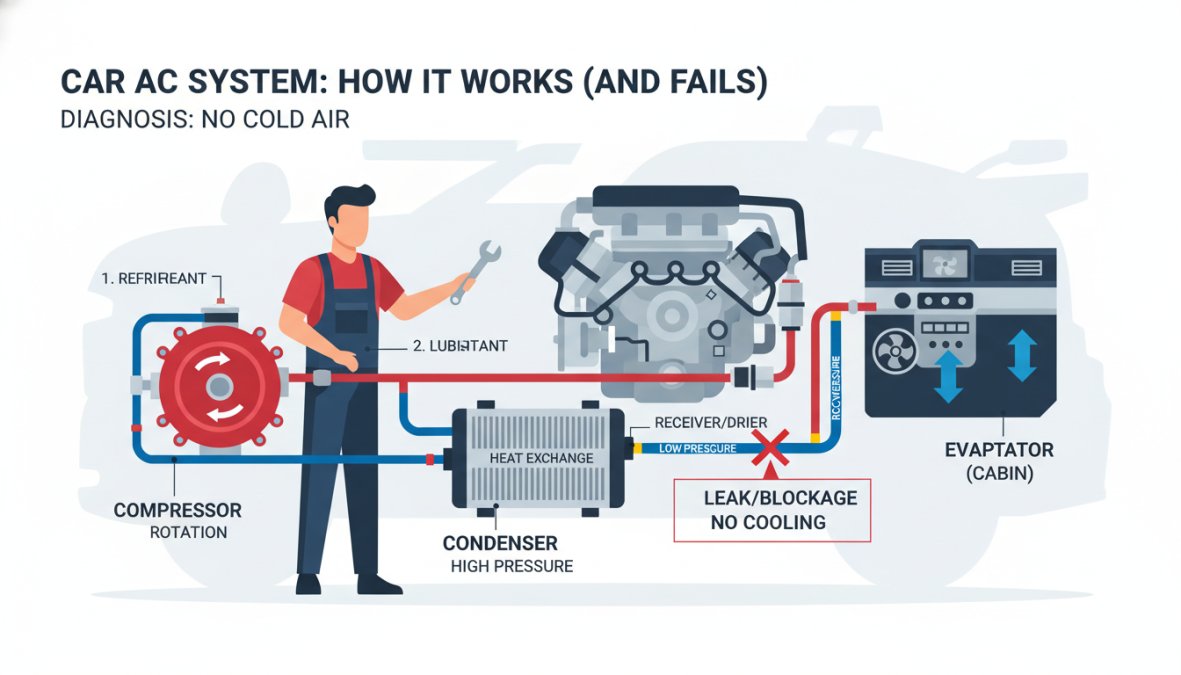
A car AC system is a closed refrigerant loop that transfers heat from inside the cabin to the outside air. The compressor pressurises the refrigerant gas and sends it to the condenser, where it releases heat and becomes liquid. That liquid passes through the thermal expansion valve (or orifice tube on older designs), which drops its pressure rapidly and causes it to cool dramatically. The cold refrigerant then flows through the evaporator inside the dashboard, absorbing heat from the cabin air. The blower fan pushes that now-cooled air through the ventilation system into the passenger compartment, and the cycle repeats.
Professional illustration showing why is my car air conditioning not cold
Every component in this chain must work correctly for cold air to reach you. But understanding which component is most likely to fail on your specific vehicle is where most generic guides stop short, and where real diagnostic value begins.
How Failure Patterns Differ by Vehicle Age
Not all AC faults are equally likely across the fleet. Vehicle age and design generation are among the strongest predictors of which component will fail first, and knowing this narrows your diagnosis before you touch a spanner.
Vehicles under 5 years old (post-2019 registration) Modern vehicles overwhelmingly use R-1234yf refrigerant and electronically controlled variable-displacement compressors. On these systems, the most common early failure is not mechanical, it is electrical. Blend door actuator faults, pressure sensor signal errors, and software-controlled compressor engagement issues account for a significant share of warm-air complaints on newer cars. The compressor may be physically intact but receiving an incorrect command from the climate control module. A fault code scan is the correct first step, not a pressure test.
Vehicles 5-10 years old (roughly 2014-2019 registration) This generation straddles the R-134a to R-1234yf transition. Many vehicles in this bracket still use R-134a. Condenser corrosion from road salt becomes a meaningful failure mode in UK conditions, particularly on vehicles where the condenser sits low and unprotected behind the front bumper. Refrigerant leaks from corroded condenser seams are common and often misattributed to hose or fitting failures. Inspect the condenser face carefully for white or greenish corrosion deposits around the inlet and outlet tanks.
Vehicles over 10 years old (pre-2014 registration) Older systems using R-134a and fixed-displacement compressors with a mechanical clutch show a different failure profile. Compressor clutch wear, shaft seal degradation from infrequent use, and expansion valve blockage from accumulated moisture and debris are the dominant faults. The receiver-drier, a small cylindrical canister in the high-pressure line that absorbs moisture, has a finite service life and is frequently overlooked. On vehicles in this age bracket that have never had AC work done, a saturated receiver-drier is often contributing to poor cooling even when refrigerant levels appear adequate.
The Blend Door Actuator: The Most Misdiagnosed AC Fault
The blend door actuator is a small electric motor that physically moves a flap inside the heater box to control the ratio of hot and cold air entering the cabin. When it fails, either mechanically seizing or losing its position signal, the climate control system can default to full heat, producing warm air regardless of what temperature you have selected.
This fault is routinely misdiagnosed as a refrigerant problem. Drivers pay for a recharge, the AC still blows warm, and the actual fault remains unfixed. The diagnostic tell is straightforward: if the AC compressor is engaging (the clutch disc is spinning with the pulley), refrigerant pressure is within range, and the system is still producing warm air, the fault is almost certainly in the air distribution side, blend door actuator, mode door actuator, or a failed temperature sensor feeding incorrect data to the climate module.
On many Ford, Vauxhall, and Volkswagen Group vehicles from the 2010s, blend door actuator failure is a known pattern. The actuator itself is often inexpensive, but access can require partial dashboard removal depending on the model.
Pro TipA quick test for blend door actuator failure: set the climate control to maximum cold, then switch to maximum hot, and listen for any clicking, grinding, or absence of the quiet whirring sound the actuator makes as it moves. No movement sound at all, combined with warm air on a cold setting, is a strong indicator the actuator has seized or lost power.
According to the Society of Motor Manufacturers and Traders guidance on vehicle maintenance, modern climate control systems are increasingly integrated with vehicle electronics, meaning faults can sometimes trigger warning codes rather than obvious mechanical symptoms. On vehicles with dual-zone or tri-zone climate control, individual zone actuators can fail independently, producing warm air on the driver's side while the passenger side remains cold, a symptom pattern that makes the fault easier to localise.
Signs of Low Freon in Your Car You Should Not Ignore
Low refrigerant produces a recognisable set of symptoms that differ from other AC faults. Catching these early prevents further damage to the compressor, which is the most expensive component in the system.
The key signs of low refrigerant include:
AC blows cool but not cold, particularly at low speeds or when idling
Visible ice or frost forming on the AC lines near the firewall
A hissing or bubbling noise from the dashboard area when the AC is running
The AC compressor clutch cycling on and off rapidly (short-cycling)
A faint sweet or chemical smell inside the cabin, which may indicate refrigerant escaping near the evaporator
Short-cycling is worth understanding specifically. When refrigerant is low, system pressure drops below the threshold required to keep the compressor clutch engaged. The clutch disengages, pressure rises slightly, the clutch re-engages, pressure drops again, and the cycle repeats rapidly. This constant cycling accelerates compressor wear and, left unchecked, leads to compressor failure.
Watch OutDo not ignore a sweet chemical smell from your vents. Refrigerant leaking near the evaporator can contaminate the cabin air. While modern refrigerants are not acutely toxic, prolonged exposure in an enclosed space is not advisable, and the leak will only worsen.
How to Troubleshoot Car AC: A Step-by-Step Visual Diagnostic Guide
Troubleshooting a car AC fault systematically saves time and money. Work through these steps in order before committing to any repair.
Step 1: Check the cabin air filter. Remove and inspect it. If it's visibly blocked, replace it and retest.
Step 2: Inspect the condenser. Look through the front grille. If the condenser fins are packed with debris, a careful clean with a low-pressure hose can restore airflow.
Step 3: Listen for the compressor clutch. Turn on the AC and open the bonnet. Watch the front of the compressor pulley. The centre disc (the clutch) should engage and spin with the pulley. If it doesn't engage at all, the issue is either low refrigerant pressure or a failed clutch.
Step 4: Check the cooling fans. With the AC running and the engine at operating temperature, both cooling fans should be running. A stationary fan points to a failed motor or a blown fuse.
Step 5: Look for oil stains on AC components. Refrigerant carries oil with it. Oily residue on hoses, line fittings, or around the compressor is a strong visual indicator of a refrigerant leak.
Step 6: Check for error codes. Many modern vehicles store AC-related fault codes in the ECU. A diagnostic scanner will reveal blend door actuator faults, pressure sensor errors, and fan control issues that aren't visible externally.
Step-by-step visual guide for car and mechanic and workshop concepts for why is my car air conditioning not cold
Visual Cues That Point to the Problem
Certain visual signs are highly specific to particular faults. Oil staining near the compressor shaft points to a shaft seal leak. Ice forming on the low-pressure line suggests either low refrigerant or a blocked expansion valve. A condenser with bent or crushed fins from road debris will show obvious physical damage. These cues narrow the diagnosis significantly before any pressure testing begins.
Safety Precautions Before Any DIY AC Work
This is the part most guides skip entirely. Refrigerant handling carries real risks that DIY mechanics should understand before attempting any work.
R-134a and R-1234yf are pressurised gases. Releasing them improperly can cause frostbite on contact with skin.
R-1234yf is mildly flammable. It should not be handled near ignition sources.
Venting refrigerant to atmosphere is illegal in the UK under F-Gas regulations. Refrigerant must be recovered using approved equipment by a certified technician.
DIY recharge cans sold at motor factors are a temporary measure at best. They cannot evacuate moisture from the system, and moisture in an AC system causes acid formation that corrodes components from the inside.
Always wear safety glasses when working near AC fittings. A pressurised line that separates unexpectedly releases refrigerant at high velocity.
Car AC recharge cost in the UK varies depending on the refrigerant type, the amount needed, and whether a leak test is included. A standard recharge service at a reputable garage typically includes evacuating the old refrigerant, checking system pressure, and refilling to the manufacturer's specification.
Vehicles requiring R-1234yf refrigerant cost noticeably more to recharge than older R-134a systems, because R-1234yf is significantly more expensive per kilogram. Most post-2017 vehicles use R-1234yf, so if you drive a newer car, factor this into your expectations.
Service
Typical UK Cost Range
Notes
AC recharge (R-134a)
£50 - £80
Older vehicles, pre-2017
AC recharge (R-1234yf)
£90 - £150
Most post-2017 vehicles
Leak detection (UV dye)
£30 - £60
Usually added to recharge
Full AC service with leak test
£100 - £200
Recommended approach
These are indicative ranges for the UK market in 2026. Prices in Kettering and Northamptonshire broadly align with these figures, though specialist independent garages typically offer better value than national chains for this type of work.
Car AC Compressor Replacement Cost and When You Need It
Compressor replacement is the most significant AC repair cost you're likely to face. The compressor itself is expensive, and fitting it requires evacuating the refrigerant, replacing the receiver-drier (mandatory when opening the system), and recharging with fresh refrigerant. But the decision of whether to replace the compressor, versus addressing a different fault entirely, is where many drivers spend money unnecessarily.
When Compressor Replacement Is the Right Decision
Not every compressor symptom means the compressor needs replacing. Work through this decision framework before authorising the repair:
Replace the compressor if:
The compressor is making a grinding, knocking, or rattling noise that changes with engine speed. This indicates internal bearing or piston failure.
The clutch is seized, the pulley has stopped spinning entirely, which will also cause the drive belt to fail.
Metal debris or black contamination is visible in the refrigerant oil when the system is opened. This means internal components have shed material into the refrigerant loop, requiring a full system flush before any new compressor will survive.
The compressor body is visibly cracked or oil-soaked from a catastrophic shaft seal failure.
Do not replace the compressor if:
The clutch is simply not engaging but the compressor spins freely when turned by hand. This points to low refrigerant pressure (a safety cutout preventing engagement), a failed clutch coil, or a wiring fault, all of which are far cheaper to address.
The system blows warm but the compressor runs quietly and smoothly. The fault is elsewhere: expansion valve, condenser, blend door, or refrigerant level.
A fault code points to a pressure sensor or clutch relay rather than the compressor itself.
Watch OutFitting a new compressor into a contaminated system without flushing the condenser, evaporator, and lines will destroy the new compressor within weeks. Metal particles from a failed compressor circulate through the entire refrigerant loop. Flushing is not optional, it is the difference between a lasting repair and an expensive repeat failure.
Compressor Failure Patterns by Vehicle Type
Certain vehicles show compressor failure patterns that are worth knowing before you book a diagnostic:
High-mileage vehicles used primarily for short urban journeys are disproportionately represented in compressor failures. Short trips mean the engine rarely reaches full operating temperature, and the AC is often switched off in cooler months. Without regular refrigerant circulation, the compressor's internal lubrication, carried by the refrigerant oil, is not distributed across the shaft seals and pistons. Seals dry out, and the first time the AC is switched on after a long dormant period, the compressor runs briefly without adequate lubrication. Running the AC for at least ten minutes every few weeks, even in winter, is the single most effective way to extend compressor life.
Vehicles with belt-driven compressors where the clutch has been slipping often show accelerated wear on the clutch friction disc before the compressor internals fail. On these vehicles, replacing the clutch assembly alone, rather than the whole compressor, is sometimes viable if the compressor body is confirmed to be sound. A qualified technician can assess this, but it requires opening the system regardless.
Electric and hybrid vehicles use an electrically driven compressor that runs independently of the engine. These compressors use a specific PAG oil grade that is incompatible with conventional AC system oils. Mixing oil types during a service is a known cause of premature failure on hybrid AC systems. If you drive a hybrid or EV, confirm that any garage servicing your AC is familiar with the correct oil specification for your vehicle.
What the Repair Actually Involves
A proper compressor replacement is not a single-component swap. The sequence a competent garage should follow:
Recover existing refrigerant using certified equipment (legally required under F-Gas regulations)
Remove the failed compressor and inspect the refrigerant oil for contamination
If contamination is present, flush the condenser, evaporator, and all lines
Fit the new compressor with the correct PAG oil pre-charge for the vehicle specification
Replace the receiver-drier or accumulator (mandatory, opening the system exposes the desiccant to moisture)
Replace the expansion valve if it shows signs of blockage or debris ingestion
Evacuate the system to remove moisture and non-condensable gases
Recharge to the manufacturer's specified weight of refrigerant
Pressure test and verify system operation under load
Skipping steps 3, 5, or 7 is a common shortcut that leads to repeat failures. When comparing quotes, ask specifically whether the receiver-drier is included and whether a system evacuation (vacuum pull-down) is part of the process. A quote that omits these is not a like-for-like comparison.
Compressor Replacement Cost in the UK (2026)
Vehicle Category
Typical UK Cost Range
Key Variable
Small/medium petrol (e.g., Ford Focus, Vauxhall Astra)
£400 - £650
Compressor accessibility
Larger petrol/diesel (e.g., BMW 3 Series, VW Passat)
£550 - £850
OEM vs. aftermarket compressor
SUV or 4x4
£600 - £950
Refrigerant volume, labour time
Hybrid or electric vehicle
£700 - £1,200+
Specialist compressor type, oil spec
System flush required (contamination)
Add £150 - £300
Depends on system complexity
These ranges reflect parts and labour at independent UK garages in 2026. Main dealer pricing typically sits 20-40% above independent rates for the same work. Vehicles requiring R-1234yf refrigerant add to the recharge cost at the end of the job, as noted in the recharge cost section above.
Key TakeawayThe compressor is the most expensive AC component to replace, but it is also the most frequently misidentified fault. Confirm the compressor is genuinely the failed component, not a clutch coil, a pressure sensor, or a refrigerant level issue, before authorising replacement. A proper diagnostic with pressure gauges and a fault code scan costs far less than an unnecessary compressor.
Why Is My Car Air Conditioning Not Cold After a Recharge?
This is a question that genuinely frustrates drivers, and the answer points to something the recharge process itself cannot fix. If your car air conditioning is still not cold after a recharge, one of three things has happened.
First, the underlying leak was not addressed. Refrigerant has escaped again, often within days or weeks of the recharge. Second, a component fault, such as a failing compressor, a blocked expansion valve, or a faulty blend door actuator, is preventing the system from using the refrigerant correctly. Third, the recharge was performed without properly evacuating the system first, leaving moisture inside that is now reducing efficiency and causing internal corrosion.
The diagnostic checklist here is short: check system pressure with gauges, inspect for leaks, and scan for fault codes. If the pressure is correct but the air is still warm, the fault lies in a mechanical or electrical component rather than the refrigerant level. A proper AC diagnostic, not just a recharge, is what the situation requires.
Key TakeawayA recharge treats the symptom, not the cause. If your AC fails again within a season of being recharged, the system has a leak that needs finding and sealing before the next recharge will hold.
Get Your Car AC Fixed in Kettering, Northamptonshire
For drivers near Kettering looking for reliable AC diagnosis and repair, the difference between a garage that just recharges and one that actually diagnoses the fault is significant. A recharge without a leak test is money spent on a temporary fix.
Kettering Motorist Centre provides full AC diagnostic and repair services for all vehicle types, including specialist work on electric and hybrid vehicles where the AC system operates differently from conventional combustion engines. The team uses proper refrigerant recovery equipment, pressure testing, and electronic diagnostics to identify the actual fault before recommending any repair.
Booking is straightforward through the hassle-free online system, with no upfront payment required. For drivers in Kettering, Northamptonshire, and the surrounding villages, this is a transparent and convenient way to get a genuine diagnosis rather than a guess.
Frequently Asked Questions
How do I know if my car AC needs refrigerant?
The most common signs of low refrigerant include the AC blowing warm or only slightly cool air, the compressor not engaging, hissing or bubbling noises from the dashboard, and visible ice forming on the AC lines. You may also notice the climate control taking much longer than usual to cool the cabin. If you spot any of these signs, it is worth having the system pressure-tested by a qualified mechanic before booking an AC recharge.
What are the signs of a failing car AC compressor?
A failing AC compressor often makes a loud grinding, rattling, or squealing noise when the AC is switched on. You may notice the clutch is not engaging, the AC only blows warm air, or the system cycles on and off rapidly. In some cases, refrigerant leaks around the compressor body are visible. Compressor failure is one of the more serious reasons why your car air conditioning is not cold and usually requires professional diagnosis and replacement.
How much does a car AC recharge cost in the UK?
Car AC recharge costs in the UK typically vary depending on the refrigerant type your vehicle uses. Older vehicles use R-134a refrigerant, while many cars manufactured after 2017 use R-1234yf, which tends to cost more. Prices can also vary by garage and region. It is always worth getting a diagnostic check first to confirm a refrigerant top-up will actually resolve the problem, rather than masking a leak or another underlying fault.
Can I recharge my car AC myself at home?
DIY AC recharge kits are available for purchase, but they come with important limitations and safety considerations. Refrigerants like R-134a and R-1234yf are pressurised chemicals that can cause frostbite or eye injury if mishandled. DIY kits also cannot detect leaks or diagnose compressor faults, so they may only temporarily mask a bigger problem. For accurate diagnosis and safe handling, having your car AC serviced by a qualified mechanic is strongly recommended.
Is it safe to drive with a broken car AC?
Driving with a non-functional AC is generally safe in mild weather, but it can become a comfort and safety issue in hot conditions, particularly on long journeys. A faulty AC can also affect windscreen demisting in wet weather, which is a genuine safety concern. Additionally, leaving AC faults unresolved can allow small leaks or minor component failures to develop into more costly repairs over time, so prompt diagnosis is advisable.
How often should car AC be serviced?
Most manufacturers and mechanics recommend having your car AC system serviced every two years. Over time, AC systems naturally lose a small amount of refrigerant even without a specific leak, and seals can degrade. Regular servicing includes checking pressure levels, inspecting hoses and lines for wear, testing the compressor and condenser, and replacing the cabin air filter if needed. Routine maintenance helps prevent the system from blowing warm air unexpectedly.
Your booking Failed
Please try again or please call 01536 410142
Thank you for placing a booking with Kettering Motorist Centre Limited for vehicle
PLEASE TAKE YOUR BOOKING REFERENCE NUMBER WITH YOU TO THE MOT CENTRE
Your items
MOT Test
×
Terms and Conditions
These terms and conditions form the basis on which you can visit and use this website. Please read them carefully as they contain important information.
General terms and conditions
This website is owned and operated by Kettering Motorist Centre Ltd (company registration number: 4485858) operating at Trafalgar Road, Kettering, Northamptonshire, NN16 8DB (the "MOT Centre", the "Company", "we" or "us"). If you have any queries about these terms and conditions or if you have any comments or complaints on or about this website, you can contact us at [email protected] or 01536 410142.
The website is to promote and offer for sale the products and services of Kettering Motorist Centre Limited.
1. The contract between us
This website does not take payment for products or services online. The website enables you to view products and services online and to make a booking for later delivery and payment. The vehicle and provision of other products and services promoted by this website and the payment by you of the price of those products and services will take place at the MOT Centre. The booking does not constitute a contract.
The booking process on the site provides details of the booked MOT order. Please take the time to read and check your booking. It is your responsibility to make sure the order is correct and for the correct vehicle.
2. Ownership of rights
All rights, including copyright, in this website are owned by or licensed to the Company. Any use of this website or its contents, including copying or storing it or them in whole or part, other than for your own personal, non commercial use, is prohibited without our permission. You may not modify, distribute or repost anything on this website for any purpose.
3. Accuracy of content
We have taken care in the preparation of the content of this website, in particular to ensure that prices quoted are correct at the time of publishing and that all goods have been fairly described. However, bookings will only be accepted if there are no material errors in the description of the goods or their prices as advertised on this website. Any weights, dimensions and capacities given about the goods are approximate only.
4. Damage to your computer
We try to ensure that this website is free from viruses or defects. However, we cannot guarantee that your use of this website or any websites accessible through it will not cause damage to your computer. It is your responsibility to ensure that the right equipment is available to use the website. Except in the case of negligence on our part, we will not be liable to any person for any loss or damage which may arise to computer equipment as a result of using this website.
5. Availability
All bookings are subject to acceptance and availability. If the MOT date you have requested are is not available, the Centre will contact you by e-mail or phone. You will have the option either to wait until another slot is available or to cancel your booking.
6. Booking errors
You are able to correct errors on your booking up to the point on which you click on “Place Booking” during the booking process.
7. Price
The prices payable for goods that you order are as set out in our website. All prices are inclusive of VAT at the current rates and are correct at the time of entering information, errors and omissions excepted.
Whenever it is not possible to accept your booking to buy goods of the specification and description at the price indicated, the MOT Centre will advise you by email or phone or when you visit the centre.
8. Payment terms
You will be required to pay for the goods or services to the Centre at time of a completed MOT.
9. Delivery charges
N/A
10. Cancellation
The MOT Centre reserves the right to cancel the booking if:
10.1 There is insufficient stock to deliver the goods you have booked.
10.2 One or more of the goods you booked was listed at an incorrect price.
If your booking is cancelled the Centre will notify you by e-mail or phone.
You have the right to cancel your booking at any time up to the point of the MOT. If you do cancel your booking you should inform the centre by phone.
11. Liability
Notwithstanding the foregoing, nothing in these terms and conditions is intended to limit any rights you might have as a consumer under applicable local law or other statutory rights that may not be excluded nor in any way to exclude or limit our liability to you for any death or personal injury resulting from our negligence.
12. Notices
Unless otherwise expressly stated in these terms and conditions, all notices from you to us must be in writing and sent to our contact address given above and all notices from us to you will be displayed on our website from time to time.
13. Changes to legal notices
We reserve the right to change these terms and conditions from time to time and you should look through them as often as possible.
14. Law, jurisdiction and language
This website, any content contained therein and any contract brought into being as a result of usage of this website are governed by and construed in accordance with English law. Parties to any such contract agree to submit to the exclusive jurisdiction of the courts of England and Wales.
15. Invalidity
If any part of these terms and conditions is unenforceable (including any provision in which we exclude our liability to you) the enforceability of any other part of these conditions will not be affected.
16. Privacy
You acknowledge and agree to be bound by the terms of our privacy policy
17. Third party rights
Nothing in this Agreement is intended to, nor shall it confer any rights on a third party.