8 Signs Your Car Needs New Tyres (And What to Do Next)
Knowing the signs your car needs new tyres could be the difference between a safe journey and a dangerous blowout on the A14. At Kettering Motorist Centre, we see vehicles every week where worn or damaged tyres have gone unnoticed far too long. The good news: most tyre problems are visible to the naked eye if you know what to look for.
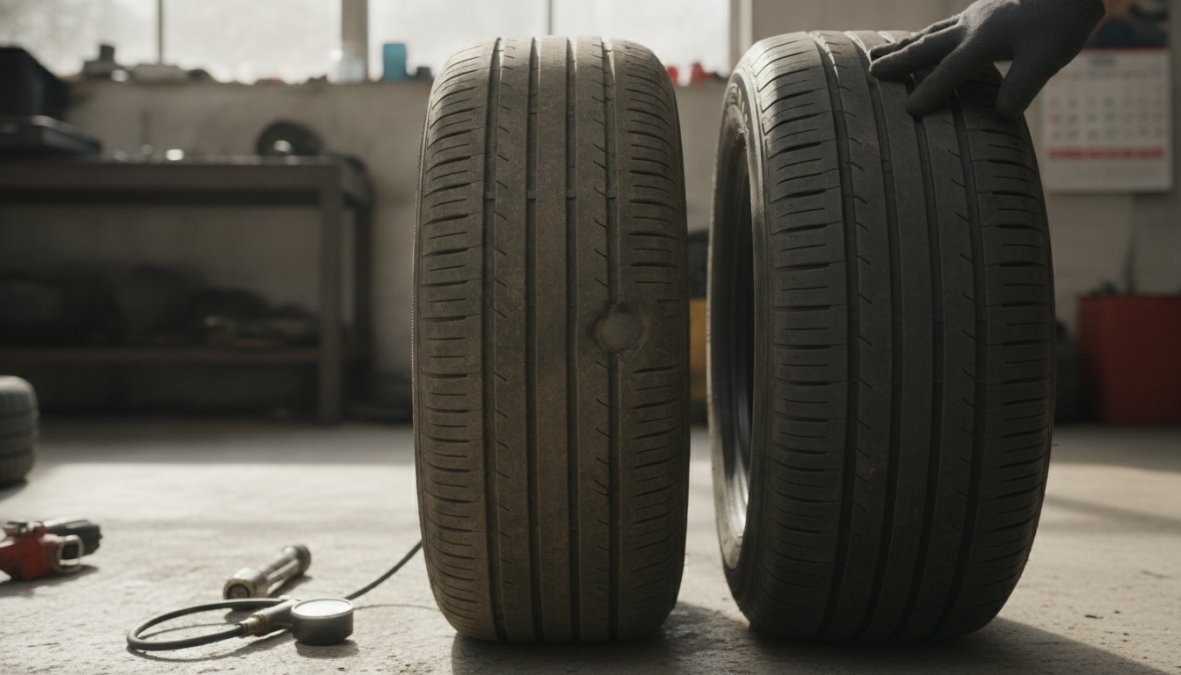
Close-up photograph of a badly worn car tyre on a concrete garage floor, showing tread wear bars completely flush with the tyre surface and shallow, almost smooth tread grooves under bright workshop lighting
1. Tread Depth Below the Legal Minimum
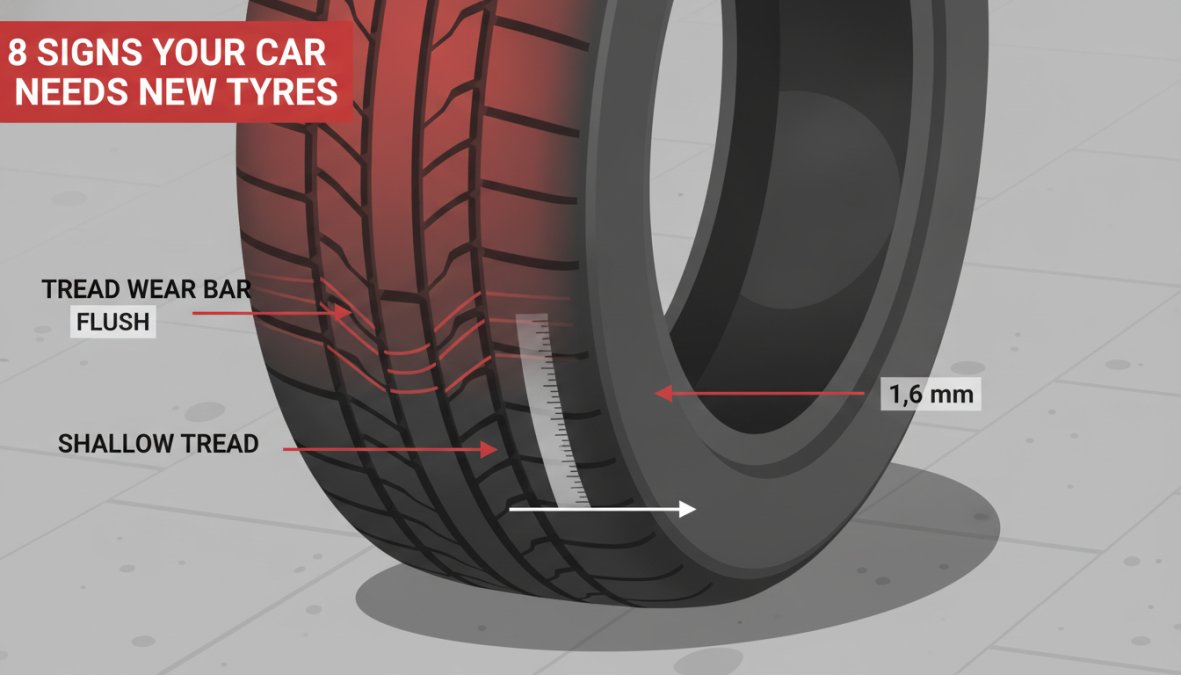
The legal minimum tread depth in the UK is 1.6mm across the central three-quarters of the tyre's width. Below that limit, the tyre's ability to channel water away from the contact patch collapses, dramatically increasing the risk of hydroplaning. Safety experts recommend replacing tyres at 3mm rather than waiting for the legal limit, because stopping distance increases sharply through that final millimetre.
2. Visible Tread Wear Bars Are Flush with the Tyre Surface
Tread wear bars are small raised rubber bridges moulded into the tyre groove at 1.6mm depth. When they become flush with the surrounding tread surface, the tyre has reached the legal minimum and must be replaced immediately. Run your finger across the tread grooves, if the wear bars are level with the tread blocks, you're at or past the limit.
3. Cracks, Dry Rot, or Hardened Rubber on the Sidewall
Rubber degrades over time even when tread remains. Dry rot produces a network of fine cracks on the sidewall or between tread blocks, caused by UV exposure, ozone, and natural breakdown of rubber compounds. A tyre affected by dry rot has lost structural integrity and is far more likely to blow out at motorway speeds. If you see cracking or a hardened surface texture, replace the tyre regardless of tread depth.
4. Bulges, Protrusions, or Cuts in the Sidewall
A bulge in the sidewall means the internal structure has been compromised, usually after a pothole or kerb strike, and the outer rubber is holding pressure the internal cords can no longer contain. This is not a "monitor it" situation. A bulging tyre can fail without warning, and cuts that expose structural cords carry the same risk.
5. Uneven or Irregular Wear Patterns Across the Tread
Uneven tyre wear signals an underlying mechanical problem. Centre wear points to over-inflation; edge wear on both shoulders suggests under-inflation; one-sided wear typically indicates a wheel alignment problem; cupping or scalloping usually signals worn suspension components. Fitting a new tyre without addressing the root cause means the replacement will wear out just as quickly.
6. Persistent Tyre Pressure Loss or Inflation Problems
A tyre that consistently loses pressure has a problem, slow puncture, damaged valve stem, or corroded rim. Driving under-inflated generates excessive heat, accelerates shoulder wear, and increases blowout risk. If one tyre repeatedly needs topping up, have it inspected rather than just inflating it again.
7. Vibration, Pulling, or Reduced Road Grip While Driving
Vibration through the steering wheel at motorway speeds often indicates internal tyre damage or lost balance. A car that pulls to one side suggests uneven wear or a wheel alignment issue. Reduced grip in wet conditions means tread depth has fallen to the point where the tyre can no longer channel water effectively, hydroplaning becomes a real risk.
8. Impact Damage from Potholes or Kerb Strikes
A single pothole or kerb strike can cause damage that isn't immediately visible. After any significant impact, inspect the tyre and wheel for bulges, cracks, or cuts, and check whether the rim has been bent or cracked. Northamptonshire roads take a heavy toll on tyres, make a habit of checking after any hard impact, not just when you notice a handling change.
What Is the Minimum Tyre Tread Depth in the UK?
The minimum legal tyre tread depth in the UK is 1.6mm, measured across the central three-quarters of the tyre's width and around its entire circumference. Driving below this limit carries a fine of up to £2,500 and three penalty points per tyre, as outlined in UK tyre law and legal tread depth requirements.
The 2/32 Inch (1.6mm) Legal Limit Explained
The 1.6mm legal limit corresponds to 2/32 of an inch. At this depth, tread wear bars become flush with the tyre surface, giving you a built-in visual indicator. The problem with treating 1.6mm as your target rather than your absolute floor is the safety margin it leaves, wet-weather stopping distances increase significantly as tread wears from 3mm down to 1.6mm, so by the time you reach the legal limit, performance in rain has already deteriorated substantially.
Why Safety Experts Recommend Replacing at 3mm (4/32 Inch)
The 3mm recommendation exists because traction loss is not linear. The performance difference between 3mm and 1.6mm is far greater than between 8mm and 6mm. According to TyreSafe tyre safety guidance and stopping distance research, replacing at 3mm rather than 1.6mm can reduce wet-weather stopping distances by a meaningful margin, critical in the UK, where rain is a near-constant factor.
Watch OutTreating 1.6mm as your replacement target rather than your legal floor is a common mistake. By the time a tyre reaches the legal minimum, its wet-weather performance has already been compromised significantly. Replace at 3mm.
How to Check Tyre Tread with a Coin: Step-by-Step
The UK 20p coin test is a quick, no-tools method any driver can perform in under two minutes. The outer band of a 20p coin measures approximately 2mm, giving you a practical safety check above the legal minimum.
The 20p Coin Test (UK Method)
Total time: 2 minutes per tyre
Take a 20p coin and insert it into the main tread groove of the tyre.
If the outer band of the coin disappears into the groove, your tread depth is above 2mm and likely legal.
If the outer band remains visible, your tread depth is at or below 2mm. The tyre needs professional inspection immediately.
Repeat in at least three positions across the tyre width: centre, inner shoulder, and outer shoulder.
Check multiple grooves around the circumference to catch uneven wear patterns.
The 20p test confirms whether you're above or below roughly 2mm, but doesn't give a precise reading.
Using a Digital Tread Depth Gauge for Greater Accuracy
For precise measurement, a dedicated gauge is the right tool. The Sealey Digital Tyre Tread Depth Gauge provides instant digital readings in metric and imperial, measuring to a fraction of a millimetre. The GODESON Smart Colour Coded Tread Depth Gauge offers a simpler alternative, a colour-coded system (green, yellow, red) that gives immediate visual safety status without interpreting a number, at around £6-8.
Pro TipCheck tread depth at multiple points across the tyre width, not just in the centre groove. Many tyres wear unevenly across the shoulder, and a centre-only check can give a falsely reassuring reading.
Causes of Uneven Tyre Wear and What They Tell You
Uneven tyre wear is one of the most informative signs your car needs attention beyond just new rubber. The pattern of wear tells you precisely what mechanical problem is causing it.
Centre Wear vs Edge Wear: Tyre Pressure as the Culprit
Centre wear, where the middle of the tread wears faster than the shoulders, is a direct result of over-inflation. An over-inflated tyre bulges in the centre, concentrating contact on a narrow band. Edge wear on both shoulders simultaneously points to chronic under-inflation: the tyre sags, shifting the contact patch to the outer edges and generating excess heat that accelerates degradation. Both are fixed by correcting inflation to the vehicle manufacturer's specification.
One-Sided Wear and the Role of Wheel Alignment
One-sided wear, where one shoulder wears significantly faster than the other, is almost always caused by a wheel alignment problem. The tyre runs at an angle to the direction of travel, scrubbing rubber off one edge continuously. Fitting a new tyre without correcting the alignment is a waste of money, the replacement will develop the same wear pattern within a few thousand miles.
Cupping and Scalloping: Suspension and Rotation Issues
Cupping or scalloping, a wavy, irregular wear pattern, typically indicates worn shock absorbers or struts causing the tyre to bounce rather than maintain consistent road contact. It can also result from a tyre that has never been rotated. Regular tyre rotation every 6,000-8,000 miles distributes wear evenly and extends service life.
When to Replace Tyres by Age, Not Just Tread Depth
Tyre age is one of the most overlooked signs your car needs new tyres. A tyre with 4mm of tread that is ten years old is not a safe tyre. Rubber compounds degrade through oxidation regardless of use, resulting in hardened, less flexible rubber that cracks under stress and loses road grip.
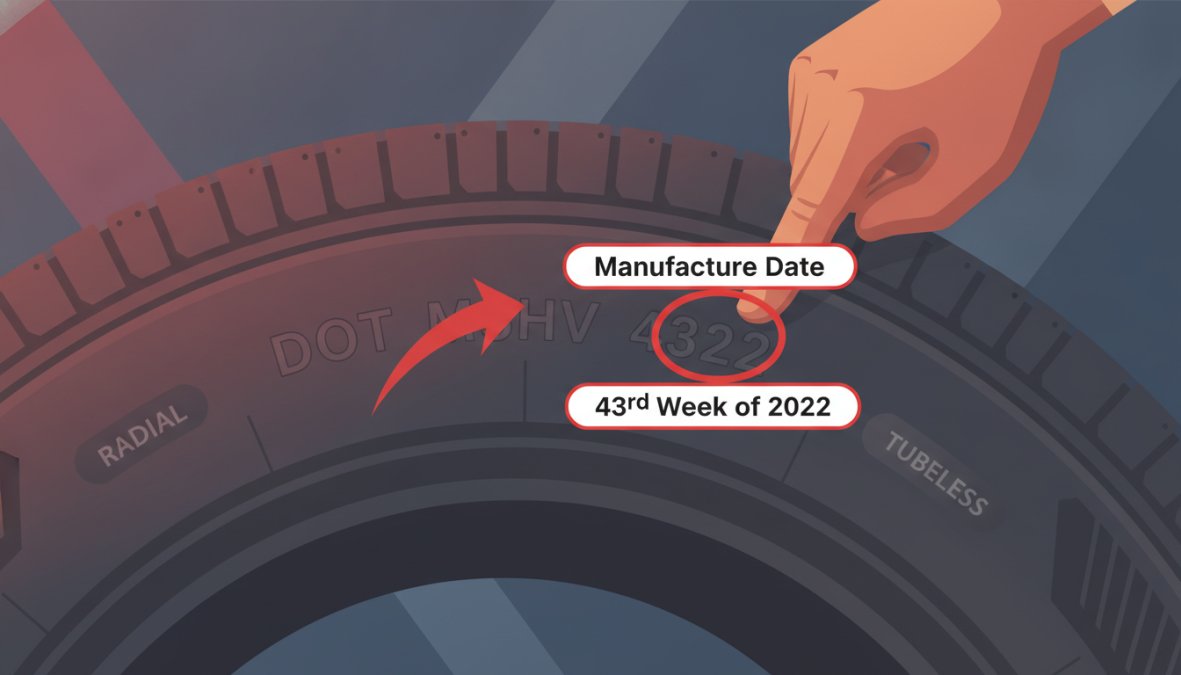
Close-up photograph of a car tyre sidewall showing the DOT code stamped into the rubber, with a mechanic's finger pointing to the four-digit week and year code under bright workshop lighting
Most tyre manufacturers and safety organisations recommend replacing tyres at ten years from manufacture, with inspection from five years onwards. According to NHTSA guidance on tyre age and replacement recommendations, age-related degradation can occur even in tyres that appear to have adequate tread depth.
How to Find Your Tyre's DOT Manufacture Date
Every tyre has a DOT code moulded into the sidewall. The last four digits tell you the week and year of manufacture, a tyre stamped "2318" was made in the 23rd week of 2018. If your tyres are approaching or past the ten-year mark, replace them regardless of tread depth.
Age Limits for Electric, Hybrid, and High-Mileage Vehicles
Electric and hybrid vehicles place higher demands on tyres due to greater kerb weight and instant torque delivery, causing faster wear than equivalent petrol or diesel vehicles. At Kettering Motorist Centre, we offer specialist tyre inspection and replacement services for EVs and hybrids. If you drive one in the Kettering area, factor in more frequent tyre checks as part of your maintenance routine.
Repair or Replace? A Practical Cost-Benefit Guide
Not every tyre problem requires replacement. Understanding when a repair is appropriate saves money without compromising safety.
Situation
Repair or Replace?
Notes
Puncture in central tread, nail or screw
Repair (plug/patch)
Must be within repairable zone
Puncture within 25mm of sidewall
Replace
Sidewall repairs are not safe
Sidewall bulge or cut
Replace immediately
Structural integrity compromised
Tread depth at or below 1.6mm
Replace
Legal minimum reached
Tread depth between 1.6mm and 3mm
Replace soon
Safety performance significantly reduced
Dry rot or cracking
Replace
Age-related degradation, not repairable
Impact damage (pothole)
Inspect, then decide
Internal damage may not be visible
The cost of replacing a tyre is always lower than the cost of a blowout, a collision, or a roadside callout. The decision should be driven by the location and nature of the damage, not the cost difference.
Key TakeawayA puncture in the central tread zone can often be safely repaired. Any damage to the sidewall, any bulge, and any tyre at or below 3mm tread depth should be replaced, not patched.
How to Stay on Top of Tyre Maintenance Between Checks
A monthly five-minute check covers the majority of failure modes.
Monthly tyre check routine:
Check tyre pressure on all four tyres (including the spare) when cold
Run the 20p coin test across the central tread and both shoulders
Visually inspect sidewalls for cracks, bulges, cuts, or embedded objects
Look for uneven wear patterns across the tread width
Check the DOT date on any tyre approaching five years of age
Have wheel alignment inspected whenever you notice pulling or uneven wear, and after any significant pothole or kerb impact. Tyre rotation every 6,000-8,000 miles extends service life and ensures even wear across all four tyres.
The TyreSafe Tyre Safety Companion App offers free push notifications for maintenance reminders and guides on tread depth and pressure checks. For real-time monitoring, the TyreMate Pro provides continuous pressure and temperature data while driving, with instant alerts for leaks or abnormal temperature, particularly useful for high-mileage drivers covering long motorway journeys.
Conclusion: Don't Ignore the Signs Your Car Needs New Tyres
Recognising the signs your car needs new tyres early is straightforward once you know what to look for. The eight warning signs covered here, from tread depth and wear bars to sidewall damage and age-related dry rot, give you a complete picture of tyre health that goes well beyond a quick visual glance. The cost of ignoring these signs is always higher than the cost of acting on them.
Frequently Asked Questions
How do I know if my tyres need replacing?
There are several signs your car needs new tyres: tread depth below 1.6mm (the UK legal minimum), visible tread wear bars flush with the tyre surface, cracks or bulges on the sidewall, uneven wear patterns, and persistent tyre pressure loss. You should also consider age, tyres older than five to seven years may need replacing even if the tread looks acceptable. A visual inspection every month and a proper tread depth check every few weeks is good practice.
What is the legal tyre tread depth in the UK?
The minimum tyre tread depth in the UK is 1.6mm (approximately 2/32 inch) across the central three-quarters of the tyre, measured around the full circumference. Driving on tyres below this limit is illegal and can result in a fine of up to £2,500 and three penalty points per tyre. However, many safety organisations recommend replacing tyres at 3mm, as stopping distances increase significantly once tread depth falls below this level, particularly in wet conditions.
What are the main causes of uneven tyre wear?
The most common causes of uneven tyre wear include incorrect tyre pressure (over- or under-inflation), poor wheel alignment, worn or damaged suspension components, and infrequent tyre rotation. Centre wear typically indicates over-inflation, while edge wear points to under-inflation. One-sided wear usually signals an alignment problem. Cupping or scalloping patterns often suggest suspension issues. Identifying the root cause is important, replacing tyres without fixing the underlying problem means the new tyres will wear unevenly too.
How often should you replace car tyres by age?
Most tyre manufacturers and safety bodies recommend replacing tyres every five to seven years regardless of tread depth, as rubber flexibility degrades over time even if the tyre looks fine. You can find your tyre's manufacture date on the sidewall, look for the four-digit DOT code where the first two digits are the week and the last two are the year. Electric and hybrid vehicles, which are heavier, may need earlier replacement due to accelerated tread wear.
Can you drive with worn tyres, and what are the risks?
Driving on worn tyres is both illegal and dangerous. Below the 1.6mm legal limit, tyres lose significant traction, especially in wet weather, dramatically increasing stopping distances and the risk of hydroplaning. Worn tyres are also more vulnerable to blowouts. Even tyres approaching the limit but not yet illegal carry real safety risks. NHTSA data and UK road safety research consistently link tyre condition to accident rates, making timely tyre replacement one of the most important vehicle safety actions a driver can take.
How do I check tyre tread depth with a coin?
The easiest UK method is the 20p coin test. Insert a 20p coin into the main tread groove of your tyre. If the outer band of the coin is hidden, your tread is above 1.6mm and likely legal. If the band is visible, your tread is too shallow and the tyre should be replaced. Check multiple points around the tyre and across its width. For greater accuracy, a digital tread depth gauge, available for around £10-£15, gives a precise reading in millimetres and is more reliable than the coin method alone.
If you're unsure about the condition of your tyres, or if any of the signs above apply to your vehicle, the team at Kettering Motorist Centre is here to help. We serve drivers across Kettering, Northamptonshire and the surrounding areas, with expert diagnostic and tyre services backed by a hassle-free online booking system that requires no upfront payment. Book your tyre inspection or MOT online today and drive with confidence.
Your booking Failed
Please try again or please call 01536 410142
Thank you for placing a booking with Kettering Motorist Centre Limited for vehicle
PLEASE TAKE YOUR BOOKING REFERENCE NUMBER WITH YOU TO THE MOT CENTRE
Your items
MOT Test
×
Terms and Conditions
These terms and conditions form the basis on which you can visit and use this website. Please read them carefully as they contain important information.
General terms and conditions
This website is owned and operated by Kettering Motorist Centre Ltd (company registration number: 4485858) operating at Trafalgar Road, Kettering, Northamptonshire, NN16 8DB (the "MOT Centre", the "Company", "we" or "us"). If you have any queries about these terms and conditions or if you have any comments or complaints on or about this website, you can contact us at [email protected] or 01536 410142.
The website is to promote and offer for sale the products and services of Kettering Motorist Centre Limited.
1. The contract between us
This website does not take payment for products or services online. The website enables you to view products and services online and to make a booking for later delivery and payment. The vehicle and provision of other products and services promoted by this website and the payment by you of the price of those products and services will take place at the MOT Centre. The booking does not constitute a contract.
The booking process on the site provides details of the booked MOT order. Please take the time to read and check your booking. It is your responsibility to make sure the order is correct and for the correct vehicle.
2. Ownership of rights
All rights, including copyright, in this website are owned by or licensed to the Company. Any use of this website or its contents, including copying or storing it or them in whole or part, other than for your own personal, non commercial use, is prohibited without our permission. You may not modify, distribute or repost anything on this website for any purpose.
3. Accuracy of content
We have taken care in the preparation of the content of this website, in particular to ensure that prices quoted are correct at the time of publishing and that all goods have been fairly described. However, bookings will only be accepted if there are no material errors in the description of the goods or their prices as advertised on this website. Any weights, dimensions and capacities given about the goods are approximate only.
4. Damage to your computer
We try to ensure that this website is free from viruses or defects. However, we cannot guarantee that your use of this website or any websites accessible through it will not cause damage to your computer. It is your responsibility to ensure that the right equipment is available to use the website. Except in the case of negligence on our part, we will not be liable to any person for any loss or damage which may arise to computer equipment as a result of using this website.
5. Availability
All bookings are subject to acceptance and availability. If the MOT date you have requested are is not available, the Centre will contact you by e-mail or phone. You will have the option either to wait until another slot is available or to cancel your booking.
6. Booking errors
You are able to correct errors on your booking up to the point on which you click on “Place Booking” during the booking process.
7. Price
The prices payable for goods that you order are as set out in our website. All prices are inclusive of VAT at the current rates and are correct at the time of entering information, errors and omissions excepted.
Whenever it is not possible to accept your booking to buy goods of the specification and description at the price indicated, the MOT Centre will advise you by email or phone or when you visit the centre.
8. Payment terms
You will be required to pay for the goods or services to the Centre at time of a completed MOT.
9. Delivery charges
N/A
10. Cancellation
The MOT Centre reserves the right to cancel the booking if:
10.1 There is insufficient stock to deliver the goods you have booked.
10.2 One or more of the goods you booked was listed at an incorrect price.
If your booking is cancelled the Centre will notify you by e-mail or phone.
You have the right to cancel your booking at any time up to the point of the MOT. If you do cancel your booking you should inform the centre by phone.
11. Liability
Notwithstanding the foregoing, nothing in these terms and conditions is intended to limit any rights you might have as a consumer under applicable local law or other statutory rights that may not be excluded nor in any way to exclude or limit our liability to you for any death or personal injury resulting from our negligence.
12. Notices
Unless otherwise expressly stated in these terms and conditions, all notices from you to us must be in writing and sent to our contact address given above and all notices from us to you will be displayed on our website from time to time.
13. Changes to legal notices
We reserve the right to change these terms and conditions from time to time and you should look through them as often as possible.
14. Law, jurisdiction and language
This website, any content contained therein and any contract brought into being as a result of usage of this website are governed by and construed in accordance with English law. Parties to any such contract agree to submit to the exclusive jurisdiction of the courts of England and Wales.
15. Invalidity
If any part of these terms and conditions is unenforceable (including any provision in which we exclude our liability to you) the enforceability of any other part of these conditions will not be affected.
16. Privacy
You acknowledge and agree to be bound by the terms of our privacy policy
17. Third party rights
Nothing in this Agreement is intended to, nor shall it confer any rights on a third party.