Extending your electric vehicle's battery lifespan protects your investment and ensures reliable performance. At Kettering Motorist Centre, we've helped hundreds of EV owners across Northamptonshire maximise battery longevity through smart charging and maintenance practices. This guide covers 7 ways to extend electric car battery life, drawing on practical experience and the latest guidance from EV manufacturers and battery specialists.
How you charge, store, and drive your electric car directly impacts battery performance. Small daily habits compound into significant degradation over time. Implementing these seven strategies can add years to your battery's useful life and preserve your vehicle's resale value.
1. Master the 20-80% State of Charge Rule
The most effective way to extend EV battery life is practising the 20-80% State of Charge (SoC) rule. Lithium-ion batteries experience the most stress at charge extremes. Keeping your battery between 20% and 80% significantly reduces wear on internal cells.
EV owners who consistently charge to 80% instead of 100% can expect to retain 5-10% more battery capacity over five years compared to those who charge fully every day.
Practical Steps to Implement 20-80% Charging
Set your daily charge limit to 80% - Access your vehicle's settings and select a maximum charge level through the infotainment system or mobile app.
Reserve 100% charging for long trips only - Charge to 100% before long journeys; stick to 80% for everyday driving.
Avoid letting the battery drop below 20% - Plan your charging schedule to top up before significant depletion, especially in winter.
Use scheduled charging for overnight top-ups - Set your charger to begin during off-peak hours and stop at 80%.
Pro TipIf your daily commute is under 100 miles, you may never need to charge above 60%. Lower charge limits mean less stress and longer lifespan.
2. Optimise How to Charge EV Battery for Longevity
The charging method you choose affects charging speed, battery temperature, and long-term health.
Level 2 vs Fast Charging: Impact on Battery Health
Level 2 charging is the gentlest option, delivering power slowly over 6-10 hours and minimising heat generation. DC fast charging delivers energy at much higher power levels, generating significant heat and putting more strain on battery cells. Research shows frequent DC fast charging can accelerate degradation by 10-15% compared to Level 2 charging alone.
Use Level 2 charging for everyday needs and reserve DC fast charging for occasional long-distance travel. If you have home or workplace charging available, you're in an ideal position to protect your battery.
Watch OutCharging in extremely cold weather using DC fast charging can cause permanent damage to battery cells. Precondition your vehicle first to warm the battery pack.
Scheduled Charging and Smart Home Integration
Modern home chargers allow you to automate your charging schedule. Set your charger to begin during off-peak hours (typically 11 PM to 6 AM) and stop at 80%. This saves money on electricity, provides gentler charging overnight, and ensures sufficient charge for daily needs.
If your home charger has solar integration, charging directly from solar panels during daylight hours means your battery receives clean, renewable energy with minimal grid stress.
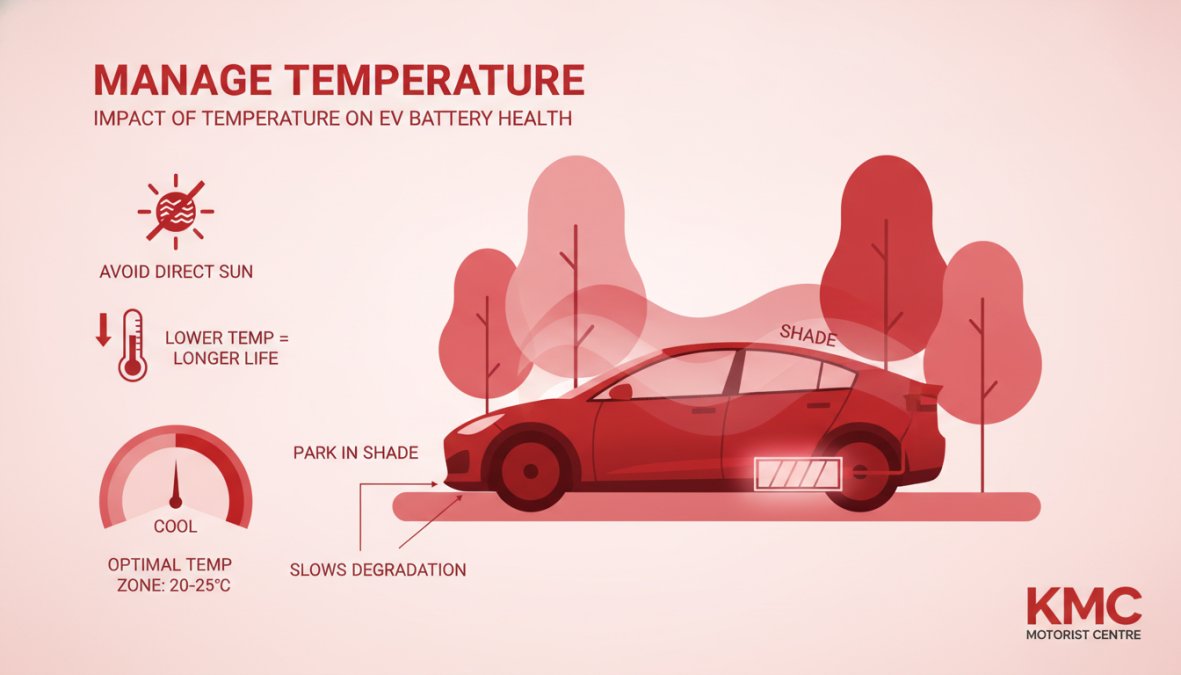
3. Manage Temperature: Impact of Temperature on EV Battery Health
Temperature is one of the most significant factors affecting battery longevity. The ideal operating temperature for EV batteries is between 15°C and 25°C.
Professional illustration showing extend electric car battery
Preconditioning Your Vehicle in Extreme Weather
Preconditioning allows you to heat or cool your battery pack before driving. In winter, precondition while plugged in for 10-15 minutes before leaving, your vehicle warms the battery using grid power rather than draining stored energy.
Use seat heaters and steering wheel heaters instead of cabin heating in cold weather, as they consume far less energy. In summer, precondition to cool the battery before driving in hot weather.
Vehicles preconditioned in winter can maintain 5-8% more range and experience less strain during charging.
Parking Habits and Thermal Management
Park in shade whenever possible in summer. Even a 10°C difference slows battery degradation significantly. Use a garage if available, garaged vehicles maintain stable temperatures year-round, protecting the battery from freezing winters and hot summers.
Avoid leaving your vehicle in direct sunlight for extended periods. Consider using a reflective sunshade on the windscreen to reduce interior temperature.
4. Understand EV Battery Degradation Factors
Battery degradation is inevitable; all lithium-ion batteries lose capacity over time. Understanding the factors that drive degradation allows you to slow the process significantly.
Battery Age, Cycling, and State of Health Monitoring
Your battery's State of Health (SoH) measures its current capacity compared to original capacity. Most manufacturers warranty batteries to retain at least 70-80% SoH after 8 years or 100,000 miles.
Battery cycling refers to charging and discharging. Each full cycle causes some degradation, but partial cycles (like 20-80% charging) cause much less damage. Monitor your battery's health using apps like Recurrent or SoH Checker, which provide monthly degradation reports.
A battery retaining 90% SoH after 5 years is performing exceptionally well. Most vehicles see 2-3% annual degradation under normal conditions.
Warranty Implications and Long-Term Storage
Review your vehicle's warranty documentation carefully. Some manufacturers penalise owners who frequently use DC fast charging or charge above 90% regularly.
If storing your vehicle for more than a month, charge it to approximately 50% SoC and store it in a cool location. This is optimal for long-term storage. A battery left at 100% charge in hot conditions will degrade rapidly, even if the vehicle isn't being driven.
5. Adopt Smart Driving Habits to Extend Electric Car Battery Life
Aggressive acceleration, high-speed driving, and harsh braking increase energy consumption and stress the battery Management System.
Regenerative Braking and Efficiency
Regenerative braking converts kinetic energy back into electrical energy stored in the battery. To maximise it:
Use one-pedal driving when possible - Lifting off the accelerator triggers strong regenerative braking, capturing more energy.
Anticipate stops rather than braking hard - Smooth, gradual deceleration captures more energy and reduces friction brake wear.
Avoid coasting in neutral - Stay in Drive and let regenerative braking capture energy.
Drive smoothly on motorways - Maintain steady speeds to avoid wasting energy.
Drivers who master regenerative braking can extend range by 10-15% and reduce battery stress.
Speed, Acceleration, and Range Management
High-speed driving significantly increases energy consumption. Driving at 70 mph uses roughly 20% more energy than driving at 50 mph. Aggressive acceleration stresses the battery and motor; smooth, gradual acceleration is gentler and more efficient.
Plan routes to avoid unnecessary acceleration and deceleration. Motorway driving at steady speeds is more efficient than stop-start city driving.
6. Use Battery Monitoring Tools and Professional Diagnostics
Understanding your battery's condition requires the right tools. Consumer-grade monitoring apps provide valuable insights, while professional diagnostics offer deeper analysis when needed.
Consumer-Grade Apps for Battery Health Tracking
Recurrent provides monthly battery health reports and benchmarking. TRONITY tracks charging efficiency and driving behaviour. SoH Checker (free for Android) is privacy-focused, keeping your data on your device.
Check your battery health quarterly. Trends matter more than individual readings. A 1% drop in SoH over three months is normal; a 5% drop suggests a problem worth investigating.
Pro TipUse free tools like SoH Checker for basic monitoring, or Recurrent's free tier for detailed analysis of battery condition and resale value.
Professional Battery Diagnostics at Kettering Motorist Centre
If you notice unusual battery behaviour, rapid degradation, slow charging, or reduced range, professional diagnostics are worth the investment. At Kettering Motorist Centre, our team has specialist equipment to test high-voltage battery systems safely and identify issues like cell imbalance, BMS faults, or thermal management problems.
Our diagnostic service includes a comprehensive report on your battery's condition and recommendations for optimising its lifespan. Visit our website to book your battery health check today.
7. Plan for Long-Term Storage and Seasonal Care
Proper preparation protects your battery during extended storage periods.
Ideal Storage Conditions and Maintenance Intervals
The optimal storage state is 50% SoC in a cool, dry location between 10°C and 20°C. Before storing:
Charge to 50% SoC - Use your vehicle's settings to charge to approximately half capacity.
Store in a cool location - A garage is ideal; direct sun is not.
Check the battery monthly - Charge back to 50% if it drops below 30% SoC.
Precondition before returning to use - If stored in cold conditions, precondition for 15 minutes before driving.
Have your battery Management System checked annually, even if not driving frequently. Small issues caught early prevent major problems later.
Common Mistakes That Damage EV Batteries
Charging to 100% daily - This accelerates degradation 20-30% faster than charging to 80%.
Using only DC fast charging - Reserve rapid chargers for long trips; use Level 2 for daily charging.
Leaving the vehicle unplugged for weeks - Charge to 50% and plug in monthly if not driving regularly.
Ignoring temperature management - Park in shade or garage; precondition in winter.
Discharging to 0% regularly - Keep charge above 20% during normal use.
Ignoring battery health warnings - Investigate immediately; early intervention prevents costly damage.
Not updating vehicle software - Manufacturers release updates that optimise battery management.
Mistake
Impact
Prevention
Charging to 100% daily
20-30% faster degradation
Set maximum charge to 80%
Relying on DC fast charging
Accelerated cell stress
Use Level 2 for daily charging
Extended storage without charging
Battery damage
Charge to 50% monthly during storage
Extreme temperature exposure
Rapid capacity loss
Park in shade or garage; precondition in winter
Deep discharge to 0%
Permanent cell damage
Recharge before battery drops below 20%
Ignoring software updates
Suboptimal battery management
Update vehicle software annually
Protecting your electric vehicle's battery is one of the smartest investments in your vehicle's longevity and resale value. The seven strategies covered here work together to significantly extend your battery's useful life. At Kettering Motorist Centre, we specialise in electric and hybrid vehicle maintenance for owners across Kettering and Northamptonshire. If you'd like professional guidance on your battery health or need diagnostic services, visit our EV specialist page or contact us to book a battery health check. Our team can help you optimise your charging strategy and ensure your EV battery performs at its best for years to come.
Frequently Asked Questions
Does fast charging damage electric car batteries?
Fast charging (DCFC) does cause slightly more thermal stress than Level 2 charging, which can accelerate battery degradation over time. However, modern Battery Management Systems (BMS) are designed to handle fast charging safely. To extend electric car battery life, limit fast charging to occasional use, especially on long journeys, and rely on slower Level 2 charging at home. Balancing charging speeds helps preserve battery capacity and longevity.
What is the ideal State of Charge percentage to keep an EV at?
The optimal State of Charge (SoC) for battery longevity is between 20% and 80%. Charging to 100% regularly and allowing the battery to drop below 10% both increase degradation. Most EV owners should aim to charge to 80% for daily use and only charge to 100% before long trips. This practice significantly extends battery health and maintains manufacturer warranty compliance.
How does temperature affect electric car battery degradation?
Extreme temperatures, both hot and cold, accelerate EV battery degradation. Heat increases chemical reactions inside lithium-ion cells, whilst cold reduces efficiency and charging speed. The impact of temperature on EV battery health is substantial: batteries perform best at 15-25°C. Use preconditioning in winter, park in shade during summer, and avoid charging immediately after fast driving when the battery is hot. Professional diagnostics at Kettering Motorist Centre can assess temperature-related wear.
Can regenerative braking help extend electric car battery life?
Yes, regenerative braking helps extend electric car battery life by converting kinetic energy back into stored electrical energy during deceleration. This reduces wear on mechanical brakes and improves overall efficiency. However, regenerative braking also contributes to charging cycles, so it's not a free benefit. The key is balancing smooth, predictable driving with regenerative braking to maximise both battery longevity and energy recovery.
What should I do to prepare my EV for long-term storage?
For long-term storage, charge your battery to 50% State of Charge, this minimises stress on the cells. Store the vehicle in a cool, dry location (ideally 15-25°C) away from direct sunlight. Disconnect the 12V auxiliary battery if storing for more than a month. Check the battery periodically and recharge to 50% every 3-6 months. Extreme temperatures during storage accelerate battery degradation, so climate control is essential for preserving battery health.
Your booking Failed
Please try again or please call 01536 410142
Thank you for placing a booking with Kettering Motorist Centre Limited for vehicle
PLEASE TAKE YOUR BOOKING REFERENCE NUMBER WITH YOU TO THE MOT CENTRE
Your items
MOT Test
×
Terms and Conditions
These terms and conditions form the basis on which you can visit and use this website. Please read them carefully as they contain important information.
General terms and conditions
This website is owned and operated by Kettering Motorist Centre Ltd (company registration number: 4485858) operating at Trafalgar Road, Kettering, Northamptonshire, NN16 8DB (the "MOT Centre", the "Company", "we" or "us"). If you have any queries about these terms and conditions or if you have any comments or complaints on or about this website, you can contact us at [email protected] or 01536 410142.
The website is to promote and offer for sale the products and services of Kettering Motorist Centre Limited.
1. The contract between us
This website does not take payment for products or services online. The website enables you to view products and services online and to make a booking for later delivery and payment. The vehicle and provision of other products and services promoted by this website and the payment by you of the price of those products and services will take place at the MOT Centre. The booking does not constitute a contract.
The booking process on the site provides details of the booked MOT order. Please take the time to read and check your booking. It is your responsibility to make sure the order is correct and for the correct vehicle.
2. Ownership of rights
All rights, including copyright, in this website are owned by or licensed to the Company. Any use of this website or its contents, including copying or storing it or them in whole or part, other than for your own personal, non commercial use, is prohibited without our permission. You may not modify, distribute or repost anything on this website for any purpose.
3. Accuracy of content
We have taken care in the preparation of the content of this website, in particular to ensure that prices quoted are correct at the time of publishing and that all goods have been fairly described. However, bookings will only be accepted if there are no material errors in the description of the goods or their prices as advertised on this website. Any weights, dimensions and capacities given about the goods are approximate only.
4. Damage to your computer
We try to ensure that this website is free from viruses or defects. However, we cannot guarantee that your use of this website or any websites accessible through it will not cause damage to your computer. It is your responsibility to ensure that the right equipment is available to use the website. Except in the case of negligence on our part, we will not be liable to any person for any loss or damage which may arise to computer equipment as a result of using this website.
5. Availability
All bookings are subject to acceptance and availability. If the MOT date you have requested are is not available, the Centre will contact you by e-mail or phone. You will have the option either to wait until another slot is available or to cancel your booking.
6. Booking errors
You are able to correct errors on your booking up to the point on which you click on “Place Booking” during the booking process.
7. Price
The prices payable for goods that you order are as set out in our website. All prices are inclusive of VAT at the current rates and are correct at the time of entering information, errors and omissions excepted.
Whenever it is not possible to accept your booking to buy goods of the specification and description at the price indicated, the MOT Centre will advise you by email or phone or when you visit the centre.
8. Payment terms
You will be required to pay for the goods or services to the Centre at time of a completed MOT.
9. Delivery charges
N/A
10. Cancellation
The MOT Centre reserves the right to cancel the booking if:
10.1 There is insufficient stock to deliver the goods you have booked.
10.2 One or more of the goods you booked was listed at an incorrect price.
If your booking is cancelled the Centre will notify you by e-mail or phone.
You have the right to cancel your booking at any time up to the point of the MOT. If you do cancel your booking you should inform the centre by phone.
11. Liability
Notwithstanding the foregoing, nothing in these terms and conditions is intended to limit any rights you might have as a consumer under applicable local law or other statutory rights that may not be excluded nor in any way to exclude or limit our liability to you for any death or personal injury resulting from our negligence.
12. Notices
Unless otherwise expressly stated in these terms and conditions, all notices from you to us must be in writing and sent to our contact address given above and all notices from us to you will be displayed on our website from time to time.
13. Changes to legal notices
We reserve the right to change these terms and conditions from time to time and you should look through them as often as possible.
14. Law, jurisdiction and language
This website, any content contained therein and any contract brought into being as a result of usage of this website are governed by and construed in accordance with English law. Parties to any such contract agree to submit to the exclusive jurisdiction of the courts of England and Wales.
15. Invalidity
If any part of these terms and conditions is unenforceable (including any provision in which we exclude our liability to you) the enforceability of any other part of these conditions will not be affected.
16. Privacy
You acknowledge and agree to be bound by the terms of our privacy policy
17. Third party rights
Nothing in this Agreement is intended to, nor shall it confer any rights on a third party.