When it comes to keeping your car safe and running efficiently, understanding tyre pressure is essential. Many drivers overlook this simple maintenance task, yet correct tyre pressure directly affects safety, fuel consumption, and tyre lifespan. At Kettering Motorist Centre, we help motorists across Northamptonshire understand their vehicle's specific requirements and check their tyres properly. This guide covers everything you need to know about tyre pressure, from finding your recommended pressure to understanding why it matters.
Why Correct Tyre Pressure for Your Car Matters
Your tyres are literally where your car meets the road, and their pressure affects nearly every aspect of how your vehicle performs. Under-inflated tyres generate excess heat, wear unevenly, and consume more fuel. Over-inflated tyres become stiff, reduce grip, and wear in the centre of the tread.
Safety and Handling
Correct tyre pressure directly influences how your car handles in emergency situations. When tyres are at the right pressure, the contact patch, the area of tyre touching the road, is optimised for grip and control. This matters most during hard braking or sharp cornering, where under-inflated or over-inflated tyres can cause unpredictable vehicle response.
Under-inflation is particularly dangerous because it reduces the structural support the tyre provides. The sidewalls flex excessively, the tyre heats up, and braking distances increase. Over-inflation creates a harder, less flexible tyre that doesn't grip effectively, especially on wet surfaces. Kettering Motorist Centre recommends checking your tyre pressure at least monthly and before long journeys to keep you safer on Northamptonshire roads and beyond.
Fuel Efficiency and Tyre Longevity
Under-inflated tyres increase rolling resistance, meaning your engine works harder to move the car forward. This translates to higher fuel consumption, sometimes 5-10% worse fuel economy if your tyres are significantly under-inflated.
Tyre lifespan also depends heavily on correct pressure. Under-inflation causes the sidewalls and shoulders to wear faster, while over-inflation concentrates wear in the centre of the tread. Maintaining correct pressure helps you get the full lifespan from your tyres, meaning fewer replacements and better value.
How to Find Your Recommended Tyre Pressure
Every vehicle has a specific tyre pressure recommendation based on its weight, suspension design, and intended use. This pressure is engineered by the manufacturer to balance safety, comfort, and efficiency.
Locating the Tyre Pressure Sticker
The tyre pressure sticker is usually located on the driver's side door jamb, the vertical surface you see when you open the driver's door. The sticker shows multiple pressures because different tyre sizes and load conditions require different pressures. You'll typically see pressures for the front and rear tyres, sometimes a separate pressure for fully loaded vehicles, and measurements in both PSI (pounds per square inch) and BAR.
Some vehicles also have pressure information inside the fuel door or in the owner's handbook. If you can't find a sticker on the door jamb, these are your next places to look.
Checking Your Vehicle Handbook
Your vehicle handbook contains detailed tyre pressure information and is your most reliable reference if the door jamb sticker is missing or unreadable. The handbook usually has a dedicated section on tyre maintenance that explains recommended pressures for different driving conditions and what to do if you're carrying extra load. If you've lost your physical handbook, you can often find a PDF version online by searching for your vehicle's registration number or model year.
How to Check Tyre Pressure in the UK
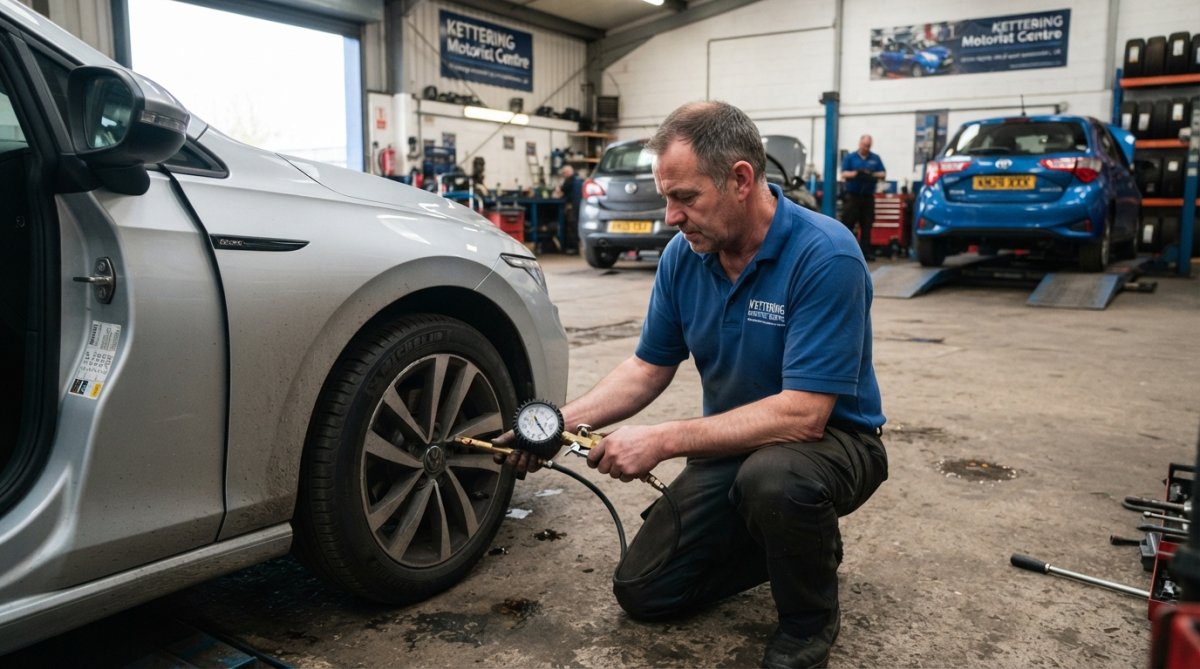
Checking your tyre pressure is straightforward and takes less than five minutes. You'll need a tyre pressure gauge; digital gauges are most accurate and easiest to read, though mechanical gauges work fine too.
Using a Tyre Pressure Gauge
A digital tyre pressure gauge is inexpensive and reliable. You can find them at most petrol stations, car accessory shops, and online retailers. Digital gauges display the reading clearly on a small screen, removing any guesswork.
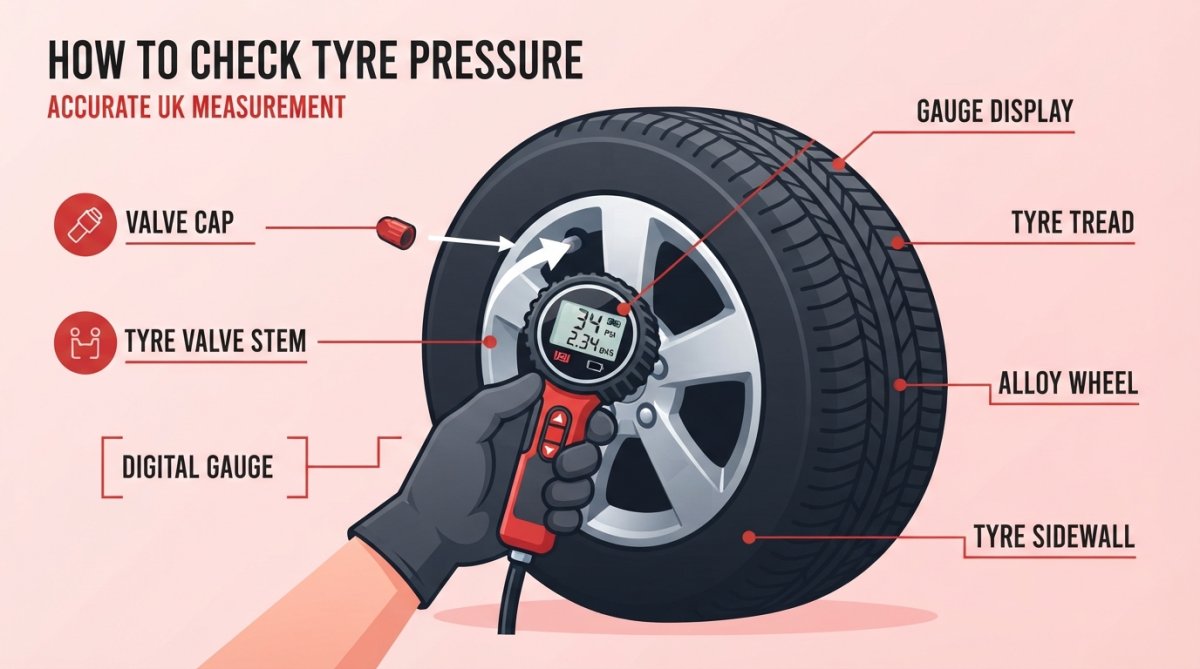
Close-up of a hand holding a digital tyre pressure gauge being pressed onto a car tyre valve stem, with the gauge display showing the pressure reading clearly
Step-by-Step Checking Process
Check when tyres are cold. Tyre pressure increases as the tyre heats up during driving. For the most accurate reading, check pressure in the morning before you've driven, or at least three hours after driving.
Remove the valve cap. Each tyre has a small plastic or metal cap on the valve stem. Unscrew this and set it aside.
Press the gauge onto the valve. Push the gauge firmly onto the valve stem. You should hear a slight hiss of air; this is normal. Hold it steady for 2-3 seconds.
Read the pressure. Digital gauges display the reading on screen.
Compare to your recommended pressure. Check the reading against the pressure listed on your door jamb sticker or handbook.
Repeat for all four tyres. Don't assume all tyres are the same; check each one.
Replace the valve cap. Screw the cap back on firmly to prevent dirt and moisture entering the valve.
If any tyre is under-inflated, add air at a petrol station. If over-inflated, release air by pressing the small pin inside the valve stem briefly.
Understanding PSI and BAR: Tyre Pressure Conversion
Tyre pressure is measured in two different units. PSI stands for pounds per square inch and is the imperial measurement you'll see on most UK vehicle door jamb stickers. A typical car tyre pressure might be 32 PSI.
BAR is the metric unit of pressure. One BAR is roughly equivalent to atmospheric pressure at sea level. A typical car tyre might be around 2.2 BAR.
To convert between the two: 1 BAR equals approximately 14.5 PSI. So if your vehicle specifies 2.2 BAR, that's roughly 32 PSI (2.2 × 14.5 = 31.9). Most modern gauges display both PSI and BAR, so you can read whichever unit your vehicle uses.
What Happens with Under-Inflated and Over-Inflated Tyres
Tyre pressure sits in a narrow sweet spot. Move too far in either direction and you'll experience real problems.
Effects of Under-Inflation
Under-inflated tyres are surprisingly common. Many drivers don't check pressure regularly, and tyres naturally lose air over time. A tyre that's 10% under its recommended pressure might not feel noticeably different to drive, but it's already causing damage.
The sidewalls of an under-inflated tyre flex excessively, generating heat that accelerates rubber degradation and can eventually lead to tyre failure. The tyre also wears faster, typically in the shoulders and sides rather than evenly across the tread. Fuel consumption increases noticeably because the engine has to work harder against increased rolling resistance. Braking distance also increases, particularly on wet roads where grip is already compromised.
Effects of Over-Inflation
Over-inflated tyres become stiff and less flexible, which reduces the contact patch. With less contact area, grip is reduced, especially on wet surfaces. The centre of the tyre wears faster than the edges, creating distinctive wear patterns that shorten tyre life.
Over-inflation also makes the ride harsher and can cause fatigue on long drives. The tyre is more susceptible to damage from potholes and road debris because it has less cushioning.
Finding Tyre Pressure by Registration: UK Tools and Resources
If you don't have access to your vehicle handbook or can't find the door jamb sticker, you can look up your tyre pressure using your vehicle's registration number. The easiest approach is to visit a local tyre specialist or petrol station; staff can look up your vehicle details and tell you the correct pressure. Kettering Motorist Centre can provide this information and check your tyres at the same time.
For electric vehicles, tyre pressure requirements are sometimes slightly different from petrol equivalents due to the vehicle's weight distribution. If you drive an electric or hybrid car, Kettering Motorist Centre's sister site kmcelectric.co.uk | kmcelectric.co.uk offers expert advice specific to electric and hybrid vehicles.
Tyre Pressure Monitoring System (TPMS) in the UK
Most vehicles manufactured after 2015 are fitted with a Tyre Pressure Monitoring System (TPMS). This technology automatically monitors the pressure in each tyre and alerts you if pressure drops significantly.
How TPMS Works
TPMS uses sensors inside each tyre or mounted on the valve stem to continuously monitor pressure. These sensors transmit data wirelessly to your vehicle's onboard computer. If any tyre pressure drops below a certain threshold, typically about 25% below the recommended pressure, the system triggers a warning light on your dashboard.
TPMS is designed to alert you to significant pressure loss, such as from a puncture or gradual leak. It's not a replacement for manual pressure checks, because TPMS only warns you when pressure has already dropped dangerously low.
TPMS Warning Lights and Troubleshooting
A TPMS warning light on your dashboard looks like an exclamation mark inside a tyre symbol. If this light comes on, at least one tyre has dropped significantly below the recommended pressure.
The first step is to check all four tyres manually with a gauge. Often you'll find one tyre is simply under-inflated, perhaps because of temperature changes or a slow leak. Inflate it to the correct pressure and the warning light should extinguish after a few minutes of driving.
If the light persists after you've inflated all tyres to the correct pressure, there may be a problem with the TPMS sensor itself. A sensor battery may have failed (most TPMS sensors have a 7-10 year lifespan), or the sensor may be faulty. Kettering Motorist Centre can check your TPMS system and replace sensors if needed.
Sometimes the TPMS light comes on after a significant temperature drop. Tyre pressure decreases as temperature falls, roughly 1 PSI for every 6°C drop. If you see the warning light on a cold morning, check your pressure and inflate as needed.
Seasonal Tyre Pressure Adjustments for UK Weather
Tyre pressure changes with temperature, and the UK's seasonal temperature variations mean your tyres will need attention as seasons change.
Cold temperatures reduce tyre pressure. For every 6°C drop in temperature, tyre pressure decreases by roughly 1 PSI. This means your tyres will be noticeably under-inflated in winter compared to summer, even if you haven't changed anything.
In autumn, as temperatures drop, check your tyre pressure more frequently, perhaps every two weeks rather than monthly. You may need to inflate your tyres slightly to maintain the correct pressure as the weather gets colder. In spring and summer as temperatures rise, tyre pressure increases, and you may need to deflate slightly if needed.
Check pressure regularly throughout the year, particularly during seasonal transitions. For winter driving in Northamptonshire and surrounding areas, some drivers switch to winter tyres, which have different tread patterns optimised for cold weather grip. Winter tyres often have slightly different pressure recommendations than summer tyres; check your handbook or consult Kettering Motorist Centre if you switch seasonal tyres.
Getting your tyre pressure right is one of the simplest yet most important maintenance tasks you can do. Correct pressure improves safety, extends tyre life, and reduces fuel consumption, benefits that add up over time. Kettering Motorist Centre makes this easier by providing expert tyre checks, pressure adjustments, and seasonal advice tailored to your vehicle. With our specialist knowledge of electric and hybrid vehicles through kmcelectric.co.uk | kmcelectric.co.uk, you can get your tyres checked without the usual garage hassle. Book your tyre check today and drive with confidence knowing your pressure is exactly where it should be.
Frequently Asked Questions
Where can I find the recommended tyre pressure for my car in the UK?
Your car's recommended tyre pressure is displayed on a sticker located inside the driver's door well or on the fuel filler flap. You can also find this information in your vehicle handbook or owner's manual. If you prefer, you can use a tyre pressure checker by registration on UK automotive websites, or visit Kettering Motorist Centre for professional guidance.
What is the difference between PSI and BAR for tyre pressure?
PSI (pounds per square inch) and BAR are two units of pressure measurement. One BAR equals approximately 14.5 PSI. UK vehicles typically display pressure in both units. For example, 32 PSI is roughly equivalent to 2.2 BAR. Understanding this tyre pressure conversion helps you read gauges and compare specifications accurately.
How often should I check my car's tyre pressure in the UK?
Check your tyre pressure at least once a month and before long journeys. Cold tyres (when the car hasn't been driven for at least three hours) give the most accurate reading. Seasonal changes affect pressure, cold weather can reduce tyre pressure, so check more frequently in winter. Kettering Motorist Centre recommends routine pressure checks as part of regular vehicle maintenance.
What happens if my tyre pressure is too low or too high?
Under-inflated tyres increase rolling resistance, reducing fuel efficiency and accelerating tread wear. They also compromise handling and increase braking distance, affecting road safety. Over-inflated tyres reduce grip, create uneven wear in the centre of the tyre, and make the ride harsher. Both conditions reduce tyre longevity and handling characteristics. Maintaining correct pressure ensures optimal safety and performance.
Your booking Failed
Please try again or please call 01536 410142
Thank you for placing a booking with Kettering Motorist Centre Limited for vehicle
PLEASE TAKE YOUR BOOKING REFERENCE NUMBER WITH YOU TO THE MOT CENTRE
Your items
MOT Test
×
Terms and Conditions
These terms and conditions form the basis on which you can visit and use this website. Please read them carefully as they contain important information.
General terms and conditions
This website is owned and operated by Kettering Motorist Centre Ltd (company registration number: 4485858) operating at Trafalgar Road, Kettering, Northamptonshire, NN16 8DB (the "MOT Centre", the "Company", "we" or "us"). If you have any queries about these terms and conditions or if you have any comments or complaints on or about this website, you can contact us at [email protected] or 01536 410142.
The website is to promote and offer for sale the products and services of Kettering Motorist Centre Limited.
1. The contract between us
This website does not take payment for products or services online. The website enables you to view products and services online and to make a booking for later delivery and payment. The vehicle and provision of other products and services promoted by this website and the payment by you of the price of those products and services will take place at the MOT Centre. The booking does not constitute a contract.
The booking process on the site provides details of the booked MOT order. Please take the time to read and check your booking. It is your responsibility to make sure the order is correct and for the correct vehicle.
2. Ownership of rights
All rights, including copyright, in this website are owned by or licensed to the Company. Any use of this website or its contents, including copying or storing it or them in whole or part, other than for your own personal, non commercial use, is prohibited without our permission. You may not modify, distribute or repost anything on this website for any purpose.
3. Accuracy of content
We have taken care in the preparation of the content of this website, in particular to ensure that prices quoted are correct at the time of publishing and that all goods have been fairly described. However, bookings will only be accepted if there are no material errors in the description of the goods or their prices as advertised on this website. Any weights, dimensions and capacities given about the goods are approximate only.
4. Damage to your computer
We try to ensure that this website is free from viruses or defects. However, we cannot guarantee that your use of this website or any websites accessible through it will not cause damage to your computer. It is your responsibility to ensure that the right equipment is available to use the website. Except in the case of negligence on our part, we will not be liable to any person for any loss or damage which may arise to computer equipment as a result of using this website.
5. Availability
All bookings are subject to acceptance and availability. If the MOT date you have requested are is not available, the Centre will contact you by e-mail or phone. You will have the option either to wait until another slot is available or to cancel your booking.
6. Booking errors
You are able to correct errors on your booking up to the point on which you click on “Place Booking” during the booking process.
7. Price
The prices payable for goods that you order are as set out in our website. All prices are inclusive of VAT at the current rates and are correct at the time of entering information, errors and omissions excepted.
Whenever it is not possible to accept your booking to buy goods of the specification and description at the price indicated, the MOT Centre will advise you by email or phone or when you visit the centre.
8. Payment terms
You will be required to pay for the goods or services to the Centre at time of a completed MOT.
9. Delivery charges
N/A
10. Cancellation
The MOT Centre reserves the right to cancel the booking if:
10.1 There is insufficient stock to deliver the goods you have booked.
10.2 One or more of the goods you booked was listed at an incorrect price.
If your booking is cancelled the Centre will notify you by e-mail or phone.
You have the right to cancel your booking at any time up to the point of the MOT. If you do cancel your booking you should inform the centre by phone.
11. Liability
Notwithstanding the foregoing, nothing in these terms and conditions is intended to limit any rights you might have as a consumer under applicable local law or other statutory rights that may not be excluded nor in any way to exclude or limit our liability to you for any death or personal injury resulting from our negligence.
12. Notices
Unless otherwise expressly stated in these terms and conditions, all notices from you to us must be in writing and sent to our contact address given above and all notices from us to you will be displayed on our website from time to time.
13. Changes to legal notices
We reserve the right to change these terms and conditions from time to time and you should look through them as often as possible.
14. Law, jurisdiction and language
This website, any content contained therein and any contract brought into being as a result of usage of this website are governed by and construed in accordance with English law. Parties to any such contract agree to submit to the exclusive jurisdiction of the courts of England and Wales.
15. Invalidity
If any part of these terms and conditions is unenforceable (including any provision in which we exclude our liability to you) the enforceability of any other part of these conditions will not be affected.
16. Privacy
You acknowledge and agree to be bound by the terms of our privacy policy
17. Third party rights
Nothing in this Agreement is intended to, nor shall it confer any rights on a third party.