Lighting and signalling failures consistently top the list of MOT failures across the UK. The DVSA (Driver and Vehicle Standards Agency) data confirms this, yet most of these failures are preventable with a simple pre-MOT inspection. Understanding what examiners check gives you the best chance of passing first time.
Pro TipBefore [your MOT](/mot) appointment, spend 15 minutes checking your headlamps, indicators, brake lights, and number plate lights. This single step catches roughly 40% of potential lighting failures before the test begins.
Lighting and Signalling: The Top MOT Failure
Lighting and signalling failures represent the most common reason vehicles fail their MOT test. Examiners check not just whether lights work, but whether they're properly aligned, the correct colour, and functioning at the right brightness levels.
Faulty Bulbs and Headlamp Alignment
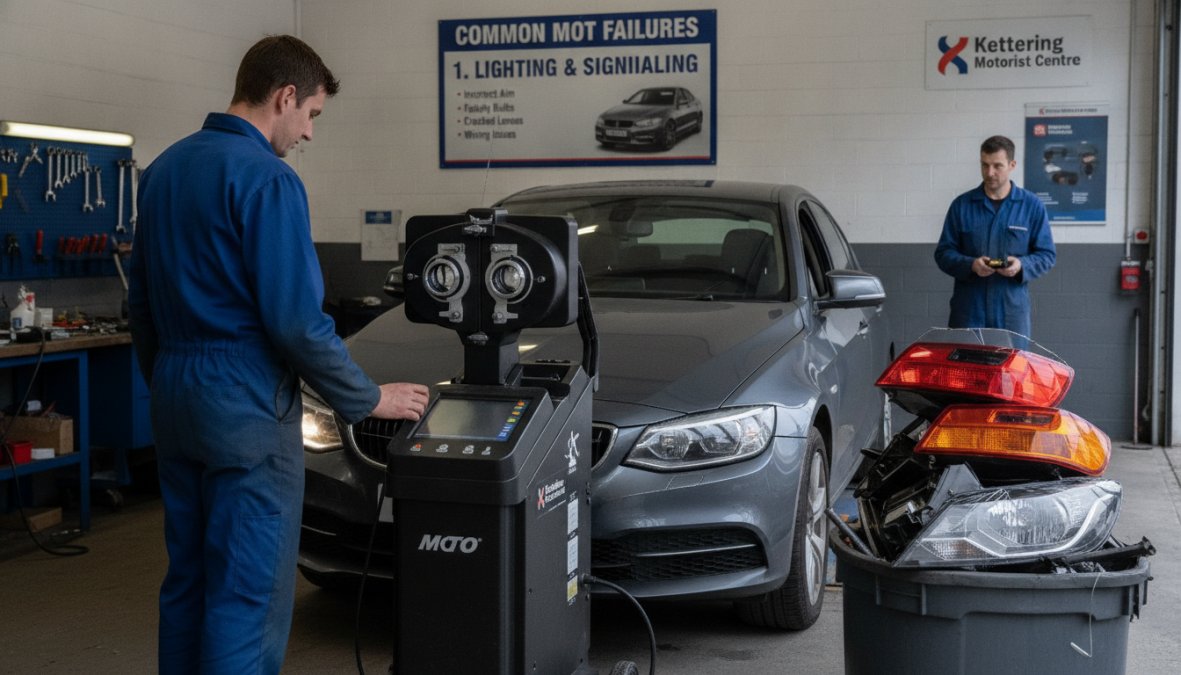
Headlamp alignment is where many drivers slip up. Your headlamps must point at the correct angle; too high and you'll dazzle oncoming traffic, too low and you won't see the road ahead. The MOT test uses a headlamp aim tester to measure the precise angle of your beam.
Indicator lights must be amber, function smoothly, and flash at the correct frequency. The examiner checks all four corners of your vehicle, and any blown bulb or slow-flashing indicator results in failure. Side lights, rear lights, brake lights, and number plate lights all fall under the same scrutiny. A single faulty bulb anywhere on your vehicle is enough to fail the test.
Watch OutIf you've recently had an accident or noticed any lights dimmer than usual, get them checked before your MOT. Corroded bulb holders and water ingress in light clusters are common causes of intermittent failures.
How to Check Before Your MOT
Start by turning on your headlamps in daylight and walking around the car. You should see light from both headlamps, both side lights, both front indicators, both rear indicators, both brake lights, and your number plate light.
Next, test your brake lights. Ask someone to stand behind the car while you press the brake pedal. Both brake lights should illuminate brightly and simultaneously.
For headlamp alignment, park 10 metres from a wall at night and turn on your headlamps. The beam should point roughly at the wall in front of you, not upward. If the beam seems too high or too low, a garage can adjust it using proper equipment.
Check that your number plate is clean and visible. Dirt or damage that obscures any character will fail the test.
Close-up of a vehicle's front headlamp and indicator lights being inspected by a technician with a testing device in a garage setting
Brake System Performance and Brake Pads
Brake system failures are the second most common reason for MOT failure. The examiner tests brake performance on a rolling brake tester, which measures how effectively each wheel can stop the vehicle. Your brakes must work evenly across all four wheels and meet minimum stopping power standards.
Brake Discs and Pad Wear
Brake pads have a legal minimum thickness of 1.6 millimetres. Once your pads wear below this limit, they'll fail the MOT. Brake discs can become warped, cracked, or worn unevenly, all of which affect braking performance.
The MOT examiner will visually inspect your brake discs and pads through the wheel. If the pads are visibly thin or the discs show signs of damage, the test will fail. The rolling brake tester then measures actual stopping power. If your brakes don't meet the threshold, typically around 50% of your vehicle's weight in braking force per axle, you'll fail.
Brake fluid condition also matters. Old, contaminated, or low brake fluid will trigger warning lights on your dashboard and may cause the brakes to feel spongy or unresponsive.
Key TakeawayBrake failures often come in pairs: worn pads and warped discs together, or low fluid and air in the lines. If you're failing on brakes, expect multiple issues that need addressing.
Tyre Condition and Tread Depth Requirements
Tyre failures account for a significant portion of MOT rejections. The legal minimum tread depth in the UK is 1.6 millimetres across the central three-quarters of the tyre.
Legal Tread Depth and Tyre Pressure
To check your tread depth, use the 20-pence test. Insert a 20-pence coin into the tread groove. If the outer ring of the coin is hidden, your tread is above 1.6mm and legal. If you can see the outer ring, your tread is too shallow and you'll fail the MOT.
Tyre pressure also matters. Underinflated tyres wear faster and reduce fuel efficiency. Overinflated tyres wear unevenly and provide less grip. The correct pressure is listed on a sticker inside your driver's door frame or in your owner's manual.
During the MOT, the examiner checks for uneven wear patterns, bulges, cracks, or embedded objects. Any of these defects will result in failure. Uneven wear often indicates suspension or alignment issues, which may also fail the test if severe.
Tyre Check
What to Look For
Action Required
Tread depth
20p coin test, outer ring should be hidden
Replace if visible
Tyre pressure
Check door frame sticker; inflate to correct PSI
Adjust before MOT
Uneven wear
Bald patches on one edge or centre
Investigate suspension alignment
Bulges or cracks
Visible damage on sidewall or tread
Replace immediately
Foreign objects
Nails, glass, or debris embedded
Remove or replace tyre
Suspension, Steering and Alignment Issues
Suspension and steering failures make up a smaller but significant portion of MOT rejections. The examiner tests for excessive wear in suspension components, steering linkage play, and alignment issues that affect vehicle control.
Suspension Arm and Coil Spring Wear
Suspension arms, ball joints, and coil springs wear over time, especially on rough roads or after hitting potholes hard. The MOT examiner uses a pit or ramp to visually inspect suspension components for cracks, corrosion, or excessive movement.
If you grab the wheel at 12 and 6 o'clock and move it side to side, you should feel very little play. Excessive movement indicates worn ball joints or bushings. Coil springs can crack or lose tension, causing one corner of the vehicle to sit lower than the others. A visibly sagging corner is an immediate failure.
Steering linkage must be tight with no excessive play. Worn steering components make the car feel vague or unresponsive and are a safety issue.
Pro TipIf your car pulls to one side during braking or feels "loose" when cornering, have a suspension and steering inspection before your MOT.
Driver Visibility: Windscreen Wipers and Mirrors
Driver visibility is a critical safety requirement. The MOT examiner checks that you can see clearly from the driver's seat in all directions, and that your wipers and washers work effectively.
Windscreen wipers must clear the windscreen effectively without leaving streaks or missed areas. Wiper blades typically last 6-12 months and are inexpensive to replace.
Windscreen washers must work and spray the windscreen. The fluid should be topped up regularly, especially in winter.
Mirrors, both the interior rear-view mirror and the two wing mirrors, must be present, secure, and provide an adequate view. A cracked mirror or one that's come loose will fail the test. The windscreen itself must be free from significant damage in the driver's line of sight.
Emissions Test and Exhaust System Failures
Emissions failures are less common than lighting or brake failures, but they're still a significant reason for MOT rejection. The test measures the level of harmful gases your engine produces.
Fuel System and Dashboard Warning Lights
A faulty fuel system or engine management issue will often trigger a dashboard warning light. The MOT examiner checks for active warning lights before even starting the emissions test. If the check engine light is on, the test stops immediately and the vehicle fails.
Common causes include a loose fuel cap, a faulty oxygen sensor, a blocked catalytic converter, or a failing engine management sensor. A well-maintained engine with regular oil changes, air filter replacements, and spark plug servicing will rarely fail the emissions test.
MOT Checklist: How to Prepare Your Car
The best way to pass your MOT is to prepare your car systematically in the weeks before your test. This checklist covers the most common failure points.
Pre-MOT Inspection Steps
Lighting (30 minutes)
Turn on headlamps in daylight and walk around the car. Check that both headlamps, both side lights, both front indicators, both rear indicators, and both brake lights are working. Ask someone to stand behind the car while you press the brake pedal. Both brake lights should illuminate brightly. Turn on hazard lights and check that all four corner indicators flash at the same speed. Check that your number plate light works and the plate is clean and fully visible. Replace any faulty bulbs.
Tyres (15 minutes)
Check tyre pressure using a pressure gauge and inflate to the correct PSI listed on your driver's door frame sticker. Use the 20-pence test on each tyre. Visually inspect each tyre for bulges, cracks, or embedded objects. Check that all four tyres are the same size and type.
Brakes (15 minutes)
Press the brake pedal firmly. It should feel firm and responsive, not spongy. Check the brake fluid level in the reservoir (usually a translucent plastic container under the bonnet). The fluid should reach the "max" line. Visually inspect the brake discs and pads through the wheel. Pads should be thicker than 1.6mm. Discs should be smooth without cracks or heavy scoring.
Windscreen and Wipers (10 minutes)
Clean your windscreen thoroughly inside and out. Check that windscreen wipers clear the glass without streaking. Replace the blades if they leave lines or miss areas. Top up windscreen washer fluid. Inspect the windscreen for large cracks or chips in your line of sight. Check that your interior rear-view mirror and both wing mirrors are secure, clean, and properly adjusted.
Suspension and Steering (10 minutes)
Grab the steering wheel at 12 and 6 o'clock and try to move it side to side. There should be very little play. Press down hard on each corner of the car. It should bounce back smoothly. Listen for clunks or rattles when you press on the suspension.
Engine and Emissions (5 minutes)
Check that the check engine light is not illuminated on your dashboard. Start the engine and listen for rough idling, excessive noise, or smoke from the exhaust. Check that your oil level is adequate using the dipstick.
General Checks (5 minutes)
Ensure your number plate is clean, fully visible, and securely attached. Check that your horn works. Verify that your seatbelts work smoothly and latch securely. Check that your handbrake holds the car on a slope.
If you find any issues during this checklist, address them before your MOT appointment. Many repairs are simple and inexpensive when caught early.
Key TakeawayThe most common MOT failures, lighting, brakes, and tyres, are also the easiest to prevent. Spending one hour on pre-MOT checks can save you the cost and inconvenience of a re-test.
What Happens If Your Car Fails
If your car fails the MOT, you'll receive a failure certificate listing the specific defects. You then have a set period (typically 10 working days) to get the issues fixed and return for a re-test.
The re-test is usually cheaper than the full MOT fee, as the examiner only checks the items that were originally failed. Some failures are more serious than others. A faulty bulb might take 10 minutes to fix; a suspension issue might take a day or more. The failure certificate will specify whether each defect is a "failure" (safety-critical) or an "advisory" (not yet critical but worth monitoring).
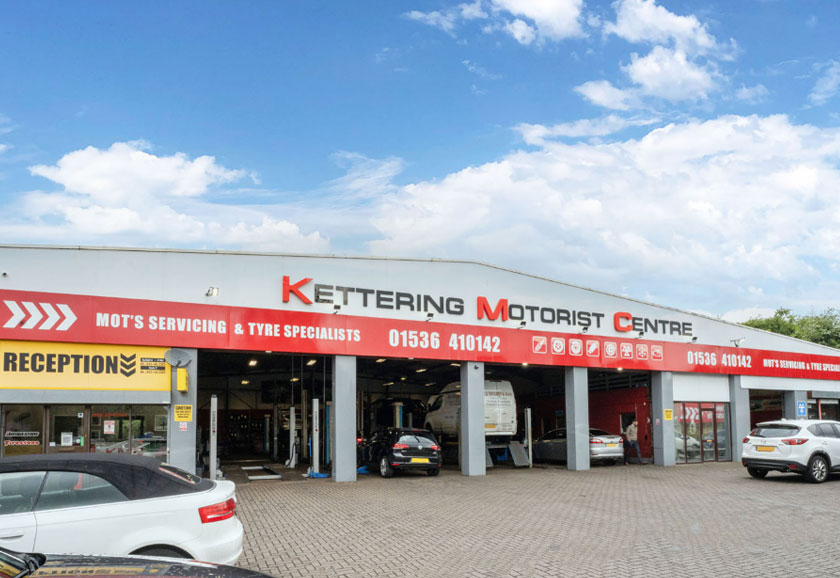
MOT failures don't have to derail your plans. Most common failures are preventable with a simple pre-test inspection and timely maintenance. Kettering Motorist Centre offers comprehensive MOT testing and pre-MOT inspection services across Kettering and Northamptonshire, with hassle-free online booking and no upfront payment required. Our experienced technicians identify issues before they become test failures, saving you time and money. Book your MOT with Kettering Motorist Centre today and drive with confidence knowing your vehicle meets all safety and emissions standards.
For electric and hybrid vehicle owners, our sister site KMC Electric provides specialist MOT and servicing expertise tailored to battery-electric and plug-in hybrid powertrains.
Frequently Asked Questions
What is the most common reason for MOT failure?
Lighting and signalling failures are consistently the most common MOT fail in the UK. This includes faulty bulbs, headlamp alignment issues, and non-functional indicators or brake lights. These failures are preventable with simple pre-MOT checks. Inspect all exterior lights, including number plate illumination, and ensure headlamp alignment meets DVSA standards. At Kettering Motorist Centre, we can perform a thorough pre-MOT inspection to catch these issues before your test.
How can I avoid common MOT failures with a pre-MOT checklist?
A comprehensive MOT checklist should cover: lighting and signalling, brake pad and disc condition, tyre tread depth (minimum 1.6mm), suspension components, windscreen wipers, mirrors, seatbelts, horn, and emissions. Check fluid levels including coolant and brake fluid. Test your dashboard warning lights and ensure your number plate is readable. Create a systematic inspection routine two weeks before your test date. KMC offers professional pre-MOT checks to identify and fix issues before your appointment.
What is the difference between an MOT advisory and a failure?
An MOT advisory means a component is approaching the end of its serviceable life but is still legal. You can pass your MOT with advisories, but you should address them soon. A failure means the component fails to meet roadworthiness standards and must be repaired before you can drive legally. Common advisories include worn brake pads nearing replacement and suspension wear. Understanding this distinction helps you prioritise repairs and plan maintenance costs effectively.
What happens if my car fails the MOT and what are the retest rules?
If your car fails, you must not drive it on public roads (except to a garage for repairs). You have ten working days to retest without paying a new MOT fee. After ten days, you must pay for a new full MOT test. Retest appointments should be booked promptly to minimise inconvenience. The DVSA sets retest rules to ensure safety and fairness. At Kettering Motorist Centre, we offer transparent guidance on retest procedures and can schedule your retest once repairs are complete.
Should I get a pre-MOT check, and is it worth the cost?
A pre-MOT check is highly cost-effective. Identifying and fixing issues before your official test prevents the expense and inconvenience of a failure and retest. You avoid the stress of driving an unroadworthy vehicle and the risk of safety hazards. Most common failures (lighting, brakes, tyres) are inexpensive to address when caught early. KMC's pre-MOT inspection service helps you pass first time, saving time, money, and peace of mind.
[EXTERNAL_LINK: DVSA MOT test standards and regulations | dvsa.gov.uk]
[EXTERNAL_LINK: UK Road Traffic Act tyre tread depth legal requirements | legislation.gov.uk]
[EXTERNAL_LINK: Vehicle emissions testing standards and limits | gov.uk]
Your booking Failed
Please try again or please call 01536 410142
Thank you for placing a booking with Kettering Motorist Centre Limited for vehicle
PLEASE TAKE YOUR BOOKING REFERENCE NUMBER WITH YOU TO THE MOT CENTRE
Your items
MOT Test
×
Terms and Conditions
These terms and conditions form the basis on which you can visit and use this website. Please read them carefully as they contain important information.
General terms and conditions
This website is owned and operated by Kettering Motorist Centre Ltd (company registration number: 4485858) operating at Trafalgar Road, Kettering, Northamptonshire, NN16 8DB (the "MOT Centre", the "Company", "we" or "us"). If you have any queries about these terms and conditions or if you have any comments or complaints on or about this website, you can contact us at [email protected] or 01536 410142.
The website is to promote and offer for sale the products and services of Kettering Motorist Centre Limited.
1. The contract between us
This website does not take payment for products or services online. The website enables you to view products and services online and to make a booking for later delivery and payment. The vehicle and provision of other products and services promoted by this website and the payment by you of the price of those products and services will take place at the MOT Centre. The booking does not constitute a contract.
The booking process on the site provides details of the booked MOT order. Please take the time to read and check your booking. It is your responsibility to make sure the order is correct and for the correct vehicle.
2. Ownership of rights
All rights, including copyright, in this website are owned by or licensed to the Company. Any use of this website or its contents, including copying or storing it or them in whole or part, other than for your own personal, non commercial use, is prohibited without our permission. You may not modify, distribute or repost anything on this website for any purpose.
3. Accuracy of content
We have taken care in the preparation of the content of this website, in particular to ensure that prices quoted are correct at the time of publishing and that all goods have been fairly described. However, bookings will only be accepted if there are no material errors in the description of the goods or their prices as advertised on this website. Any weights, dimensions and capacities given about the goods are approximate only.
4. Damage to your computer
We try to ensure that this website is free from viruses or defects. However, we cannot guarantee that your use of this website or any websites accessible through it will not cause damage to your computer. It is your responsibility to ensure that the right equipment is available to use the website. Except in the case of negligence on our part, we will not be liable to any person for any loss or damage which may arise to computer equipment as a result of using this website.
5. Availability
All bookings are subject to acceptance and availability. If the MOT date you have requested are is not available, the Centre will contact you by e-mail or phone. You will have the option either to wait until another slot is available or to cancel your booking.
6. Booking errors
You are able to correct errors on your booking up to the point on which you click on “Place Booking” during the booking process.
7. Price
The prices payable for goods that you order are as set out in our website. All prices are inclusive of VAT at the current rates and are correct at the time of entering information, errors and omissions excepted.
Whenever it is not possible to accept your booking to buy goods of the specification and description at the price indicated, the MOT Centre will advise you by email or phone or when you visit the centre.
8. Payment terms
You will be required to pay for the goods or services to the Centre at time of a completed MOT.
9. Delivery charges
N/A
10. Cancellation
The MOT Centre reserves the right to cancel the booking if:
10.1 There is insufficient stock to deliver the goods you have booked.
10.2 One or more of the goods you booked was listed at an incorrect price.
If your booking is cancelled the Centre will notify you by e-mail or phone.
You have the right to cancel your booking at any time up to the point of the MOT. If you do cancel your booking you should inform the centre by phone.
11. Liability
Notwithstanding the foregoing, nothing in these terms and conditions is intended to limit any rights you might have as a consumer under applicable local law or other statutory rights that may not be excluded nor in any way to exclude or limit our liability to you for any death or personal injury resulting from our negligence.
12. Notices
Unless otherwise expressly stated in these terms and conditions, all notices from you to us must be in writing and sent to our contact address given above and all notices from us to you will be displayed on our website from time to time.
13. Changes to legal notices
We reserve the right to change these terms and conditions from time to time and you should look through them as often as possible.
14. Law, jurisdiction and language
This website, any content contained therein and any contract brought into being as a result of usage of this website are governed by and construed in accordance with English law. Parties to any such contract agree to submit to the exclusive jurisdiction of the courts of England and Wales.
15. Invalidity
If any part of these terms and conditions is unenforceable (including any provision in which we exclude our liability to you) the enforceability of any other part of these conditions will not be affected.
16. Privacy
You acknowledge and agree to be bound by the terms of our privacy policy
17. Third party rights
Nothing in this Agreement is intended to, nor shall it confer any rights on a third party.