Why Checking Tyre Tread Depth Matters for Road Safety
Learning how to check tyre tread depth is one of the simplest yet most critical vehicle maintenance tasks you can perform. Your tyres are literally where your car meets the road, and their condition directly determines your grip, braking distance, and ability to handle wet or slippery conditions.
Tyre tread depth matters because it channels water away from the contact patch. When tread wears down, your tyres lose their ability to displace water, increasing the risk of aquaplaning on wet roads. Shallow tread means longer stopping distances, reduced traction in poor weather, and significantly higher accident risk.
The law in the UK is unambiguous: your tyres must meet the legal minimum. Below, we'll show you exactly how to check tyre tread depth using multiple methods, from the simple 20p coin test to digital gauges, and explain what the numbers mean for your driving.
Watch OutDriving on tyres below the legal minimum tread depth (1.6mm) is illegal. You face a £1,000 fine per tyre, up to £10,000 total, plus three penalty points on your licence. More importantly, you're putting yourself and others at serious risk.
Understanding the Legal Tyre Tread Depth Limit in the UK
What the Law Says About Minimum Tread Depth
The legal minimum tyre tread depth in the United Kingdom is 1.6mm across the central three-quarters of the tyre's width. This requirement applies to all vehicle types and is enforced through MOT testing and roadside police checks. The measurement must be taken in the main tread grooves, not at the edges or sidewalls.
However, many safety organisations and tyre manufacturers recommend replacing tyres at 3mm of tread depth, particularly if you drive regularly in wet conditions. At 3mm, your braking distance on wet roads increases noticeably compared to a new tyre at 8mm.
How the MOT Test Checks Tyre Tread Depth
During an MOT test, an examiner uses a tread depth gauge to measure your tyres at multiple points across the width of each tyre. If any measurement falls below 1.6mm, your vehicle fails the MOT and cannot be driven on public roads until the tyres are replaced.
When you book an MOT with Kettering Motorist Centre in Kettering or the surrounding Northamptonshire area, our technicians check your tyres thoroughly as part of the standard test. If we spot potential issues before they become critical, we'll discuss your options with complete transparency.
Key TakeawayThe legal minimum is 1.6mm, but that's the bare minimum for roadworthiness. For safety in wet conditions, especially if you drive regularly in the UK's frequent rain, consider replacing tyres at 3mm.
How to Check Tyre Tread Depth Using the 20p Test
Step-by-Step Guide to the 20p Coin Test
The 20p coin test is the most accessible way to check tyre tread depth at home. Here's exactly how to do it:
Step 1: Get a 20p coin
A standard UK 20p coin is 24mm in diameter, making it a useful reference tool. Keep one in your glove box specifically for this purpose.
Step 2: Locate the tread grooves
Find the main tread grooves running around your tyre. These are the deep channels in the rubber, not the smaller sipes between the grooves. Test the central band of the tyre, not the edges.
Step 3: Insert the coin into the groove
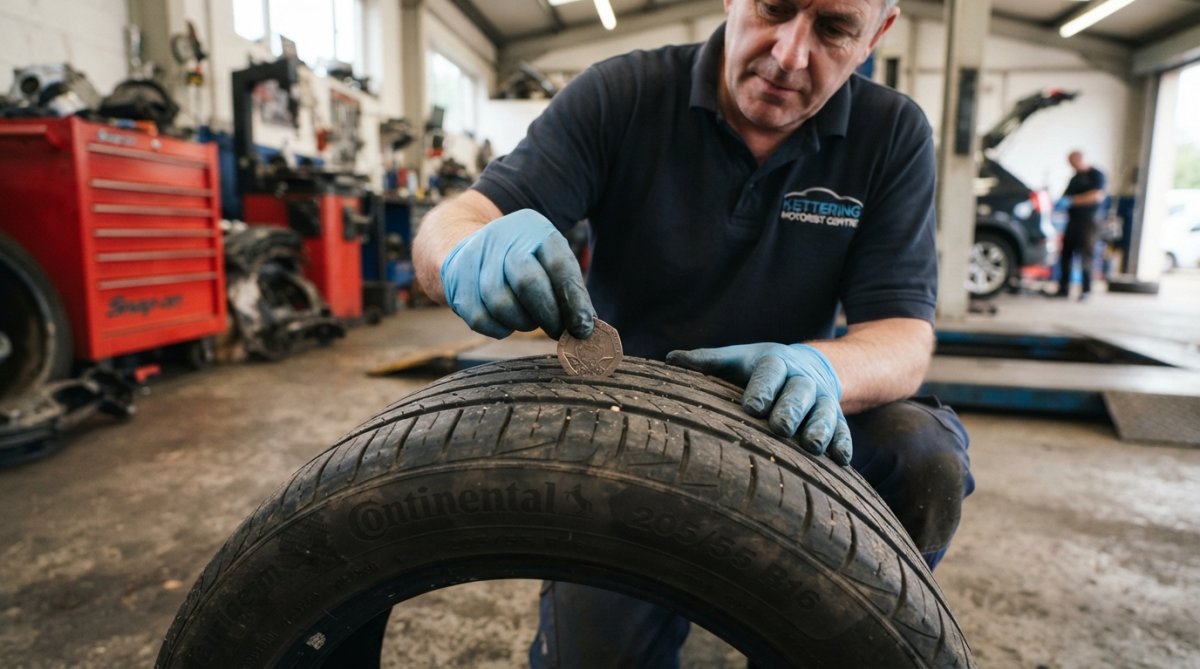
Push the 20p coin into the tread groove at an angle, with the outer edge of the coin going in first.
Step 4: Check the result
If the outer ring of the 20p coin disappears into the tread groove, your tyre tread depth is above 1.6mm and you're legal. If the outer ring remains visible above the tread surface, your tyre is at or below 1.6mm and needs replacing immediately.
Repeat this test at multiple points around each tyre, at least three locations per tyre. Uneven wear across the tyre can indicate alignment or suspension problems that need professional attention.
Close-up of a 20p coin being inserted into a tyre tread groove at an angle to demonstrate the coin test method, showing the coin's outer rim at the tread surface level
Step 5: Check all four tyres
Don't assume all four tyres wear at the same rate. Front tyres often wear faster than rear tyres. If one tyre is significantly more worn than the others, have your alignment and suspension checked.
Accuracy and Limitations of the Coin Method
The 20p test is reasonably accurate for determining whether you're above or below the 1.6mm legal limit, but it's a binary check, legal or not, without telling you exactly how much tread you have left. If your tyre is at 2.5mm, the coin test will pass, but you're still in a danger zone for wet weather driving.
For more precise measurement, many drivers prefer using a digital tread depth gauge.
Pro TipTest your tyres in multiple locations around the circumference and across the width. Uneven wear patterns often indicate suspension or alignment issues that need professional inspection. This is something we check during your MOT at Kettering Motorist Centre.
Using a Tyre Tread Depth Gauge for Precise Measurement
Digital Gauge vs. Mechanical Gauge Accuracy
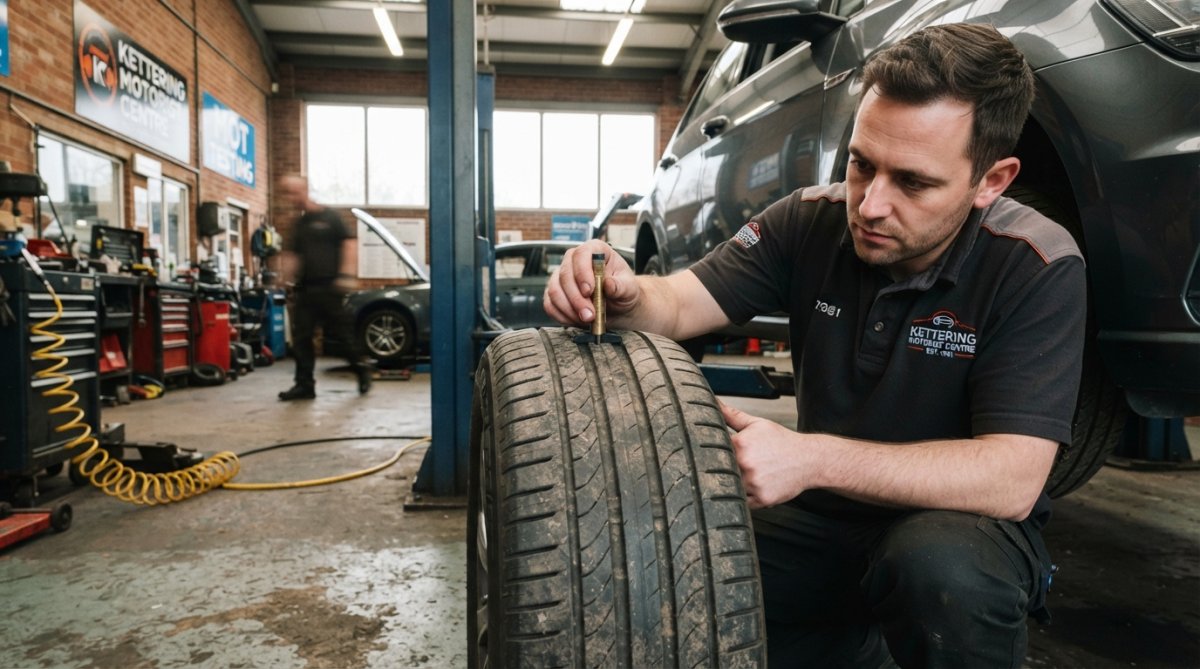
A digital tread depth gauge gives you a precise numerical reading in millimetres, far more informative than the pass/fail result of the 20p test. Digital gauges typically measure from 0mm to 25mm with accuracy to within 0.1mm, allowing you to track your tyre wear over time and plan replacement before reaching the legal limit.
Mechanical (analogue) gauges work on a similar principle but use a dial or scale instead of a digital readout. They're often cheaper and require no batteries, but they're slightly less precise and harder to read in poor light.
Digital gauges are generally more user-friendly. You simply press the gauge firmly into the tread groove until it seats properly, and the reading appears on the screen.
How to Use a Tread Depth Gauge Correctly
Step 1: Locate the main tread grooves
Identify the deepest grooves running around the tyre, not the smaller sipes.
Step 2: Press the gauge firmly into the groove
Insert the probe straight down into the tread groove, perpendicular to the tyre surface. Push it in firmly until the gauge's base plate sits flat on the tread surface.
Step 3: Read the measurement
For digital gauges, the reading appears on the screen. For mechanical gauges, read the needle position on the dial.
Step 4: Test multiple locations
Check at least three locations around the circumference of each tyre and at least two locations across the width. This reveals wear patterns.
Step 5: Document your readings
Write down the measurements for each tyre. This gives you a baseline so you can track wear rate over time.
Tyre Position
Measurement Method
Accuracy
Best For
All four tyres
20p coin test
Pass/fail only
Quick legal check
All four tyres
Digital gauge
0.1mm precision
Detailed wear tracking
All four tyres
Mechanical gauge
±0.5mm
Budget-conscious drivers
Professional check
MOT tester
±0.2mm with visual inspection
Comprehensive assessment
Visual Inspection: Spotting Tyre Wear and Damage
Locating the Tread Wear Indicator (TWI)
The Tread Wear Indicator is a built-in safety feature on modern tyres that you can use to check tread depth visually without any tools. It's a small raised bar of rubber positioned at the bottom of the main tread grooves, typically placed at intervals around the tyre. When your tyre tread wears down to the same level as the TWI, you've reached 1.6mm, the legal minimum.
To find the TWI on your tyre, look for small markings or symbols on the sidewall that indicate where the indicators are located. Common symbols include a triangle, a dot, or the letters "TWI". If the tread surface is level with the TWI bar, your tyre is at the legal limit.
The TWI is more reliable than the 20p coin test because it's engineered to align precisely with 1.6mm depth. However, it only tells you when you've reached the legal minimum, not when you've reached the 3mm safety threshold that many experts recommend.
Identifying Uneven Wear Patterns and Sidewall Damage
Beyond tread depth, visual inspection can reveal problems that indicate deeper issues with your vehicle. Uneven wear patterns are particularly important because they often signal suspension, alignment, or tyre pressure problems.
Centre wear: If the centre of the tyre is noticeably more worn than the edges, your tyres are overinflated. Check your tyre pressure and adjust to the vehicle manufacturer's recommended level.
Edge wear: If both edges of the tyre are more worn than the centre, your tyres are underinflated. This also reduces fuel efficiency and increases heat buildup.
One-sided wear: If one edge of the tyre is significantly more worn than the rest, your vehicle's wheel alignment is likely out. At Kettering Motorist Centre, we can check your alignment and make adjustments to extend tyre life and improve your vehicle's handling.
Patchy or cupped wear: If the tread surface has a wavy appearance with dips and peaks, your suspension may be worn.
Sidewall damage is also critical. Look for cuts, bulges, or cracks in the rubber on the sides of the tyre. Any damage to the sidewall compromises the tyre's structural integrity and can lead to sudden failure. Sidewall damage cannot be repaired; the tyre must be replaced.
Watch OutNever ignore sidewall damage or bulges, no matter how small. A bulging sidewall can fail suddenly without warning, potentially causing loss of control. Replace the tyre immediately. Similarly, any cut deeper than 6mm or wider than 25mm should result in replacement, not repair.
Consequences of Driving with Illegal Tyre Tread in the UK
Driving on tyres below the legal 1.6mm minimum tread depth carries serious consequences. You face a fixed penalty notice of £1,000 per tyre, up to a maximum of £10,000 if all four tyres are illegal. You'll also receive three penalty points on your driving licence for each illegal tyre (up to 12 points total, which would result in disqualification).
Beyond the legal consequences, the safety risks are severe. At 1.6mm tread depth, your braking distance on wet roads is significantly longer than on a tyre with adequate tread. In an emergency stop situation, that extra distance could be the difference between avoiding a collision and hitting another vehicle or pedestrian.
Aquaplaning risk increases dramatically with shallow tread. When water cannot be channelled away from the tyre's contact patch, the tyre loses grip and essentially floats on the water surface. This can happen suddenly and without warning, leaving you with no steering or braking control.
Your insurance may also be affected. If you're involved in an accident and your tyres are found to be below the legal minimum, your insurer may refuse to pay out, arguing that you were driving an unroadworthy vehicle.
When to Replace Your Tyres: Beyond the Legal Minimum
Weather Conditions and Tyre Safety
While 1.6mm is the legal minimum, it's not the safety minimum for most driving conditions. The UK's wet climate means that most drivers encounter wet roads regularly, and tyre performance deteriorates significantly as tread depth decreases.
At 3mm tread depth, your braking distance on wet roads increases noticeably compared to a new tyre at 8mm. Many safety experts recommend replacing tyres when they reach 3mm, particularly if you drive frequently in wet conditions, on motorways, or in winter months. Winter tyres should be replaced even earlier, at around 4mm, because winter performance drops off sharply below that level.
If you regularly drive long distances on motorways, consider replacing tyres at 4mm. Motorway driving at high speeds puts more stress on tyres, and the margin for error is smaller. If you're approaching winter (November through March in the UK), check your tyre tread now. If you're at 3mm or below, replace them before winter arrives.
Professional Tyre Replacement at Kettering Motorist Centre
When it's time to replace your tyres, Kettering Motorist Centre in Kettering, Northamptonshire, handles tyre replacement with attention to detail. Our team can advise you on the right tyre type for your vehicle and driving needs, whether that's all-season tyres, winter tyres, or performance tyres.
We offer hassle-free online booking for tyre appointments with no upfront payment required. You can check availability and book at a time that suits you, and we'll confirm the work and final cost before we start. Beyond just replacing tyres, we also check your wheel alignment and suspension during the process. Uneven wear patterns often indicate alignment issues, and fixing these at the same time as tyre replacement prevents your new tyres from wearing prematurely.
For drivers in Kettering and the surrounding Northamptonshire area, including Corby, Wellingborough, and Market Harborough, we provide expert tyre services backed by our family-run business's reputation for reliability and transparent pricing. If you have a hybrid or electric vehicle, our sister site KMC Electric provides specialist expertise for electric and hybrid tyre and suspension work.
Pro TipWhen replacing tyres, always replace them in pairs (front or rear) rather than one at a time. This maintains even handling and braking performance. If possible, replace all four at once.
Common Mistakes When Checking Tyre Tread Depth
Many drivers make avoidable mistakes when checking their tyres. Understanding these mistakes helps you get accurate readings and make informed decisions.
Mistake 1: Only checking one spot per tyre. Tyres wear unevenly. Always check at least three locations around the circumference and two locations across the width.
Mistake 2: Confusing the TWI with actual tread depth. The TWI aligns with 1.6mm but doesn't indicate when you've reached the 3mm safety threshold. Use the TWI as a last-resort warning, not as your target replacement point.
Mistake 3: Ignoring sidewall damage while focusing on tread depth. A tyre can have adequate tread depth but be unsafe due to sidewall cracks, bulges, or cuts. Always visually inspect the entire tyre.
Mistake 4: Assuming all tyres wear at the same rate. Front tyres typically wear faster than rear tyres. Check all four tyres separately.
Mistake 5: Using the 20p test as your only check. The coin test is a quick pass/fail check, but it doesn't tell you how much tread you actually have. Use it as a quick check, but follow up with a gauge if you want precise information.
Mistake 6: Ignoring tyre pressure. Tyre pressure affects wear rate directly. Underinflated tyres wear faster and reduce fuel efficiency. Check your tyre pressure monthly and adjust to the manufacturer's recommended level.
Mistake 7: Delaying replacement until you reach the legal minimum. By the time you hit 1.6mm, you're already in a danger zone for wet weather driving. Plan replacement at 3mm.
Checking your tyre tread depth is one of the simplest yet most important vehicle maintenance tasks you can do. Whether you use the 20p coin test, a digital gauge, or the Tread Wear Indicator, the key is to check regularly and replace tyres before they become unsafe. At Kettering Motorist Centre, we understand that vehicle maintenance can feel overwhelming, which is why we've made tyre replacement straightforward and transparent. Our expert team can assess your tyres, advise on the best replacement options for your vehicle and driving needs, and handle the work with complete professionalism. Book your tyre appointment online today, no upfront payment, no pressure, just honest advice and expert service.
Frequently Asked Questions
What is the legal tyre tread depth limit in the UK?
The legal minimum tyre tread depth in the UK is 1.6mm across the central three-quarters of the tyre. This applies to all vehicles. The MOT test checks for this minimum, and driving below this limit is illegal and dangerous. However, many safety experts recommend replacing tyres at 3mm for better grip and shorter stopping distances, especially in wet conditions.
How accurate is the 20p coin test compared to a tyre tread depth gauge?
The 20p test is a quick, practical check that works because the outer edge of a 20p coin is approximately 1.6mm thick. However, a digital or mechanical tyre tread depth gauge is significantly more accurate and provides precise measurements. Gauges are particularly useful for monitoring gradual wear and checking multiple points across the tyre to identify uneven wear patterns that the coin test might miss.
What happens if I drive with illegal tyre tread depth in the UK?
Driving with tyres below 1.6mm tread depth is illegal and can result in a fixed penalty notice of £100 per tyre (up to £400 for all four tyres) and three penalty points per tyre (up to 12 points). Your vehicle will also fail its MOT test. More importantly, illegal tyres significantly increase stopping distances and the risk of aquaplaning in wet weather, compromising your safety and that of others on the road.
How often should I check my tyre tread depth?
Check your tyre tread depth at least once a month and before long journeys. Regular checks help you catch uneven wear early, which may indicate alignment issues or suspension problems. If you notice rapid wear, book a professional inspection at Kettering Motorist Centre to diagnose any underlying vehicle issues. Seasonal checks are also recommended as weather conditions affect tyre wear rates.
Your booking Failed
Please try again or please call 01536 410142
Thank you for placing a booking with Kettering Motorist Centre Limited for vehicle
PLEASE TAKE YOUR BOOKING REFERENCE NUMBER WITH YOU TO THE MOT CENTRE
Your items
MOT Test
×
Terms and Conditions
These terms and conditions form the basis on which you can visit and use this website. Please read them carefully as they contain important information.
General terms and conditions
This website is owned and operated by Kettering Motorist Centre Ltd (company registration number: 4485858) operating at Trafalgar Road, Kettering, Northamptonshire, NN16 8DB (the "MOT Centre", the "Company", "we" or "us"). If you have any queries about these terms and conditions or if you have any comments or complaints on or about this website, you can contact us at [email protected] or 01536 410142.
The website is to promote and offer for sale the products and services of Kettering Motorist Centre Limited.
1. The contract between us
This website does not take payment for products or services online. The website enables you to view products and services online and to make a booking for later delivery and payment. The vehicle and provision of other products and services promoted by this website and the payment by you of the price of those products and services will take place at the MOT Centre. The booking does not constitute a contract.
The booking process on the site provides details of the booked MOT order. Please take the time to read and check your booking. It is your responsibility to make sure the order is correct and for the correct vehicle.
2. Ownership of rights
All rights, including copyright, in this website are owned by or licensed to the Company. Any use of this website or its contents, including copying or storing it or them in whole or part, other than for your own personal, non commercial use, is prohibited without our permission. You may not modify, distribute or repost anything on this website for any purpose.
3. Accuracy of content
We have taken care in the preparation of the content of this website, in particular to ensure that prices quoted are correct at the time of publishing and that all goods have been fairly described. However, bookings will only be accepted if there are no material errors in the description of the goods or their prices as advertised on this website. Any weights, dimensions and capacities given about the goods are approximate only.
4. Damage to your computer
We try to ensure that this website is free from viruses or defects. However, we cannot guarantee that your use of this website or any websites accessible through it will not cause damage to your computer. It is your responsibility to ensure that the right equipment is available to use the website. Except in the case of negligence on our part, we will not be liable to any person for any loss or damage which may arise to computer equipment as a result of using this website.
5. Availability
All bookings are subject to acceptance and availability. If the MOT date you have requested are is not available, the Centre will contact you by e-mail or phone. You will have the option either to wait until another slot is available or to cancel your booking.
6. Booking errors
You are able to correct errors on your booking up to the point on which you click on “Place Booking” during the booking process.
7. Price
The prices payable for goods that you order are as set out in our website. All prices are inclusive of VAT at the current rates and are correct at the time of entering information, errors and omissions excepted.
Whenever it is not possible to accept your booking to buy goods of the specification and description at the price indicated, the MOT Centre will advise you by email or phone or when you visit the centre.
8. Payment terms
You will be required to pay for the goods or services to the Centre at time of a completed MOT.
9. Delivery charges
N/A
10. Cancellation
The MOT Centre reserves the right to cancel the booking if:
10.1 There is insufficient stock to deliver the goods you have booked.
10.2 One or more of the goods you booked was listed at an incorrect price.
If your booking is cancelled the Centre will notify you by e-mail or phone.
You have the right to cancel your booking at any time up to the point of the MOT. If you do cancel your booking you should inform the centre by phone.
11. Liability
Notwithstanding the foregoing, nothing in these terms and conditions is intended to limit any rights you might have as a consumer under applicable local law or other statutory rights that may not be excluded nor in any way to exclude or limit our liability to you for any death or personal injury resulting from our negligence.
12. Notices
Unless otherwise expressly stated in these terms and conditions, all notices from you to us must be in writing and sent to our contact address given above and all notices from us to you will be displayed on our website from time to time.
13. Changes to legal notices
We reserve the right to change these terms and conditions from time to time and you should look through them as often as possible.
14. Law, jurisdiction and language
This website, any content contained therein and any contract brought into being as a result of usage of this website are governed by and construed in accordance with English law. Parties to any such contract agree to submit to the exclusive jurisdiction of the courts of England and Wales.
15. Invalidity
If any part of these terms and conditions is unenforceable (including any provision in which we exclude our liability to you) the enforceability of any other part of these conditions will not be affected.
16. Privacy
You acknowledge and agree to be bound by the terms of our privacy policy
17. Third party rights
Nothing in this Agreement is intended to, nor shall it confer any rights on a third party.