Diagnosing suspension noise is the process of matching a specific sound to the component that produces it, then confirming the fault with a physical check before any parts are replaced. At Kettering Motorist Centre, we often hear the same complaint: a clunk, squeak or knock that only appears on certain roads. The good news is that you can narrow down the cause yourself in an afternoon, and this guide shows you how to diagnose car suspension noise UK drivers deal with every day, from pothole clunks to speed bump squeaks.
You do not need a workshop full of equipment to get a useful answer. You need the right conditions and a methodical approach.
What you'll need:
A trolley jack and two axle stands, rated for your vehicle's weight
A tyre pressure gauge and a torch or inspection lamp
A pry bar or long screwdriver for checking play
Work gloves and wheel chocks
A dry, level surface such as a driveway or quiet car park
Watch OutNever work under a car supported only by a jack. Use axle stands on a level, solid surface, and chock the wheels that stay on the ground. Suspension work involves levering components under load, and a jack can slip.
Step 1: Match the Noise to the Driving Condition
The fastest diagnostic tool is your own ears. Where and when a noise appears tells you more than how loud it is, because different suspension components load up under different conditions. Before you lift the car, drive a short loop that includes a rough section, a speed bump and a slow full-lock turn, and note exactly when the sound happens.
Clunking Over Bumps and Potholes
A single heavy clunk as the wheel drops into a pothole usually points to worn anti-roll bar links or a failing top mount. If the clunk repeats rapidly over a rough surface, suspect a worn bush or a shock absorber that has lost its damping. A clunk that appears only when one wheel hits a bump suggests the fault is on that corner.
Squeaking When Turning or Going Over Speed Bumps
Squeaking is usually rubber against metal. Worn anti-roll bar bushes, dried-out suspension arm bushes and a dry top mount bearing are the common culprits. If the squeak only happens at full lock, check the top mount bearing first, since it rotates with the steering.
Knocking During Low-Speed Manoeuvres
A knock or single click during parking manoeuvres often comes from a worn CV joint on front-wheel-drive cars, or from a loose drop link. Knocking that speeds up with road speed rather than engine speed points to a rotating component rather than the suspension itself.
Step 2: How to Check for Suspension Play at Home
Checking for suspension play means physically loading each corner and feeling for movement that should not be there. It is the single most useful test you can do without a ramp, and it takes about ten minutes per corner.
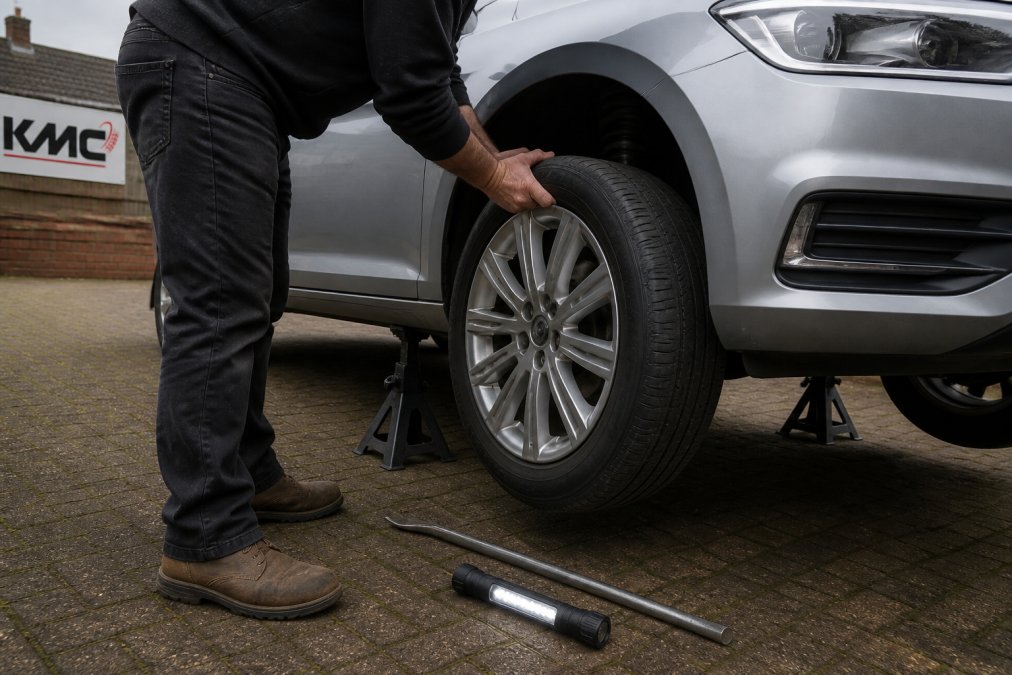
Chock the rear wheels and raise one corner on the jack, then lower it onto an axle stand.
Grip the tyre at the top and bottom and rock it in and out. Any noticeable movement suggests wheel bearing or top mount wear.
Grip at the three o'clock and nine o'clock positions and rock again. Movement here points to track rod ends or steering rack wear.
Slide a pry bar under the wheel and lift gently. Clunking or visible movement in the ball joint means replacement is due.
Repeat on the other three corners, and note which corner produces the most movement.
If you find play but cannot identify the exact source, that is the point to stop and book a proper inspection. Guessing here gets expensive quickly.
Step 3: Inspect Key Suspension Components
Component inspection is where you confirm what the play test suggested. Work through each part in order, checking for the specific wear signs that matter.
Shock Absorbers and Struts
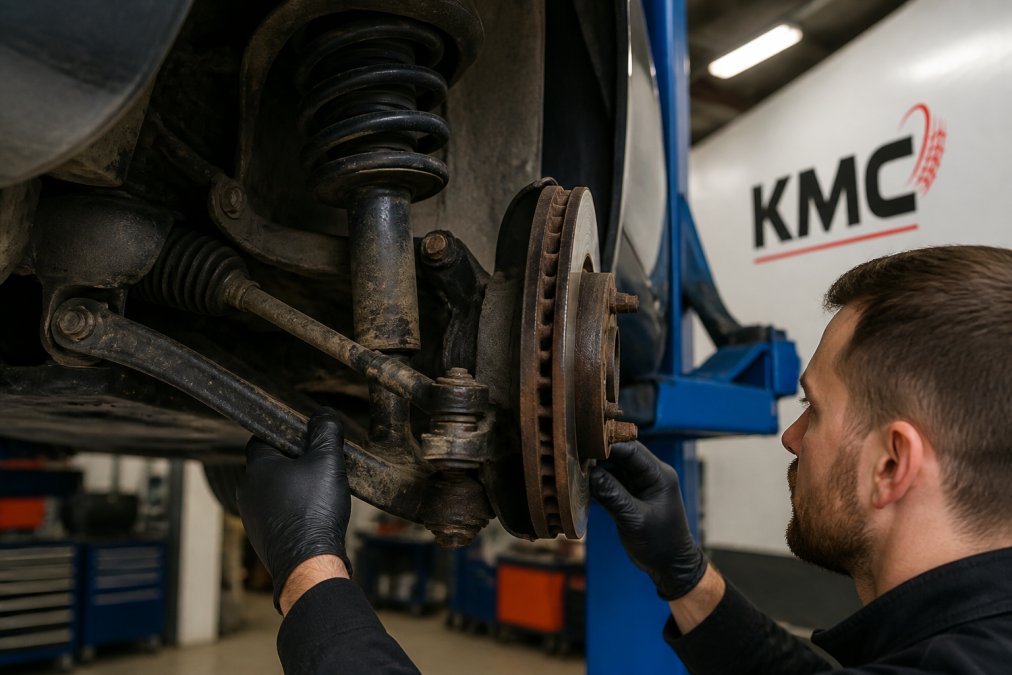
Look for oil weeping down the body of the damper, which means the seal has failed. Bounce the corner of the car firmly and release it; if it continues to rock more than once, the damper is not controlling the spring. Check the top mount for cracked rubber and any rust around the mounting bolts.
Ball Joints and Tie Rod Ends
Grab the joint and try to twist it. A small amount of rotational movement is normal, but vertical or side-to-side play is not. Check the rubber boot for splits, since a split boot lets water in and accelerates wear. Any joint with play will fail an MOT.
Bushes and Anti-Roll Bar Links
Look for cracked, perished or missing rubber, and for shiny metal where a bush has worn through to the housing. Anti-roll bar links are cheap to replace and are one of the most common sources of clunks, so check them before condemning anything more expensive.
Suspension faults are among the most frequent reasons a car fails its MOT, and most of them are visible to an inspector long before they become dangerous (gov.uk). Worn ball joints, broken coil springs, leaking shock absorbers, split bushes and excessive play in track rod ends all count as defects, and several are classed as dangerous, meaning the car cannot be driven away.
The DVSA publishes the full inspection manual, and it is worth reading the suspension section if you want to know exactly what an examiner checks. The DVSA MOT inspection manual for cars sets out the pass and fail criteria for each component, including the tolerance allowed for play. If you would rather not guess, an MOT test at Kettering Motorist Centre will identify any suspension defect, and our online booking takes a minute with no payment upfront.
Electric Vehicle Suspension Maintenance
Electric vehicles wear their suspension differently. The extra weight of a battery pack loads the springs, dampers and bushes harder than a comparable petrol car, so these parts can wear sooner even though there is no engine vibration to mask the early signs. Regenerative braking also means the friction brakes are used less, which is unrelated to suspension but worth knowing when you book a service.
The quieter cabin is the other factor. Without engine noise, you will hear a worn bush or a dry top mount long before you would in a petrol car, which is an advantage if you act on it. At KMC Electric, our team handles electric and hybrid suspension checks alongside routine servicing, and we use the same diagnostic equipment as any main dealer. If your hybrid or EV has developed a knock, book it in and we will check the suspension and the drivetrain together.
Troubleshooting Checklist for Common Suspension Noises
Work through this checklist before you spend anything on parts. Each item takes a few minutes and rules out the cheap causes first.
Confirm the noise is suspension, not a loose exhaust heat shield or a rattling brake pad
Check tyre pressures and look for uneven wear across the tread
Rock each wheel at 12 and 6, then at 3 and 9, and note any play
Bounce each corner and count the rebounds
Inspect anti-roll bar links and bushes for cracks or missing rubber
Check damper bodies for oil weeping
Look at ball joint and track rod end boots for splits
Check the top mounts under the bonnet for cracked rubber
Road test again on the same route and confirm whether the noise has changed
Pro TipA noise that disappears in the wet is almost always a rubber bush or a dry top mount, because water temporarily lubricates the contact point. It will come back when the car dries out, so note it and get it checked rather than waiting for it to become a clunk.
When to Seek Professional Help for Suspension Noise
Book a professional inspection when you cannot reproduce the noise, when you find play you cannot trace to a single component, or when the car feels unstable at speed. Steering that wanders, a wheel that vibrates above motorway speeds, or a visible lean on one corner all point to faults that need a ramp and proper diagnostic equipment.
Suspension work is also safety-critical. A ball joint that fails at speed can cause loss of control, and a broken coil spring can puncture a tyre. If you are in any doubt about what you have found, stop driving and get it looked at.
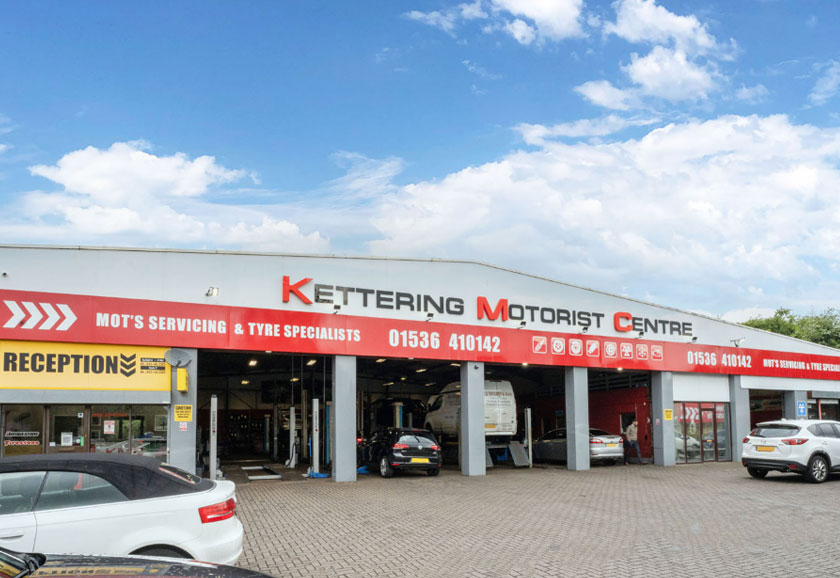
If you are searching for suspension noise diagnosis near me in the Kettering area, Kettering Motorist Centre offers expert diagnostic and repair services for all makes, including hybrid and electric vehicles, with a hassle-free online booking system for MOT and tyre appointments that requires no upfront payment. Whether you are in Kettering itself, Corby or elsewhere in Northamptonshire, you can book online in minutes and we will confirm exactly what is wrong before any work begins.
Suspension noise rarely fixes itself, and the longer a worn bush or ball joint is left, the more of the surrounding components it takes with it. If your checks have pointed to a fault you would rather not tackle on the driveway, Kettering Motorist Centre can take it from there with expert diagnostic and repair services, specialist support for hybrid and electric vehicles, and a transparent booking process that lets you schedule an MOT or tyre appointment online with no payment required upfront. Get started with Kettering Motorist Centre and put an end to the clunk.
Frequently Asked Questions
What are the common signs of bad suspension in a UK car?
Common signs include clunking or knocking over bumps, squeaking when turning, excessive bouncing after a speed bump, uneven tyre wear, and the car pulling to one side. You might also notice the steering feeling vague or the car dipping sharply when braking. Any of these symptoms mean you should get the suspension checked, especially before an MOT.
Can suspension noise cause an MOT failure?
Yes, suspension noise can lead to an MOT failure if it points to a defective component. Testers check for worn ball joints, broken springs, leaking shock absorbers, and excessive play in bushes. A clunk or knock often means a part has failed, which is a major defect. Getting it diagnosed early at a garage like Kettering Motorist Centre can save you a failed test.
Is it safe to drive with a noisy suspension?
It is not advisable. A noisy suspension often means a component is worn or broken, which can affect steering, braking, and tyre grip. Driving with a faulty suspension can worsen the damage and put you at risk. If you hear clunking or knocking, book a diagnostic check as soon as possible to avoid a breakdown or an accident.
How do I check for worn ball joints or tie rod ends?
With the car safely jacked up and supported on axle stands, grip the wheel at the top and bottom and try to rock it. Any movement suggests worn ball joints. For tie rod ends, grip the wheel at the sides and rock it. You can also look for torn rubber boots or grease leaks. If you find play, have a professional confirm the diagnosis.
Thank you for placing a booking with Kettering Motorist Centre Limited for vehicle
PLEASE TAKE YOUR BOOKING REFERENCE NUMBER WITH YOU TO THE MOT CENTRE
Your items
MOT Test
×
Terms and Conditions
These terms and conditions form the basis on which you can visit and use this website. Please read them carefully as they contain important information.
General terms and conditions
This website is owned and operated by Kettering Motorist Centre Ltd (company registration number: 4485858) operating at Trafalgar Road, Kettering, Northamptonshire, NN16 8DB (the "MOT Centre", the "Company", "we" or "us"). If you have any queries about these terms and conditions or if you have any comments or complaints on or about this website, you can contact us at [email protected] or 01536 410142.
The website is to promote and offer for sale the products and services of Kettering Motorist Centre Limited.
1. The contract between us
This website does not take payment for products or services online. The website enables you to view products and services online and to make a booking for later delivery and payment. The vehicle and provision of other products and services promoted by this website and the payment by you of the price of those products and services will take place at the MOT Centre. The booking does not constitute a contract.
The booking process on the site provides details of the booked MOT order. Please take the time to read and check your booking. It is your responsibility to make sure the order is correct and for the correct vehicle.
2. Ownership of rights
All rights, including copyright, in this website are owned by or licensed to the Company. Any use of this website or its contents, including copying or storing it or them in whole or part, other than for your own personal, non commercial use, is prohibited without our permission. You may not modify, distribute or repost anything on this website for any purpose.
3. Accuracy of content
We have taken care in the preparation of the content of this website, in particular to ensure that prices quoted are correct at the time of publishing and that all goods have been fairly described. However, bookings will only be accepted if there are no material errors in the description of the goods or their prices as advertised on this website. Any weights, dimensions and capacities given about the goods are approximate only.
4. Damage to your computer
We try to ensure that this website is free from viruses or defects. However, we cannot guarantee that your use of this website or any websites accessible through it will not cause damage to your computer. It is your responsibility to ensure that the right equipment is available to use the website. Except in the case of negligence on our part, we will not be liable to any person for any loss or damage which may arise to computer equipment as a result of using this website.
5. Availability
All bookings are subject to acceptance and availability. If the MOT date you have requested are is not available, the Centre will contact you by e-mail or phone. You will have the option either to wait until another slot is available or to cancel your booking.
6. Booking errors
You are able to correct errors on your booking up to the point on which you click on “Place Booking” during the booking process.
7. Price
The prices payable for goods that you order are as set out in our website. All prices are inclusive of VAT at the current rates and are correct at the time of entering information, errors and omissions excepted.
Whenever it is not possible to accept your booking to buy goods of the specification and description at the price indicated, the MOT Centre will advise you by email or phone or when you visit the centre.
8. Payment terms
You will be required to pay for the goods or services to the Centre at time of a completed MOT.
9. Delivery charges
N/A
10. Cancellation
The MOT Centre reserves the right to cancel the booking if:
10.1 There is insufficient stock to deliver the goods you have booked.
10.2 One or more of the goods you booked was listed at an incorrect price.
If your booking is cancelled the Centre will notify you by e-mail or phone.
You have the right to cancel your booking at any time up to the point of the MOT. If you do cancel your booking you should inform the centre by phone.
11. Liability
Notwithstanding the foregoing, nothing in these terms and conditions is intended to limit any rights you might have as a consumer under applicable local law or other statutory rights that may not be excluded nor in any way to exclude or limit our liability to you for any death or personal injury resulting from our negligence.
12. Notices
Unless otherwise expressly stated in these terms and conditions, all notices from you to us must be in writing and sent to our contact address given above and all notices from us to you will be displayed on our website from time to time.
13. Changes to legal notices
We reserve the right to change these terms and conditions from time to time and you should look through them as often as possible.
14. Law, jurisdiction and language
This website, any content contained therein and any contract brought into being as a result of usage of this website are governed by and construed in accordance with English law. Parties to any such contract agree to submit to the exclusive jurisdiction of the courts of England and Wales.
15. Invalidity
If any part of these terms and conditions is unenforceable (including any provision in which we exclude our liability to you) the enforceability of any other part of these conditions will not be affected.
16. Privacy
You acknowledge and agree to be bound by the terms of our privacy policy
17. Third party rights
Nothing in this Agreement is intended to, nor shall it confer any rights on a third party.