Proper tyre pressure affects fuel efficiency, braking distance, and overall road safety, yet remains one of the most overlooked aspects of vehicle maintenance. Under-inflated tyres generate excess heat and increase rolling resistance, whilst over-inflated tyres cause uneven tread wear. Both compromise braking distance and increase the risk of tyre failure during emergency manoeuvres or poor weather.
At Kettering Motorist Centre, we see the consequences of neglected tyre pressure weekly. Drivers who don't check regularly experience premature tread wear, reduced fuel economy, and dangerous blowouts. Learning to check tyre pressure safely takes minutes and requires minimal equipment. Checking tyres before an MOT is particularly important, as incorrect pressure causes uneven wear that results in failure. Regular pressure checks keep you safe, save money on fuel, and extend tyre life significantly.
Finding the Recommended Tyre Pressure for Your Car
Your vehicle's recommended tyre pressure is a precisely calculated figure based on your car's weight, suspension design, and load capacity. Every vehicle has a specific cold inflation pressure, measured when tyres are cold (before driving or at least three hours after).
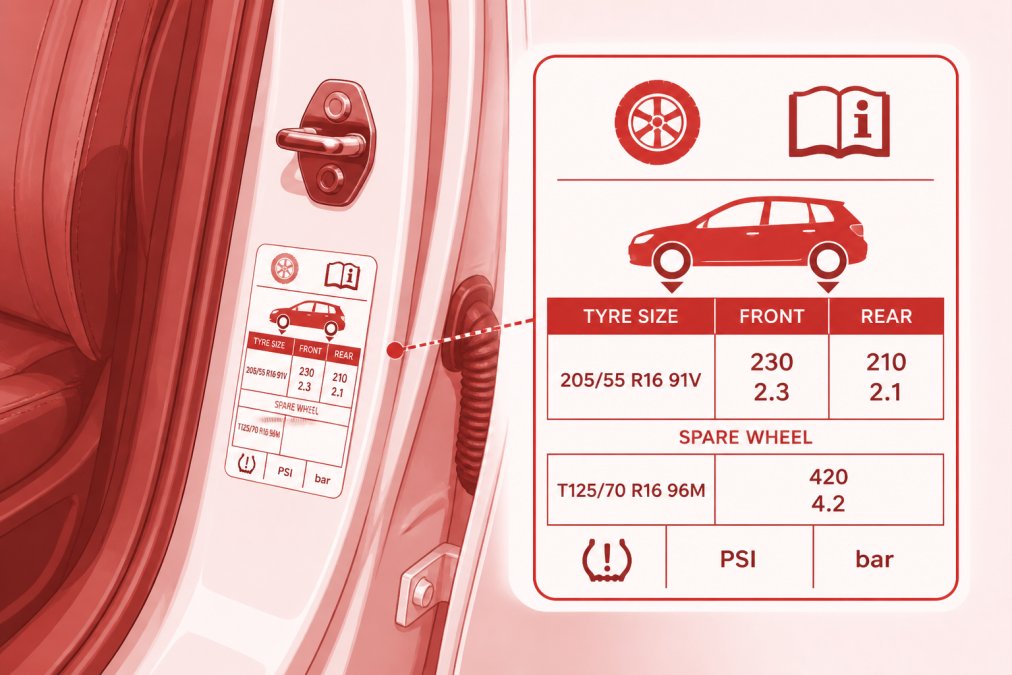
The fastest source is the tyre placard, usually located on the driver's side door jamb or fuel door. This label displays the recommended pressure in both PSI (pounds per square inch) and bar, along with maximum tyre load rating.
Locating the Tyre Placard
The tyre placard is a small white or silver label with black text, typically on the inside edge of the driver's door or fuel filler flap. It shows the recommended pressure for front and rear tyres (which may differ) and maximum load capacity.
Some vehicles have different pressure recommendations for front and rear tyres. If carrying heavier loads, passengers, or luggage, you may increase pressure slightly within the vehicle manufacturer's guidelines.
If you can't locate a placard, check your owner's manual or contact the dealership. For hybrid and electric vehicles serviced at Kettering Motorist Centre, we can provide this information during your next appointment. For electric vehicle owners, visit our sister site KMC Electric for EV-specific guidance to understand how battery weight affects tyre pressure recommendations.
Understanding PSI and Bar
PSI stands for pounds per square inch, whilst bar is the metric equivalent. One bar equals approximately 14.5 PSI. Most UK vehicles use PSI as their primary measurement on the placard, though bar increasingly appears alongside it. A typical passenger car might have a recommended pressure of 32 PSI (2.2 bar), whilst heavier vehicles, SUVs, and vans typically require 35-38 PSI (2.4-2.6 bar). Always cross-reference which unit your gauge displays with your placard to avoid dangerous under-inflation or over-inflation.
Tools You'll Need to Check Tyre Pressure
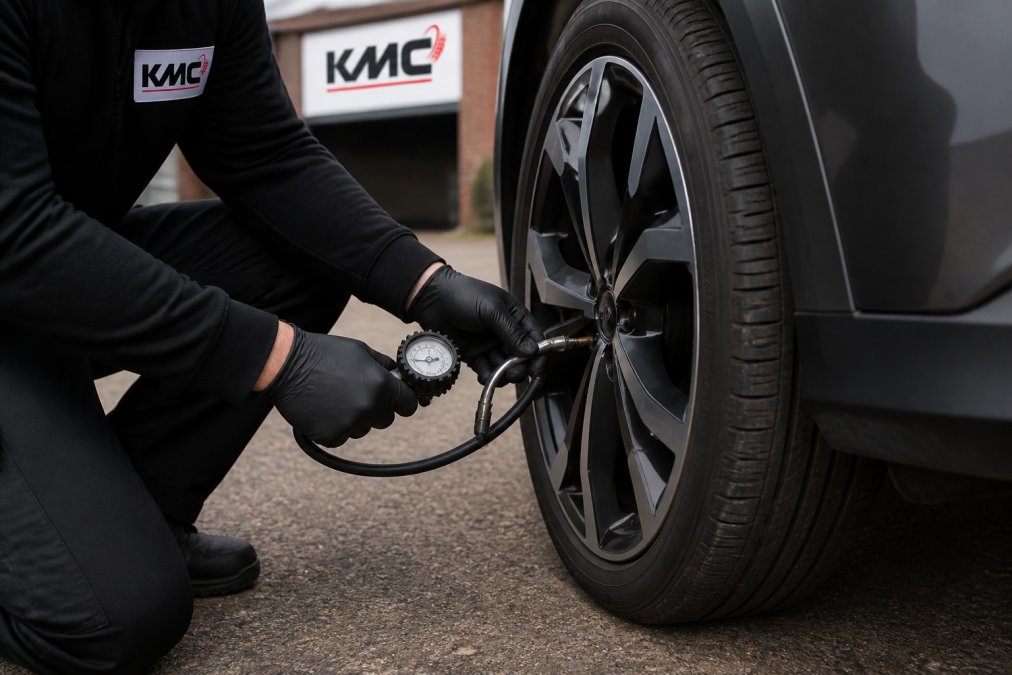
You need only a basic tyre pressure gauge and access to compressed air. A tyre pressure gauge (digital or analog) and compressor with pressure gauge (available at petrol stations, supermarkets, and other providers) are essential. Modern vehicles include a tyre pressure monitoring system (TPMS) that alerts you when pressure drops significantly, but this is not a substitute for manual checking.
Digital vs. Analog Gauges
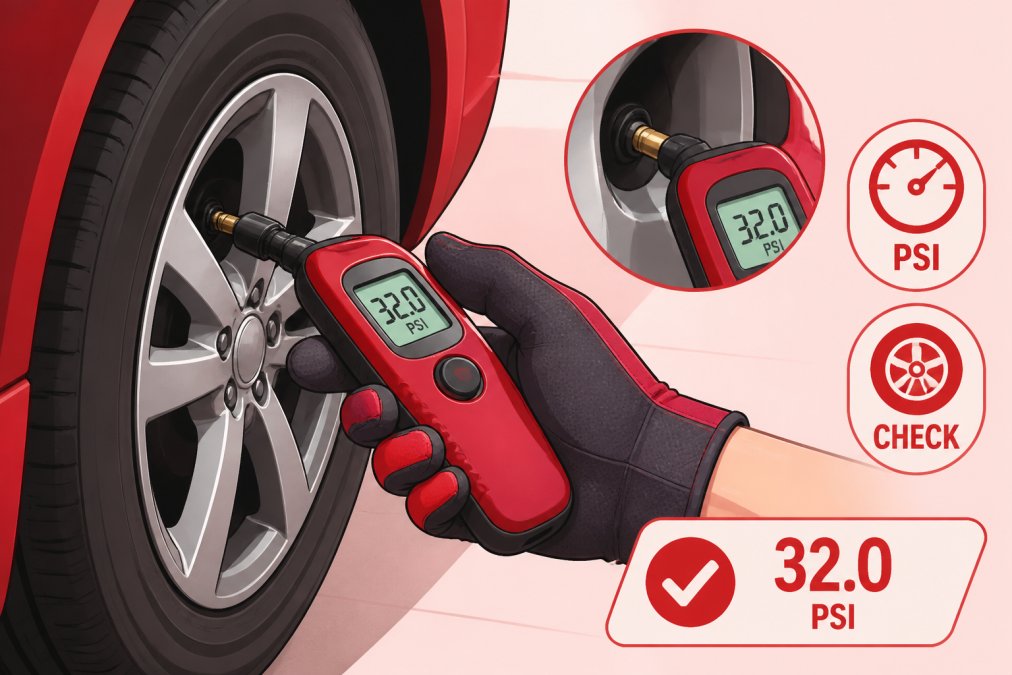
Digital gauges display pressure on an LCD screen and are generally more accurate and easier to read, typically costing between £10 and £25. Analog gauges use a needle and dial and are cheaper (£5-£15), but harder to read accurately and prone to drift if dropped. For most home users, a digital gauge is the better choice.
At Kettering Motorist Centre, we use calibrated digital gauges during every tyre check and MOT appointment, ensuring accuracy and precision.
Step-by-Step Guide: How to Use a Tyre Pressure Gauge
Step 1: Prepare Your Vehicle
Park on level ground with cold tyres. Check before driving or at least three hours after your last journey, as driving heats tyres temporarily, giving false high readings.
Step 2: Remove the Valve Cap
Unscrew the valve cap and keep it safe.
Step 3: Attach the Gauge
Press the gauge firmly onto the valve stem. You should hear a brief hissing sound. If you hear a loud, prolonged hiss, the gauge isn't seated properly; remove and try again.
Step 4: Read the Pressure
Digital gauges display pressure within a second or two. Write down the reading.
Step 5: Compare to Your Placard
Check the reading against your vehicle's recommended pressure. If within 2 PSI (0.15 bar), you're in the acceptable range. If lower, inflate. If higher, release some air.
Step 6: Replace the Valve Cap
Screw the valve cap back on firmly to prevent dirt and moisture from entering the valve stem.
Step 7: Repeat for All Four Tyres
Check all four tyres using the same process. Remember that front and rear pressures may differ.
Checking Cold Inflation Pressure
Cold inflation pressure is the industry standard because it provides a consistent baseline unaffected by driving heat. If you must check warm tyres, expect readings 3-5 PSI higher than cold pressure. Never deflate warm tyres to match a lower target; wait until they cool and check again.
Seasonal temperature changes also affect pressure. During winter, tyre pressure may drop 1-2 PSI for every 10°C decrease in ambient temperature. Many drivers adjust pressure slightly between seasons, particularly in regions with significant temperature variation.
Adjusting Pressure at a Compressor
If your tyres are under-inflated, use a compressor available at most petrol stations, supermarkets, and other providers. Attach the compressor nozzle firmly to the valve stem, set the desired pressure, and press start; the compressor will inflate automatically and stop at target pressure. Remove the nozzle and replace the valve cap. Repeat for remaining tyres.
At Kettering Motorist Centre, we offer free tyre pressure checks and inflation as part of routine vehicle servicing. Our online booking system makes scheduling easy with no upfront payment required; we'll check and adjust your pressures and provide a transparent quote before any additional work.
Pressure Adjustments for Different Loads and Seasons
Your vehicle's placard provides baseline pressure for standard conditions. When carrying additional weight, passengers, or luggage, tyre pressure increases slightly due to extra load. Most modern vehicles are engineered so that standard placard pressure accommodates typical load variations. If carrying significantly more weight than usual, you may increase pressure by 2-3 PSI on the loaded axle, staying within the maximum pressure listed on the tyre sidewall.
Seasonal adjustments are more significant. Winter temperatures can reduce tyre pressure by 4-6 PSI compared to summer conditions. Many drivers in Kettering and Northamptonshire adjust tyre pressure twice yearly, in spring and autumn, to account for seasonal temperature swings.
For hybrid and electric vehicles, weight considerations are even more important because these vehicles are heavier than equivalent petrol cars. The battery pack adds significant mass, affecting tyre pressure requirements. If you drive a hybrid or electric vehicle, consult your vehicle's manual or visit our sister site KMC Electric for hybrid and EV servicing guidance to understand your specific pressure needs.
Tyre Safety Checks for MOT Compliance
Your MOT test includes a tyre safety inspection, and correct tyre pressure is fundamental to passing. An MOT tester will visually inspect your tyres for damage, check tread depth, and assess overall condition. Arriving at your MOT with under-inflated tyres is a common reason for test failure. Under-inflated tyres show uneven tread wear patterns (more wear at the edges), which examiners flag immediately. Correct pressure ensures even tread wear and a better chance of passing.
Tread Depth and Legal Requirements
The legal minimum tread depth in the UK is 1.6 mm across the central three-quarters of the tyre. Many safety experts recommend replacing tyres at 3 mm, as braking distance increases significantly below this threshold, particularly in wet conditions.
Insert a 20 pence coin into the tread groove. If the outer ring is visible, your tread is below the legal minimum and your tyres must be replaced before the MOT. Correct tyre pressure supports even tread wear, extending tyre life and helping you reach the legal minimum threshold much later, saving money and improving safety.
Identifying Under-Inflated and Over-Inflated Tyres
Under-inflated tyres may appear slightly bulged at the sidewalls. The tread wear pattern is the most telling sign: if the edges are worn significantly more than the centre, your tyres have been under-inflated. Over-inflated tyres show more wear in the centre than at the edges.
If unsure about your tyres' condition, Kettering Motorist Centre offers free tyre inspections as part of our MOT and servicing packages. Our team can assess tread depth, identify pressure-related wear patterns, and recommend replacement if necessary. Book your appointment online with no upfront payment required.
Common Mistakes When Checking Tyre Pressure
Checking warm tyres. The most common error is checking pressure immediately after driving. Warm tyres read 3-5 PSI higher than cold pressure. Always check in the morning or after the vehicle has been parked for at least three hours.
Not checking all four tyres. Pressure can vary between tyres due to different wear rates, valve issues, or slow leaks. Check all four every time.
Ignoring the placard. Some drivers rely on tyre sidewall markings (the maximum pressure) instead of the vehicle placard (the recommended pressure). Always use the placard.
Over-inflating to improve fuel economy. Whilst higher pressure reduces rolling resistance slightly, over-inflating compromises handling, braking, and comfort. The fuel savings are minimal and not worth the safety trade-off.
Forgetting to replace the valve cap. A missing cap can lead to slow leaks. Always replace the cap immediately after checking.
Using an uncalibrated gauge. If your gauge is old or has been dropped, it may be inaccurate. A new digital gauge provides years of reliable service.
Troubleshooting Faulty Valves and Pressure Loss
If you check tyre pressure regularly and notice it dropping faster than expected, a faulty valve may be the culprit. Valve stems are small but critical components that allow air in and prevent it from escaping.
Signs of a faulty valve include:
Hissing sound coming from the tyre when stationary
Pressure that drops noticeably between checks (more than 2-3 PSI per month)
Difficulty attaching the gauge
Visible corrosion or damage around the valve stem
First check that the valve cap is tight and not damaged. If the cap is secure and pressure continues to drop, the valve likely needs replacement. Valve replacement is straightforward and performed by any tyre specialist. At Kettering Motorist Centre, we can diagnose valve problems during a tyre check and replace faulty valves quickly. Our online booking system makes scheduling convenient, and we provide transparent pricing before any work begins.
Another common cause of pressure loss is a slow puncture. Small punctures may not deflate your tyre immediately but will cause gradual pressure loss over days or weeks. If you notice consistent pressure drops and there's no obvious valve problem, have your tyres inspected for punctures. Small punctures can often be repaired if caught early, avoiding replacement costs.
Seasonal temperature changes can also cause pressure fluctuations that seem like a problem but are actually normal. A 10°C temperature drop causes approximately 1 PSI pressure loss.
Checking your tyre pressure safely is one of the most important preventative maintenance tasks you can perform. It takes minutes, requires minimal equipment, and directly impacts your safety, fuel economy, and tyre lifespan. At Kettering Motorist Centre in Northamptonshire, we perform tyre pressure checks as part of every MOT and servicing appointment, and we're happy to show you the process if you'd like to learn. Our hassle-free online booking system lets you schedule a tyre check with no upfront payment; we'll assess your tyres, adjust pressure if needed, and provide a transparent quote before proceeding with any additional work. Book your tyre appointment with Kettering Motorist Centre today
Frequently Asked Questions
What is the correct way to check tyre pressure?
Check tyre pressure when tyres are cold, ideally before driving or at least three hours after driving. Remove the valve cap, firmly attach your tyre gauge to the valve stem, and read the pressure. For digital gauges, the reading appears on screen; for analog gauges, read the needle position. Always check all four tyres and compare readings to your vehicle's recommended pressure found on the door jamb placard. Repeat monthly and before long journeys to maintain safe handling and fuel efficiency.
Where can I find the recommended tyre pressure for my car?
The recommended tyre pressure for your vehicle is printed on a placard located on the driver's door jamb, inside the fuel filler flap, or in your vehicle manual. This placard shows the correct PSI and bar pressure for your specific car model and load conditions. Never rely on the maximum pressure printed on the tyre sidewall itself, as that is the maximum safe limit, not the recommended operating pressure. If you cannot locate the placard, consult your owner's handbook or contact us for guidance.
How often should I check my tyre pressure?
Check your tyre pressure at least once a month and before any long journey. Tyres naturally lose pressure over time, and seasonal temperature changes affect PSI levels. Cold weather can reduce pressure by 1 PSI for every 5.5°C drop in temperature, so winter checks are especially important. Regular checks help prevent under-inflated tyres, which increase rolling resistance, reduce fuel efficiency, and compromise braking distance. If you notice frequent pressure loss, have a professional inspect for valve stem damage or punctures.
What are the legal requirements for tyre pressure and tread depth in the UK?
UK law requires a minimum tread depth of 1.6mm across the central three-quarters of the tyre. Tyre pressure must match your vehicle manufacturer's recommended specifications, not exceed the maximum sidewall rating. Driving with under-inflated tyres is unsafe and can result in MOT failure, increased accident risk, and reduced vehicle control. During MOT testing, examiners check for visible tyre damage, correct pressure, and adequate tread depth. Maintaining proper pressure and tread ensures compliance and keeps you safe on the road.
Thank you for placing a booking with Kettering Motorist Centre Limited for vehicle
PLEASE TAKE YOUR BOOKING REFERENCE NUMBER WITH YOU TO THE MOT CENTRE
Your items
MOT Test
×
Terms and Conditions
These terms and conditions form the basis on which you can visit and use this website. Please read them carefully as they contain important information.
General terms and conditions
This website is owned and operated by Kettering Motorist Centre Ltd (company registration number: 4485858) operating at Trafalgar Road, Kettering, Northamptonshire, NN16 8DB (the "MOT Centre", the "Company", "we" or "us"). If you have any queries about these terms and conditions or if you have any comments or complaints on or about this website, you can contact us at [email protected] or 01536 410142.
The website is to promote and offer for sale the products and services of Kettering Motorist Centre Limited.
1. The contract between us
This website does not take payment for products or services online. The website enables you to view products and services online and to make a booking for later delivery and payment. The vehicle and provision of other products and services promoted by this website and the payment by you of the price of those products and services will take place at the MOT Centre. The booking does not constitute a contract.
The booking process on the site provides details of the booked MOT order. Please take the time to read and check your booking. It is your responsibility to make sure the order is correct and for the correct vehicle.
2. Ownership of rights
All rights, including copyright, in this website are owned by or licensed to the Company. Any use of this website or its contents, including copying or storing it or them in whole or part, other than for your own personal, non commercial use, is prohibited without our permission. You may not modify, distribute or repost anything on this website for any purpose.
3. Accuracy of content
We have taken care in the preparation of the content of this website, in particular to ensure that prices quoted are correct at the time of publishing and that all goods have been fairly described. However, bookings will only be accepted if there are no material errors in the description of the goods or their prices as advertised on this website. Any weights, dimensions and capacities given about the goods are approximate only.
4. Damage to your computer
We try to ensure that this website is free from viruses or defects. However, we cannot guarantee that your use of this website or any websites accessible through it will not cause damage to your computer. It is your responsibility to ensure that the right equipment is available to use the website. Except in the case of negligence on our part, we will not be liable to any person for any loss or damage which may arise to computer equipment as a result of using this website.
5. Availability
All bookings are subject to acceptance and availability. If the MOT date you have requested are is not available, the Centre will contact you by e-mail or phone. You will have the option either to wait until another slot is available or to cancel your booking.
6. Booking errors
You are able to correct errors on your booking up to the point on which you click on “Place Booking” during the booking process.
7. Price
The prices payable for goods that you order are as set out in our website. All prices are inclusive of VAT at the current rates and are correct at the time of entering information, errors and omissions excepted.
Whenever it is not possible to accept your booking to buy goods of the specification and description at the price indicated, the MOT Centre will advise you by email or phone or when you visit the centre.
8. Payment terms
You will be required to pay for the goods or services to the Centre at time of a completed MOT.
9. Delivery charges
N/A
10. Cancellation
The MOT Centre reserves the right to cancel the booking if:
10.1 There is insufficient stock to deliver the goods you have booked.
10.2 One or more of the goods you booked was listed at an incorrect price.
If your booking is cancelled the Centre will notify you by e-mail or phone.
You have the right to cancel your booking at any time up to the point of the MOT. If you do cancel your booking you should inform the centre by phone.
11. Liability
Notwithstanding the foregoing, nothing in these terms and conditions is intended to limit any rights you might have as a consumer under applicable local law or other statutory rights that may not be excluded nor in any way to exclude or limit our liability to you for any death or personal injury resulting from our negligence.
12. Notices
Unless otherwise expressly stated in these terms and conditions, all notices from you to us must be in writing and sent to our contact address given above and all notices from us to you will be displayed on our website from time to time.
13. Changes to legal notices
We reserve the right to change these terms and conditions from time to time and you should look through them as often as possible.
14. Law, jurisdiction and language
This website, any content contained therein and any contract brought into being as a result of usage of this website are governed by and construed in accordance with English law. Parties to any such contract agree to submit to the exclusive jurisdiction of the courts of England and Wales.
15. Invalidity
If any part of these terms and conditions is unenforceable (including any provision in which we exclude our liability to you) the enforceability of any other part of these conditions will not be affected.
16. Privacy
You acknowledge and agree to be bound by the terms of our privacy policy
17. Third party rights
Nothing in this Agreement is intended to, nor shall it confer any rights on a third party.