Choosing between an independent garage vs dealership for hybrid cars is one of the most consequential decisions a hybrid owner makes, and most people get it wrong by defaulting to the dealership out of habit. This guide from Kettering Motorist Centre breaks down exactly what separates these two service options for hybrid vehicles, covering everything from high-voltage battery diagnostics to warranty implications and hybrid car maintenance cost. The hybrid powertrain is fundamentally different from a conventional petrol engine, and that difference changes the service equation considerably. Below, we'll show you exactly how to evaluate your options and when each choice makes sense.
Here's what most guides get wrong: they treat this as a simple cost comparison. It isn't. The real question is whether your chosen garage has the technical capability to service a hybrid powertrain safely and accurately. A cheap service at a garage that lacks the right diagnostic scan tools or high-voltage safety training is not a bargain. It's a liability.
Independent Garage vs Dealership for Hybrid Cars: The Core Differences
An independent garage vs dealership for hybrid cars comparison comes down to four pillars: technical capability, cost structure, warranty compliance, and service consistency. Dealerships and independent repair facilities differ substantially on each of these.
What Dealership Service Departments Offer Hybrid Owners
Dealership service departments are staffed by manufacturer-trained technicians who receive direct access to proprietary software, technical service bulletins (TSBs), and OEM parts. For hybrid vehicles still under a powertrain warranty, this matters. Dealerships can perform software updates that independent garages typically cannot, because those updates require access to the manufacturer's proprietary diagnostic platform. They also maintain detailed service records that support certified pre-owned valuations and warranty claims.
The trade-off is cost. Flat-rate labour at a dealership service department is consistently higher than at an independent repair facility. Scheduling can also be slower, and the service experience is often less personal.
What Independent Repair Facilities Bring to the Table
The independent repair facility has changed dramatically over the past decade. Many now invest in professional-grade diagnostic equipment, access OEM-accurate repair data through platforms like ALLDATA Repair's OEM technical database, and employ technicians who hold ASE certification, including the L3 light duty hybrid/electric vehicle specialist designation.
The honest advantage of a well-equipped independent garage is value. Labour rates are typically lower, and a reputable shop will use quality aftermarket components or source OEM parts directly. The disadvantage is inconsistency: the gap between a well-equipped independent and an underprepared one is enormous. Vetting matters.
Factor
Dealership Service
Independent Garage
Manufacturer-trained technicians
Yes
Varies (ASE L3 available)
Proprietary software access
Yes
Limited
Labour rates
Higher (flat-rate)
Generally lower
OEM parts availability
Standard
Available on request
TSB access
Direct
Via ALLDATA/subscription
Hybrid battery diagnostics
Full
Depends on equipment
Booking flexibility
Limited
Often more flexible
Manufacturer-Specific Training, ASE Certification, and Hybrid Expertise
Technical training is where the dealership vs independent debate gets genuinely interesting, but most guides stop at 'dealerships have manufacturer-trained technicians' without explaining what that actually means for your hybrid. The real differentiator is not the training certificate on the wall. It is access to the proprietary diagnostic software that manufacturer training unlocks, and understanding this distinction helps you ask the right questions before booking any garage.
The Proprietary Software Problem: What Dealerships Can Do That Most Independents Cannot
Every major hybrid manufacturer operates a closed diagnostic platform that is only accessible to franchised dealer networks. These are not general-purpose scan tools, they are the only software capable of performing certain calibrations, software updates, and deep system interrogations on that manufacturer's hybrid powertrain.
Toyota and Lexus hybrids use Toyota Techstream, a PC-based diagnostic platform that provides access to hybrid battery ECU data, inverter system calibration, regenerative braking force distribution adjustment, and hybrid system software updates. Techstream also allows technicians to read individual battery module voltages and run active tests on the Motor Generator Control ECU, functions that third-party tools approximate but do not fully replicate.
Honda hybrid vehicles (including the Jazz Hybrid, CR-V Hybrid, and Civic e:HEV) use Honda Diagnostic System (HDS), which controls Intelligent Power Unit (IPU) diagnostics, IMA battery conditioning cycles on older Integrated Motor Assist systems, and the two-motor system calibration on newer Sport Hybrid i-MMD platforms.
Nissan uses CONSULT-III Plus for the e-POWER and older Leaf-derived hybrid systems, covering battery management system resets and motor inverter diagnostics.
BMW uses ISTA (Integrated Service Technical Application) for its eDrive and mild-hybrid systems, which is required for high-voltage battery replacement coding and drivetrain software updates.
The critical point: some software updates and post-repair calibrations can only be applied through these platforms. An independent garage using a professional aftermarket tool, even a high-end unit like the Autel MaxiSys Ultra EV, can read and clear codes, perform bidirectional tests, and analyse battery cell data. What it cannot do is apply a manufacturer-issued software patch that requires authentication through the OEM's closed server network. For vehicles with an open Technical Service Bulletin requiring a software update, a dealership visit is not optional.
ASE L3 Certification: What It Covers and What It Does Not
The ASE L3 Light Duty Hybrid/Electric Vehicle Specialist certification is the most meaningful independent credential for hybrid technicians, and it has raised the floor for independent shops considerably. The L3 examination covers:
High-voltage system safety procedures and personal protective equipment requirements
Hybrid battery system diagnosis, including state of charge, state of health, and cell balance analysis
Regenerative braking system operation and hydraulic brake system interaction
Inverter and converter diagnosis
Electric motor and generator diagnosis
Hybrid-specific wiring and high-voltage isolation testing
A technician holding an L3 designation has demonstrated competency across hybrid powertrains regardless of brand. Specialist training providers such as FutureTech Auto Training's hybrid certification courses deliver curriculum covering high-voltage safety, battery diagnostics, and inverter repair to independent technicians who want to close the gap with dealership expertise.
What the L3 does not provide is access to manufacturer-proprietary software or brand-specific TSB feeds. It certifies the technician's knowledge of hybrid systems generically. The equipment and data subscriptions are separate investments the garage must make independently.
How to Vet an Independent Garage for Hybrid-Specific Capability
Because the gap between a well-equipped independent and an underprepared one is substantial, the vetting process matters more for hybrid work than for conventional servicing. Apply this framework before booking:
Ask for the technician's ASE L3 certification number. Legitimate certifications are verifiable through the ASE website. This single question filters out most underqualified shops immediately.
Ask which diagnostic platform they use for hybrid battery analysis. A specific answer (Autel MaxiSys Ultra EV with EVDiag box, Snap-on Zeus, or equivalent) is a positive signal. A vague answer ('we have a good scanner') is a red flag.
Ask whether they have access to ALLDATA Repair or a comparable OEM data subscription. This determines whether they can access TSBs and factory wiring diagrams for your specific hybrid model.
Ask directly whether your vehicle's hybrid system requires any open TSBs or software updates. A garage that cannot check this is operating without complete information.
For vehicles still within the powertrain warranty period, ask how they document work to manufacturer standards. The answer tells you whether they understand warranty compliance requirements.
A dealership retains a genuine technical advantage for two specific scenarios: applying manufacturer-proprietary software updates, and processing hybrid battery warranty claims through the OEM network. For everything else, diagnosis, routine maintenance, battery health monitoring, and component replacement, a well-equipped independent with L3-certified technicians and professional diagnostic hardware delivers equivalent technical capability, typically at lower cost.
Pro TipIf you own a Toyota or Lexus hybrid, ask any independent garage whether they have access to Toyota Techstream or a licensed equivalent. Some specialist independent shops do invest in OEM software licences for high-volume brands. A shop servicing significant numbers of Prius or Yaris Cross vehicles may well have made this investment, and if they have, the capability gap with the dealership narrows substantially.
Does Hybrid Service Void Your Warranty? What Every Owner Should Know
Hybrid service does not automatically void your warranty when performed by an independent repair facility. Under consumer protection principles applicable in the UK, manufacturers cannot legally require that all servicing be performed at a franchised dealership as a condition of warranty coverage, provided the service is carried out to the manufacturer's standard using appropriate parts and documented correctly.
The critical conditions are: the service must follow the manufacturer's recommended service intervals, the parts used must meet OEM specification, and the work must be recorded in the vehicle's service history. An independent garage that issues a vehicle health report, uses quality parts, and documents the work correctly preserves your warranty coverage.
Where warranty voiding becomes a genuine risk is with high-voltage battery system interventions. Many manufacturers specify that high-voltage battery work must be performed by trained technicians using approved procedures. Attempting hybrid battery repairs at a garage without the correct equipment or training can invalidate the powertrain warranty on that specific component.
Watch OutIf your hybrid is within its manufacturer warranty period, confirm in writing that any independent garage's work will be documented to manufacturer standards before authorising repairs. Undocumented or non-standard work on the high-voltage battery system is the most common cause of warranty disputes for hybrid owners.
Hybrid Car Maintenance Cost: Dealership Labour Rates vs Independent Garages
Hybrid car maintenance cost is where independent garages hold a clear structural advantage, but the size of that advantage varies significantly depending on which service item you are comparing. Understanding where the real savings lie, and where cutting cost creates risk, is more useful than a blanket statement that independents are cheaper.
Where the Cost Gap Is Largest
Dealership service departments operate on flat-rate labour models, and their hourly rates reflect the overhead of manufacturer-branded facilities, training programmes, and physical infrastructure. For routine maintenance items that require no proprietary software access and no hybrid-specific expertise beyond basic competency, the labour rate difference between a dealership and a well-equipped independent garage represents a straightforward saving with no meaningful trade-off.
The service items where independent garages offer the most significant cost advantage include:
Engine oil and filter changes, Identical procedure to a conventional vehicle. No hybrid-specific risk. The only consideration is using an oil specification that meets the manufacturer's hybrid engine requirements (Toyota, for example, specifies 0W-20 for most Prius variants; using an incorrect viscosity is a risk at any garage, not a dealership-specific protection).
Air filter replacement, Straightforward consumable. No proprietary access required.
Brake fluid replacement, Hybrid vehicles use conventional hydraulic brake fluid in the service circuit, and fluid replacement follows the same moisture-content-based interval as any vehicle. Regenerative braking reduces the frequency of brake pad replacement but does not reduce hydraulic fluid degradation. This is a routine item where independent pricing is competitive with no capability trade-off.
Tyre inspection and replacement, No hybrid-specific consideration beyond confirming the replacement tyre meets the vehicle's load rating.
Cabin air filter, Straightforward consumable.
Where the Cost Gap Narrows or Reverses
For hybrid-specific service items, the cost comparison becomes more nuanced. The cheapest option is not always the best option, and in some cases the dealership's higher labour rate reflects genuine capability that an underprepared independent cannot match.
Inverter cooling system coolant replacement is one of the most commonly deferred items on hybrid service schedules and one of the most consequential. The inverter cooling circuit is separate from the engine cooling circuit on most hybrid architectures, and it uses a specific low-conductivity coolant formulation. Using the wrong coolant type, or failing to bleed the system correctly after a flush, can introduce conductivity into a circuit that runs adjacent to high-voltage components. This is a service item where the quality of the garage matters more than the price of the service.
High-voltage battery health checks require dedicated EVDiag hardware or equivalent. A garage that offers a 'battery check' using a standard OBD2 reader is not performing the same assessment as one using an Autel MaxiSys Ultra EV with the EVDiag box, which analyses individual cell voltages, state of charge consistency, and thermal performance across the pack. The cost difference between these two services may appear similar on an invoice but the diagnostic value is not comparable.
Hybrid-specific component replacement, for components within the high-voltage system, including the 12V auxiliary battery (which plays a more critical role in hybrid systems than in conventional vehicles, as it powers the systems that wake the high-voltage battery), inverter coolant pump, and hybrid battery cooling fan, the cost of the part itself often matters less than whether the technician understands the system interaction. A failed auxiliary battery on a hybrid can present as a range of fault codes that an underprepared technician may misdiagnose as a high-voltage battery fault.
OEM Parts vs Aftermarket Components: What the Price Difference Means
OEM parts are manufactured to the exact specification of the original component. Aftermarket components are produced by third-party manufacturers, and quality varies widely. For hybrid-specific components, particularly those within the high-voltage battery system, inverter cooling circuit, or regenerative braking system, OEM parts are worth the premium. The tolerances matter, and the consequences of a premature failure in these systems are more expensive than the saving on the part.
For general service consumables, oil filters, air filters, cabin filters, brake fluid, quality aftermarket components from reputable suppliers perform comparably to OEM at lower cost. A competent independent garage will advise you on which components justify OEM pricing and which do not. A shop that insists on OEM pricing for every consumable item is not necessarily acting in your interest; equally, a shop that reaches for the cheapest available part for every job regardless of system criticality is not either.
The True Cost Comparison: Out-of-Warranty vs In-Warranty Vehicles
For hybrid vehicles still within the manufacturer's powertrain warranty period, the cost calculation includes a compliance dimension that changes the comparison. Warranty-compliant servicing at an independent garage is achievable, consumer protection principles in the UK mean manufacturers cannot legally require franchised dealership servicing as a warranty condition, provided the work is performed to manufacturer standards using appropriate parts and documented correctly. However, the administrative burden of ensuring compliance falls on the owner to verify, not the garage to guarantee.
For out-of-warranty vehicles, the cost argument for a well-equipped independent garage strengthens considerably. There is no warranty compliance reason to pay dealership labour rates for routine preventative maintenance, and the savings over the vehicle's remaining service life are material. The key condition is that the independent garage has the diagnostic capability to identify hybrid-specific issues accurately, because a misdiagnosis that leads to an unnecessary component replacement eliminates any labour rate saving immediately.
Key TakeawayThe most cost-effective approach for most hybrid owners is a hybrid-capable independent garage for routine maintenance and post-warranty battery health checks, with a dealership visit reserved for manufacturer software updates and any warranty claim that must be processed through the OEM network. Applying this split consistently delivers the cost efficiency of independent pricing without sacrificing the technical access that only the dealership network can provide.
Maintenance Schedule Impact on Hybrid Longevity and Resale Value
Maintenance schedule adherence has a disproportionate impact on hybrid longevity compared to conventional vehicles. The high-voltage battery system is the most expensive component in a hybrid drivetrain, and its degradation rate is influenced by thermal management, charging cycles, and the health of supporting systems. A well-maintained inverter cooling system directly affects battery temperature regulation and therefore long-term battery capacity retention.
From a resale value perspective, according to the Society of Motor Manufacturers and Traders' hybrid vehicle market data, hybrid vehicles continue to represent a growing share of UK registrations, which means the used hybrid market is maturing and buyers are becoming more sophisticated. A hybrid with a complete, specialist-verified service history, including documented battery health checks, achieves better resale outcomes than one with gaps or generic servicing records. Buyers are increasingly aware of high-voltage battery replacement costs, and documented evidence of consistent battery performance directly addresses the most common objection in a used hybrid transaction.
The practical implication: choose a garage that issues detailed documentation, not just a stamp in a service book. A vehicle health report that includes battery state of health, individual cell balance data, fluid conditions, and system-specific checks is worth measurably more at the point of sale than a service stamp with no supporting detail.
Hybrid-Specific Diagnostic Equipment: Why It Matters When Choosing a Garage
The biggest practical differentiator in the independent garage vs dealership for hybrid cars debate is diagnostic equipment. Hybrid vehicles require specialist diagnostic scan tools that go beyond standard OBD2 readers. High-voltage battery analysis, inverter system mapping, and regenerative braking calibration all require dedicated hardware.
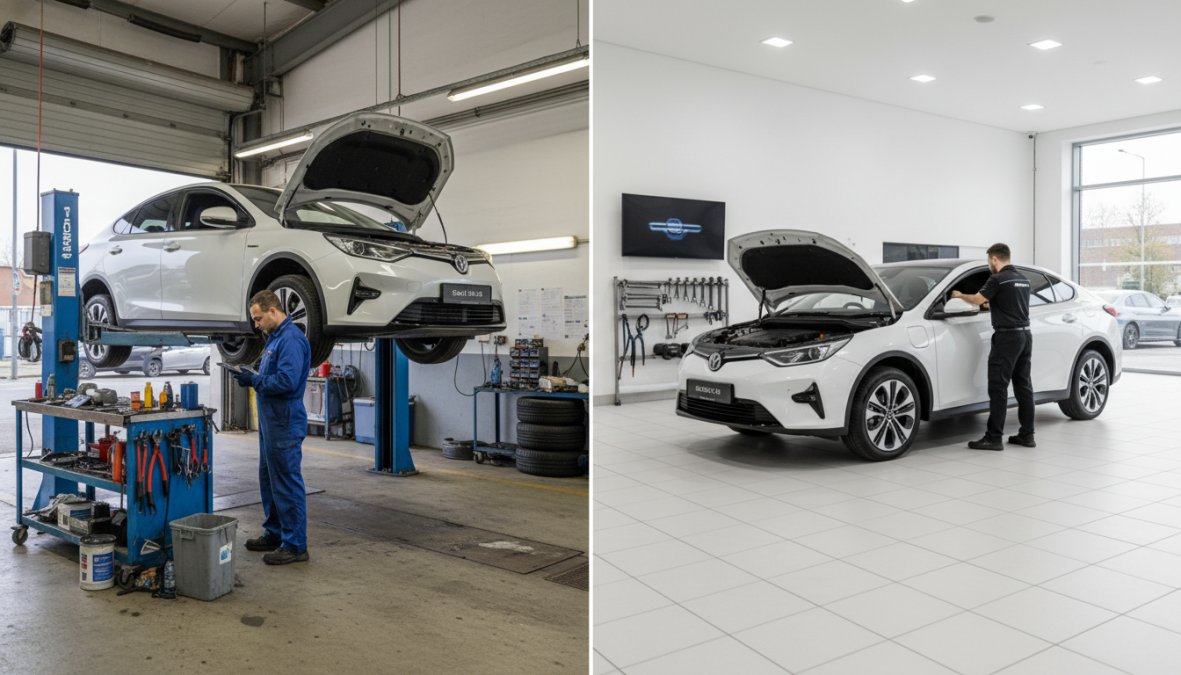
Professional illustration showing independent garage vs dealership for hybrid cars
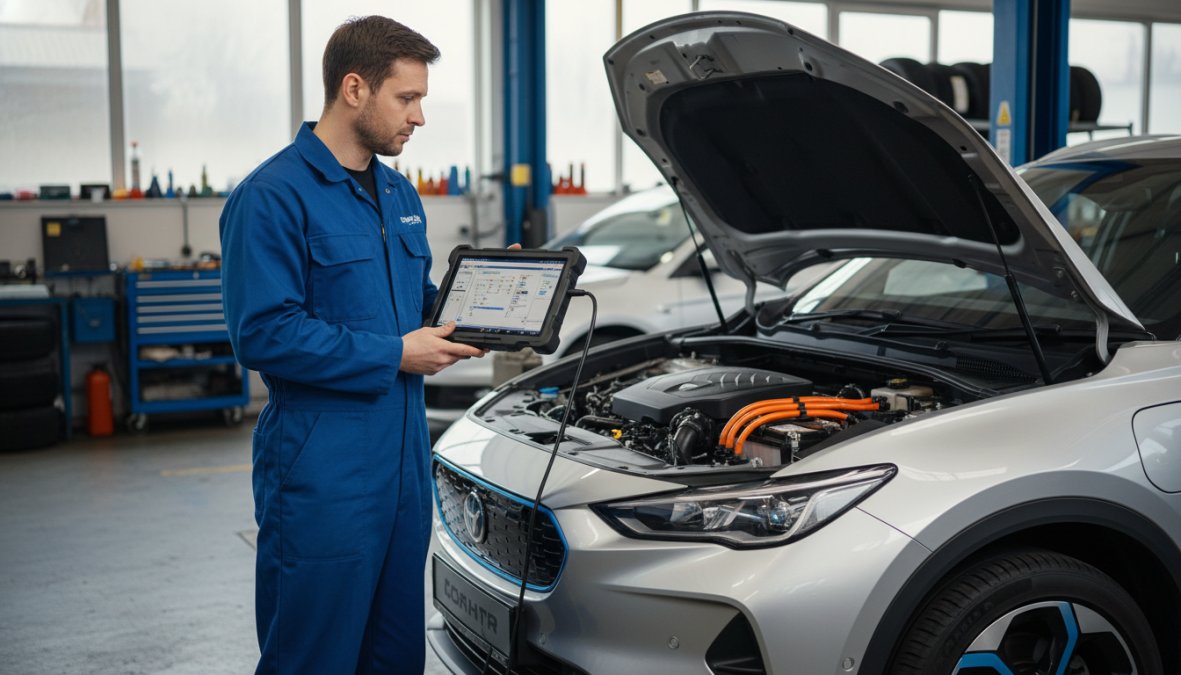
Professional-grade tools like the Autel MaxiSys Ultra EV provide advanced topology module mapping for all-system status visualisation and include a dedicated EVDiag box for high-voltage battery pack analysis. This is the category of equipment that separates a genuinely hybrid-capable independent garage from one that will simply clear fault codes and hope for the best. According to Autel's diagnostic technology specifications, the MaxiSys Ultra EV integrates a 5-in-1 VCMI device covering oscilloscope, multimeter, waveform generator, and CAN BUS testing, giving independent technicians dealership-level diagnostic depth.
Mid-range tools like the Innova 5610 offer a dedicated hybrid/EV battery test function and bi-directional actuator tests at a lower investment point, making them practical for independent shops handling hybrid battery health checks alongside general diagnostics.
The question to ask any independent garage: what diagnostic equipment do you use for hybrid battery analysis? A vague answer is a red flag.
Proprietary Software and Technical Service Bulletins (TSBs)
Technical service bulletins are manufacturer-issued updates addressing known issues, software patches, and revised repair procedures. Dealerships receive TSBs automatically. Independent garages access them through subscription platforms like ALLDATA Repair, which provides factory-direct repair procedures, detailed high-voltage system wiring diagrams, and TSB archives for specific hybrid models.
The gap here is narrower than many assume. A well-subscribed independent shop has access to the same TSB information as a dealership. The difference is that some manufacturer software updates can only be applied using the manufacturer's proprietary diagnostic platform, which independent garages cannot access. For vehicles requiring a specific software update, a dealership visit may be unavoidable.
Post-Warranty High-Voltage Battery Health Checks: A Gap Most Garages Miss
This is the area where both dealerships and most independent garages fall short. Once a hybrid moves out of its powertrain warranty period, systematic high-voltage battery health monitoring tends to drop off the service agenda entirely. Most standard service schedules do not include a dedicated battery health assessment, and many garages lack the equipment to perform one accurately.
A high-voltage battery health check involves analysing individual cell voltages within the battery pack, assessing state of charge consistency, checking for thermal anomalies, and evaluating overall capacity against the original specification. This requires dedicated EVDiag hardware or equivalent, not a standard OBD2 scan.
Why does this matter for resale value? A hybrid with documented battery health records commands a stronger position in the used vehicle market. Buyers are wary of high-voltage battery replacement costs, and a vehicle health report showing consistent battery performance addresses that concern directly. For hybrid owners in Northamptonshire planning to sell within the next few years, scheduling a post-warranty battery health check is one of the highest-return maintenance decisions available.
Many hybrid owners assume their battery is either fine or failed. The reality is more nuanced: battery degradation is gradual, and catching a developing issue early, before it triggers a fault code, is far less expensive than addressing it after the fact.
Key TakeawayPost-warranty high-voltage battery health checks are one of the most underused tools in hybrid ownership. A specialist independent garage with the right diagnostic equipment can deliver this assessment at a fraction of dealership cost, and the documentation adds measurable value at resale.
Best Practices for Hybrid Vehicle Maintenance Regardless of Where You Go
The best practices for hybrid vehicle maintenance apply whether you choose a dealership or an independent repair facility. Following these consistently is what actually determines long-term reliability and resale value.
Follow manufacturer service intervals precisely. Hybrid powertrains are more sensitive to deferred maintenance than conventional engines because the interaction between combustion and electric systems amplifies the consequences of degraded fluids or worn components.
Ensure inverter cooling system coolant is replaced at the specified interval. This is one of the most commonly missed items on hybrid service schedules and one of the most consequential.
Request a vehicle health report at every service, not just the annual MOT.
Keep all service records. A complete, documented service history is the single most effective way to protect both warranty coverage and resale value.
Schedule a dedicated high-voltage battery health check at least every two years for vehicles beyond the powertrain warranty period.
Verify that brake fluid is inspected for moisture content, not just visually checked. Regenerative braking reduces brake pad wear but does not reduce hydraulic fluid degradation.
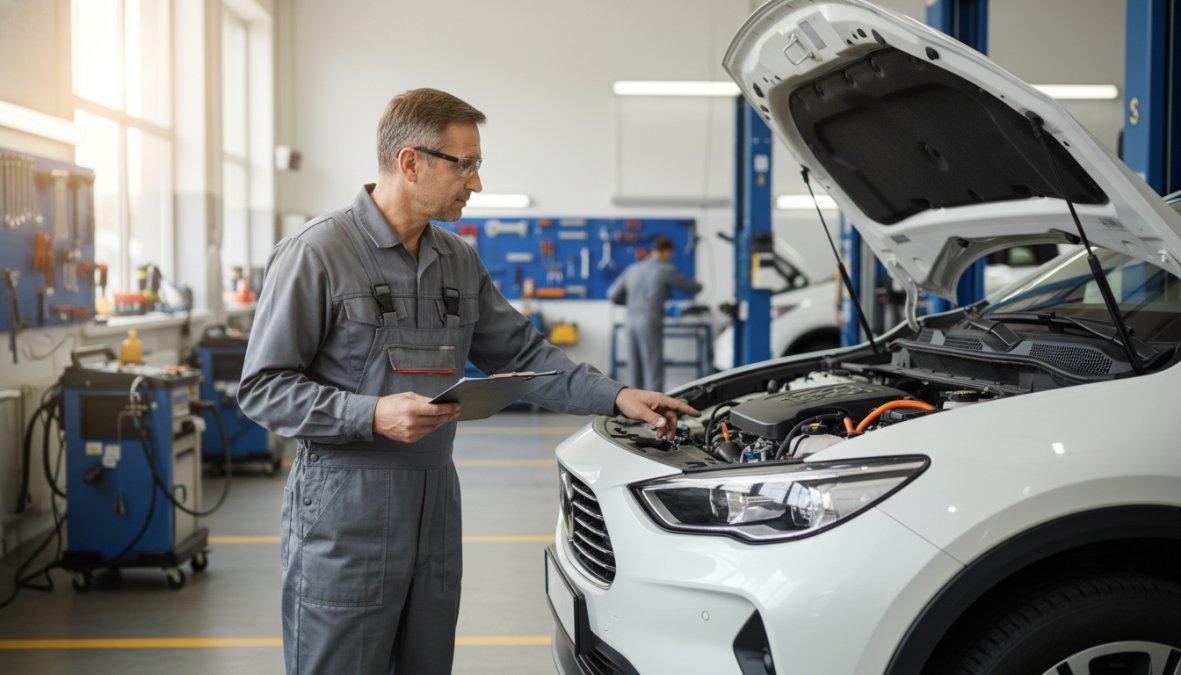
Best practices diagram for mechanic and clean and well-lit concepts for independent garage vs dealership for hybrid cars
Maintenance Schedule Impact on Hybrid Longevity and Resale Value
Maintenance schedule adherence has a disproportionate impact on hybrid longevity compared to conventional vehicles. The high-voltage battery system is the most expensive component in a hybrid drivetrain, and its degradation rate is influenced by thermal management, charging cycles, and the health of supporting systems. A well-maintained inverter cooling system, for example, directly affects battery temperature regulation and therefore long-term battery capacity.
From a resale value perspective, according to the Society of Motor Manufacturers and Traders' hybrid vehicle market data, hybrid vehicles continue to represent a growing share of UK registrations, which means the used hybrid market is maturing and buyers are becoming more sophisticated. A hybrid with a complete, specialist-verified service history achieves better resale outcomes than one with gaps or generic servicing records.
The practical implication: choose a garage that issues detailed documentation, not just a stamp in a service book. A vehicle health report that includes battery state, fluid conditions, and system-specific checks is worth significantly more at the point of sale.
Choosing Between an Independent Garage vs Dealership for Hybrid Cars in Kettering
For hybrid owners in Kettering and the surrounding Northamptonshire area, the local service landscape offers genuine options beyond the franchised dealership. The key is knowing what to verify before booking.
When evaluating an independent garage vs dealership for hybrid cars near you, apply this checklist:
Does the garage have technicians with ASE L3 or equivalent hybrid/EV certification?
What diagnostic equipment do they use for high-voltage battery analysis?
Do they have access to TSBs and OEM repair data via a platform like ALLDATA?
Will they issue a vehicle health report documenting all hybrid-specific checks?
Can they perform inverter cooling system service and regenerative braking inspection?
Do they use OEM or OEM-equivalent parts for hybrid-specific components?
Is their work documented in a format that satisfies warranty compliance requirements?
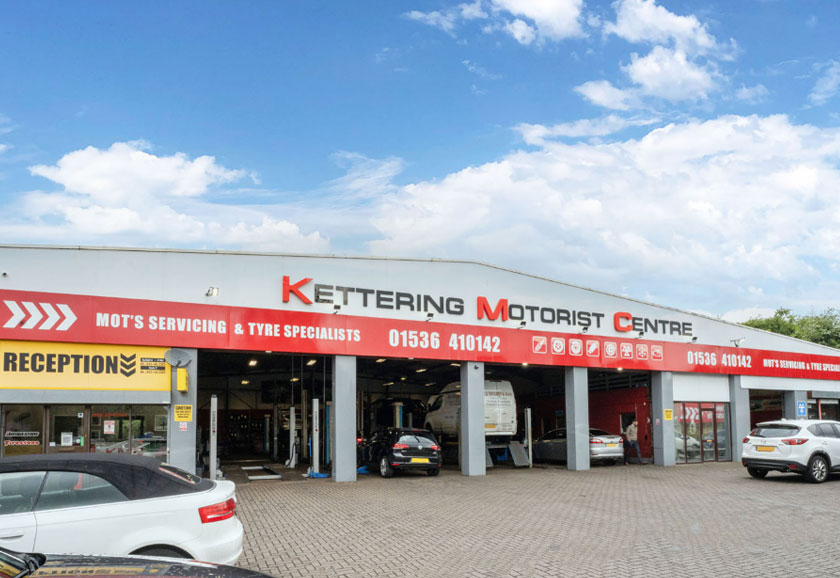
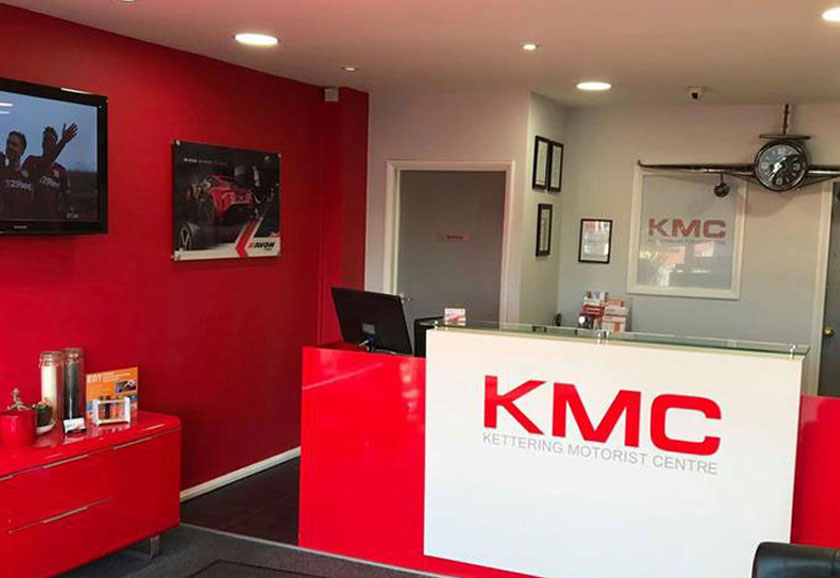
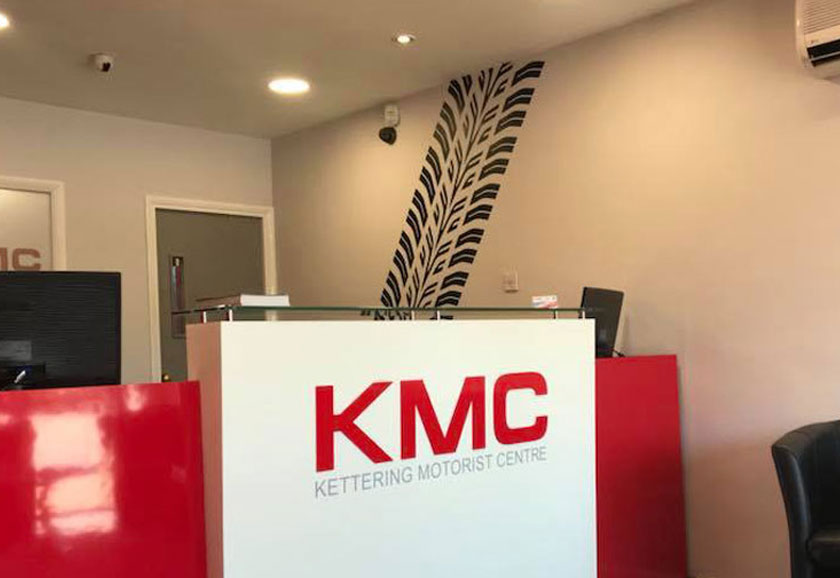
Kettering Motorist Centre is a family-run independent repair facility with specialist expertise in electric and hybrid vehicles. The combination of specialist hybrid diagnostic capability, transparent service documentation, and a straightforward online booking process, with no upfront payment required, makes it a practical alternative to dealership pricing for hybrid owners across Kettering and Northamptonshire.
For routine hybrid servicing, MOT preparation, and post-warranty battery health checks, an independent garage that meets the criteria above will deliver equivalent technical quality at lower cost than a franchised dealership. The dealership retains an advantage only in two specific scenarios: vehicles requiring manufacturer-proprietary software updates, and hybrid battery warranty claims that must be processed through the manufacturer's network.
For everything else, the independent garage vs dealership for hybrid cars question increasingly favours a well-equipped independent, particularly for out-of-warranty vehicles where cost efficiency and service flexibility matter most.
Frequently Asked Questions
Can independent mechanics work on hybrid cars?
Yes, independent mechanics can service hybrid cars, provided they have the right training and equipment. Technicians holding an ASE L3 Light Duty Hybrid/Electric Vehicle Specialist certification are qualified to work on hybrid powertrains, including regenerative braking and inverter cooling systems. The key is verifying that the garage has hybrid-specific diagnostic scan tools and access to technical service bulletins for your model, rather than assuming all independent repair facilities are equally equipped.
Does using an independent garage void my hybrid car warranty?
In the UK, using an independent garage for servicing does not automatically void your hybrid car warranty, provided the work is carried out to the manufacturer's service intervals using appropriate parts and documented correctly. Under block exemption regulations, manufacturers cannot insist you use their dealership network during the warranty period. However, any work on the high-voltage battery or powertrain warranty components should be performed by a technician with recognised hybrid qualifications to avoid disputes.
Is it cheaper to service a hybrid at a dealership or an independent garage?
Independent garages typically charge lower flat-rate labour rates than dealership service departments, which can make routine hybrid car maintenance cost noticeably less. However, the gap narrows for complex repairs requiring proprietary software or OEM parts. A well-equipped independent garage that stocks quality aftermarket components and holds hybrid certifications can offer genuine savings on standard service intervals, while dealerships may be more cost-competitive for software updates or warranty-related work.
What are the risks of taking a hybrid to a non-specialised garage?
The main risks include misdiagnosis of hybrid powertrain faults, unsafe handling of high-voltage battery systems, and missing manufacturer-issued technical service bulletins specific to your model. Without proper diagnostic scan tools capable of reading hybrid-specific fault codes, a general garage may only address surface symptoms. This can affect long-term reliability, resale value, and in some cases create safety hazards. Always confirm that any garage servicing your hybrid has relevant training and equipment before booking.
How often should a hybrid car's high-voltage battery be checked?
Most manufacturers recommend a high-voltage battery health check as part of regular service intervals, typically every 12 months or in line with your vehicle's service schedule. Post-warranty, this check becomes especially important as battery degradation can affect fuel efficiency and performance. A vehicle health report from a qualified technician — using dedicated hybrid diagnostic equipment — can identify early signs of cell imbalance or capacity loss, helping you plan for preventative maintenance before a costly failure occurs.
Your booking Failed
Please try again or please call 01536 410142
Thank you for placing a booking with Kettering Motorist Centre Limited for vehicle
PLEASE TAKE YOUR BOOKING REFERENCE NUMBER WITH YOU TO THE MOT CENTRE
Your items
MOT Test
×
Terms and Conditions
These terms and conditions form the basis on which you can visit and use this website. Please read them carefully as they contain important information.
General terms and conditions
This website is owned and operated by Kettering Motorist Centre Ltd (company registration number: 4485858) operating at Trafalgar Road, Kettering, Northamptonshire, NN16 8DB (the "MOT Centre", the "Company", "we" or "us"). If you have any queries about these terms and conditions or if you have any comments or complaints on or about this website, you can contact us at [email protected] or 01536 410142.
The website is to promote and offer for sale the products and services of Kettering Motorist Centre Limited.
1. The contract between us
This website does not take payment for products or services online. The website enables you to view products and services online and to make a booking for later delivery and payment. The vehicle and provision of other products and services promoted by this website and the payment by you of the price of those products and services will take place at the MOT Centre. The booking does not constitute a contract.
The booking process on the site provides details of the booked MOT order. Please take the time to read and check your booking. It is your responsibility to make sure the order is correct and for the correct vehicle.
2. Ownership of rights
All rights, including copyright, in this website are owned by or licensed to the Company. Any use of this website or its contents, including copying or storing it or them in whole or part, other than for your own personal, non commercial use, is prohibited without our permission. You may not modify, distribute or repost anything on this website for any purpose.
3. Accuracy of content
We have taken care in the preparation of the content of this website, in particular to ensure that prices quoted are correct at the time of publishing and that all goods have been fairly described. However, bookings will only be accepted if there are no material errors in the description of the goods or their prices as advertised on this website. Any weights, dimensions and capacities given about the goods are approximate only.
4. Damage to your computer
We try to ensure that this website is free from viruses or defects. However, we cannot guarantee that your use of this website or any websites accessible through it will not cause damage to your computer. It is your responsibility to ensure that the right equipment is available to use the website. Except in the case of negligence on our part, we will not be liable to any person for any loss or damage which may arise to computer equipment as a result of using this website.
5. Availability
All bookings are subject to acceptance and availability. If the MOT date you have requested are is not available, the Centre will contact you by e-mail or phone. You will have the option either to wait until another slot is available or to cancel your booking.
6. Booking errors
You are able to correct errors on your booking up to the point on which you click on “Place Booking” during the booking process.
7. Price
The prices payable for goods that you order are as set out in our website. All prices are inclusive of VAT at the current rates and are correct at the time of entering information, errors and omissions excepted.
Whenever it is not possible to accept your booking to buy goods of the specification and description at the price indicated, the MOT Centre will advise you by email or phone or when you visit the centre.
8. Payment terms
You will be required to pay for the goods or services to the Centre at time of a completed MOT.
9. Delivery charges
N/A
10. Cancellation
The MOT Centre reserves the right to cancel the booking if:
10.1 There is insufficient stock to deliver the goods you have booked.
10.2 One or more of the goods you booked was listed at an incorrect price.
If your booking is cancelled the Centre will notify you by e-mail or phone.
You have the right to cancel your booking at any time up to the point of the MOT. If you do cancel your booking you should inform the centre by phone.
11. Liability
Notwithstanding the foregoing, nothing in these terms and conditions is intended to limit any rights you might have as a consumer under applicable local law or other statutory rights that may not be excluded nor in any way to exclude or limit our liability to you for any death or personal injury resulting from our negligence.
12. Notices
Unless otherwise expressly stated in these terms and conditions, all notices from you to us must be in writing and sent to our contact address given above and all notices from us to you will be displayed on our website from time to time.
13. Changes to legal notices
We reserve the right to change these terms and conditions from time to time and you should look through them as often as possible.
14. Law, jurisdiction and language
This website, any content contained therein and any contract brought into being as a result of usage of this website are governed by and construed in accordance with English law. Parties to any such contract agree to submit to the exclusive jurisdiction of the courts of England and Wales.
15. Invalidity
If any part of these terms and conditions is unenforceable (including any provision in which we exclude our liability to you) the enforceability of any other part of these conditions will not be affected.
16. Privacy
You acknowledge and agree to be bound by the terms of our privacy policy
17. Third party rights
Nothing in this Agreement is intended to, nor shall it confer any rights on a third party.