Does Car Service Improve Fuel Efficiency? The Short Answer
Yes, car service improves fuel efficiency. A poorly maintained engine works harder than necessary, burning more fuel to produce the same output. Routine maintenance preserves the mechanical conditions under which combustion, lubrication, and airflow operate at their designed efficiency. When any of those systems degrades, fuel consumption rises.
According to the UK Department for Energy Security and Net Zero guidance on vehicle efficiency, maintaining correct tyre pressures alone can reduce fuel consumption meaningfully. Stack oil changes, air filter replacement, spark plug maintenance, and wheel alignment together, and the cumulative effect on gas mileage becomes significant.
Key Takeaway[A full car service](/servicing) addresses multiple efficiency drains simultaneously. The combined effect on fuel economy is almost always greater than any single repair in isolation.
How Regular Oil Changes Impact Engine Performance and Fuel Economy
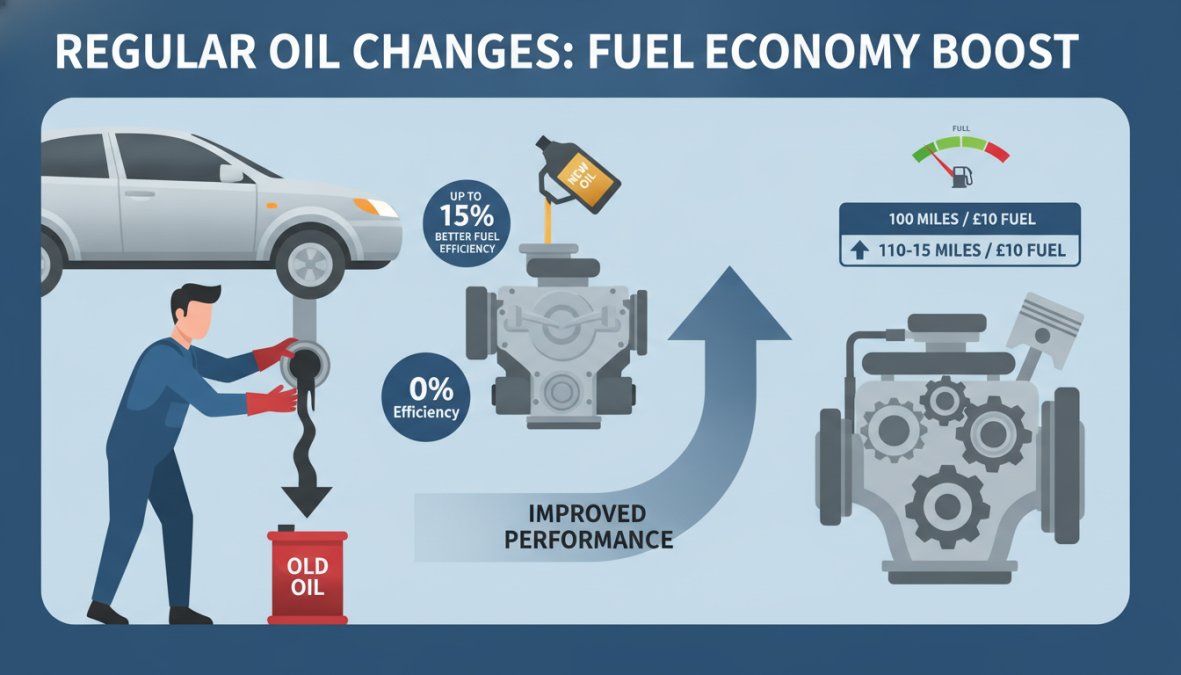
Fresh motor oil reduces friction between moving metal components, and friction is wasted energy. When oil degrades, its viscosity changes and lubrication properties weaken, forcing the engine to work harder and consume more fuel.
Professional illustration showing does car service improve fuel efficiency
(/oil-change) Impact Engine Performance and Fuel Economy]
Motor Oil Viscosity and Friction Reduction
Motor oil viscosity measures a fluid's resistance to flow. Using the correct viscosity grade specified by the manufacturer ensures oil films form correctly between moving parts at both cold start and operating temperature. Modern full synthetic oils, such as 0W-20 or 5W-30 specifications, minimise internal friction across a wide temperature range. Switching from degraded conventional oil to fresh full synthetic delivers near-immediate fuel economy improvement.
Always use the viscosity grade specified in your owner's manual. Using a heavier grade "for extra protection" often increases fuel consumption without delivering meaningful additional protection.
Engine Sludge and Combustion Efficiency
Engine sludge forms when motor oil oxidises and breaks down over time, restricting oil flow and forcing the engine to work harder. Regular oil changes at manufacturer-recommended intervals prevent sludge formation. Once present, a professional flush may be required before fresh oil can restore efficiency.
Watch OutSkipping oil changes progressively degrades fuel economy over thousands of miles, often without obvious warning until the problem is advanced.
Air Filters, Spark Plugs, and Combustion: Why These Services Matter
Air Filter Replacement for Optimal Airflow
A clean air filter ensures unrestricted airflow for combustion. The ECU adjusts fuel delivery based on airflow data from the mass air flow sensor. A clogged air filter restricts airflow, forcing the ECU to either enrich the fuel mixture or reduce power output, both increasing fuel consumption. Air filter replacement is one of the lowest-cost, highest-return service items available.
Spark Plug Maintenance and Engine Performance
Worn spark plugs misfire, allowing unburned fuel to pass through the exhaust rather than contributing to engine output. The ECU may compensate by enriching the fuel mixture, compounding waste. Modern iridium or platinum-tipped spark plugs maintain consistent electrode gaps far longer than older designs. Replacing spark plugs at recommended intervals restores consistent ignition timing and correct throttle response. According to the Energy Saving Trust's guidance on vehicle running costs, keeping an engine in good mechanical condition is one of the most reliable ways to control running costs.
Does Wheel Alignment Affect Fuel Consumption?
Misaligned wheels create uneven rolling resistance. When wheels are not parallel to each other and perpendicular to the road, tyres scrub laterally as the vehicle moves forward, forcing the engine to overcome additional resistance continuously. The effect is most pronounced at motorway speeds. Wheel alignment also affects tyre wear, adding to the cost of ownership beyond fuel alone.
Tire Pressure, Rolling Resistance, and Fuel Economy
Under-inflated tyres deform more as they roll, increasing rolling resistance and the energy required to maintain forward motion. This has a direct, linear relationship with fuel consumption. The correct tyre pressure is listed on a sticker inside the driver's door jamb or in the owner's manual. Pressures should be checked monthly when tyres are cold. The target is always the manufacturer's specified pressure, not the maximum printed on the tyre sidewall.
Maintenance Item
Primary Efficiency Mechanism
Service Frequency
Engine oil change
Reduces internal friction
Every 10,000-15,000 miles or annually
Air filter replacement
Restores optimal airflow to combustion
Every 15,000-20,000 miles
Spark plug replacement
Ensures complete combustion
Every 30,000-60,000 miles (type dependent)
Tyre pressure check
Reduces rolling resistance
Monthly
Wheel alignment
Eliminates lateral scrub resistance
Annually or after kerb strikes
Fuel injector cleaning
Restores correct fuel spray pattern
Every 30,000 miles or as needed
Car Maintenance Tips for Better Gas Mileage in Kettering and Beyond
The most effective maintenance tips are not about any single dramatic intervention. They are about maintaining the baseline conditions under which your engine was designed to operate. A well-serviced vehicle maintains consistent fuel economy over time rather than gradually deteriorating.
Fuel Injector Cleaning and ECU Performance
Fuel injectors atomise petrol into a fine mist for combustion. Carbon deposits accumulate on injector nozzles over time, altering the spray pattern and reducing combustion efficiency. The ECU cannot fully compensate for degraded injector spray patterns. For vehicles with high mileage or those using lower-quality fuel regularly, professional injector cleaning is worthwhile.
Routine Tune-Ups and Vehicle Longevity
A routine tune-up covers spark plugs, air filter, fuel filter, ignition timing verification, and throttle body inspection. The cumulative effect on vehicle longevity is as important as immediate fuel economy gains. An engine operating within designed parameters experiences less thermal stress and wear.
Pro TipLog your fuel economy at every fill-up using a free tool like Fuelly. A sudden drop in MPG is often the first sign of a developing mechanical issue, frequently before any warning light appears.
Common Car Problems That Cause High Fuel Consumption
Not all fuel consumption problems are solved by routine servicing. Some require diagnosis of a specific fault. The most frequent culprits include:
Faulty oxygen sensors: A failing sensor sends incorrect data, causing the ECU to run an excessively rich fuel mixture.
Leaking fuel injectors: A leaking injector drips fuel into the cylinder, flooding the combustion chamber and dramatically increasing fuel consumption.
Stuck thermostat: A thermostat stuck open prevents the engine from reaching optimal operating temperature, causing cold engines to run richer fuel mixtures.
Dragging brakes: Partially seized brake callipers apply constant friction, forcing the engine to work harder to maintain speed.
Exhaust gas recirculation (EGR) valve faults: A blocked or stuck EGR valve disrupts combustion chemistry and increases fuel consumption.
Many of these faults trigger a fault code readable via an OBD2 diagnostic scanner, making professional diagnostic checks the most efficient first step when fuel consumption increases suddenly.
The Post-Service Fuel Economy Drop: Why Your MPG Might Dip Initially
A vehicle that has just had a full service sometimes returns worse fuel economy for the first 50 to 200 miles than before. Fresh motor oil has not yet been through its initial thermal cycling, and full synthetic oils can have slightly higher viscosity at operating temperature during their first heat cycles. New spark plugs may also require a brief bedding-in period. Additionally, if a vehicle has run with degraded oil for an extended period, the ECU may have adapted its fuelling parameters to compensate. After service, it gradually relearns optimal parameters over several hundred miles.
Do not judge the fuel economy impact of a service within the first tank of fuel. Give it 200 to 300 miles of normal mixed driving before drawing conclusions.
DIY Maintenance vs. Professional Service: Cost-Benefit Analysis
DIY-suitable tasks:
Tyre pressure checks and inflation
Topping up screenwash and coolant
Replacing cabin air filters
Checking and topping up engine oil between services
Tasks best left to professionals:
Wheel alignment (requires specialist equipment)
Fuel injector cleaning (professional ultrasonic cleaning is more thorough)
Spark plug replacement on direct-injection engines
OBD2 fault diagnosis and ECU parameter resets
Brake calliper inspection and servicing
The cost-benefit calculation is straightforward: the fuel savings from a properly executed full service, combined with avoidance of premature component wear, typically outweigh the service cost over 12 months. For drivers in Kettering and across Northamptonshire, the question is whether the service is done correctly and completely.
Fuel consumption that creeps upward over time is rarely the result of a single problem. It is almost always the accumulated effect of several small degradations, each individually tolerable but collectively significant. Kettering Motorist Centre provides comprehensive vehicle servicing, specialist diagnostics, and expert care for both conventional and hybrid vehicles across Kettering and the surrounding areas of Northamptonshire. Book your MOT or service online today with no upfront payment required, and get your vehicle back to running as efficiently as it was designed to.
Frequently Asked Questions
Does car service really improve fuel efficiency?
Yes, regular car service can improve fuel efficiency by maintaining optimal engine performance, reducing friction through fresh motor oil, and ensuring clean fuel injectors and air filters. However, improvements depend on your vehicle's condition and maintenance history. A well-maintained engine runs more efficiently, which translates to better fuel economy and lower fuel consumption over time.
What car maintenance tasks improve gas mileage the most?
The most impactful maintenance tasks for fuel economy include regular oil changes (reduces internal friction), air filter replacement (improves airflow and combustion), spark plug maintenance (optimises engine performance), and maintaining correct tire pressure (reduces rolling resistance). Wheel alignment also prevents uneven tyre wear, which increases fuel consumption. These preventative maintenance measures work together to maximise fuel efficiency.
Why does fuel economy sometimes drop after a car service?
Post-service fuel economy drops are temporary and occur because your engine is operating at peak efficiency after service. Fresh oil, clean filters, and optimised spark plugs mean your engine works harder initially as it adjusts to the improved combustion and reduced friction. Additionally, new driving patterns during the break-in period after service can affect MPG. This dip typically normalises within 50-100 miles as your driving settles into normal patterns.
How does tire pressure affect fuel consumption?
Underinflated tyres increase rolling resistance, forcing your engine to work harder and consume more fuel. Maintaining the correct tyre pressure, as specified in your vehicle's manual, reduces friction between the tyre and road surface, improving fuel economy significantly. Checking tyre pressure monthly and ensuring proper wheel alignment are simple preventative maintenance steps that directly impact fuel efficiency and vehicle longevity.
Your booking Failed
Please try again or please call 01536 410142
Thank you for placing a booking with Kettering Motorist Centre Limited for vehicle
PLEASE TAKE YOUR BOOKING REFERENCE NUMBER WITH YOU TO THE MOT CENTRE
Your items
MOT Test
×
Terms and Conditions
These terms and conditions form the basis on which you can visit and use this website. Please read them carefully as they contain important information.
General terms and conditions
This website is owned and operated by Kettering Motorist Centre Ltd (company registration number: 4485858) operating at Trafalgar Road, Kettering, Northamptonshire, NN16 8DB (the "MOT Centre", the "Company", "we" or "us"). If you have any queries about these terms and conditions or if you have any comments or complaints on or about this website, you can contact us at [email protected] or 01536 410142.
The website is to promote and offer for sale the products and services of Kettering Motorist Centre Limited.
1. The contract between us
This website does not take payment for products or services online. The website enables you to view products and services online and to make a booking for later delivery and payment. The vehicle and provision of other products and services promoted by this website and the payment by you of the price of those products and services will take place at the MOT Centre. The booking does not constitute a contract.
The booking process on the site provides details of the booked MOT order. Please take the time to read and check your booking. It is your responsibility to make sure the order is correct and for the correct vehicle.
2. Ownership of rights
All rights, including copyright, in this website are owned by or licensed to the Company. Any use of this website or its contents, including copying or storing it or them in whole or part, other than for your own personal, non commercial use, is prohibited without our permission. You may not modify, distribute or repost anything on this website for any purpose.
3. Accuracy of content
We have taken care in the preparation of the content of this website, in particular to ensure that prices quoted are correct at the time of publishing and that all goods have been fairly described. However, bookings will only be accepted if there are no material errors in the description of the goods or their prices as advertised on this website. Any weights, dimensions and capacities given about the goods are approximate only.
4. Damage to your computer
We try to ensure that this website is free from viruses or defects. However, we cannot guarantee that your use of this website or any websites accessible through it will not cause damage to your computer. It is your responsibility to ensure that the right equipment is available to use the website. Except in the case of negligence on our part, we will not be liable to any person for any loss or damage which may arise to computer equipment as a result of using this website.
5. Availability
All bookings are subject to acceptance and availability. If the MOT date you have requested are is not available, the Centre will contact you by e-mail or phone. You will have the option either to wait until another slot is available or to cancel your booking.
6. Booking errors
You are able to correct errors on your booking up to the point on which you click on “Place Booking” during the booking process.
7. Price
The prices payable for goods that you order are as set out in our website. All prices are inclusive of VAT at the current rates and are correct at the time of entering information, errors and omissions excepted.
Whenever it is not possible to accept your booking to buy goods of the specification and description at the price indicated, the MOT Centre will advise you by email or phone or when you visit the centre.
8. Payment terms
You will be required to pay for the goods or services to the Centre at time of a completed MOT.
9. Delivery charges
N/A
10. Cancellation
The MOT Centre reserves the right to cancel the booking if:
10.1 There is insufficient stock to deliver the goods you have booked.
10.2 One or more of the goods you booked was listed at an incorrect price.
If your booking is cancelled the Centre will notify you by e-mail or phone.
You have the right to cancel your booking at any time up to the point of the MOT. If you do cancel your booking you should inform the centre by phone.
11. Liability
Notwithstanding the foregoing, nothing in these terms and conditions is intended to limit any rights you might have as a consumer under applicable local law or other statutory rights that may not be excluded nor in any way to exclude or limit our liability to you for any death or personal injury resulting from our negligence.
12. Notices
Unless otherwise expressly stated in these terms and conditions, all notices from you to us must be in writing and sent to our contact address given above and all notices from us to you will be displayed on our website from time to time.
13. Changes to legal notices
We reserve the right to change these terms and conditions from time to time and you should look through them as often as possible.
14. Law, jurisdiction and language
This website, any content contained therein and any contract brought into being as a result of usage of this website are governed by and construed in accordance with English law. Parties to any such contract agree to submit to the exclusive jurisdiction of the courts of England and Wales.
15. Invalidity
If any part of these terms and conditions is unenforceable (including any provision in which we exclude our liability to you) the enforceability of any other part of these conditions will not be affected.
16. Privacy
You acknowledge and agree to be bound by the terms of our privacy policy
17. Third party rights
Nothing in this Agreement is intended to, nor shall it confer any rights on a third party.